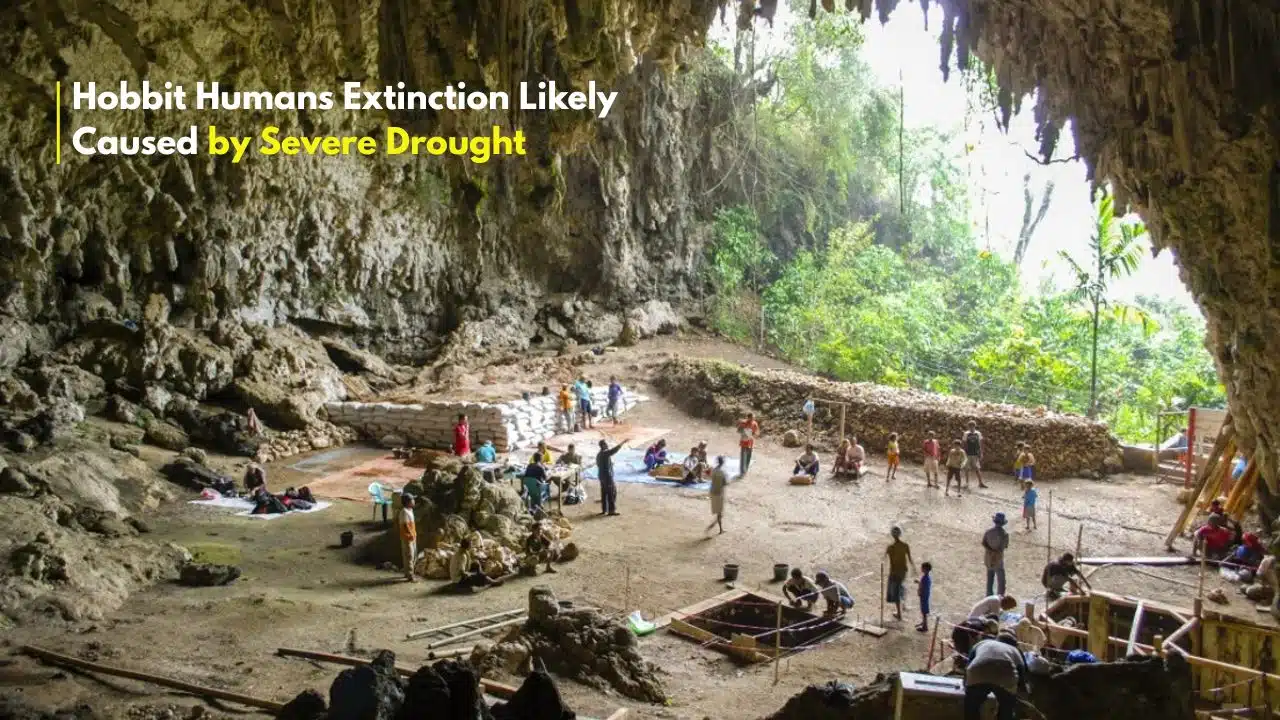
In the remote jungles of Indonesia’s Flores Island, an ancient riddle continues to captivate scientists and the public alike. Nearly two decades after the astonishing discovery of Homo floresiensis — the diminutive “Hobbit” humans — new research now sheds light on why these small-statured people suddenly vanished from the fossil record around 50,000 years ago.
According to a new interdisciplinary study combining geological, paleoclimatic, and archaeological evidence, a prolonged period of severe drought may have played a decisive role in their extinction. The findings not only rewrite aspects of human evolutionary history but also underscore how vulnerable ancient populations were to environmental upheaval.
Rediscovering the “Hobbits” of Flores
When Indonesian scientists and Australian archaeologist Mike Morwood first uncovered skeletal remains in 2003 within Liang Bua cave, the scientific community was stunned. The fossils belonged to a previously unknown species of human that stood barely one meter tall with unusually small skulls — earning them the nickname “Hobbits” after the fictional creatures from J.R.R. Tolkien’s The Lord of the Rings.
Subsequent analyses revealed that Homo floresiensis had lived on Flores Island for hundreds of thousands of years, surviving in isolation long after larger-brained humans (Homo erectus) and Neanderthals had evolved or gone extinct elsewhere. Despite their small size, these early humans fashioned stone tools, hunted pygmy elephants (Stegodon florensis), and perhaps even controlled fire.
But what caused these remarkable island dwellers to disappear so abruptly?
New Clues from Cave Sediments and Climate Records
The recent breakthrough comes from an international team of researchers from Indonesia’s National Research and Innovation Agency (BRIN) and the University of Wollongong in Australia, who conducted extensive sediment analysis within Liang Bua and surrounding sites.
Using a combination of radiocarbon dating, pollen reconstruction, and isotopic analysis, the team pieced together a detailed environmental timeline covering the past 190,000 years. Their findings suggest that the island experienced significant cycles of wet and dry periods — but that a particularly harsh and prolonged drought around 60,000–50,000 years ago drastically transformed the ecosystem.
“Flores shifted from a humid, forested environment to a much drier and open landscape,” said Dr. Richard Roberts, one of the study’s co-authors. “This ecological stress likely reduced the resources that Homo floresiensis depended on — eventually pushing them beyond their survival threshold.”
From Forests to Grasslands: An Ecological Collapse
Before the climate shift, Flores was an island rich in biodiversity. Fossil and pollen evidence suggests that the “Hobbits” lived among dense rainforests teeming with fruits, small animals, and forest-adapted creatures such as the giant stork Leptoptilos robustus.
As conditions became drier, however, forest cover dwindled. Grasslands expanded, streams evaporated, and many smaller animals disappeared — including Stegodon florensis, the dwarf elephant that served as a crucial food source for H. floresiensis.
Archaeological layers once abundant with stone tools and animal bones suddenly became sparse. By 50,000 years ago, the tools and remains of the “Hobbits” cease altogether.
“It looks as if the environment essentially flipped,” said Indonesian archaeologist Dr. Wahyu Saptomo. “The ecosystems these humans had adapted to collapsed around them. Without adequate food and water, their small populations couldn’t recover.”
Did Modern Humans Play a Role?
Not all scientists are convinced that drought alone sealed the “Hobbits’” fate. The timing of their disappearance coincides suspiciously with the arrival of Homo sapiens in Southeast Asia.
Modern humans reached nearby Australia roughly 65,000 years ago, suggesting that early explorers may also have traversed or passed near the Indonesian archipelago at that time. Some archaeologists believe contact between the two species — whether through competition, disease, or even violence — may have hastened Homo floresiensis’ extinction.
“When Homo sapiens show up, small and isolated populations tend to vanish soon afterward,” noted paleoanthropologist Dr. Penny Spikins from the University of York. “It’s a pattern seen with Neanderthals, Denisovans, and now possibly H. floresiensis.”
However, the latest research team cautions against assuming direct contact. No fossils, DNA, or stone tools belonging to modern humans have yet been found on Flores from the same layers as H. floresiensis. The drought scenario, they argue, remains the most evident and data-supported explanation.
Lessons in Climate Adaptation and Island Evolution
The concept of island dwarfism — where large animals shrink over generations due to restricted resources — has long fascinated evolutionary biologists. Homo floresiensis stands as one of the most dramatic examples of this phenomenon in human evolution.
The species’ small brain (around 400 cubic centimeters, about the size of a chimpanzee’s) and body size likely emerged from prolonged evolutionary isolation on Flores, where fewer resources favored smaller, more energy-efficient organisms.
Yet that same specialization also made them vulnerable to environmental change. When forests receded, the evolutionary advantages of small size offered little protection against starvation and dehydration.
“Flores was both a refuge and a trap,” said geologist Prof. Gert van den Bergh, another co-author of the study. “The isolation that preserved Homo floresiensis for so long also prevented them from escaping when conditions deteriorated.”
A Fragile Island Ecosystem at the Edge of Survival
Modern climate models of the Indonesian archipelago reveal how drastic even modest temperature and rainfall shifts can be in tropical island ecosystems. The Pleistocene epoch, which ended around 11,700 years ago, was marked by frequent global glacial cycles. These glaciations caused dramatic swings in sea levels, sometimes connecting islands but often isolating them for tens of thousands of years.
During dry periods, rainfall on small equatorial islands like Flores could drop sharply, leading to widespread water shortages. Without rivers fed by consistent rainfall or glacial runoff, small ecosystems were highly sensitive to change.
The Liang Bua sediment record shows drops in freshwater mollusk fossils and carbon isotopes consistent with arid conditions. Plant pollen analysis further confirms the replacement of wet forest species by drought-tolerant grasses and shrubs. Together, these indicators align chronologically with the disappearance of Homo floresiensis artifacts.
A Window into Human Vulnerability
The extinction of the “Hobbit” humans serves as a sobering reminder that environmental changes — even gradual ones — can decimate entire species, including our close relatives.
Unlike Homo sapiens, who evolved complex social networks and long-distance migration strategies, H. floresiensis likely had limited numbers and minimal ability to disperse to more hospitable regions.
“Evolution doesn’t favor intelligence alone — it favors adaptability,” said genetic anthropologist Dr. Silvia Bello. “While Homo floresiensis were toolmakers with local ingenuity, they were locked into an insular world they couldn’t escape.”
In that respect, the story of the Hobbits mirrors countless extinction events throughout prehistory, where climate shifts — rather than direct predation or competition — quietly rewrote the course of evolution.
Advanced Technologies Sharpen the Picture
Understanding what happened on Flores has been made possible only through advanced modern techniques, including optically stimulated luminescence (OSL) dating, sediment DNA analysis, and microfossil reconstruction. These tools allow scientists to reconstruct the environment down to millennia — sometimes even centuries — with remarkable precision.
For example, isotopic data extracted from cave formations known as speleothems (stalagmites and stalactites) helped trace changes in rainfall patterns across Southeast Asia. These findings correlated with monsoon weakening phases elsewhere in the region, implicating a regional-scale climatic disruption tied to glacial cycles.
Moreover, new mapping of Wallacea — the biogeographical region encompassing Flores — reveals how shifts in sea level may have further isolated the island, amplifying resource scarcity.
The Broader Puzzle of Human Diversity
The extinction of Homo floresiensis leaves an intriguing gap in the narrative of human diversity in Asia. Their existence, along with discoveries of other small-bodied hominins like Homo luzonensis in the Philippines and the enigmatic Denisovans in Siberia and Tibet, paints a far richer and more complex picture of our family tree than previously imagined.
For much of the 20th century, scientists assumed that human evolution followed a relatively linear path — from Homo erectus to modern humans. But recent fossil finds have overturned that view, revealing that multiple human species coexisted across Asia, often adapting to unique geographies and climates.
“Fifty thousand years ago, Asia was home to a real mosaic of humans,” said Professor Chris Stringer of London’s Natural History Museum. “Each type of human had found a niche — some in cold mountains, others in tropical forests. Homo floresiensis was one of those — until the climate shifted their world beyond recovery.”
Could the Hobbits Still Have Survived Longer?
While the last known fossils of Homo floresiensis date to roughly 50,000 years ago, some local folklore on Flores Island tells tales of small, human-like forest dwellers called ebu gogo — said to have survived into relatively recent centuries.
Anthropologists caution that such tales are likely mythic echoes rather than evidence of survival, but they highlight how deeply these “little people” have imprinted themselves in local consciousness.
“We can’t dismiss Indigenous oral histories,” said Professor Roberts. “They might preserve faint memories of encounters with ancient species, or simply serve as cultural narratives of isolation and survival.”
Still, no physical evidence supports the persistence of Homo floresiensis beyond the fossil record. Modern excavations in Liang Bua and other caves have yet to uncover younger remains.
Relevance to Today’s Climate Challenges
The story of the “Hobbit” humans carries important parallels to the modern age. While humans today possess vastly greater technological and social resilience, we too face escalating challenges from climate instability. Small, isolated communities — especially on islands — remain among the most vulnerable to drought, habitat loss, and rising seas.
The extinction of Homo floresiensis reminds scientists that even intelligent species can succumb to ecological thresholds when adaptation fails.
“Climate doesn’t kill directly,” noted paleoclimatologist Dr. Kira Westaway from Macquarie University. “It changes the rules of the game — food disappears, water sources vanish, and migration becomes the only option. For the Hobbits of Flores, isolation meant no escape route.”
Unanswered Questions and Future Research
Despite these insights, many questions about Homo floresiensis remain unanswered. Researchers still debate:
-
Whether the species evolved directly from Homo erectus or from an even earlier ancestor like Homo habilis.
-
How sophisticated their toolmaking and cognitive abilities truly were.
-
Whether DNA from H. floresiensis might eventually be recovered to clarify their lineage.
-
If regional factors — such as volcanic eruptions or disease — also contributed to their demise.
Future research aims to widen the search to other nearby islands, including Sulawesi and Timor, where similar ecological conditions may have produced comparable evolutionary outcomes.
What the Hobbits Tell Us About Being Human
Perhaps the greatest contribution of the “Hobbits” to science is philosophical as much as biological. Their existence demonstrates that there was never a single “correct” path of human evolution. Intelligence, size, and brain capacity followed different trajectories shaped by local environments.
As paleoanthropologist Dean Falk once put it, “They remind us that being human isn’t one thing — it’s many things, shaped by luck, geography, and change.”
In the end, the disappearance of Homo floresiensis was not a failure of intelligence or adaptation. It was the inevitable result of nature’s unpredictability — a stark reminder that even the smallest branches of our family tree can vanish when the climate turns against them.
A Final Reflection: The Echoes of the Past
Today, visitors to Liang Bua cave on Flores find a quiet, shadowed space — cool, echoing, and laden with mystery. Carved into limestone and history alike, it offers a humbling connection to beings who looked human but lived in a world profoundly different from our own.
As scientists continue to unearth new evidence, each fragment of bone and grain of dust tells a timeless story: how fragile life can be when the environment that sustains it begins to change.
The droughts that once silenced the voices of the Hobbits stand as both a warning and a lesson — that survival, even for us, depends on how gracefully we can adapt to the rhythms of a restless planet.