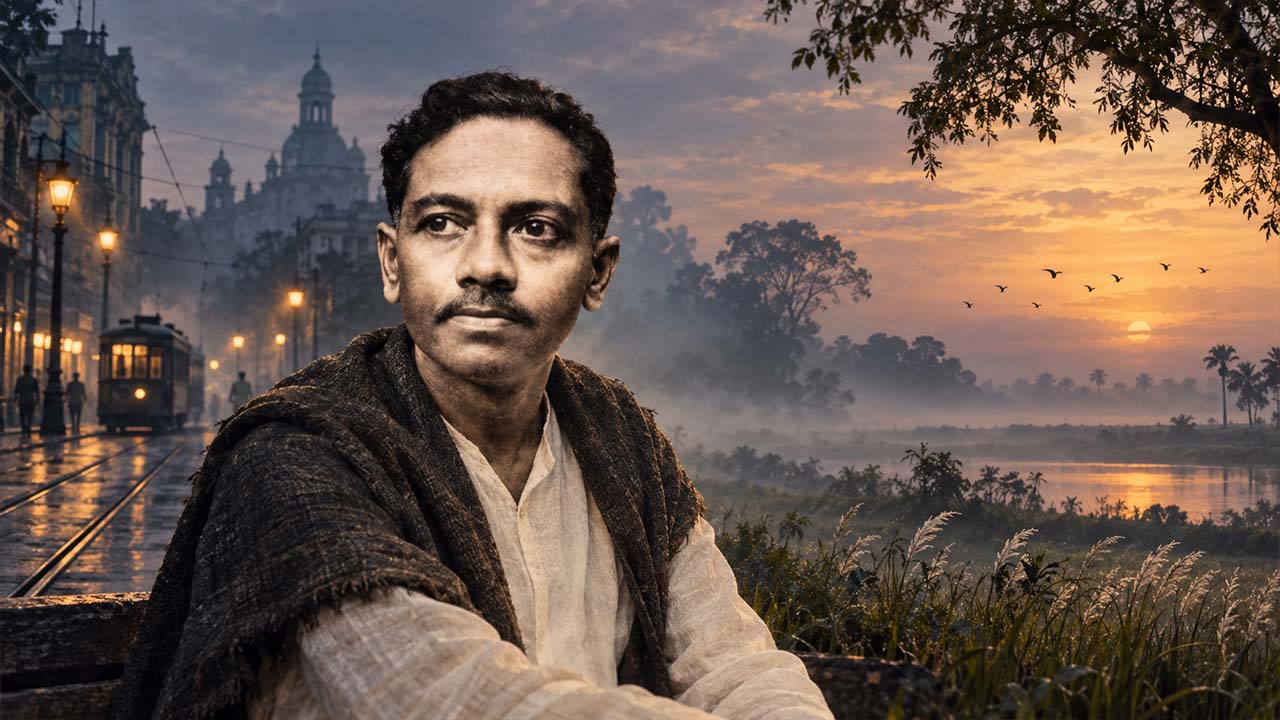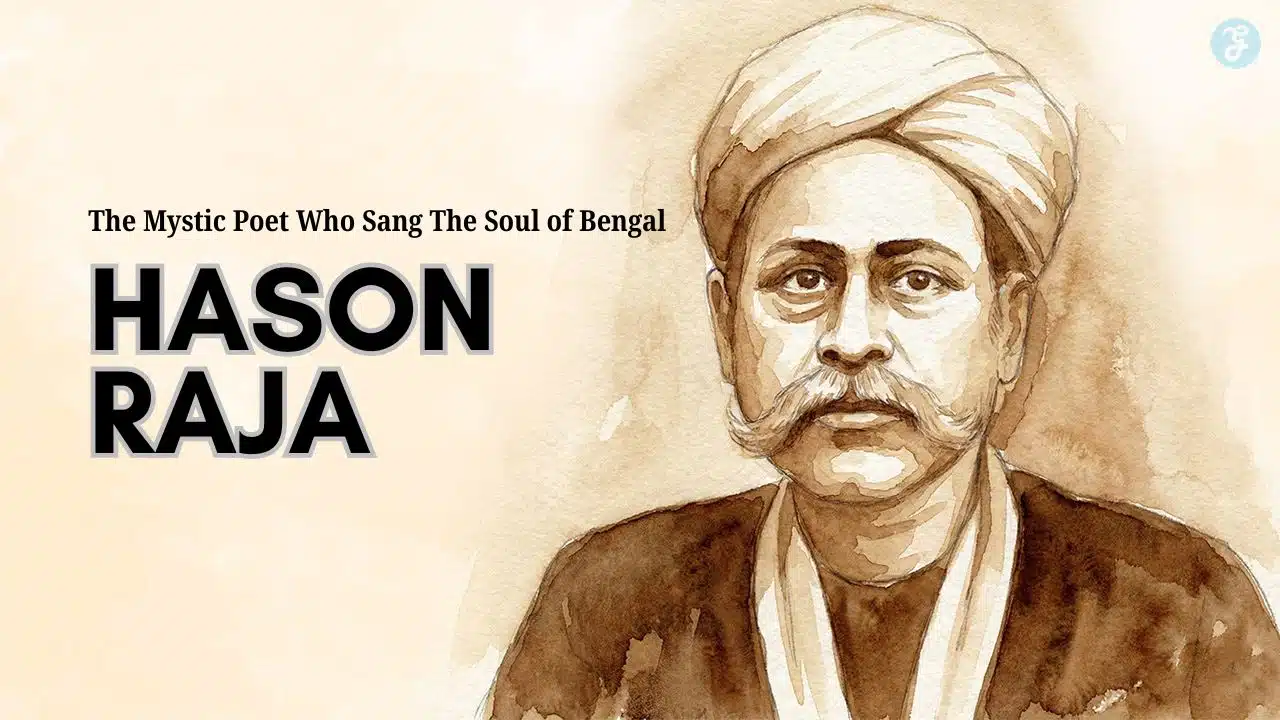
Have you ever heard a song that stops you in your tracks? You might be searching for Hason Raja because you stumbled upon a haunting melody and wanted to know who wrote it. Often overlooked, Hason Raja was more than just a singer. Today is his 103rd death anniversary.
He was a powerful landlord who walked away from a life of extreme luxury to find the soul of Bengal. He used simple words and local speech to sing about divine love in a way that still echoes from village pools to city rooftops.
I’m going to walk you through his fascinating life. We will look at his climb from a wealthy zamindar to a spiritual writer and his unique bond with his mother, Hurmat Jahan Bibi. We will also explore his connection with Rabindranath Tagore and take a look inside the Museum of the Rajas.
So, grab a cup of coffee, and let’s go through it together. I’ll show you why they call him “the soul singer of Bengal.”
Key Takeaways
- From Landlord to Mystic: Hason Raja (1854-1922) was a wealthy zamindar in Sylhet who traded a life of luxury for spirituality and music.
- A Voice for the People: He composed songs in the local Sylheti dialect, making deep spiritual ideas easy for farmers and villagers to understand.
- Tagore’s Admiration: Rabindranath Tagore famously quoted Hason Raja in his Oxford lectures, introducing his philosophy to the world.
- The Museum: You can see his personal artifacts, including his 75 kg safe and pet names, at the Museum of Rajas’ in Zinda Bazar, Sylhet.

Who Was Hason Raja and What Was His Early Life Like?
Hason Raja was born on December 21, 1854, in Lakshmansree, Sylhet, which is part of present-day Bangladesh. He was not born into the humble life of a wandering bard. Instead, he came from a powerful and wealthy zamindar family.
His father, Dewan Ali Raja (also known as Babu Khan), was a man of significant influence and land ownership. This meant young Hason grew up surrounded by comfort, authority, and the best things money could buy.
But his life took a sharp turn early on. His father passed away when Hason was still young, leaving him to manage the vast estate. His mother, Hurmat Jahan Bibi, became his anchor during this time.
Before his spiritual transformation, Hason Raja lived the classic life of a feudal lord. He loved the finest pleasures and had a particular passion for animals. In fact, records from the Museum of Rajas show he kept beloved horses named Jang Bahadur and Chand Mushki, along with pet Kura birds. He spent his days in nature, often listening to the songs of boatmen on the Surma River.
These moments with local farmers and workers planted a seed in his heart. While he lived like a king, he listened like a student. Their stories of joy and sorrow would later shape his poems about faith, soul-searching, and divine love.
Hason Raja’s Journey into Mysticism
Hason Raja did not always wear the simple clothes of a mystic. His search for answers began when the quiet whispers inside his heart became too loud to ignore. Several personal tragedies, including the death of his half-brother Ubaidur, shook his world.
Some historians also point to the devastating Great Assam Earthquake of 1897 as a turning point. Seeing his grand home damaged and his beloved animals perish made him realize how fragile material wealth truly is.
How Did Spirituality Influence Hason Raja
Spirituality completely rewrote Hason Raja’s script. He realized that his vast estates and power could not bring him lasting peace. Guided by deep faith, he began to question the meaning of life, death, and the soul.
He adopted the pen name “Hason Udas” (Hason the Sorrowful) to sign his works. This wasn’t just a name change; it was a new identity. His songs stopped praising earthly beauty and started exploring the “Creator” and the “cage of the body.”

“Loke bole, bole re, ghor bari bala nay amar”
(People say, oh they say, my home is not good enough)
This famous line reflects his detachment. He wasn’t talking about his brick-and-mortar mansion; he was talking about his body as a temporary home for his soul. Rabindranath Tagore later called him the voice of rural Bengal because he sang with such raw honesty.
How Did Hason Raja Transition From Zamindar to Mystic Poet
The transition wasn’t overnight. It was a slow burn fueled by loss and reflection. As he spent more time with Sufi saints and mystics, his priorities shifted. He began to see his tenants not as subjects, but as fellow travelers on a spiritual journey.
He channeled his emotions into music. He published his collected songs in a book titled Hason Udas in the early 20th century. This collection didn’t use the high-brow Bengali of the elite; it used the language of the soil. His transformation became a symbol of cultural heritage, proving that wisdom often comes from letting go rather than holding on.
Contributions to Bengali Folk Music
Hason Raja filled his songs with simple words that carried heavy meanings. His tunes danced through markets and fields, blending the speech of everyday folks with high philosophy. He created a unique sound that was distinct from the traditional Baul music of Lalon Shah but just as powerful.
To help you understand his unique place in music, here is how his themes compare to typical folk subjects:

| Theme | Traditional Folk Focus | Hason Raja’s Unique Twist |
|---|---|---|
| Love | Romance between humans (Radha-Krishna imagery) | The soul’s desperate longing for the Divine Creator |
| Nature | Beautiful rivers and seasons | Nature as a metaphor for the temporary human body |
| Identity | Social struggles and daily life | Self-questioning: “Who am I? Where did I come from?” |
What Are the Unique Styles and Themes in Hason Raja’s Music
Mysticism flows through every verse he wrote. He often sang about the “bird” trapped in the “cage” of the body, a metaphor that resonates deeply in Bengali culture. Spirituality shines bright in tracks like “Nesha Lagilo Re” and “Sona Bonde.”
His tunes followed the rhythm of the Surma River—gentle but persistent. Albums such as “Surma Nadir Gangchilera” and “O Maa Kali Kali Go” showcase this range. While some songs praise the Creator, others express the intense pain of separation from the Divine.
You can almost hear the beats from Bengal’s countryside markets echoing beneath each line. It is this raw emotion that makes his work a pillar of Bengali cultural heritage.
How Did Hason Raja Use Regional Dialects in His Songs
Hason Raja did something brave. He refused to polish his language for the elites in Kolkata. Instead, he used the Sylheti dialect, the language spoken by his mother and his neighbors.
He mixed local idioms with profound Sufi thoughts. Songs like “Loke Bole” feel true to village life because they sound similar to a conversation you might overhear at a tea stall. This accessibility meant that an illiterate farmer could understand his philosophy just as well as a scholar.
This gave his work a flavor that stood out even next to giants like Rabindranath Tagore. Today, you can hear these dialects preserved in albums like “Best Folk Flavour Bangla,” keeping the authentic voice of the region alive.
Hason Raja’s Impact on Bengali Culture
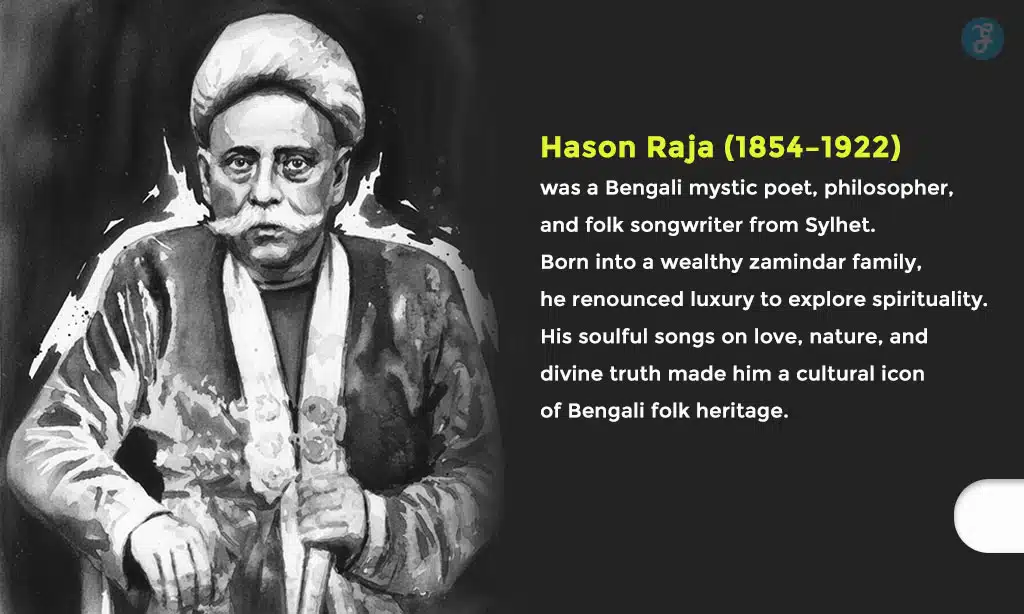
Hason Raja left deep marks on the cultural map of Bengal. His influence reached far beyond his village, catching the ear of the greatest poet of the time.
What is Hason Raja’s Legacy in Literature and Music
A very famous endorsement cements his legacy. Rabindranath Tagore was so moved by Hason Raja’s depth that he quoted him in his famous Hibbert Lectures at Oxford University in 1930.
In his lecture series, titled The Religion of Man, Tagore cited Hason Raja’s songs as a perfect example of the “philosophy of the simple man.” This introduced Hason Raja to a global audience. Today, his lyrics fill albums like “Mahajone Lokogaan” and “Totally Folk.” Legends like Manna Dey and bands like Lakkhichhara have sung his works, proving his art is timeless.
Representation in Popular Culture
Filmmakers and songwriters love Hason Raja because his life story has everything: wealth, loss, transformation, and music. He is a favorite subject for movies and TV shows.
How Have Films and Biographies Portrayed Hason Raja
Films often depict him as a complex figure—a man torn between worldly pleasure and spiritual peace. You might see him with his ektara, singing songs full of hope and pain.
The 2002 film Hason Raja, which won a National Film Award, brought his story to the big screen. More recently, the movie Ballabhpurer Roopkotha (2022) featured a haunting version of “Loke Bole,” which became a viral sensation across India and Bangladesh.
For the true history buffs, the Museum of Rajas’ in Zinda Bazar, Sylhet, is a must-visit. It is housed in his ancestral home, “Raja-Kunjo.” There, you can see his 75kg iron safe and the actual instruments he played. It offers a tangible connection to the man behind the myth.
What Are the Modern Interpretations of His Songs
Modern singers are not afraid to experiment with his classics. Artists like Aankhi Das and Rishi Panda put fresh spins on his tunes, using guitars and keyboards to replace the traditional dotara.
“Nesha Lagilo Re” pops up in many versions now, from rock ballads to fusion dance tracks. Popular playlists like “Best Folk Flavor Bangla” are filled with these new takes. By blending his deep lyrics with modern beats, artists ensure Hason Raja remains relevant for the next generation.
Takeaways
Hason Raja still touches hearts because his questions are our questions. We all search for meaning, love, and a place to call home.
His spirit shines in every line, simple yet deep, like ripples on a pond at dawn. Whether you are listening to a classic folk rendition or a modern Coke Studio remix, you are connecting with a man who looked at the stars and saw a reflection of his own soul.
You can spot traces of Hason’s wisdom in folk music playlists on Commons or quotes shared across Wikiquote. His voice lives on, echoing through generations—proof that true art never fades away.
FAQs on Hason Raja
1. Who was Hason Raja, and why do people call him the mystic poet of Bengal?
You might know him as the “Mystic Poet,” but Dewan Hason Raja Chowdhury was actually a wealthy Zamindar born in Sunamganj, Sylhet, back in December 1854. He earned this title because he famously turned away from his luxurious lifestyle to write songs that explore the deep connection between the human soul and the divine creator.
2. What themes did Hason Raja sing about in his poetry?
His lyrics, most notably in the famous song “Loke Bole O Bole Re,” often use the metaphor of a bird trapped in a cage to describe the soul’s temporary stay in the physical body.
3. How did Hason Raja influence Bengali culture?
His unique musical style was so powerful that even Nobel Laureate Rabindranath Tagore quoted his philosophy in lectures to the world. Today, you can visit the Museum of Rajas in Sylhet to see his history or hear his influence in the folk songs performed across West Bengal and Bangladesh.
4. Why do people still listen to Hason Raja’s songs after so many years?
Listeners still love his work because modern artists like Habib Wahid have reimagined these classic tracks for a whole new generation. His songs speak to that universal feeling of searching for spiritual meaning, making them just as relevant on a 2025 playlist as they were a century ago.