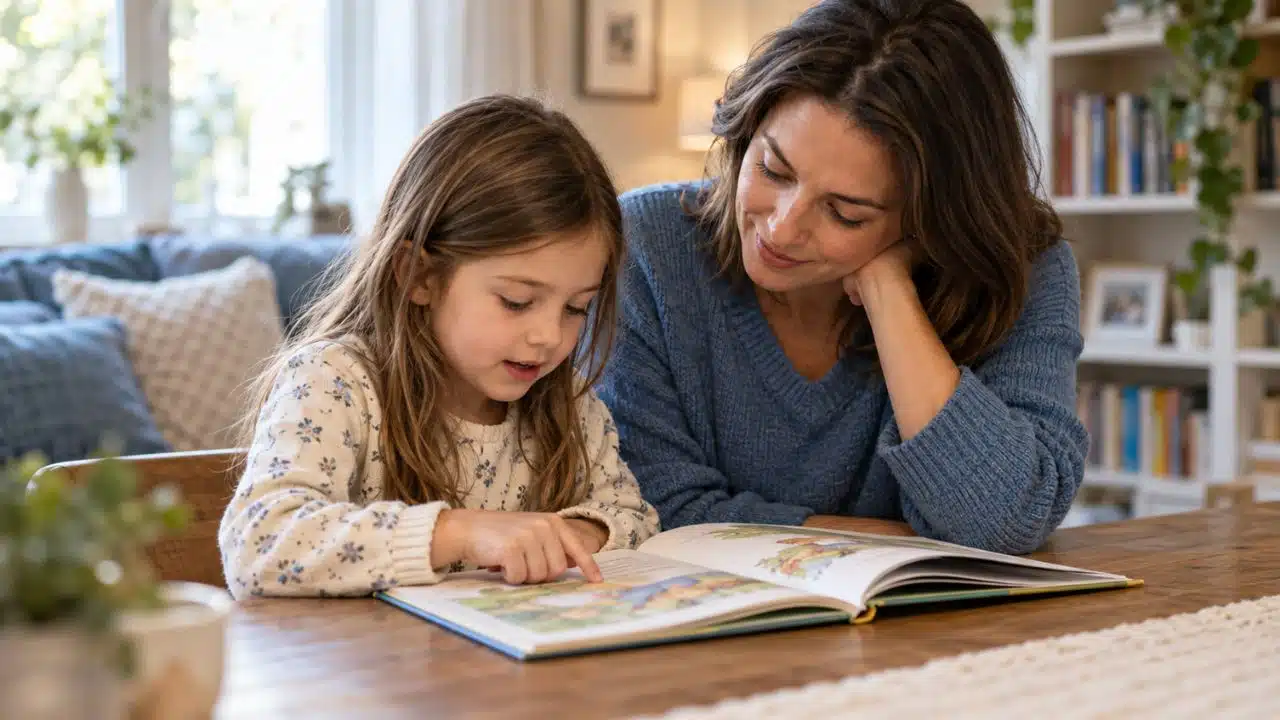
Your child stops at a word. You wait, then wonder whether to say it, ask them to sound it out, or let them keep trying. Guided reading for parents starts with knowing what kind of help to offer in that moment.
Yes, parents can adapt guided reading at home. The practical version is straightforward: choose a suitable short text, listen while your child reads, help with difficulties, and talk about the meaning. You do not need to recreate a classroom lesson or buy a special kit.
The book matters as much as the help. If it is full of spellings your child has not learned, encouragement alone will not make it suitable for independent reading practice.
What Guided Reading Actually Means
In school, guided reading is an approach in which a teacher supports a small group as children read a selected text. The teacher chooses a learning focus, listens, and responds to what the readers need.
Schools use the term in different ways. Ask what it involves in your child’s classroom rather than assuming every guided reading lesson follows the same method. The home routine here draws on established reading practices; it is not a separately tested programme.
Some approaches have encouraged beginners to identify words through pictures, sentence patterns, or an initial letter. For beginning readers of English, evidence-based guidance supports explicit teaching of letter-sound relationships and blending, alongside vocabulary and comprehension. Pictures remain useful for discussing a story, but children need to attend to the print when working out its words.
As your child develops, make room for three kinds of reading:
- Adult read-alouds: You read while your child listens, enjoys the story, and talks with you.
- Supported reading: Your child reads suitable text while you help when needed.
- Independent reading: Your child reads material they can manage without continual assistance.
These experiences serve different purposes. A child who needs a very simple practice book can still enjoy listening to a much richer story.
Start With What Your Child Can Already Do
A school year or birthday does not tell you exactly which text will work. Look at the reading task itself.
For a preschooler who is not yet connecting letters with sounds, concentrate on shared stories, conversation, rhymes, and playful exploration of print. Point out the title, talk about an illustration, or notice a familiar letter. There is no need to require independent reading to make this time worthwhile.
A child who knows some letter-sound relationships and is beginning to blend them can try short words and sentences using that knowledge. For example, to sound out sat, a child needs the sounds represented by the letters and practice bringing those sounds together. Naming the letters alone does not produce the word.
A more established reader may need support with longer words, unfamiliar vocabulary, or understanding why a character behaved a certain way.
A child may discuss a story thoughtfully yet struggle to read its words. Another may pronounce the words accurately without understanding them. Guided reading for parents should respond to the difficulty you can actually see.
Choose the Practice Book Carefully
For beginners, choose a practice book that is decodable for that particular child: it matches the letter-sound relationships they have been taught, with any exception words introduced beforehand.
A book labelled “beginner” may still contain spellings your child has never learned. A short sentence can also hide a difficult word. Page count, large print, and cheerful pictures do not establish suitability.
Ask the teacher which sound-spelling patterns your child is practising and whether a matching book can come home. If you homeschool, use texts aligned with the sequence in your phonics instruction.
Before sitting down together, read the chosen passage yourself. Notice possible obstacles: an unfamiliar spelling, a character’s name, or a word your child can pronounce but may not understand.
If a book comes home without instructions, ask whether it is intended for your child to read, for you to share, or for you to read aloud. A favourite library book may be intended for shared enjoyment, even if your child cannot yet read it alone.
Once you have suitable options, let your child choose between them. You can check the difficulty; they can choose the animal story or the book about trucks.
If almost every line requires substantial help, shorten the passage or choose an easier text. You can read the harder book aloud. Its subject may be exactly right even when its words are not yet manageable independently.
Once your child can decode a wider range of words accurately, expand the choice to stories, poems, and factual books. Decodable books are a tool for early word-reading practice, not a permanent restriction on what children may read.
A Simple Guided Reading for Parents Routine
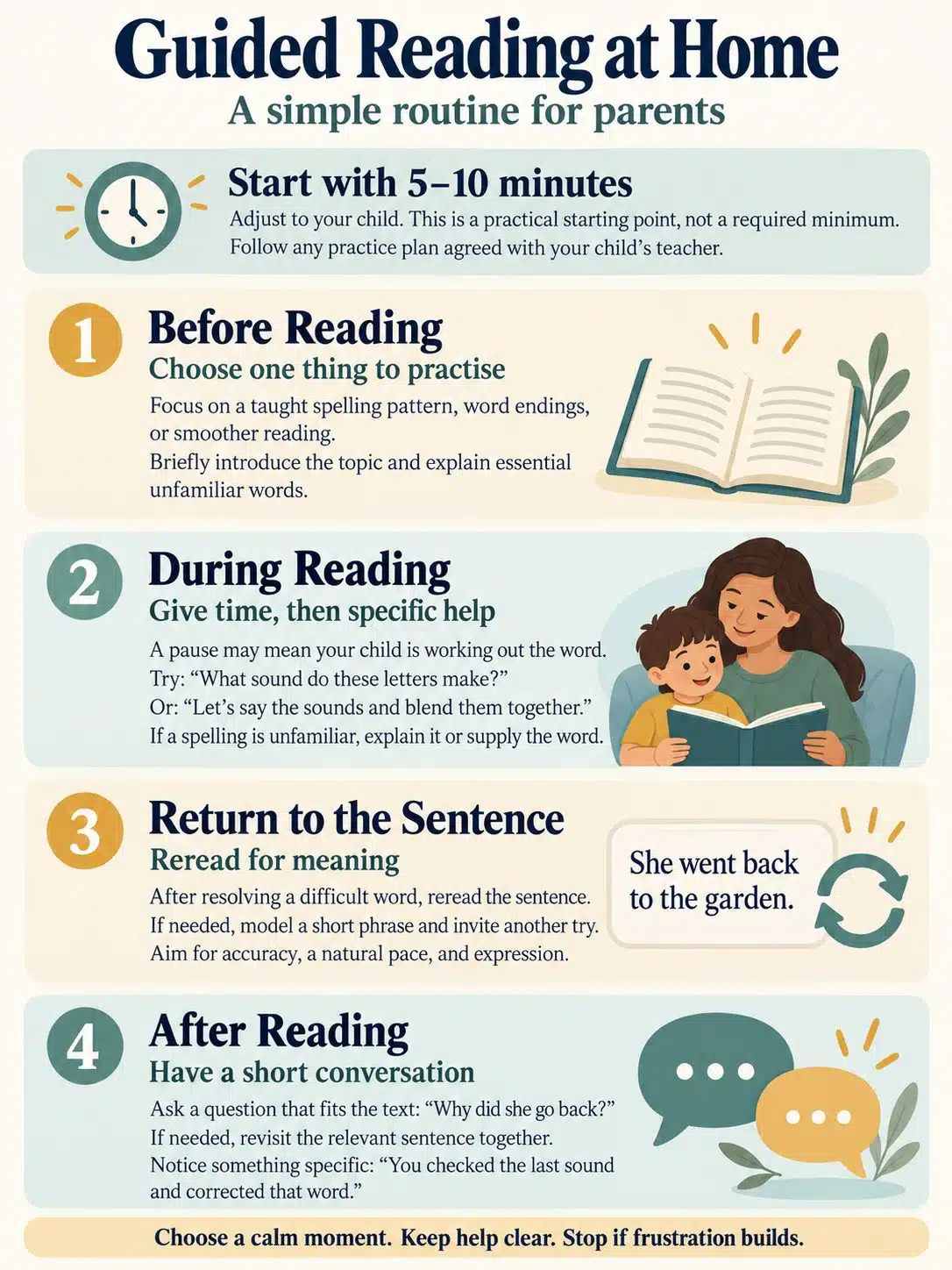
Try a brief session of around five to ten minutes as a practical starting point, adjusting to your child. The timing is a practical suggestion, not an evidence-based minimum. Follow any individual practice plan agreed with your child’s teacher.
Choose a moment when neither of you is already exhausted. If bedtime practice regularly ends in tears, try a few minutes after an afternoon snack and save bedtime for a story you read aloud.
Before Reading: Choose One Thing to Practise
Choose one focus based on recent reading or the teacher’s advice: blending words with a taught spelling pattern, checking endings, or reading a familiar sentence more smoothly. You do not need to work on all three in one sitting.
Say it simply: “Today, let’s look carefully at the ends of the words.” Keep the explanation brief and specific.
Introduce the book’s topic and explain any essential unfamiliar vocabulary. Keep this short enough that your child still has something to discover through reading.
During Reading: Help With the Actual Difficulty
Sit where you can both see the print. Let your child read a sentence or a short section. A pause is not automatically a request for help; they may be working through the word.
When they hesitate, use a prompt that fits the difficulty:
- “What sound do these letters make?”
- “Let’s say the sounds and blend them together.”
- “Check the end of the word. Did you read that part?”
If the spelling is unfamiliar, explain it or supply the word. Repeating “sound it out” does not explain a letter-sound relationship the child has never learned.
Avoid a long sequence of prompts after frustration begins. Give clear help, then let the reading continue.
Return to the Sentence
Once the difficult word is resolved, ask your child to reread the sentence. This lets them reconnect the word with its meaning instead of leaving the sentence as a string of separate efforts.
For a child who already reads the words accurately but sounds hesitant, model a short phrase and invite them to read it again. Keep the model natural. Fluency includes accuracy, a suitable pace, and expression; rushing through the words is not the aim.
After Reading: Have a Short Conversation
Choose a question that fits what you actually read. “Why did she go back?” invites a different kind of thinking from “What did she find?” A factual text might lead to “What did we learn about how this animal stays warm?”
Follow the answer with a comment or a question of your own. If your child looks puzzled, return to the relevant sentence together. Avoid turning a short passage into a comprehension test.
Finish with a specific observation: “You checked the last sound and corrected that word.” That tells your child what helped.
Correct a Word Without Taking Over
Imagine a practice sentence says, “Sam got a red hat,” and your child reads cap instead of hat. The illustration may make cap seem plausible, but it does not match the print.
A useful response is: “You said ‘cap.’ Look at this word. Let’s read the sounds.” Help your child blend hat, then reread the sentence.
Once the word is correct, check the meaning together. Does the sentence now fit what is happening? That uses context to confirm understanding after reading the print.
For English words with an unexpected spelling, explain the part that needs attention. In said, for example, explain that ai represents the same vowel sound as the e in bed. Point out the regular beginning and ending sounds if your child already knows them. A child should not be left trying the same unsuccessful pronunciation indefinitely.
Avoid turning corrections into a test of memory: “We did this yesterday” adds pressure without explaining the word. Point to the part that needs attention and help your child read it.
If your child notices an error and corrects it independently, let that success stand. There is no need to interrupt with another explanation.
Keep Meaning in the Conversation
Accurate word reading matters, but a correctly pronounced sentence can still be confusing.
Consider the sentence “The pup hid in the den.” A child might decode den successfully without knowing what it means. A brief explanation solves a vocabulary problem that additional sounding out would not address.
You can also ask your child to describe what happened in their own words. This is often more revealing than asking, “Did you understand?” If the response is unclear, read the relevant part aloud and talk it through together.
Do not require a question after every sentence. Constant interruption can make it difficult to follow a story. Leave room for laughter, surprise, and the child’s own comments.
Keep some books for listening and conversation, without asking your child to read any of the words. A beginner reader should still have access to interesting ideas, unfamiliar places, and stories with more demanding language.
Notice What Is Getting Easier
For home practice, a few useful observations are enough. You might note that a child blended a previously difficult word, noticed an ending, or explained a character’s decision with less help. These observations can support a conversation with the teacher; they are not a formal reading assessment.
One brief note can capture this: “Read the short passage with help on ‘ship’; reread the first sentence independently.” Share observations like this with the teacher if needed.
Rereading a familiar book can be useful, but reciting its words from memory does not show whether the child can read new text. Occasionally offer another suitable passage containing already-taught patterns and notice how they approach it.
Avoid timing every attempt or treating a book level as a score. Useful questions are more specific: Are the words becoming easier to read? Does the child understand what they read? What still requires support?
Use what you notice to choose the next small step. If the same spelling keeps causing trouble, bring that example to the teacher instead of simply adding more pages.
When the Routine Becomes a Battle
If a child repeatedly refuses, first reconsider the demand. The text may be too hard, the session too long, or the timing poor. Ask what feels difficult, and listen before deciding that more practice is the answer.
Try one small adjustment. Read a shorter section, offer two suitable choices, or move practice to an earlier part of the day. If frustration rises, stop and return another time. You can still read a story together, with you doing the reading.
Persistent difficulty deserves a conversation with the teacher or a qualified reading specialist. Bring concrete examples: difficulty remembering taught letter-sound relationships, blending familiar sounds, or reading simple new words despite instruction and practice.
Ask what the school’s assessment shows, which skill needs attention, and what targeted support will follow. Agree on when you will review progress and what, specifically, to practise at home.
Home reading can reinforce instruction; it should not become the only response to continuing difficulty. You do not need to wait until a child is far behind before raising a concern.
Final Thoughts
Before the next reading session, check one thing: does the book match the sounds and spellings your child has learned? If you are unsure, ask the teacher for a suitable text and a quick demonstration of how to help with a difficult word.
That is a useful starting point for guided reading for parents. Read a small amount together, notice where help is needed, and stop before frustration takes over. If the same difficulty keeps returning, bring the example to someone who can help you plan the next step.
FAQs about Guided reading for parents
What is guided reading?
Guided reading is a teaching approach where a child reads a book with support from an adult. The adult helps the child understand unfamiliar words, improve reading strategies, and build confidence while gradually encouraging independent reading.
Can parents do guided reading at home?
Yes. Parents can use simple guided reading techniques at home by choosing an age-appropriate book, listening to their child read, asking questions, and helping with difficult words without immediately giving the answer.
What age is guided reading suitable for?
Guided reading can be helpful for children from the early stages of learning to read through the elementary years. The books and level of support should be adjusted to match the child’s reading ability.
How long should a guided reading session last?
A guided reading session at home can take about 10 to 20 minutes. Short, regular sessions are often more effective than long sessions that may make a child tired or frustrated.