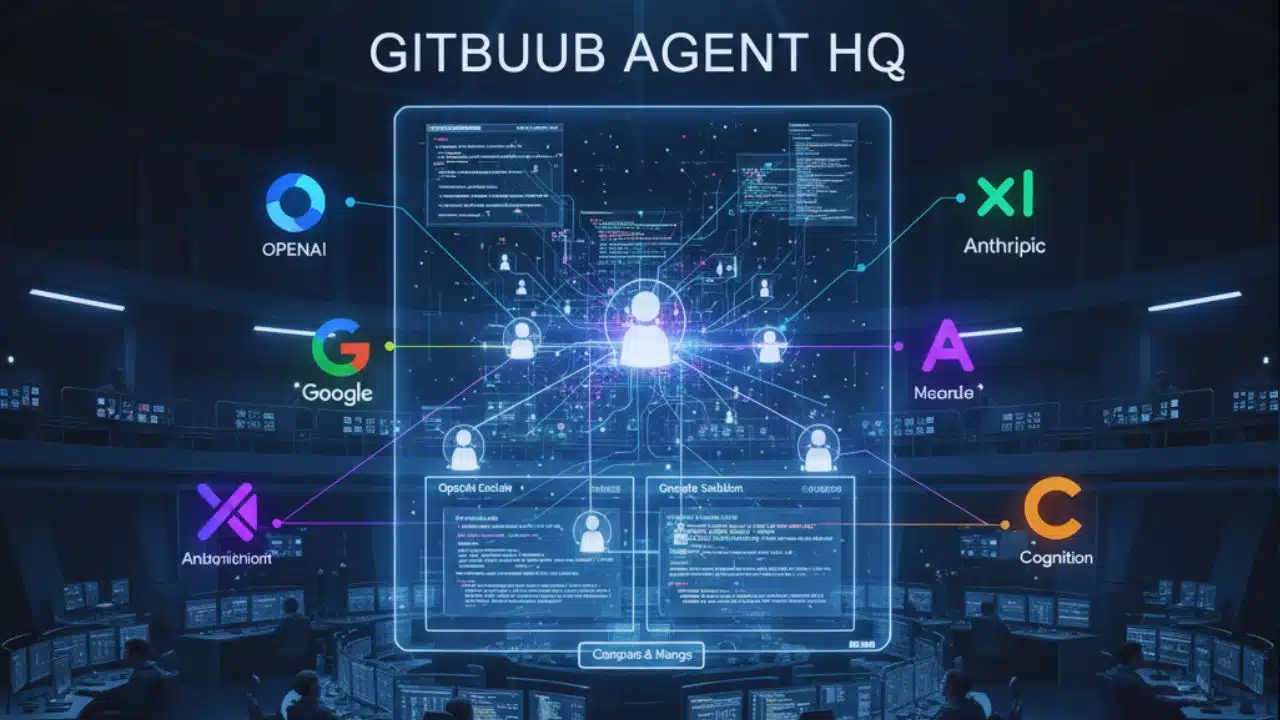
In a strategic pivot that redefines its role in the artificial intelligence landscape, GitHub today unveiled GitHub Agent HQ, a new “mission control” center designed to orchestrate and manage a vast ecosystem of third-party AI coding agents.
Announced at its annual Universe 2025 conference, the platform will directly integrate competing models from OpenAI, Google, Anthropic, xAI, and Cognition alongside its own Copilot, transforming GitHub from a single-AI provider into an open, competitive marketplace for agentic software development.
The GitHub Agent HQ Launch
- What It Is: A new “mission control” dashboard within GitHub and VS Code to centrally manage, assign, monitor, and steer multiple, disparate AI coding agents.
- Multi-Vendor Support: Agent HQ creates an open ecosystem, integrating first-party (Copilot) and third-party agents from major players like OpenAI (Codex), Google (Gemini), Anthropic (Claude), xAI (Grok), and Cognition.
- Parallel Execution: A key feature allows developers to assign the same coding task to multiple competing agents (e.g., Google vs. OpenAI) simultaneously and compare the results.
- Centralized Governance: For enterprises, it provides a new control plane to manage agent permissions, enforce security policies, and review audit logs from a single interface.
- Initial Availability: Agent HQ will begin rolling out later this week, starting with OpenAI Codex integration for GitHub Copilot Pro+ subscribers ($39/month) in VS Code Insiders.
- New Project-Level Controls: Introduces AGENTS.md files, allowing teams to define and version-control custom AI behaviors (e.g., “use table-driven tests”) for their specific projects.
“Order from Chaos”: GitHub’s New AI Strategy
The explosive growth of generative AI has created a new problem for developers: agent overload. In the past year, developers have been inundated with specialized AI tools—GitHub’s own Copilot, Anthropic’s Claude for complex reasoning, Google’s Gemini for broad integration, and highly autonomous agents like Cognition’s Devin.
This fragmented landscape, described by some as “vibe coding chaos,” forces development teams to juggle multiple tools, subscriptions, and security contexts, leading to inefficiency and governance nightmares.
GitHub Agent HQ is the company’s direct answer to this problem. It aims to be the “coordination fabric” that unifies these disparate services.
In a keynote at the GitHub Universe 2025 event, Chief Operating Officer Kyle Daigle framed the move as essential for the next phase of AI development.
“With so many different agents, there’s so many different ways of kicking off these asynchronous tasks, and so our big opportunity is to bring this all together,” Daigle told reporters. “We want to bring a little bit of order to the chaos of innovation.”
This move signals a fundamental strategic shift. Instead of trying to build a single, dominant “Autopilot,” GitHub is positioning itself as the indispensable platform—the airport, not the airline—where all AI agents can land, refuel, and be directed, regardless of their origin.
What is GitHub Agent HQ and How Does it Work?
At its core, Agent HQ is a centralized orchestration layer. It provides developers and enterprise administrators with a unified set of tools to manage AI agents as first-class citizens within the software development lifecycle.
The “Mission Control” Dashboard
The primary interface is a new “mission control” dashboard, which is accessible directly within GitHub, Visual Studio Code, mobile apps, and the command-line interface (CLI).
From this single panel, a developer can:
- Assign Tasks: Write a task (e.g., “Refactor this entire module for better performance”) and assign it to one or more agents.
- Monitor Progress: See in real-time what each agent is working on, which files it’s touching, and what steps it’s planning.
- Steer and Intervene: If an agent is “going off track” or hallucinating, the developer can intervene, provide corrected instructions, or halt the task without having to switch contexts.
The AI “Battleground”: Parallel Agent Execution
Perhaps the most disruptive feature is the ability to run competing agents in parallel. A developer can give the exact same task to OpenAI’s Codex, Google’s Gemini 2.5 Pro, and Anthropic’s Claude Opus 4.1 simultaneously.
The agents will work on the task in sandboxed environments, and Agent HQ will present the different proposed solutions (e.g., separate pull requests) to the developer. This allows for direct, real-world comparison, enabling a developer to cherry-pick the best solution or even merge ideas from multiple AIs. This effectively creates an open “battleground” where the best model wins on a per-task basis, driving model providers to compete on quality rather than just platform lock-in.
Project-Level AI: AGENTS.md and “Plan Mode”
To move AI from a personal setting to a standardized, project-level asset, Agent HQ introduces two new features:
- AGENTS.md Files: This is a new configuration file that lives in a repository’s root directory. Teams can use it to define custom behaviors and preferences for any AI agent that interacts with the project. For example, the file can specify: “prefer this logger,” “use table-driven tests for all handlers,” or “adhere to this specific error-handling pattern.” By making agent configuration source-controlled, its behavior becomes versioned, auditable, and consistent for all team members.
- Plan Mode”: Integrated into VS Code, this feature helps developers map out complex tasks before coding. A developer can describe a feature, and the AI will prompt with clarifying questions before generating a structured, step-by-step project plan that can then be executed by other agents.
A New “Coordination Fabric”: The Broad Ecosystem
GitHub’s power comes from its massive user base and its new open-platform approach.
Key Statistics and Developer Adoption
The scale of this launch is significant. GitHub, which was acquired by Microsoft in 2018, is now home to a developer community that surpasses a critical milestone.
- 180 Million Developers: GitHub now supports over 180 million developers on its platform.
- 80% Adoption: The company stated that “80% of new developers use Copilot within their first week on GitHub,” demonstrating that AI is already deeply embedded in the modern development workflow.
Agent HQ leverages this existing adoption by integrating the most powerful models from across the industry directly into the Copilot ecosystem that developers already use.
Integrating the Titans: OpenAI, Google, and Anthropic
The list of launch partners confirms GitHub’s neutral-platform ambitions. The Copilot ecosystem, which Agent HQ will orchestrate, now includes models from nearly every major AI lab:
- OpenAI: GPT-5, GPT-5 mini, and the original Codex.
- Google: Gemini 2.5 Pro.
- Anthropic: Claude Opus 4.1, Claude Sonnet 4.5, and Claude Haiku 4.5.
- xAI: Grok Code Fast 1.
- Cognition: The company behind the “Devin” agent.
- Others: Models like Qwen2.5 are also listed.
Beyond Code: The Model Context Protocol (MCP) Registry
Agent HQ also integrates the new GitHub MCP Registry. The Model Context Protocol (MCP) is a standard that allows AI agents to securely interact with third-party application services.
This means agents can move beyond simply writing code to performing complex, external actions. Through the registry, a developer can grant an agent “tool” access to services like Stripe, Figma, or Sentry. This would allow a developer to issue commands like, “Query the Sentry error log for the last 24 hours, find the root cause, and fix the bug,” or “Fetch the new button component from this Figma design and implement it in the React frontend.
Governance and Enterprise Impact
For corporations, the “agent chaos” is primarily a security and compliance risk. Granting multiple third-party AI tools broad access to private source code repositories is a non-starter for most Chief Information Security Officers (CISOs).
Agent HQ is designed to solve this. It provides a centralized enterprise control plane for IT administrators. Instead of agents having broad access, they inherit the granular security and governance of GitHub Copilot.
Key security features include:
- Sandboxed Environments: Third-party agents run within secure, firewalled GitHub Actions environments.
- Granular Permissions: Admins can define exactly what repositories, or even what parts of a repository, an agent can access.
- Audit Logs: All agent actions, from planning to code commits, are logged and auditable.
- AI-Powered Code Review: A new feature, GitHub Code Quality, is also in public preview. This extends Copilot’s security checks to act as an AI code reviewer, assessing the maintainability and reliability of AI-generated code before a human developer ever sees it.
The rollout of Agent HQ will be phased.
- This Week (Oct 27, 2025): Initial access begins for GitHub Copilot Pro+ subscribers ($39 per month). This first phase will feature OpenAI Codex integration within the VS Code Insiders build.
- Coming Months: Support for the other major agents—including those from Google, Anthropic, xAI, and Cognition—will be rolled out “in the coming months.
This launch solidifies a new era of software development. The job of the human developer is rapidly shifting from writing every line of code to directing a team of specialized AI agents. With Agent HQ, GitHub has firmly positioned itself as the central, indispensable “mission control” for this new workflow, betting that the platform that best manages the agents will ultimately win, regardless of which AI model is “smartest” on any given day.
The Information is Collected from Times of India and MSN.