A parent can sit through a school presentation today and hear a very polished promise. There will be smart classrooms. AI-supported learning. Personalized dashboards. Coding exposure. Digital homework. International methods. Real-time updates. Future-ready skills. Then the same parent may go home and watch a child struggle to finish two pages of reading without reaching for a device. That contradiction is where the real education debate begins.
The future of school will not be built by adding more screens to the old classroom. Nor will it be saved by pretending children can be educated for tomorrow with yesterday’s habits alone. The schools worth trusting will be the ones that become more honest: honest about learning gaps, honest about distraction, honest about what technology can do, and honest about what only good teaching can do.
My argument is not anti-technology. That would be too easy and, in many parts of the world, unfair. Digital tools can help children learn, especially where teachers, libraries, specialist support, or language resources are limited. But technology has become a convenient symbol of seriousness. Too many schools now look modern before they prove they are effective.
Parents should not be dazzled by the surface. The more useful test is simple. Can the child read well? Can they write clearly? Can they explain what they think? Can they sit with difficulty for more than a few minutes? Can they work with other children? Can they use a digital tool without becoming dependent on it? Can the teacher see the child clearly enough to help?
If the answer is weak, the school is not future-ready. It is just better packaged.
The Pandemic Did Not Create the Crisis; It Removed the Cover
COVID-19 did not damage a perfect education system. It exposed a fragile one.
UNESCO estimated that pandemic-related education disruption affected more than 1.6 billion learners worldwide. The number is large enough to sound almost abstract, but parents felt the reality in smaller ways: the child sharing one phone with siblings, the teacher trying to hold attention through a weak connection, the worksheet submitted without real understanding, the quiet student disappearing behind a switched-off camera.
Some children continued learning because they had devices, stable internet, quiet space, adult guidance, and schools that adapted quickly. Others were pushed to the edge of the system almost overnight. When classrooms reopened, many children returned with academic gaps, weaker routines, and emotional strain.
That is why post-pandemic education should not be treated as a temporary repair project. It should be treated as a warning about the old assumptions.
For years, many systems behaved as if enrollment, attendance, promotion, and exam marks could stand in for learning. They cannot. A child can move from one grade to the next and still be weak in reading. A teenager can submit assignments on time and still be unable to build an argument. A school can send parents regular digital updates and still give them very little useful information.
This is the part parents should take seriously. The appearance of learning has become easier to polish.
The 2022 learning-poverty estimate from the World Bank, UNICEF, UNESCO, and partners made the risk painfully clear: in low- and middle-income countries, an estimated 70% of 10-year-olds were unable to read and understand a simple written text. That figure should not be treated as a permanent headline for every country or every year. But as a warning about foundational learning, it remains powerful.
A child who cannot read with understanding by the middle years of primary school is not simply “a little behind.” That child is being asked to climb the rest of the education ladder with missing steps.
The future of school must begin there, not with the newest platform.
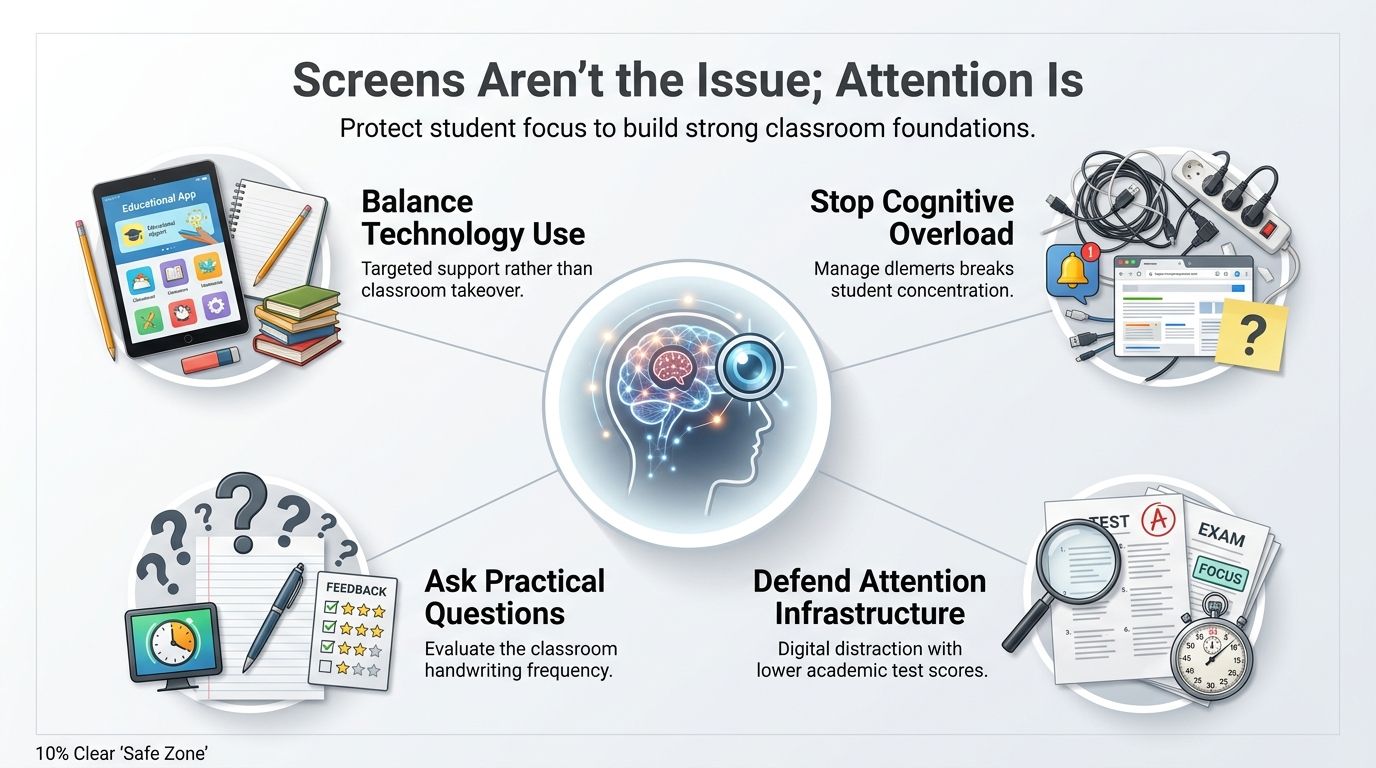
Screens Are Not the Real Issue; Attention is
The school technology debate often becomes lazy. One side acts as if every screen is progress. The other acts as if every screen is damaged. Parents deserve a better argument than that.
A tablet may help a child with a disability. A video can make a science process visible. A digital quiz can give a teacher quick information about where the class is confused. AI can support translation, revision, and practice when used carefully. In under-resourced settings, technology can widen access in ways that printed materials alone may not.
But a classroom can also become quietly worse when every task moves onto a device. The child is no longer only learning the lesson. They are managing notifications, tabs, passwords, pop-ups, gaming temptations, chat windows, and the habit of switching attention every few seconds.
Children are not small office workers. They are still building the capacity to concentrate.
OECD’s PISA 2022 results showed a record decline across OECD countries between 2018 and 2022, with mathematics performance falling by almost 15 points and reading by 10 points. That decline cannot be blamed on devices alone. Pandemic disruption, inequality, school culture, family support, curriculum, and long-term academic trends all matter.
Still, the distraction signal should not be brushed aside. OECD analysis found that students who reported being distracted by peers using digital devices in at least some mathematics lessons scored lower in mathematics than students who were barely exposed to that distraction. That does not prove every laptop or tablet harms learning. It does prove that attention is not a soft issue.
Attention is infrastructure.
A school that protects attention is not being old-fashioned. It is doing one of the basic jobs of education.
Parents should ask practical questions before accepting a digital-first model. How much of the day is screen-based? When do children read printed text? When do they write by hand? How are phones handled? Are teachers choosing the tools, or are tools being imposed on them? Is the technology making feedback better, or just making submission easier?
The answer matters more than the brochure.
Phone Bans Help, But They Do Not Teach the Lesson
The global shift toward school phone restrictions is not surprising.
UNESCO’s 2026 monitoring found that 114 education systems, representing 58% of countries, now have national measures restricting or banning mobile phones in schools. That is a major change in a short period.
Many teachers will feel relieved. Many parents will too. Phones can interrupt lessons, intensify social pressure, enable cheating, record other students without consent, and pull children into private digital worlds while they are physically sitting in class.
A school has every right to set firm rules around phones. But adults should resist the temptation to treat phone bans as a complete answer. A 2026 NBER working paper on lockable phone pouches in U.S. schools found that strict restrictions reduced phone use during the school day, but the evidence on test scores, attendance, engagement, and bullying was limited or mixed.
That finding should not be used to dismiss phone policies. It should make the policy conversation more honest.
Removing phones may make the classroom calmer. It may help teachers regain control of the room. It may reduce one obvious source of distraction. But it will not automatically improve reading instruction, reduce class size, train teachers, fix weak feedback, or rebuild trust between school and home.
This is a recurring weakness in education reform. A visible problem is identified, then one visible policy is expected to carry the whole burden.
Phone rules are necessary in many schools. They are not a substitute for teaching quality.
AI Makes Weak Assignments Easier to Expose
Generative AI has made parents and teachers nervous for good reason.
A student can now produce a passable paragraph without understanding the subject. A homework answer can look polished while being hollow. A project can be assembled from summaries the child barely read. Schools are right to worry about plagiarism, privacy, bias, and overdependence.
But AI is also exposing something schools should have admitted earlier: many assignments were already too easy to fake.
If homework only asks for a finished answer, AI will weaken it. If writing is judged only by the final paragraph, AI will blur authorship. If students can pass by repeating information without explaining it, the problem is not the tool. The problem is the task.
The better response is not panic. It is a redesign.
Schools should make thinking more visible. That can mean more in-class writing, more oral explanation, more drafts, more project logs, more teacher-student conferences, and more assignments tied to local observation or classroom discussion. It can mean asking students not only what answer they produced, but how they got there, what they rejected, what confused them, and what they can defend.
Parents should not ask only, “Does the school ban AI?” A ban may sound reassuring, but it may be unrealistic. A better question is, “How does the school teach students to verify information, disclose assistance, question output, and take responsibility for their work?”
That is not a small skill. It may become one of the central academic habits of the next decade. Future workplaces will not reward people for pretending AI does not exist. They will reward people who can use tools without surrendering judgment.
There is also an equity issue. Wealthier students are more likely to get better tools, private guidance, and adults who can teach them how to use AI safely. If lower-cost schools respond only with fear and bans, the gap may widen. Sensible AI education should not mean giving every child a chatbot and calling it progress. It should mean age-appropriate rules, teacher guidance, privacy protection, and assignments that make real understanding harder to fake.
AI should force schools to improve assessment. If it only helps them automate old habits, the opportunity will be wasted.
The Teacher Is Not the Part to Automate Away
One of the weakest ideas in education technology is the suggestion that software can make teachers less important. It sounds efficient. It is wrong.
As tools become more powerful, the adult in the room matters more. A platform may show that a student missed five mathematics questions. A teacher may notice that the child is embarrassed, afraid to ask for help, missing one earlier concept, or too tired to focus. A dashboard can show performance. It cannot fully understand hesitation, confidence, peer dynamics, family pressure, or the moment when a child is about to give up.
The future school needs teachers who are trusted to diagnose learning, not just deliver content. That requires time, training, fair pay, manageable class sizes, and fewer pointless reporting demands.
This is not sentimental. It is operational. UNESCO and the Teacher Task Force have projected a need for 44 million additional primary and secondary teachers worldwide by 2030. That number should make policymakers more cautious about techno-utopian promises. A system cannot claim to be ready for AI, personalized learning, and global competition if it cannot recruit and retain enough capable teachers.
A school with expensive devices and exhausted teachers is not advanced. It is unstable.
Parents should pay attention to this. Are teachers staying? Do they have time to speak properly with families? Are they trained to use technology with judgment? Does the school respect teacher expertise, or does it bury teachers under platforms, forms, and performance dashboards?
The future of school will not be teacherless. If it is any good, it will be more teacher-dependent than ever.
The Pro-Technology Side is Not Wrong
The strongest argument for more technology in schools is not fashion. It is access.
In many places, technology is the only practical way to connect rural learners with specialist instruction, support children with disabilities, translate materials, provide extra practice, and give teachers better resources. During floods, conflict, public health emergencies, or local closures, digital systems can keep part of the learning process alive. For families that cannot afford private tutoring, a well-designed learning tool may provide support that would otherwise be out of reach.
A strict anti-screen position can become unfair very quickly. It can become a comfort argument for families that already have books, quiet rooms, educated parents, and paid help.
That is why the serious position is not “less technology everywhere.” The serious position is “better reasons for using technology.”
A device is useful when it gives a child access they did not have. It is harmful when it replaces the concentration they need. A platform is useful when it helps a teacher see and respond to learning. It is harmful when it turns teaching into data entry. AI is useful when it helps students question, revise, translate, or practice. It is harmful when it lets them avoid thinking.
Access matters. Attention matters. Schools that pretend only one of those is true will fail children in different ways.
What Most People Get Wrong About the Future of School
Many debates treat the future of school as a question of location. Will children learn in classrooms? Online? At home? In hybrid systems? Through tutors? Through apps?
Location matters, but it is not the central issue. A physical classroom can be shallow. An online class can be serious. A high-tech school can be weak. A low-tech school can be excellent.
The real question is how learning is organized, measured, and supported. The old model sorts children mainly by age, moves them through a syllabus, tests them at intervals, and often waits too long before addressing gaps. That model is too blunt for what comes next.
Schools need to become more precise without becoming colder. They need to know where a child is struggling without turning every child into a data profile. They need to personalize support without isolating students in individual screen bubbles. They need to assess more honestly without creating endless tests.
Parents should be especially careful about exam-only confidence. Exams have value. They can build discipline and reveal knowledge. But they cannot carry the whole meaning of education. A child also needs to explain, discuss, create, question, collaborate, and keep learning after the test is over.
A better school future will not be defined by whether the child learns on paper or a screen. It will be defined by whether the school knows the child well enough to teach properly.
Final Words
The future of school will look nothing like today’s if we stop confusing modernization with improvement.
The next generation of schools should be more flexible but not careless. More digital, but not screen-dominated. More personalized, but not isolating. More data-informed, but not reduced to dashboards. More open to AI, but much stricter about truth, privacy, and student responsibility.
For parents, the task is not to predict every new tool. It is to defend the conditions children need in any age: attention, strong basics, capable teachers, honest feedback, healthy routines, and room to become thoughtful human beings.
So the question is not whether a school looks futuristic. The question is whether it helps a child learn deeply enough to face the future with judgment. That is the future of school worth fighting for.