

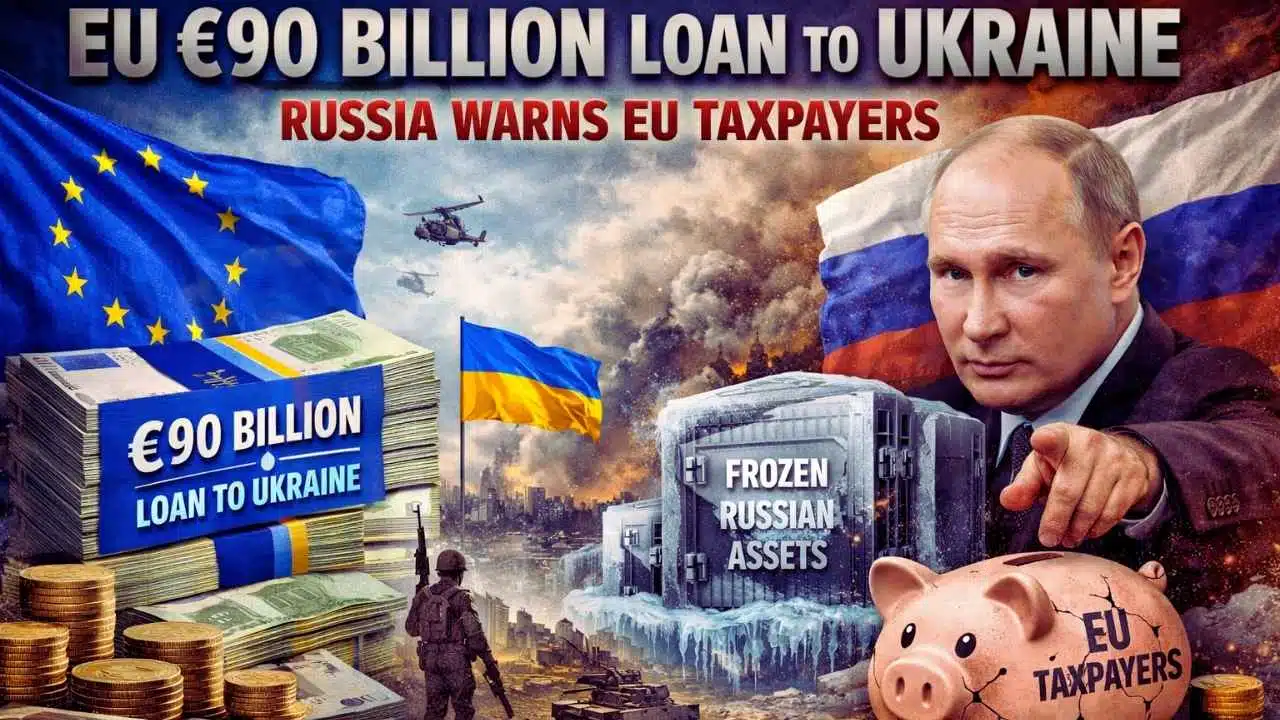
The EU 90 Billion Loan to Ukraine was agreed by EU leaders in Brussels on December 18–19, 2025, to fund Ukraine’s urgent needs in 2026–2027 after member states failed to agree on using frozen Russian assets—prompting Russia to claim EU taxpayers may never be repaid.
What the EU decided in Brussels and what it covers?
EU leaders agreed to provide a €90 billion loan to Ukraine for 2026 and 2027, framing it as a way to cover “pressing financing needs” while keeping Ukraine resilient under Russia’s ongoing war.
The loan is intended to support Ukraine’s budget stability and defence-related needs across the next two years. In wartime, “budget support” often means the basics that keep a state running—salaries for teachers and doctors, pensions, emergency services, and the public administration that holds the economy together. When national revenue is strained by destruction, displacement, and elevated security spending, international financing becomes a bridge between what a country must pay and what it can reliably collect.
The timing matters. The EU has already provided extensive support since 2022, but EU leaders now point to a looming funding gap for 2026–2027. Their decision is designed to avoid a scenario where Ukraine faces a cash crunch that could disrupt essential services, limit the state’s ability to plan, and weaken the wider European security posture.
A notable political feature of the plan is its repayment logic. According to the European Council’s summary, the loan “would be repaid by Ukraine only once Russia compensates Ukraine for the damage caused by its war of aggression,” and until then “Russia’s assets will remain immobilised” while the EU “reserves the right to use them to repay the loan” in line with EU and international law.
That wording signals two things at once: a commitment to keep financing Ukraine in the near term, and an attempt to connect long-term repayment to a political objective—Russian compensation—without immediately crossing the most legally contentious line, which would be confiscating frozen sovereign assets.
Key numbers at a glance
| Topic | Figure | Why it matters |
| EU loan to Ukraine | €90 billion | Core EU financing package for 2026–2027 |
| Timeframe | 2026–2027 | Targets the next two-year funding horizon |
| Rebuild estimate (10 years) | $524 billion (€506 billion) | Scale of long-term recovery needs |
| Windfall-profit allocation model | 90% / 10% | Shows how EU channels profits from immobilised assets |
Why Russia is calling this a “taxpayer loan” and what that claim means?
Russia’s messaging focuses on a simple political narrative: if frozen Russian assets are not directly used to finance Ukraine, then European taxpayers will carry the burden. That message is designed to create domestic pressure inside EU countries by turning a complex financial structure into a household-level fear—higher taxes, tighter budgets, or reduced spending elsewhere.
There is a kernel of truth that makes the message effective: the EU plan relies on EU-level borrowing backed by the EU budget. If a loan is backed by a public budget, the public ultimately stands behind the promise that bondholders will be repaid.
But “taxpayers will pay” is still an oversimplification. The real picture depends on multiple layers:
- Who gets paid first: The EU would borrow in financial markets. The first obligation is to the investors who buy EU debt. That is the core reason the EU needs a credible guarantee structure.
- How the EU guarantees the borrowing: The European Council says the borrowing would be backed by the EU budget “headroom.”
- Whether Ukraine repays under normal timelines: The plan’s political concept is that Ukraine repays only when compensation arrives. If compensation does not arrive in an enforceable way, the repayment path becomes uncertain.
- Whether Russia’s immobilised assets are ever used for repayment: The EU states it “reserves the right” to use immobilised assets to repay the loan, but insists this must align with EU and international law.
So Russia’s claim is not a precise forecast. It is a pressure point: the longer a war lasts, the larger the financing requirements, and the more difficult it becomes for European leaders to keep support politically sustainable—especially if voters believe they are underwriting an open-ended commitment.
At the same time, EU leaders have emphasized the opposite message: that supporting Ukraine is not charity, but a security decision. The European Council’s language frames the financing as part of deterring aggression and maintaining long-term stability on the continent.
How the EU loan is structured and why “budget headroom” matters?
The EU plan says the loan will be “based on EU borrowing on the capital markets backed by the EU budget headroom.” In plain language, that means:
- The EU issues bonds (borrows money) from investors.
- Investors lend cheaply because EU debt is considered highly credible.
- The EU transfers the money to Ukraine as a loan.
- The EU budget’s “headroom” helps reassure investors that, even in a worst case, the EU has capacity to service the debt.
“Headroom” is essentially the margin between:
- how much the EU could call from member states under EU budget rules, and
- how much it plans to spend.
That margin can function like a guarantee. It does not automatically mean new taxes tomorrow. But it does mean that, if repayment becomes a long-term issue, EU politics around budgets and contributions become more sensitive.
The European Council also notes a legal and political workaround: the loan involves “enhanced cooperation” under Article 20 of the Treaty on European Union, and any mobilisation of EU budget resources “will not impact the financial obligations of Czechia, Hungary or Slovakia.”
That clause matters because it shows how difficult unity can be on Ukraine financing. The EU chose a structure that allowed the package to move forward while addressing objections from specific member states that wanted legal or fiscal insulation.
What this structure tries to achieve (and what it cannot guarantee)?
The architecture is trying to balance five competing goals:
- Speed: make financing available without endless negotiation over asset seizure.
- Scale: meet a large, multi-year budget need with one decision.
- Unity: prevent a single member state from blocking aid.
- Legality: avoid steps that could be struck down or trigger larger financial disruption.
- Leverage: keep pressure on Russia by maintaining immobilisation of assets and reserving future options.
What it cannot guarantee is the political endpoint the repayment condition implies. Reparations and compensation are not a normal “payment schedule.” They are an outcome tied to future diplomacy, future legal enforcement, and future geopolitical realities.
A simple comparison of the main financing approaches being debated
| Option | How it funds Ukraine | Political upside | Main risk |
| EU borrowing (this €90B loan) | EU issues debt, lends to Ukraine | Fast, scalable, avoids immediate legal leap | Longer-term burden sits with EU if repayment is delayed |
| Windfall profits on immobilised assets | Redirects net profits earned by institutions holding immobilised assets | Uses Russia-linked money without touching principal | Smaller and variable amounts; depends on market conditions |
| Using the frozen principal | Directly uses Russian sovereign asset value | Symbolically powerful; could reduce EU borrowing need | High legal, retaliation, and financial stability risks |
The frozen Russian assets debate: what the EU is already doing and what it avoided?
A central reason this story keeps resurfacing is the difference between immobilisation, monetising profits, and using the principal.
- Immobilisation means Russia cannot access the assets.
- Profit monetisation means using the extra net earnings generated because assets are stuck in certain systems.
- Using the principal means taking or pledging the underlying sovereign assets themselves.
The EU has already moved on profit monetisation. In May 2024, the Council adopted legal acts to ensure that net profits stemming from “unexpected and extraordinary revenues” accruing to central securities depositories (CSDs) due to restrictive measures would be used for Ukraine’s self-defence and reconstruction-related support.
That press release also spelled out a basic allocation approach:
- 90% toward the European Peace Facility (commonly associated with military support),
- 10% toward EU programmes financed from the EU budget, which can include reconstruction-related support.
Those decisions demonstrate the EU’s willingness to use Russia-linked financial flows—while staying within a framework it argues is legally defensible.
What EU leaders did not agree on, at least for this €90 billion package, is a bigger step: tying the loan directly to the principal of immobilised Russian assets. EU leaders instead agreed to keep Russia’s assets immobilised and continue work on “technical and legal aspects” of an instrument described as a reparations loan linked to cash balances associated with those immobilised assets.
That phrasing signals that the EU wants optionality. But optionality is not the same as action. In practice, the strongest resistance tends to come from states and institutions worried that moving too aggressively could lead to:
- prolonged legal battles,
- damage claims against institutions or states,
- retaliation against European interests abroad,
- and reputational or stability risks in financial markets.
Even without naming every internal objection, the outcome is clear: the EU chose the tool it could agree on now—borrowing—while keeping the asset debate alive.
What the loan means for Ukraine’s finances, Europe’s security, and what comes next?
The €90 billion loan arrives against a wider reality: Ukraine’s long-term recovery costs are vast, and wartime financing needs do not disappear just because a package is announced.
A joint assessment by Ukraine’s government, the World Bank Group, the European Commission, and the United Nations estimated that, as of December 31, 2024, the total cost of reconstruction and recovery over the next decade is $524 billion (€506 billion). That number is not a “bill due next year.” It is a scale indicator—how large the recovery challenge is once active conflict damage, infrastructure rebuilding, and economic restoration are measured.
The EU loan is therefore best understood as one piece of a layered financing strategy:
- Short-term survival financing (2026–2027): Keeping the state functional—budget support, stability, defence-related needs.
- Medium-term resilience: Supporting reform, anti-corruption measures, and rule-of-law systems that donors often insist on to sustain public trust and reduce leakage.
- Long-term recovery: Rebuilding housing, energy systems, transport, healthcare, education, and industrial capacity.
EU leaders explicitly linked the loan to governance themes, stating that the support should ensure Ukraine continues to uphold the rule of law and fight corruption. That is both a policy goal and a political necessity: European taxpayers and parliaments typically demand safeguards when money is raised at scale.
What happens next (the likely next pressure points)?
- Implementation details for 2026–2027
Even after a political agreement, the EU must finalize how funds will be raised, scheduled, and disbursed. The key question for Ukraine’s planners will be predictability: the difference between “promised” and “available on schedule” is enormous in wartime budgeting. - The frozen-asset debate will return
The EU has signaled it will keep exploring a reparations-linked instrument tied to immobilised assets. If Ukraine’s needs expand further—or if political fatigue rises—pressure to use Russia-linked resources could intensify. - EU unity will continue to be tested
The opt-out language for Czechia, Hungary, and Slovakia shows that internal EU compromise is part of the financing story. If future packages become larger, or if economic conditions tighten inside Europe, negotiating support may become harder. - A bigger question: how Europe defines “endgame financing”
Loans can bridge time, but they do not solve political endgames. If the war drags on, Europe faces a strategic choice: continue rolling financing tools forward, or change the framework (for example, by taking more decisive action on assets, creating a larger permanent facility, or shifting toward more grants).
A quick “what to watch” table
| What to watch | Why it matters |
| EU decisions on immobilised assets | Could reduce pressure on EU borrowing, but raises legal and retaliation concerns |
| Disbursement schedule and conditions | Determines whether Ukraine can plan budgets without disruptive gaps |
| EU budget debates and headroom politics | Public support may hinge on whether voters see costs as manageable |
| Ukraine governance and oversight measures | Shapes donor confidence and long-term sustainability |
| Reconstruction funding mobilisation | $524B scale requires long-term multi-source financing |
























