We live in a world where movies, series, music, games, and viral videos never stop. Yet a lot of what people “know” about showbiz is based on gossip, clickbait, and half-truths. From box office myths to celebrity rumors, from “reality” TV to AI and cancel culture, the same stories get repeated so often that they start to feel like facts.
This feature takes a step back and looks at 12 entertainment myths you should stop believing if you want to be a smarter viewer, fan, or creator. Once you understand how the industry really works, you can enjoy it more—without falling for hype or manipulation.
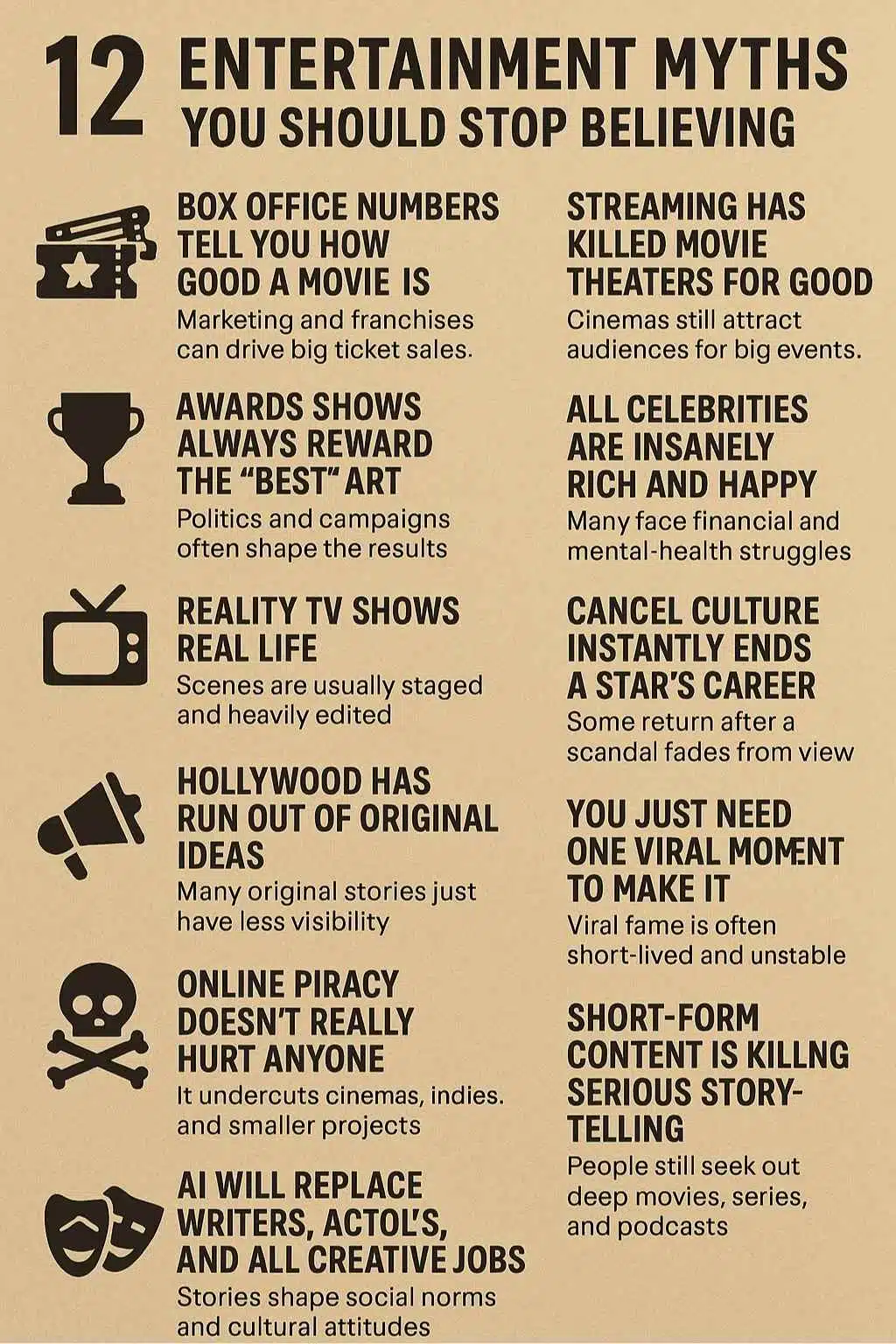
12 Entertainment Myths You Should Stop Believing
Many of the ideas we accept about movies, celebrities, streaming, and showbiz aren’t based on facts—they’re shaped by rumors, marketing, and social media repetition. This section uncovers the most common entertainment myths you should stop believing and explains the real forces driving the industry.
From box office misconceptions to the truth behind reality TV, viral fame, and AI in entertainment, this overview helps you separate hype from reality so you can enjoy content more intelligently and understand how modern media truly works.
Myth #1 – “Box Office Numbers Tell You How Good a Movie Is”
“If it’s number one at the box office, it must be amazing.” This is one of the most common movie myths. Many people treat weekend grosses as a direct quality score.
The Reality
Box office reflects attention and access, not pure artistic value.
A film can earn huge money because:
- It belongs to a popular franchise.
- The studio spent heavily on marketing.
- It was released on a holiday or long weekend.
- Ticket prices are higher for premium formats.
At the same time, smaller films, foreign-language titles, and original stories often open in fewer theaters with limited publicity. They can be brilliant and still have modest numbers.
Why It Matters
When you rely only on box office headlines, you let advertising and distribution decide your taste.
A better approach is to mix:
- Professional reviews
- Audience reactions
- Your own interests
Some of the most beloved classics in film history were not commercial hits at first. Looking beyond box office myths opens the door to a wider, richer film life.
Myth #2 – “Streaming Has Killed Movie Theaters for Good”
“Everyone stays home now. Cinemas are over. Streaming has won.”
The Reality
Streaming has changed viewing habits, but it hasn’t erased cinemas.
Instead, we now see a split ecosystem:
- Theaters focus on big “event” films, franchises, horror, communal experiences, and local hits.
- Streaming handles comfort rewatches, niche genres, long series, and experimental content.
The truth is more nuanced than “streaming vs cinema.” Studios use both. A film might get a short theatrical release, then move quickly to streaming. Some titles go direct-to-digital. Others are made only for big screens.
Why It Matters
When you believe theaters are “dead,” you’re more likely to skip local cinemas. That becomes a self-fulfilling prophecy. Supporting theatrical releases you care about—especially originals—helps keep that side of the industry alive.
Myth #3 – “Awards Shows Always Reward the ‘Best’ Art”
“If it won the Oscar or the Grammy, that proves it was the best.”
The Reality
Awards shows are not neutral judges floating above the industry.
They are built on:
- Voting bodies with their own biases and blind spots
- Intense lobbying and “For Your Consideration” campaigns
- Strategic screenings, events, and advertising
- Industry relationships and politics
Sometimes the widely acclaimed favorite wins. Sometimes a smaller film or album rises because a studio or label runs a very effective campaign. And sometimes a daring, innovative work is barely nominated because it doesn’t fit the voting members’ tastes.
Why It Matters
Awards have real consequences. They affect:
- Which stories get financed next
- Who gets hired or promoted
- What ends up in “best of all time” lists and film schools
Treat awards as one signal, not the final truth. You’re allowed to love something that never won—and to question winners that don’t speak to you.
Myth #4 – “Reality TV Shows Real Life”
“What you see is exactly what happened. People are just being themselves.”
The Reality
Reality TV is one of the biggest entertainment myths you should stop believing.
Almost everything is shaped by the production team:
- Producers suggest topics and conflicts.
- Conversations are staged or repeated for the camera.
- Editing rearranges events and reactions.
- Music, cuts, and reaction shots create heroes and villains.
Contestants are often filmed for long hours, under pressure, with limited sleep and outside contact. That environment is designed to produce dramatic behavior. What reaches the screen is a heavily constructed story, not a neutral document.
Why It Matters
When viewers forget how manipulated reality TV is, they rush to judge real people:
- They harass contestants online.
- They treat edited storylines as the full truth.
- They ignore the mental and emotional toll of sudden exposure.
You can enjoy reality TV as entertainment—just remember it’s closer to scripted drama than real life.
Myth #5 – “All Celebrities Are Insanely Rich and Happy”
“If you’re famous, your problems are over. Money and happiness forever.”
The Reality
This is one of the most persistent celebrity myths and rumors.
In reality:
- Many actors and musicians are gig workers, not millionaires.
- A large cut of their income goes to agents, managers, lawyers, and taxes.
- They often face unstable schedules and long periods without work.
- Social media pressure pushes them to maintain expensive lifestyles.
On top of that, fame can magnify insecurity and mental-health challenges. Constant scrutiny, online abuse, paparazzi, and privacy loss can make normal life almost impossible.
Why It Matters
When people say, “They’re rich, they’ll be fine,” it becomes easier to ignore:
- Exploitative contracts
- Unpaid work or unfair deals
- Burnout and breakdowns
Recognizing the gap between image and reality helps us treat public figures as human beings, not just content.
Myth #6 – “Cancel Culture Instantly Ends a Star’s Career”
“One backlash and a celebrity’s career is over forever.”
The Reality
The phrase “cancel culture” is everywhere, but the reality is complicated:
- Some people, especially those with less power, do lose jobs and opportunities after serious allegations.
- Others return after apologies, rebranding, or simply waiting until the internet moves on.
- Large studios and platforms often make decisions based more on financial risk and public image than pure ethics.
There is a big difference between public criticism, organized boycotts, and formal consequences from courts, unions, or employers.
Why It Matters
Treating every controversy as “cancelling” hides key questions:
- Who actually loses long-term power and money?
- Who gets a quiet second or third chance?
- How do victims and marginalized groups experience these events?
Understanding this myth helps you read headlines more critically and see the real power dynamics behind them.
Myth #7 – “Hollywood Has Run Out of Original Ideas”
“Everything is a remake or superhero movie. Creativity is dead.”
The Reality
On the surface, it’s easy to believe this. Franchises dominate marketing budgets, and posters for sequels and reboots fill theaters.
But look closer:
- Big studios lean on existing IP because it feels safer for investors.
- Original and riskier work has shifted toward independent cinema, international industries, prestige TV, and streaming series.
- Many beloved “original” classics were actually adaptations from novels, stage plays, or comics.
The problem is not that there are no original ideas. It’s that original ideas often have less visibility than familiar brands.
Why It Matters
If you only follow the biggest Hollywood myths and blockbusters, you’ll miss:
- International films with fresh voices
- Bold low-budget experiments
- Unique animated and arthouse projects
Supporting them with your time and money is one of the best ways to keep creativity alive.
Myth #8 – “You Just Need One Viral Moment to Make It”
“One viral TikTok or YouTube clip will secure your entertainment career.”
The Reality
Viral fame is exciting, but it’s usually temporary:
- Algorithms change and move on quickly.
- A spike in views does not automatically translate into loyal fans.
- Brands and studios look at consistency, reliability, and long-term engagement.
The creators who last usually treat virality as a bonus, not a plan.
They build:
- A clear identity and niche
- Multiple income streams (shows, merch, memberships, licensing)
- Direct channels to their audience (mailing lists, communities, websites)
Why It Matters
This myth creates false hope and pressure. People feel like failures if they haven’t “blown up” yet. In reality, the most sustainable careers come from steady work, not a single burst of attention.
Myth #9 – “Online Piracy Doesn’t Really Hurt Anyone”
“Studios are rich and greedy. Downloading a movie or series for free is harmless.”
The Reality
Piracy affects more than corporate profits:
- It can reduce revenue for cinemas, indie distributors, and streaming platforms.
- Lower income makes studios more cautious and risk-averse.
- Smaller, original, or foreign-language projects suffer most because they already operate on tight margins.
Behind every release you pirate, there are:
- Crew members who work long hours
- Freelancers and small vendors who rely on future projects
- Local theaters are struggling to survive
Why It Matters
Choosing legal options where possible—ad-supported platforms, budget subscriptions, off-peak tickets, digital rentals—helps signal what you value. If you want diverse, bold storytelling, the industry needs ways to earn money from it.
Myth #10 – “Short-Form Content Is Killing Serious Storytelling”
“TikTok, Reels, and Shorts are destroying attention spans. Nobody wants deep stories anymore.”
The Reality
Short-form content is everywhere, but long-form is not dead:
- People still binge multi-season series.
- Documentaries and limited series attract passionate audiences.
- Long podcasts and essays have loyal followings.
What has changed is how discovery works. Many creators and studios use short clips as:
- Teasers for full episodes or films
- Highlights that bring new viewers to longer content
- Tools to test ideas before investing heavily
Why It Matters
The real challenge isn’t length. It’s noise. There is more content than ever before. Curating your own media diet—balancing quick hits with deeper experiences—is key.
Instead of blaming short videos, ask:
- What do I want from my entertainment this week?
- Am I choosing what I watch, or just scrolling?
Myth #11 – “AI Will Replace Writers, Actors, and All Creative Jobs”
“Generative AI will soon write movies, act in them, and make human artists unnecessary.”
The Reality
AI is reshaping the industry, but not as a full replacement:
- Unions and guilds have demanded protections, credit, and limits on AI use.
- Many directors, writers, and actors are openly critical of fully synthetic performances or AI-only scripts.
- Current tools are powerful for research, drafting, localization, and visual effects—but they still depend heavily on human input and existing data.
In practice, AI often acts as a collaborative tool:
- Helping with storyboard ideas
- Cleaning audio
- Speeding up subtitling and dubbing
- Supporting concept art and previsualization
Why It Matters
The real debate is about control, consent, and compensation, not robots magically becoming artists. Asking who owns training data, who gets paid when their image or voice is cloned, and who decides how AI is used is much more important than repeating “AI will replace everyone.”
Myth #12 – “Entertainment Is Just Escapism; It Doesn’t Change Society”
“It’s only a movie.”
“It’s just a song.”
“Relax, it’s entertainment.”
The Reality
Stories are powerful.
They shape:
- How we see heroes, villains, and “normal” people
- Which communities get empathy—or stereotypes
- How we imagine crime, justice, war, and politics
- What we consider beautiful, desirable, or dangerous
From casting decisions to plot choices, entertainment sends messages. Over time, those messages influence public opinion, policy debates, and everyday behavior.
Why It Matters
Recognizing this doesn’t mean you must turn every watch into a homework assignment.
It simply means:
- You notice patterns and representation.
- You question harmful tropes instead of absorbing them.
- You support stories that broaden empathy instead of shrinking it.
Entertainment is fun, but it’s never neutral.
Now that we’ve gone through these entertainment myths you should stop believing, how do you avoid falling for new ones?
1. Check the Source and the Incentive
Ask simple questions:
- Who is telling this story?
- What do they gain if you believe it?
A studio might push a narrative about “record-breaking success.” A gossip site might push extreme drama for clicks. A fan account might spin facts to protect or promote a favorite star.
2. Look for Data, Not Just Drama
Be careful with statements that rely on:
- One screenshot
- One angry thread
- One out-of-context clip
See whether there are reliable numbers, official statements, or consistent reporting, especially when it comes to box office myths, cancel culture, or AI in the entertainment industry.
3. Compare Multiple Perspectives
Try to read or watch:
- Both fan and critic reactions
- International viewpoints, not only one country’s media
- Voices from inside the industry, as well as outside observers
This is especially useful when exploring Hollywood myths debunked versus how other film industries operate.
If something makes you immediately outraged, amused, or smug, take a breath.
Ask yourself:
- “Could there be missing context?”
- “Would I think differently if this were about someone I know?”
Often, a quick pause is enough to stop a myth from spreading further.
Key Takeaways
- Big numbers don’t equal great art. Box office and streaming charts are shaped by marketing, timing, and franchises, not only quality.
- Awards aren’t pure merit. Campaigns, politics, and lobbying sit behind many “best” labels.
- Reality TV and celebrity gossip are heavily edited. What looks spontaneous is often carefully staged.
- Viral fame is fragile. One trending clip rarely turns into a stable entertainment career.
- Piracy and AI reshape the industry, but not in simple ways. The impact is complex and often misunderstood.
- Entertainment is never “just escapism.” Stories shape culture, stereotypes, and how we see each other.
FAQs on Entertainment Myths
1. What is the most damaging entertainment myth people still believe?
One of the most damaging myths is that entertainment is “just for fun” and has no real impact. This belief allows harmful stereotypes, narrow representation, and shallow narratives to continue without challenge. When audiences realize that stories help shape attitudes and norms, they start demanding better—and the industry pays attention.
2. Are streaming platforms more honest than traditional studios?
Not automatically. Streaming platforms and studios use similar tools:
- Selective data releases (“most watched ever!”)
- Aggressive marketing claims
- Algorithm-driven promotion that favors certain content
They offer more choice and convenience, but they are still businesses with their own interests. Treat their announcements and rankings as marketing, not the absolute truth.
3. Is it wrong to enjoy reality TV if I know it’s manipulated?
No. You can enjoy reality TV as long as you understand what it is.
The key is media literacy:
- Remember that storylines are edited and exaggerated.
- Be careful about judging real people based on heavily cut footage.
- Avoid joining online harassment or dog-piling.
You can enjoy the drama while still keeping empathy and perspective.
4. How can fans push back against harmful myths and stereotypes?
Fans actually have more power than they think.
You can:
- Support diverse and responsible stories with your views and money.
- Call out lazy tropes and misinformation in respectful ways.
- Share nuanced analysis, not just outrage.
- Follow creators and critics who discuss representation and ethics.
When enough people care, the industry notices. Trends in casting, storytelling, and marketing follow audience behavior.
5. Will AI eventually create full movies without any human crew?
Technically, AI could generate more and more parts of a film over time.
But quality, ethics, and law stand in the way of a fully human-free production becoming the norm:
- Viewers still crave human emotion, nuance, and lived experience.
- Unions, courts, and regulators are setting boundaries.
- Artists and audiences resist purely synthetic creations that feel hollow or exploitative.
The most likely future is a hybrid model, where human creativity leads, and AI offers support in specific tasks.
Final Thought – Becoming a Smarter Fan in a Noisy World
The entertainment industry is full of noise, hype, and half-truths. Box office myths, celebrity rumors, panic about cancel culture, and fear about AI all compete for your attention. When you slow down and look at how things really work, many of the entertainment myths you should stop believing start to fall apart.
You don’t have to abandon your favorite shows, films, or stars.
You simply watch with your eyes open:
- Question big claims.
- Notice who benefits from a particular narrative.
- Support creators and stories that reflect the world you want to see.
In a media landscape where everything is trying to go viral, critical thinking is a real superpower—and it makes entertainment more rewarding, not less.