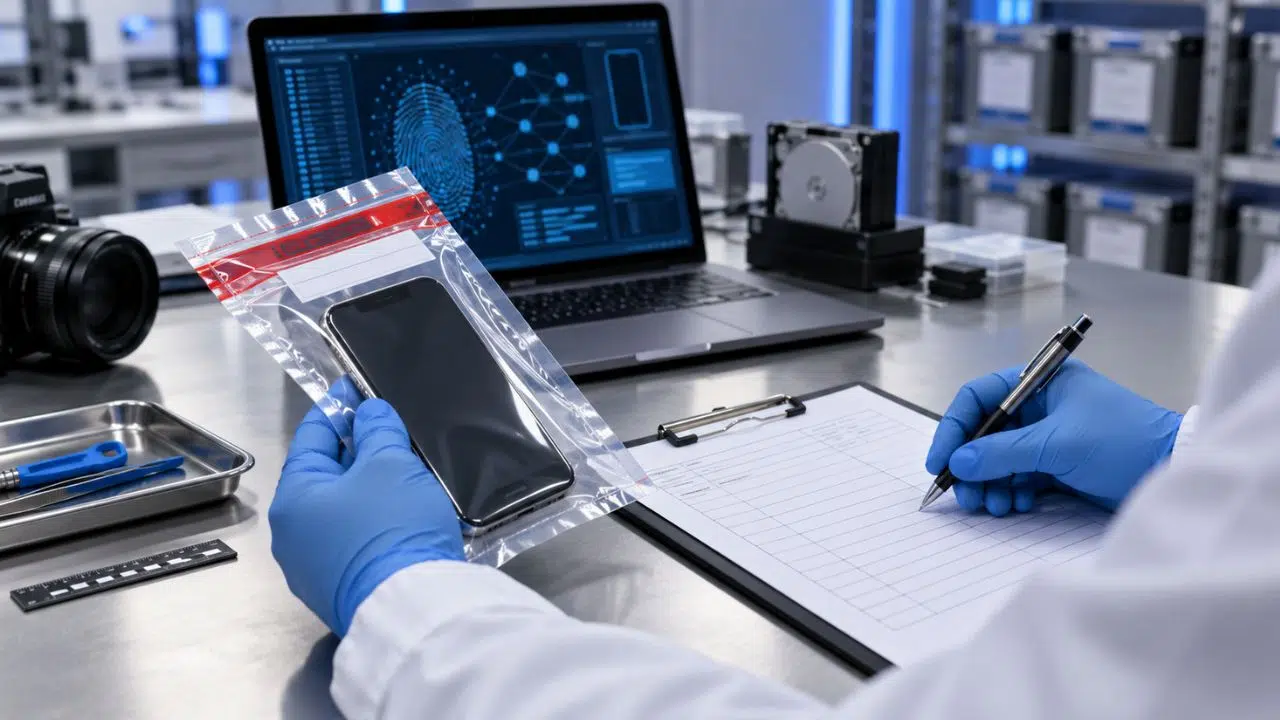
A phone or laptop may hold the message, file or record an investigation needs. The harder question often comes later: Can anyone show where that data came from, who handled it and whether it changed? A digital chain of custody records those steps so investigators and reviewers can assess how electronic evidence moved from collection to examination.
That record supports confidence in the handling process. It does not prove that the evidence is true, complete or relevant. Those questions require separate analysis, but without a clear record, even sound analysis can be harder to evaluate.
What a Digital Chain of Custody Records
A chain of custody should let a reviewer follow an item from discovery through examination. It is more than a form signed when someone receives a device.
Record the item’s description and unique identifier, its source, who collected or received it, and the date and time. Include the collection method, relevant tools and settings, storage location, access and examination history, and any integrity checks. For every transfer, note who released and received the item, when it happened and why.
The record should also disclose known problems: an interrupted acquisition, an unexpected device change or a late correction to a log. SWGDE guidance calls for contemporaneous documentation that identifies the evidence, records receipt details and reflects transfers. The exact form will vary by organization and evidence type.
Why Electronic Evidence Needs Careful Handling
Digital data can be copied, moved, edited or deleted without visible signs. Systems may also change data as part of ordinary operation: a computer can update logs, a phone can receive messages, and a cloud service can retain or remove information under its own policies.
Preservation decisions can affect the evidence, too. Turning on a device, connecting it to a network or opening a file may change its state. In some cases, responders need to capture volatile information that could disappear if the system is shut down. That decision depends on the circumstances, legal authority and available expertise; it is not a universal instruction to leave every device running.
ISO/IEC 27037 gives guidance on identifying, collecting, acquiring and preserving potential digital evidence. It provides a technical framework, not a guarantee of legal admissibility or a single procedure for every investigation.
How Hashes Support Evidence Integrity
A cryptographic hash is a value calculated from digital data. When the same algorithm is applied to unchanged data, it should produce the same value. Comparing hashes can therefore help detect whether two copies differ. NIST describes a hash as a way to identify a file and notes that a change to the file changes its hash.
That check has limits. A matching hash does not establish who created the file, whether it was accurate before collection or whether the acquisition captured everything relevant. It also does not record who handled the evidence.
For a useful comparison, document what was hashed, when, which algorithm was used and what tool or process produced the value. Be specific about scope: a hash for one exported file says nothing about the rest of a device. If values do not match, investigate and document the discrepancy rather than treating it as self-explanatory.
A Practical Evidence-Handling Workflow
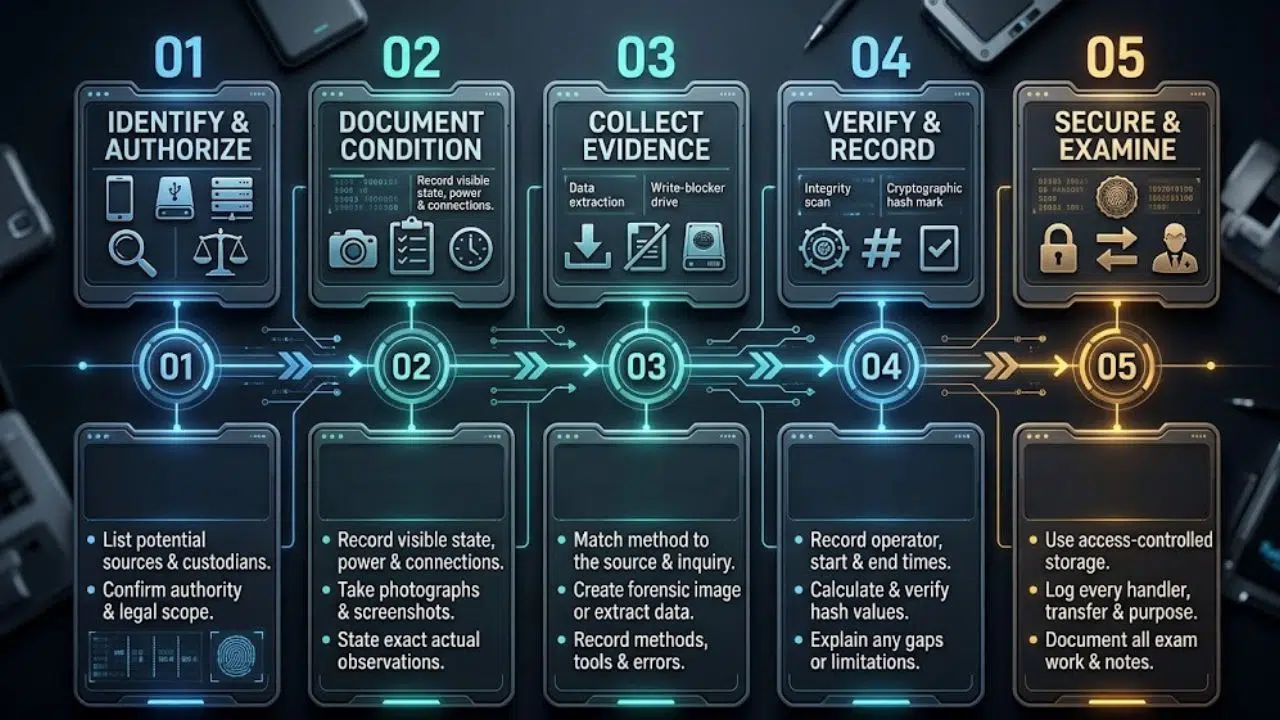
These stages are common, but they are not a universal procedure. Law, organizational policy, the type of source and the investigation’s needs shape the right approach.
List potential sources, such as a phone, removable drive, user account, server or other system. Record identifying details, location and known custodians. Before collecting or accessing data, confirm the authority and scope. Rules for searches, workplace investigations, privacy and cross-border data access differ by jurisdiction.
2. Document the initial condition
Record what was observed before collection: the device’s visible state, connections, power status, date and time, and other conditions that may affect the work. Photographs or screenshots may help document observations. For a cloud or network source, note the account or system, collection period, access method and known limitations.
State what was actually observed. If a device was already powered on, record that fact rather than implying it was found switched off.
3. Collect or acquire the evidence
The collection method should fit the source and the question being investigated. A qualified examiner might create a forensic image, collect selected files, export account data or capture volatile information from a running system. Record the method, operator, relevant tools and settings, and any errors or interruptions.
Where practical, investigators may preserve an original and examine a verified working copy. That approach does not suit every source: a cloud export or live response may not produce a traditional device image.
4. Verify and record the acquisition
Record when acquisition began and ended, who performed it, the method and tools used, and any issues encountered. Where appropriate, calculate hash values and state exactly what they cover.
If a complete acquisition was not possible, explain what was collected and why. A clear limitation gives later reviewers something to assess; an unexplained gap does not.
5. Secure, transfer and examine
Store evidence in an access-controlled location and log access under the applicable procedures. For every transfer, record who released and received the item, when, why and in what condition. During examination, document the work performed, relevant tools and procedures, and findings.
Keep notes and working copies with the case records so another qualified examiner can follow the work. If an error occurs, document it and explain its potential effect. The digital chain of custody should reflect events as they happened, including corrections or late entries, instead of reconstructing an ideal history afterward.
Chain of Custody and Legal Admissibility
A documented chain can help explain how evidence was collected and handled. It does not automatically make evidence admissible. Courts apply rules that vary by country and type of proceeding.
In the United States, Federal Rule of Evidence 901 addresses authentication: the proponent must provide evidence sufficient to support a finding that an item is what they claim it is. Rules 902(13) and 902(14) provide certification pathways for authenticating certain electronic evidence, including data copied from a device, storage medium or file. Authentication is a separate issue from relevance, hearsay and other legal questions.
These rules are U.S. examples, not global requirements. Following a technical standard may support a process, but it cannot guarantee admissibility or settle a dispute about what the data means. When evidence may be used in formal proceedings, involve qualified forensic and legal professionals.
Common Chain-of-Custody Mistakes
A record may look complete and still leave important questions open. Watch for:
- Vague descriptions: “Laptop” may not distinguish one device from another. Include available identifiers and distinguishing details.
- Incomplete transfer entries: A signature without a date, time, recipient or purpose can leave a gap.
- Unrecorded access: Account for people who handle, copy or examine evidence under the applicable procedure.
- Thin acquisition notes: Naming a tool without recording relevant settings, errors or steps may make the work difficult to review.
- Overstated hash results: Matching hashes support a comparison of data; they do not establish origin, completeness or truth.
- Confused copies: Label and track originals and working copies separately.
- Memory-based reconstruction: Make records as events happen. Identify and explain any later correction.
- Ignored privacy limits: Collecting or retaining data beyond authorized or necessary limits can create legal and operational problems.
Digital Evidence Beyond Physical Devices
Evidence may come from cloud platforms, messaging services, workplace systems or network logs, not just a device in an evidence bag. Record how the data was requested or accessed, the account or system involved, the collection period, the export format and any relevant provider-supplied metadata or limitations.
Time zones, retention settings, permissions and service changes can affect availability and interpretation. Preserve useful context alongside the files. An exported message, for example, may be difficult to interpret without its timestamps or account information. Distinguish data supplied by a provider from material investigators later converted, filtered or analyzed.
What a Strong Process Achieves
A strong digital chain of custody makes the evidence’s history understandable and reviewable. It helps investigators identify handling problems, supports integrity checks and gives legal teams a clearer basis for evaluating the material.
It cannot make unreliable data reliable, prove a collection was complete or resolve what evidence means. Those questions depend on the source, method, surrounding facts and applicable law.
Final Thoughts
A digital chain of custody is most useful when it is built during the work, not assembled from memory when a case is already under review. Identify items clearly, record transfers and significant actions, use integrity checks where appropriate, and disclose limitations or mistakes.
Before an item leaves a collection site or changes hands, check that its identifier, current condition, handler and next destination are documented. That simple discipline makes the evidence easier for an independent reviewer to follow.
Frequently Asked Questions (FAQs) About Digital Chain of Custody
Does a chain of custody prove digital evidence is authentic?
It documents handling and can support an authenticity assessment, but it does not by itself prove who created the data or whether it is accurate. Investigators must consider the source, collection method and other supporting evidence.
Can a hash replace a chain-of-custody record?
No. A hash can help detect whether compared data has changed. It does not show who handled the evidence, when it was transferred or what examination took place.
Is ISO/IEC 27037 a legal requirement everywhere?
No. It is an international standard that provides guidance on handling potential digital evidence. Whether it is required or relevant depends on the jurisdiction, organization and case.