

Google’s New AI Models are arriving in a confusing sequence of announcements, access expansions and product updates. Gemini 4 Argon, Carbon and Hydrogen raise a practical question: is Google repeatedly building a new intelligence from scratch, or delivering different versions of a shared foundation? The available evidence points to a mixture of foundational development, adaptation and staged deployment. Understanding that distinction is more useful than choosing a winner from a model name or a single impressive answer.
This analysis examines announcements and model documentation available on November 14, 2026. It also includes my firsthand same-prompt editorial test of Carbon, Argon and Hydrogen, with three original screenshots and a comparison of their visible responses. That qualitative experience is separate from the broader testing framework proposed below, which has not yet been carried out.
What Is Actually New in Google’s New AI Models?
The short answer is that “new” can describe several different changes. A new foundational model changes the underlying learned system. An adapted model builds on an existing foundation. A thinking setting changes how a supported model approaches a request. An application update may change access, tools or routing without introducing a newly trained foundation.
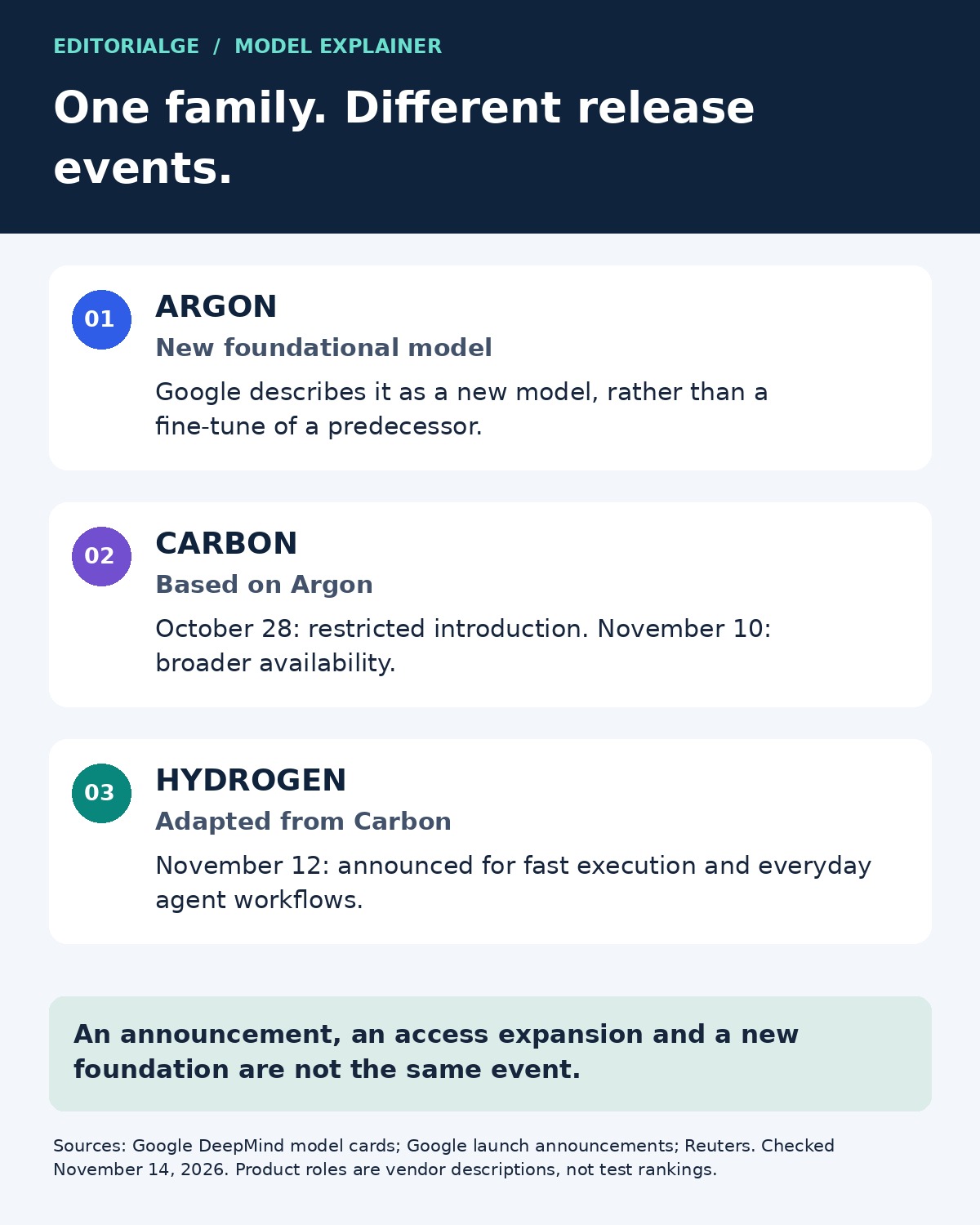
Google DeepMind’s model cards make an unusually helpful distinction: Argon is described as a new model rather than a fine-tune of a predecessor; Carbon is based on Argon; Hydrogen is adapted from Carbon. That documented relationship helps explain why closely spaced releases do not necessarily represent three independent training efforts completed in a few weeks.
| Model | Documented relationship | Google’s stated emphasis | Practical question to test |
|---|---|---|---|
| Gemini 4 Argon | New foundational model | Complex software and knowledge work | Does it handle the reasoning your workflow requires? |
| Gemini 4 Carbon | Based on Argon | Demanding, extended reasoning and verification | Does additional effort reduce important errors? |
| Gemini 4 Hydrogen | Adapted from Carbon | Fast execution and everyday agent tasks | Can it meet your quality threshold with less delay? |
These are product positions and documented dependencies, not Editorialge performance rankings. Public documentation does not disclose enough detail to reconstruct every training stage or infer a complete model’s behavior from its family tree.
Why the Release Calendar Looks So Busy
Carbon illustrates the difference between unveiling a model and widening access. Reuters reported its initial October 28 introduction and restricted cybersecurity-defender access. Google’s November 10 announcement then expanded availability. Hydrogen followed on November 12. Counting each announcement as an entirely separate foundational breakthrough would exaggerate the pace of underlying invention.
The Reuters report on Carbon’s initial release is particularly useful for understanding that staged rollout. It records an initial restricted release, rather than suggesting that every customer received the same access immediately.
| Date in 2026 | Development | How to interpret it |
|---|---|---|
| October 28 | Carbon unveiled with initial defender access | A restricted introduction |
| November 10 | Google announced broader Carbon availability | An access expansion for the same named model |
| November 12 | Hydrogen announced | A separate adapted model with a different operating emphasis |
There is also a business explanation, although it should be identified as analysis rather than a disclosed internal strategy. Customers have conflicting requirements. A researcher may tolerate a longer wait for a difficult answer; a support workflow processing many routine requests may place greater value on speed and predictable cost. Serving both with one default configuration creates compromises.
Our interpretation is that a family of models lets Google address different workloads while reusing technical progress. The public dependency descriptions support that interpretation. They do not reveal the company’s internal development timetable, staffing allocation or precise commercial motives.
Rapid announcements can consequently coexist with long research cycles. Work on training, evaluation, infrastructure and product integration can overlap. The date users see a launch is not a reliable measure of how long its development took.
How These AI Models Work Behind the Interface
1. Training creates the learned foundation
Google describes Argon as a multimodal transformer using a sparse mixture-of-experts architecture. Its documentation identifies broad pretraining data and subsequent instruction, preference and reinforcement-learning work. These stages have different purposes: building general capabilities and then shaping how the system responds to tasks.
In simplified terms, training changes numerical parameters using examples and learning objectives. Using a model is a different process: the trained system processes the context supplied to it and generates an output. A long conversation should not be confused with proof that the deployed model has permanently retrained itself.
2. Attention connects information within the input
The transformer architecture introduced in the 2017 paper Attention Is All You Need uses attention to relate different parts of a sequence. For a reader, the useful idea is that the model can weigh relevant context when producing an answer instead of treating every word as an isolated item.
Imagine asking a system to identify an exception in a contract. The relevant sentence may be far from the clause it modifies. Attention provides a mechanism for connecting information across the supplied material. That mechanism does not guarantee that the exception will be interpreted correctly. The output still needs checking against the document.
3. Mixture of experts is internal computation
In a sparse mixture-of-experts system, routing selects portions of the network for computation. “Experts” here are learned neural components. They are not a panel of human specialists or necessarily separate chatbots discussing your problem.
This distinction matters when reading AI marketing. Routing inside one model and coordinating several models are different mechanisms. An application can use both, but evidence that a model uses mixture-of-experts does not establish that every response came from a team of autonomous agents.
4. Thinking settings change the operating trade-off
Carbon’s model card describes configurable thinking levels and warns that higher effort can consume more tokens or increase delays. A setting labeled High therefore needs to be recorded during a comparison. It is not a universal measurement unit shared across all products.
For a difficult debugging task, extra checking may be worth the wait. For extracting an invoice date from a clear document, the same effort could add little value. The practical objective is adequate verified quality at an acceptable cost, rather than maximum effort on every request.
5. Tools turn a response into a workflow
A model’s text output and an agent’s completed task should be judged separately. A system may propose a search, read a result, edit a file and inspect a test outcome. The surrounding application must supply tools, permissions, state and execution feedback for those actions to happen.
Google describes its Antigravity Orchestrator as switching between models within a session. That is application-level coordination, distinct from internal expert routing. Google’s reported efficiency gains are benchmark-specific vendor claims, not a promise that every customer’s workflow will improve by the same amount.
Editorialge’s guide to AI task automation tools develops this operational distinction: useful automation needs verified actions and clear boundaries around what the software may change.
Does Google Use AI to Build Its Next AI?
There are several meanings behind that question. AI can assist a developer with code. Generated examples can enter a training process. A teacher model can help train a student. None of those activities, by itself, demonstrates a system independently designing, training and safely deploying its successor.
Knowledge distillation is an established research approach. The 2015 paper Distilling the Knowledge in a Neural Network explored transferring predictive behavior into a system that is easier to deploy. It helps explain how capability and efficiency can be pursued together. However, Hydrogen being “adapted from” Carbon does not, on its own, establish the exact distillation recipe used for that release.
Inference engineering is another route to speed. Google’s research on speculative decoding describes generating candidate tokens with a faster mechanism and checking them with a target model. That is a general explanation of an efficiency technique, not a claim that a particular Gemini release uses a specific undisclosed implementation.
The cautious conclusion is still meaningful: faster product iteration need not come only from larger training runs. Adaptation, better execution software and improved evaluation can also matter. Claims of autonomous recursive self-improvement require much stronger evidence than a busy announcement calendar.
My Same-Prompt Test of Google’s New AI Models: Carbon, Argon and Hydrogen
To bring this discussion closer to actual editorial work, I tested Carbon, Argon and Hydrogen with the same underlying editorial prompt and compared their responses. I am presenting them in the order Carbon, Argon, then Hydrogen—the capability hierarchy I had in mind when approaching the comparison. That order is my starting expectation, not an intelligence ranking established by these three screenshots.
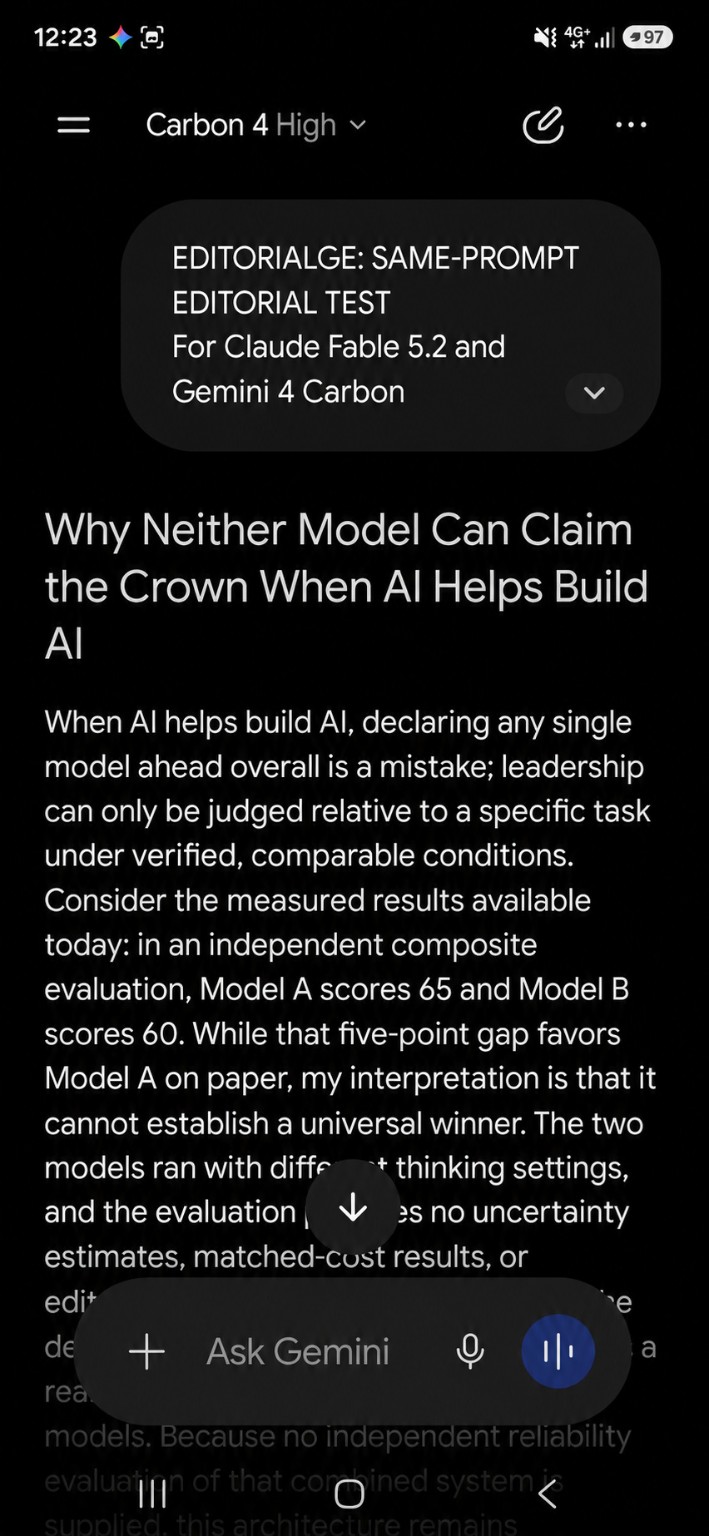
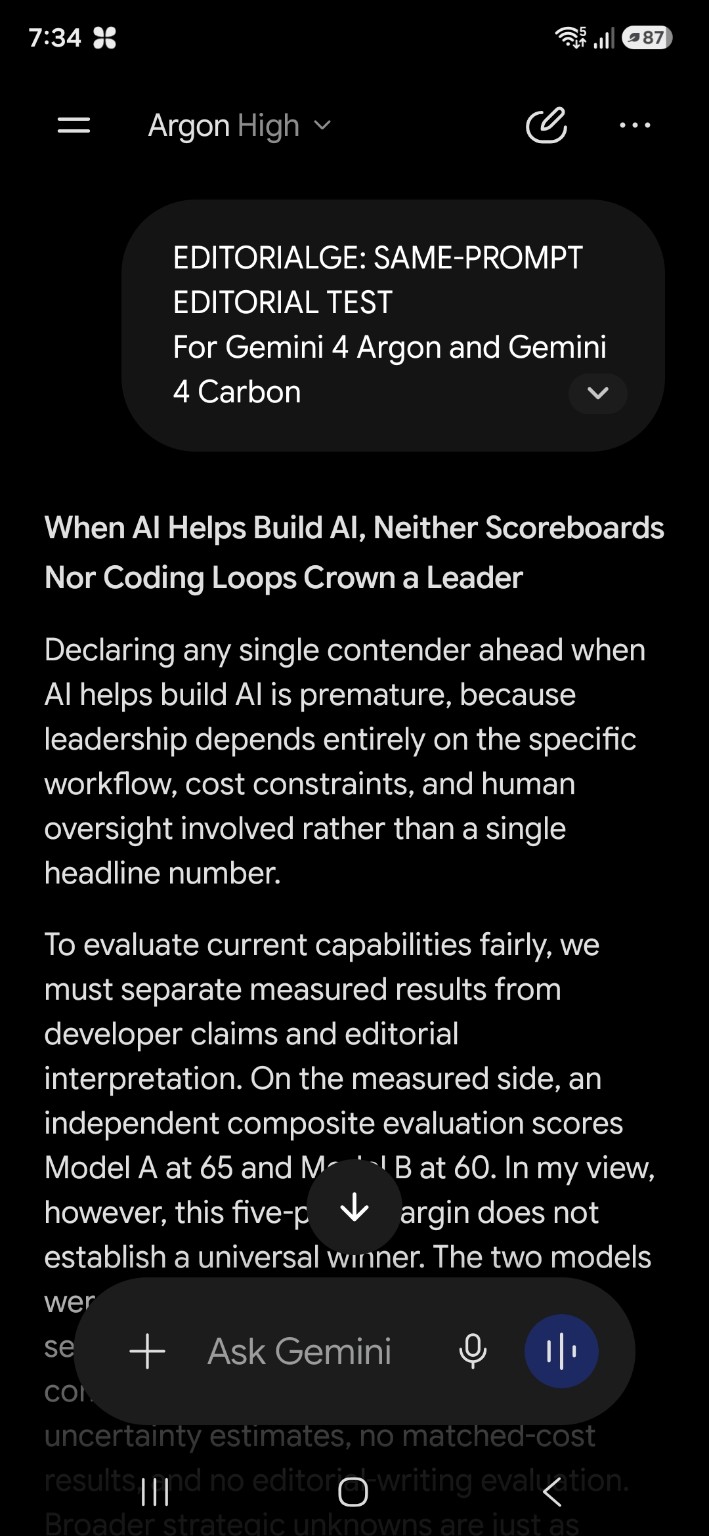
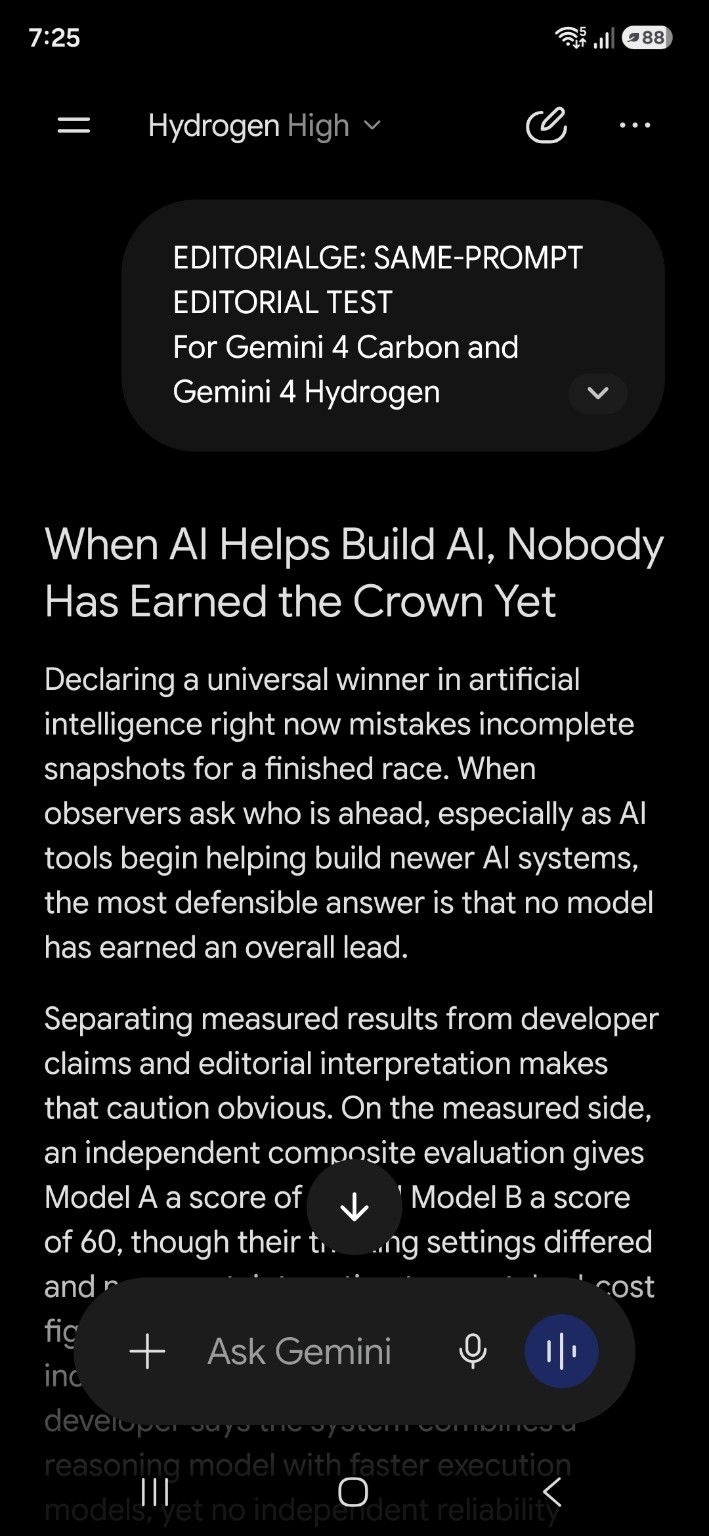
The screenshots below are my own usage record. They show the High session labels and the visible opening portions of the responses. The test concerned how to judge AI leadership when AI itself helps build AI: could the models distinguish evidence from claims and avoid declaring a winner without sufficient support? The account of conducting this test is mine, Sukanta Parthib; the comparisons below concern what readers can inspect in the supplied excerpts.
Method note: I confirm that the underlying editorial prompt was the same. The visible prompt headers name different model pairings, and the screenshots do not display the complete instructions or conversation histories. Those headers are preserved rather than edited to make the images appear identical. This is a qualitative firsthand comparison, not an independently reproduced, statistically controlled benchmark.
1. Carbon High: The Clearest Focus on Comparable Evidence
Carbon’s visible response moves quickly from rejecting an overall winner to explaining what would make a comparison defensible. It discusses task-specific judgment, different thinking settings, missing uncertainty estimates and the absence of matched-cost results. Its value in this excerpt is the connection between a numerical advantage and the reasons that advantage may not justify a broader conclusion.
For an editor, this is useful analytical structure: state the apparent result, examine the conditions behind it, then limit the conclusion. My reading is that Carbon provides a strong starting point for an evidence-focused analysis. That does not mean its embedded numbers are independently verified or that every later paragraph would pass a fact-check.
2. Argon High: The Most Explicit Operational Framing
Argon’s opening places workflow, cost constraints and human oversight at the center of the question. It then separates measured results, developer claims and editorial interpretation before discussing why a headline score is insufficient. Compared with Carbon’s immediate focus on comparability, Argon’s first paragraph gives a business reader a more explicit account of the conditions under which a model would be useful.
My interpretation is that this framing fits an article about adoption decisions: the relevant question becomes whether a model serves a particular process under real constraints. Carbon and Argon overlap substantially in their caution. The difference visible here is emphasis, not proof of a large capability gap.
3. Hydrogen High: An Accessible Explanation of the Same Caution
Hydrogen opens with a straightforward argument that incomplete snapshots cannot settle the wider competition. It then distinguishes measured evidence from developer claims and editorial interpretation. Of the three visible openings, this one uses an especially accessible narrative to introduce the uncertainty before moving into the evidence categories.
That makes it a useful candidate for explaining a complicated debate to a general audience. Its visible reasoning reaches a similarly cautious conclusion to the other two, despite its place in my starting hierarchy. This observation concerns the writing shown in the screenshot; it does not establish equal reasoning depth across harder tasks, lower cost or faster completion.
What Changed Across the Three Results?
| Criterion | Carbon High | Argon High | Hydrogen High |
|---|---|---|---|
| Opening emphasis | Comparable conditions and task-specific judgment | Workflow, cost and human oversight | Why incomplete evidence cannot settle the race |
| Visible analytical approach | Examines the limits of a numerical advantage | Connects evaluation limits to operating conditions | Organizes evidence, claims and interpretation for the reader |
| Potential editorial fit, based on this excerpt | Evidence-focused analysis | Business and workflow explanation | General-reader introduction |
| Common strength | Avoids a universal-winner conclusion | Avoids a universal-winner conclusion | Avoids a universal-winner conclusion |
| What this record cannot score | Full-answer accuracy, speed or cost | Full-answer accuracy, speed or cost | Full-answer accuracy, speed or cost |
My main takeaway is that the difference between these results lies more in how the argument is organized than in their visible final position on AI leadership. Carbon foregrounds comparison discipline; Argon makes operational constraints explicit; Hydrogen offers a readable route into the uncertainty. A useful editorial comparison should preserve those differences instead of assigning invented scores to them.
My Working Hypothesis After This Test
My hypothesis is that a shared, well-specified editorial task can produce similar high-level conclusions across models with different capability profiles, while differences emerge in framing, depth and the amount of editing required. The similar caution in these three excerpts is consistent with that hypothesis. It does not establish whether the convergence comes from the prompt, shared model-family characteristics or other factors.
To test it further, I would keep the same source packet and full prompt, introduce conflicting evidence, retain complete outputs and have the results reviewed without model labels. I would measure unsupported claims, missed contradictions and editing time. If the models diverged materially on those checks, similarity in the opening paragraphs would not establish equivalent usefulness.
There are also limits I cannot responsibly turn into findings. The generated answers mention scores of 65 and 60, but the screenshots do not establish the underlying benchmark or identify its models reliably enough for this article to adopt those numbers. Phone clocks do not measure response time. The lower portions are partly obscured by interface controls, and the complete answers are not shown. The screenshots are evidence of my experience and the displayed responses—not a substitute for verifying every factual claim they contain.
Three Hypotheses Worth Testing
The following are editorial hypotheses, not findings about these models. Each comes with a condition that could show it is wrong.
Hypothesis 1: Routine editorial work may not need the deepest model
A faster model may be sufficient for extracting dates, classifying supplied evidence or producing a structured outline. Test this with a fixed set of documents and an answer key. If it misses exceptions or invents supporting details more often than a deeper model, the proposed saving may disappear during review.
Hypothesis 2: More reasoning helps most when the evidence conflicts
A deeper model may justify its extra time when sources disagree, a calculation depends on hidden assumptions or a software bug crosses several files. Compare corrected outputs, not first impressions. If extra reasoning simply produces a longer explanation without reducing important errors, the hypothesis fails for that workflow.
Hypothesis 3: Model routing helps only if handoffs preserve context
A system that assigns hard judgments to one model and routine execution to another may improve overall efficiency. It may also lose instructions during handoffs or spread an early mistake across several workers. Compare the complete routed workflow with a single-model baseline using the same tasks and approval rules. Count rework and coordination overhead.
This is why broader competition, discussed in Editorialge’s analysis of Chinese and American AI, should not be reduced to one score. A benchmark can inform a decision without answering every operational question.
How to Evaluate Google’s New AI Models for Your Work
Step 1: Choose a small, representative task set
Start with work you actually repeat. For an editorial team, that might include summarizing a source packet, detecting unsupported claims, calculating a percentage change, comparing two policy documents and drafting an explanation from verified notes. Include difficult cases, not just prompts likely to produce attractive prose.
Prepare the expected facts before testing. If the answer cannot be fully predetermined, define the review criteria: faithful attribution, no invented quotations, accurate calculations, clear uncertainty and adherence to the brief.
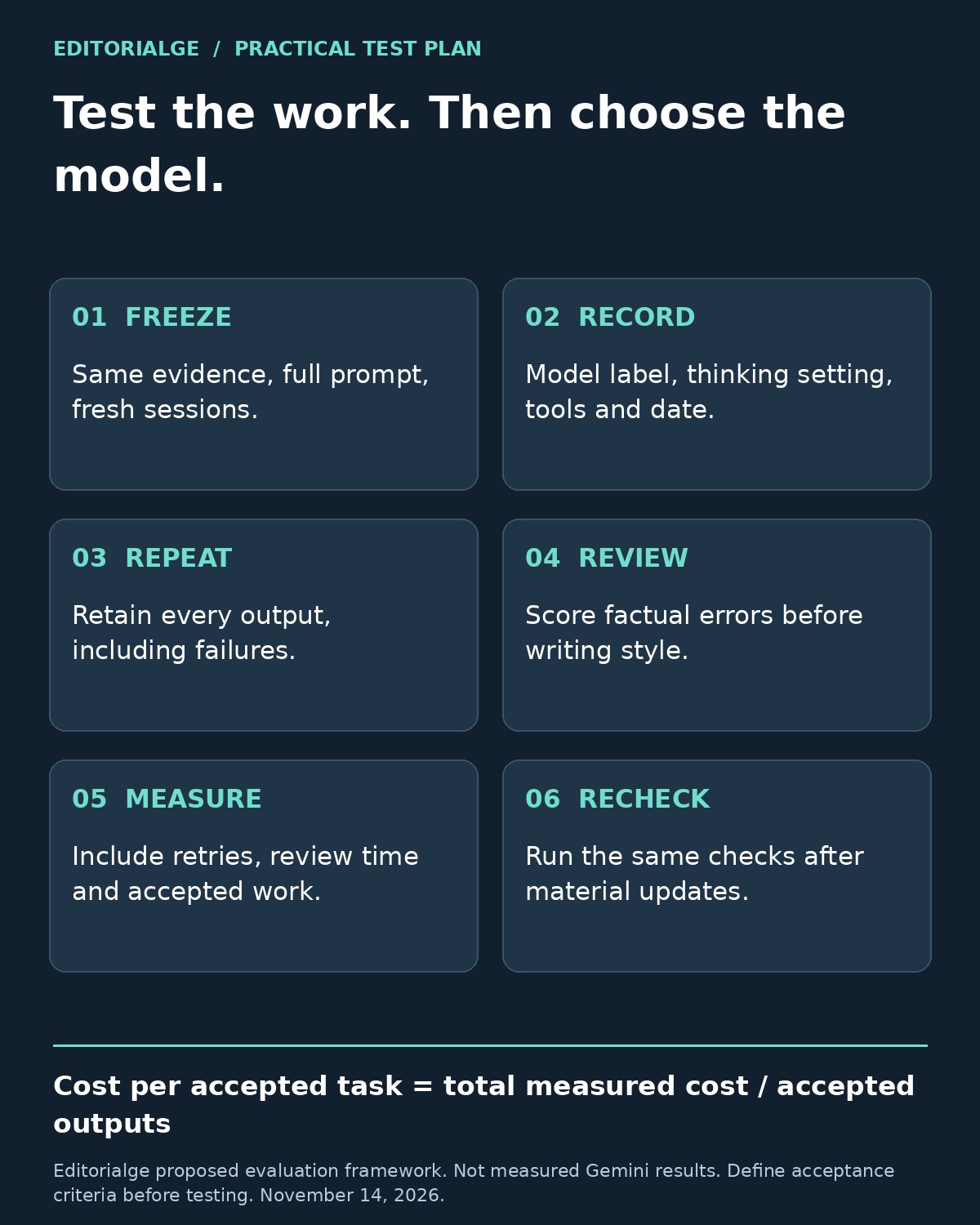
Step 2: Freeze the inputs and record the environment
Use fresh sessions with the same source material and complete prompt. Record the date, visible model label, thinking setting, product surface and enabled tools. If you use an API, retain the returned model identifier and usage data where available. If a consumer interface does not expose a setting, record it as unknown.
Do not mix an answer produced with web access and one produced without it, then attribute every difference to the underlying model. Likewise, a paid application’s quota is not interchangeable with an API token allowance.
Step 3: Use a prompt that exposes uncertainty
Using only the supplied evidence packet, explain the development for a business reader. Separate established facts, attributed claims and analysis. For each factual claim, identify the supporting document and passage. Flag contradictions and missing information. Do not invent figures, quotations or firsthand experience. End with the checks an editor should complete before publication.
This sample is a proposed evaluation prompt, not the full prompt from the supplied screenshots. It makes factual discipline observable. A beautifully written answer that fails to identify a contradiction should not receive a passing factual score.
Step 4: Repeat, then review without model labels
Run each task more than once if your budget permits. Keep the outputs, including failures. Ask a reviewer to assess anonymized answers against the same criteria before revealing model names. Repetition can expose instability; blind review can reduce brand expectations. Neither turns a small internal test into a universal benchmark.
Separate critical errors from stylistic preferences. A fabricated source and an awkward sentence should not carry the same penalty. For publishing work, one unsupported allegation can matter more than several polished paragraphs.
Step 5: Measure the cost of an accepted result
Track waiting time, retries, reviewer time and usable completions. For API work, include billed model usage and any separately charged tools. For subscriptions, report quota consumption and time rather than inventing a per-request token bill.
A useful internal calculation is: cost per accepted task equals total measured testing cost divided by the number of outputs that meet the acceptance standard. Define what counts as accepted in advance. If none pass, report zero accepted outputs rather than calculating a misleading average.
Consider a hypothetical editor who saves a minute on generation but spends several extra minutes correcting sources. That workflow has not become faster overall. This is an illustration of what to measure, not a measured Gemini result.
Step 6: Introduce changes gradually
Try the selected configuration on low-risk drafts first. Keep the earlier workflow available. Recheck a compact set of representative tasks after a model or application update, and investigate material changes in error rate, delay or cost before expanding use.
For agent workflows, verify the completed artifact or system state. A response saying that a file was saved, a test passed or a draft was created is not sufficient evidence that the action succeeded.
What Readers Should Watch Beyond the Launch Claims
The Times of India’s Hydrogen launch coverage describes its rollout across Google’s products. That reporting provides context about distribution; it is not an independent validation of every claimed improvement. Availability can also differ by account, product and rollout stage.
A large context window is useful only if the system retrieves and interprets the relevant material accurately. Similarly, a model that accepts images can still misread a screenshot. Model cards are valuable partly because they identify limitations that a promotional demonstration may not emphasize.
For business adoption, ask whether the workflow is auditable. Can a reviewer trace a statement to evidence? Can a failed action be detected? Can the system stop before making a consequential change? Those questions remain relevant even when a model improves on a benchmark.
Frequently Asked Questions
Is every new Gemini release trained from scratch?
No. Google’s documentation distinguishes Argon’s foundational development from Carbon’s dependency on Argon and Hydrogen’s adaptation from Carbon. An expanded rollout is also different from a newly trained model.
Does High mean the same thing on Carbon, Hydrogen and Argon?
Do not assume that it does. Record the label, but compare observed output quality and resource use. Identical-looking settings are not proof of identical computation or evaluation conditions.
Can the supplied screenshots identify the best model?
They support a qualitative comparison of the visible responses from my confirmed same-prompt test, but not an overall intelligence ranking. The complete outputs, repeat runs, timing and cost records would be needed for a stronger performance comparison.
Should a business switch whenever Google launches a model?
Use a release as a reason to evaluate, not an automatic reason to migrate. Switch when your own acceptance checks show a useful improvement and the surrounding workflow remains reliable.
The Practical Verdict on Google’s New AI Models
Google’s New AI Models make more sense as a developing family of capabilities and deployment choices than as a succession of identical replacements. The documented model relationships explain part of the rapid cadence; staged access explains another part. Neither establishes that every new release is better for every task.
The supplied firsthand record adds a useful editorial lesson: sophisticated answers can sound similarly careful while leaving crucial evidence unverified. Keep that distinction visible. Choose a model with a repeatable test, measure the work required to accept its output, and retain human responsibility for what ultimately reaches readers.