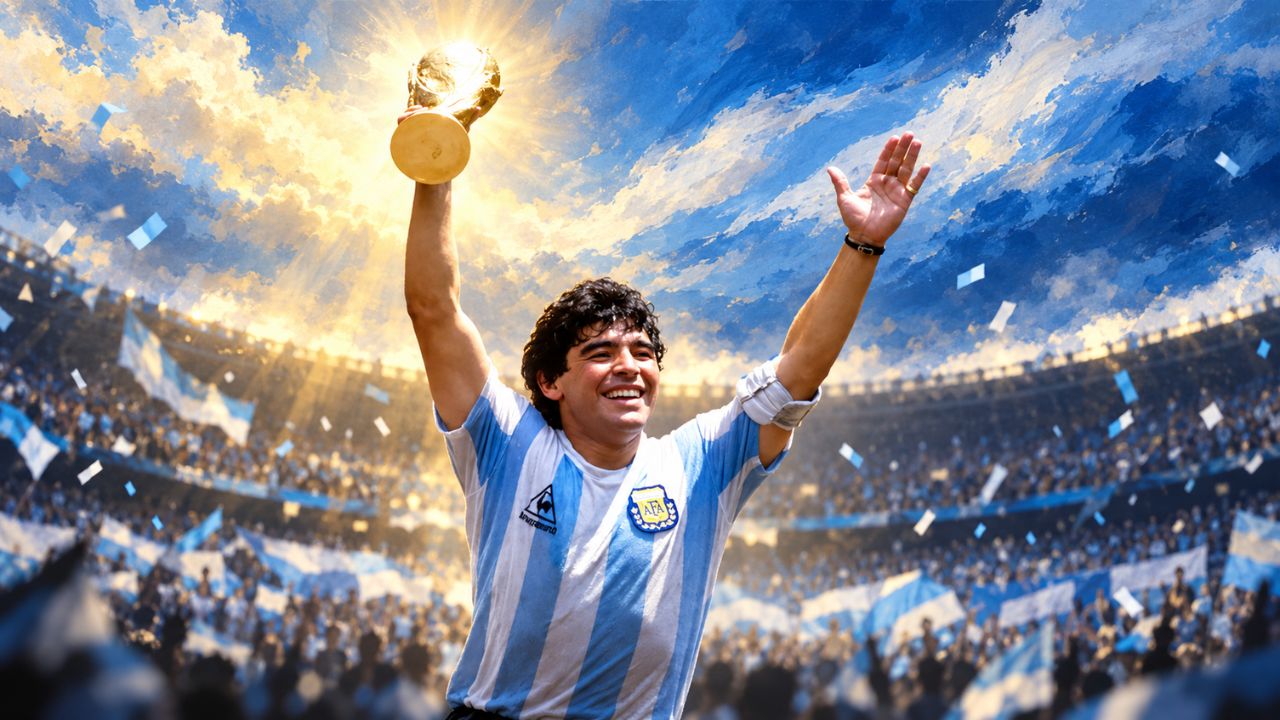
On October 30, 2026, Diego Maradona would have turned 66. Diego Maradona’s 66th birth anniversary gives me a reason to honor a footballer I never watched live, but whose presence has followed me throughout my life as an Argentina supporter.
His final appearance for Argentina came at the 1994 World Cup. He played his last official club match for Boca Juniors on October 25, 1997, before I was even born. My memories of Maradona, then, are not really memories. They are stories I inherited.
My Argentina story began with Lionel Messi. Maradona reached me through my father and uncles, who remembered his dribbling, passing, ball control, and especially his free kicks. They spoke about him with an excitement that made matches from decades ago sound as if they had ended only yesterday.
Their stories made me curious. I began watching old clips and match footage, looking beyond the famous goals to understand how he moved, created space, and controlled games. That was when I understood why people still love Maradona.
My Argentina Story Began With Lionel Messi
Messi was the player I could watch while his story was still unfolding. I grew up seeing him carry the expectations of Argentina. Every major tournament brought new pressure. Every defeat reopened questions about whether he could achieve what Maradona had achieved. Every great performance invited another comparison between the two number 10s.
I admired Messi for his close control, passing, finishing, and ability to change a match in seconds. Following him made Argentina feel like my team, even though it was thousands of miles away.
Maradona initially existed on the other side of those comparisons. He was the historical standard people used to judge Messi.
For a while, that was almost all he was to me. But older supporters did not talk about Maradona as a collection of records that Messi needed to surpass. They talked about what it felt like to watch him. Eventually, I wanted to understand that feeling for myself.
The Maradona My Family Passed Down
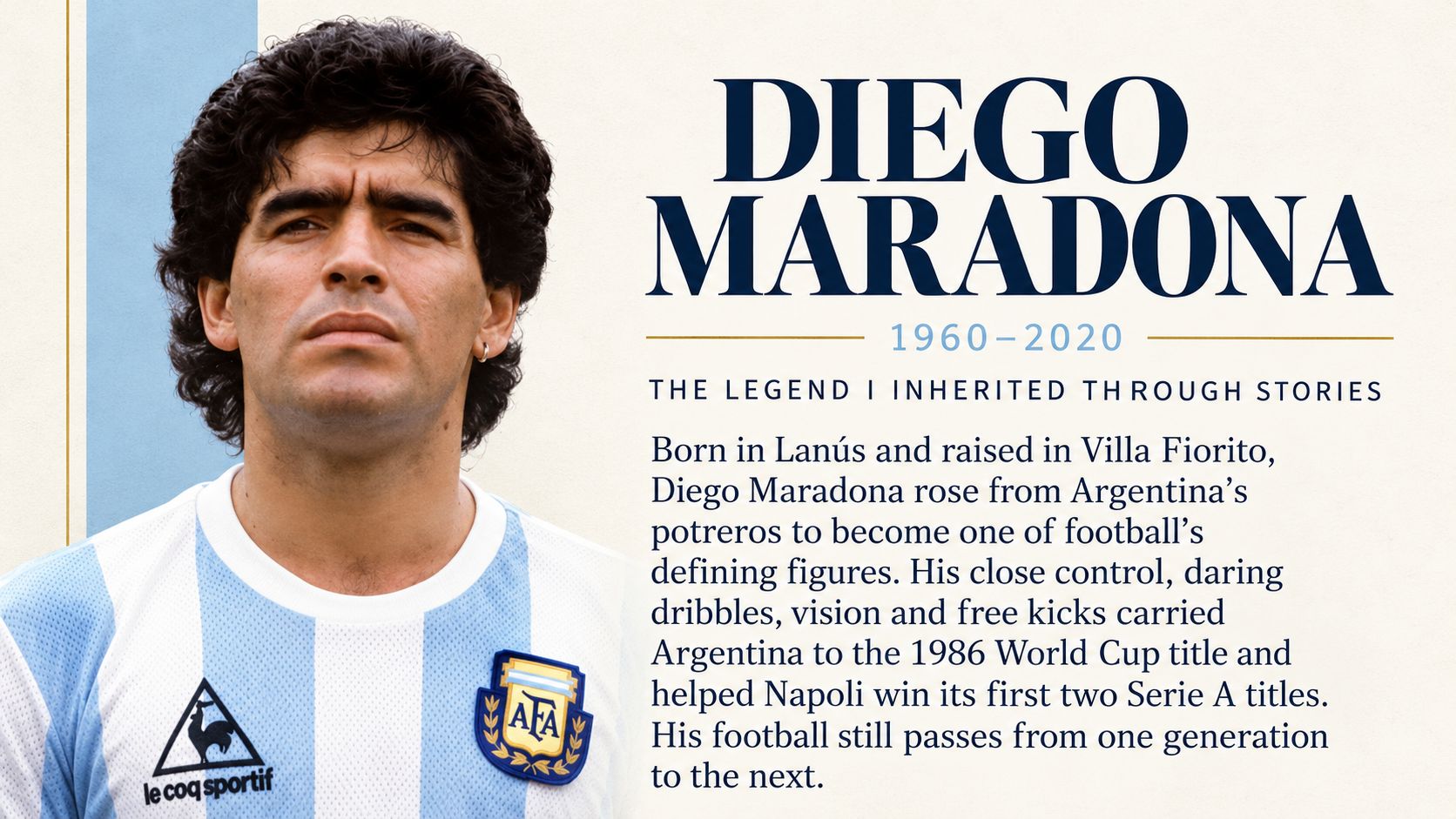
My father and uncles never began with Maradona’s trophy count. They began with movement.
They remembered how he could receive the ball with defenders surrounding him and still find a way out. They talked about his sudden turns, the strength with which he protected possession, and the passes that opened spaces nobody else appeared to see.
His free kicks received special attention. Whenever the ball was placed within shooting distance, they believed he could score. The expectation began before he even took his first step toward the ball.
Their descriptions taught me something about how football survived before every match, touch and goal became instantly available online.
My generation can find almost any Messi moment within seconds. We can replay it from several angles, slow it down and share it with thousands of people. Older supporters often carried Maradona through memory, conversation and occasional television replays.
They did not simply remember what he did. They preserved how it felt. When I finally watched him for myself, I was not searching for borrowed nostalgia. I wanted to know whether the stories survived the evidence.
They did. The first thing I noticed was his balance. Defenders could kick him, pull him, or lean into him, yet he often remained upright and kept the ball. He seemed to expect contact and adjust his body before it arrived.
His control was just as remarkable. The ball did not appear separate from his movement. He could slow down, accelerate or change direction without losing command of it.
Then there was his passing. The goals dominate most highlight collections, but his passing showed the completeness of his game. He could carry the ball through midfield, attract several defenders and release it at precisely the right moment.
He did not wait for the match to come to him. He went looking for the ball and accepted the responsibility that came with it.
The footage did not make me nostalgic for something I had experienced. It made me understand the nostalgia of those who had.
Four Minutes That Explain the Maradona Legend
No match captures Maradona’s brilliance and contradictions better than Argentina’s 1986 World Cup quarterfinal against England.
His first goal was an intentional handball. It was illegal, regardless of how often it has been celebrated or transformed into folklore. Maradona later described it as partly his head and partly the “hand of God.” Less than five minutes later, he scored a goal that required no trickery or explanation.
Maradona collected the ball inside his own half, turned away from pressure and accelerated toward England’s goal. In approximately 11 seconds, he carried the ball about 68 meters, escaped a succession of challenges, rounded goalkeeper Peter Shilton and scored.
One goal showed his willingness to break the rules. The other displayed balance, speed, courage, control and imagination at their highest level.
The recent history between Argentina and the United Kingdom added more emotion to the occasion. The match took place four years after the Falklands/Malvinas War. Football could not resolve that conflict, but the political background shaped what the victory meant to many Argentines.
The England match was only one part of Maradona’s extraordinary tournament. FIFA credits him with five goals and five assists at the 1986 World Cup. He scored both goals against Belgium in the semifinal and created Jorge Burruchaga’s winner against West Germany in the final.
Argentina did not win with one player. Carlos Bilardo organized the team, and Maradona’s teammates made decisive contributions throughout the competition.
Still, no individual shaped the identity of that World Cup more completely. Forty years later, Mexico 1986 remains the tournament most closely associated with a single player.
From Villa Fiorito to Naples
Maradona’s appeal cannot be separated from where he came from. He was born at Hospital Evita in Lanús and raised in Villa Fiorito, a poor neighborhood outside Buenos Aires. He grew up as the fifth of eight children in a small family home with a dirt courtyard.
The nearby potreros, or informal football pitches, became his first football school. He developed in spaces where creativity mattered more than perfect surfaces and where protecting the ball was a practical necessity.
In 2026, volunteers began using the courtyard of his former family home as a community soup kitchen. People now collect meals from the same modest property associated with the beginning of his story. It is difficult to imagine a more fitting reminder of his origins. Maradona carried that identity to Napoli in 1984.
The club had never won Serie A and competed in a football culture dominated by wealthier northern institutions. With Maradona, Napoli won its first league championship in 1986–87. The club added the Coppa Italia that season, lifted the UEFA Cup in 1989 and won Serie A again in 1989–90.
For Naples, these were more than football victories. Maradona helped a southern city defeat teams representing Italy’s established centers of wealth and power. Neapolitans recognized something familiar in him: exceptional talent from the margins refusing to accept an assigned place below the powerful.
He gave the city trophies, but he also gave it a language for pride.
Why Bangladesh Made Maradona Its Own
My family’s connection to Maradona is part of a much larger Bangladeshi football story. For many Bangladeshis, the 1986 World Cup was the first tournament they experienced live on television. Maradona’s performances helped transform Argentina from a distant national team into an emotional attachment.
The victory over England carried an additional meaning for some viewers. Britain’s colonial rule over the Indian subcontinent remained part of Bangladesh’s historical memory. Watching an Argentine star defeat England therefore resonated beyond the football field.
That was not the only reason Bangladeshis embraced Argentina. The excitement of Maradona’s football, the expansion of television, communal match viewing and the appeal of an underdog all contributed.
People watched together in homes, neighborhoods and public spaces. They argued, celebrated, and carried those stories forward. Argentina gradually became something families passed from one generation to another.
My father and uncles belonged to the generation that watched Maradona bring Argentina closer to Bangladesh. My generation received that attachment and carried it into the Messi era.
By the time we began watching Messi, much of the emotional foundation was already there.
Maradona and Messi Do Not Need to Compete
I am a Messi fan. That does not prevent me from appreciating Maradona. Messi belongs to my lived experience of football. Maradona belongs to a history I inherited and later explored. One gave my generation its own memories. The other helped create the emotional connection that made those memories matter.
There are understandable reasons to compare them. Both were left-footed Argentine number 10s with extraordinary close control, vision, and passing ability. Both carried expectations that would have overwhelmed most players.
But they performed in different eras, under different tactical conditions and within entirely different media environments. Reducing them to a permanent competition tells us less about both.
I do not need to diminish Maradona to explain what Messi means to me. Nor do I need to exaggerate Maradona’s achievements to understand why my father’s generation remembers him differently.
Messi gave my generation its World Cup moment in 2022. Maradona gave an earlier generation theirs in 1986. One memory does not erase the other.
Remembering the Genius Without Inventing a Saint
Maradona’s life was not a simple heroic story. He struggled with cocaine dependence, alcohol, and serious health problems. A positive cocaine test led to a 15-month suspension in 1991. At the 1994 World Cup, another failed drug test brought his international career to a painful end.
His conduct away from football was frequently controversial. The handball against England was unfair, even if it became part of football folklore. His sporting greatness cannot turn every decision he made into something worthy of defense.
But reducing his entire life to addiction and controversy would be another kind of dishonesty. Honoring Maradona does not require pretending that he was flawless. It requires recognizing that human beings can create beauty while carrying weaknesses, causing disappointment and making serious mistakes.
He died on November 25, 2020, at only 60. Argentina declared three days of national mourning, while supporters gathered in Buenos Aires, Naples, and cities around the world. Their grief did not make him a saint. It showed how deeply his football had entered their lives.
Read Diego Maradona’s Death Anniversary Tribute here.
Diego Maradona’s 66th Birth Anniversary: The Legend I Inherited
I cannot remember where I was when Maradona scored against England. I did not watch him lift the World Cup in Mexico or lead Napoli to the Italian championship.
Those memories belong to my father, my uncles, and millions of people from their generation. What I inherited was the way they spoke about him.
Their stories made me curious enough to search for the matches. The footage then gave those stories a shape. I saw the balance, the passing, the close control, the free kicks, and the refusal to hide from physical challenges.
On this, Diego Maradona’s 66th birth anniversary, I do not need to pretend that I watched him live. I do not need to place him above Messi or defend everything he did. I only need to acknowledge what the footage eventually confirmed: the stories were not exaggerations.
I never saw Diego Maradona play in real time, but I now understand why those who did still speak about him as if the match never ended.