

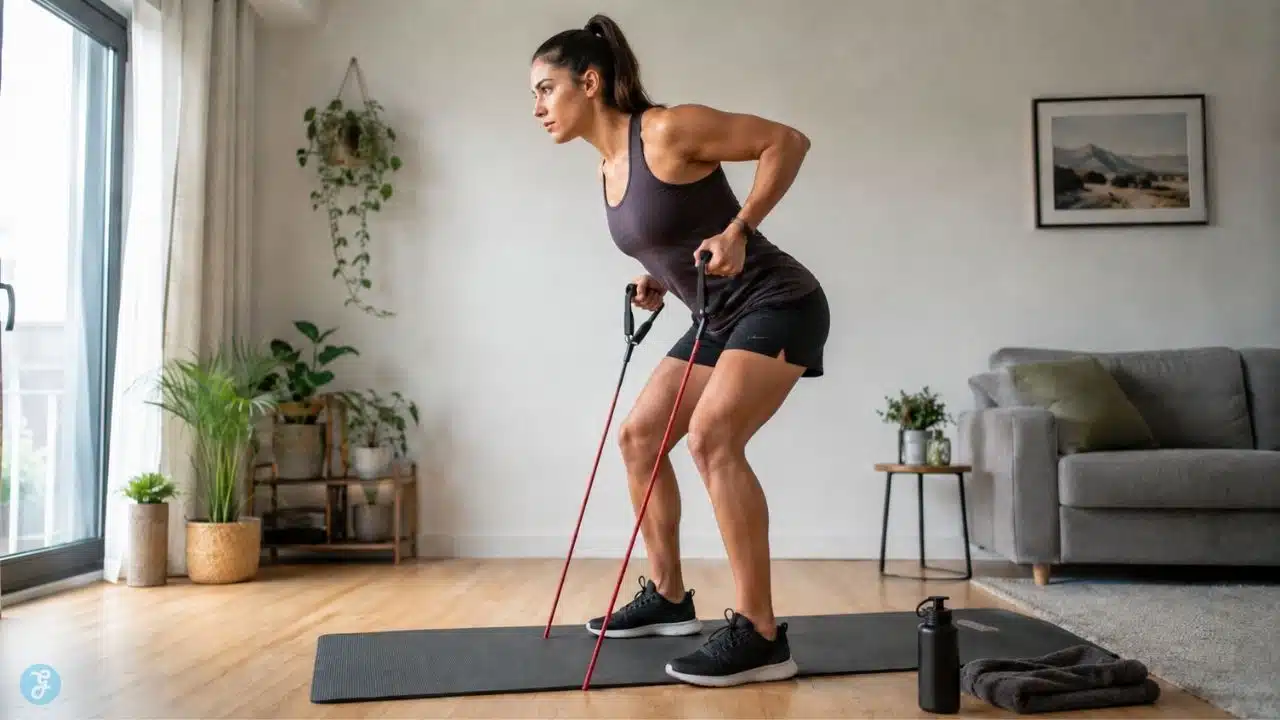
Resistance bands look simple until you use them properly. Then you realize they are not just “light workout tools” for beginners. A good band can train your back, shoulders, chest, legs, glutes, arms, and core with more control than many people expect. That is why I like following resistance band routines for home workouts.
They do not need much space, they are easy to store, and they make strength training possible even when you do not have dumbbells or gym machines. I have also found them useful on days when I want a proper session but do not want to set up too much equipment.
But random band exercises are not enough. If you only do a few pull-aparts and curls whenever you remember, you will not get much from them. Good resistance band routines need structure. They should include pushing, pulling, squatting, hinging, bracing, and controlled movement.
In this guide, I organized 13 practical band workouts for different goals: full-body strength, upper body, lower body, glutes, core, mobility, posture, travel, and quick training days. The routines are simple enough for home use but structured enough to help you progress.
Why Resistance Bands Are Worth Using
Resistance bands are useful because they create tension through the movement. Unlike dumbbells, which mostly depend on gravity, bands can challenge you from different angles. That makes them especially helpful for rows, pull-aparts, glute activation, shoulder work, and anti-rotation core exercises.
Research also supports resistance bands as a real training tool. The 2026 American College of Sports Medicine position stand notes that strength can be improved through resistance training methods, including elastic band training and home-based resistance training. ACSM also emphasizes that moving from no resistance training to any resistance training can create meaningful benefits.
For general health, adults are also advised to include muscle-strengthening activities at least 2 days per week. The CDC recommends strengthening all major muscle groups, including the legs, hips, back, abdomen, chest, shoulders, and arms. The American Heart Association gives similar advice, recommending muscle-strengthening activity, such as resistance or weights, on at least 2 days per week.
So, resistance bands are not a gimmick. They are useful when you train with good form, enough tension, and steady progression.
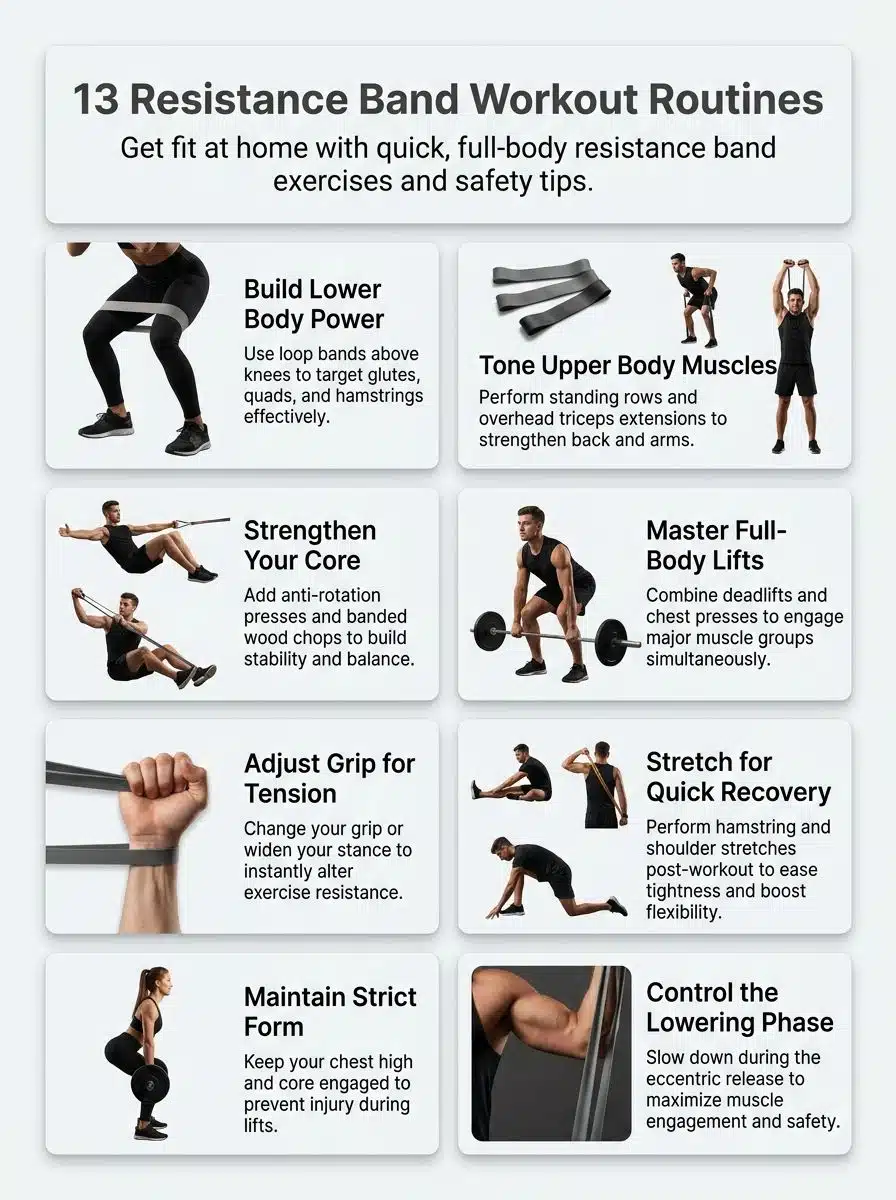
Who These Resistance Band Routines Are For
These routines are useful for beginners, home exercisers, desk workers, travelers, and anyone who wants low-equipment strength training.
They are especially helpful if you want:
- Strength training without dumbbells
- Better upper-back and posture work
- Glute and hip activation
- Portable workouts for travel
- Low-impact home training
- A simple way to add resistance to bodyweight workouts
They may not be enough if your main goal is maximum strength or advanced bodybuilding. Bands can be challenging, but heavy weights are easier to load precisely for serious strength goals.
What Type of Resistance Band Should You Use?
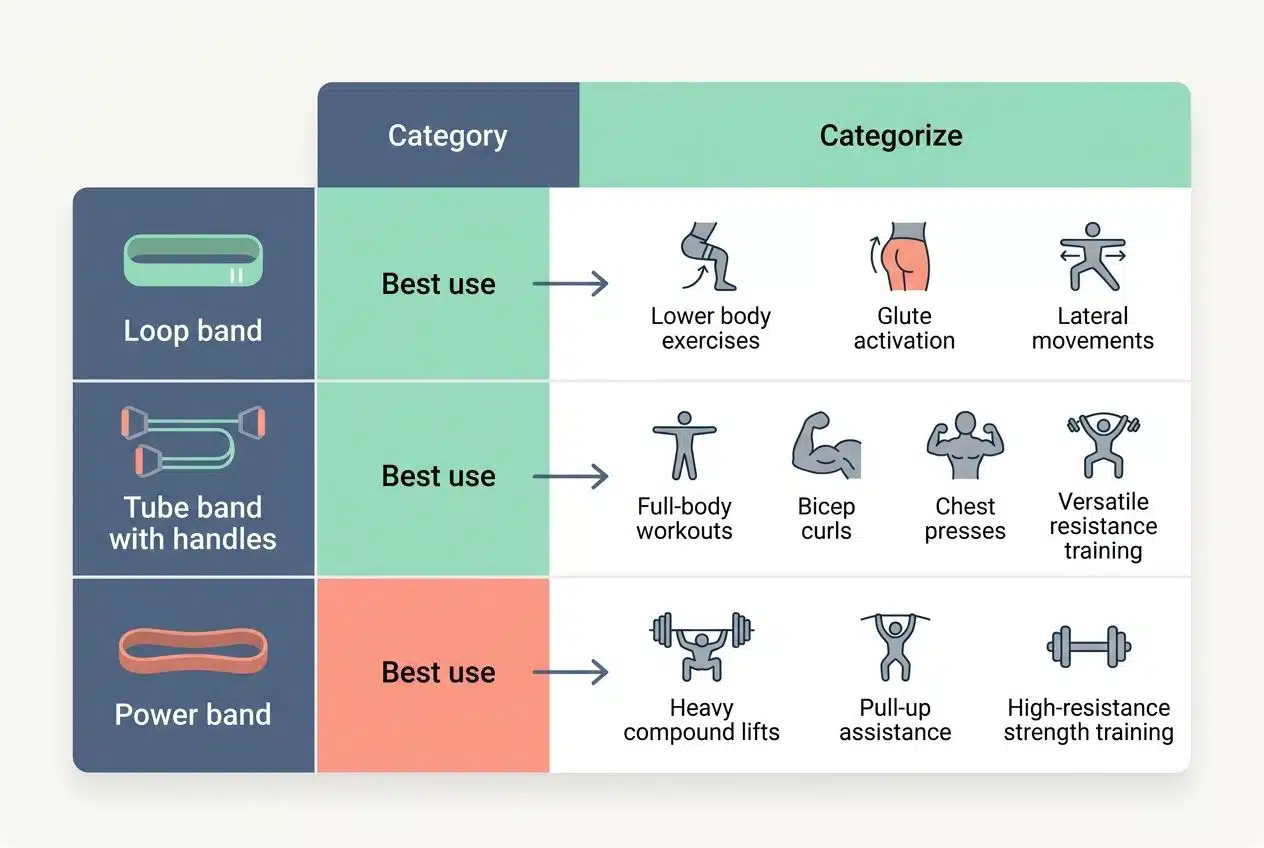
You do not need every type of band. Start simple.
| Band Type | Best Use |
| Loop bands | Glutes, hips, lateral walks, squat activation |
| Tube bands with handles | Rows, presses, curls, upper-body work |
| Long flat bands | Mobility, stretching, warm-ups |
| Heavy loop bands | Stronger pulling and lower-body exercises |
For most people, a light-to-medium tube band and a small loop band are enough to start. If you train regularly, keep a light, medium, and heavy option so you can progress.
Before every workout, check the band for cracks, thinning, or small tears. A damaged band can snap, especially during rows, presses, or anchored exercises.
How to Use These Band Training Plans
You do not need to do all 13 routines. Pick based on your goal. If you are new, start with the beginner full-body routine. If you sit all day, use the posture routine. If you want stronger legs and glutes, choose the lower-body or glute routine. If you only have 15 minutes, use the quick full-body option.
A simple weekly setup could look like this:
| Day | Workout |
| Monday | Full-body band routine |
| Wednesday | Upper-body band routine |
| Friday | Lower-body or glute band routine |
| Weekend | Core or mobility band routine |
This gives you 3–4 sessions per week without making the plan too complicated.
13 Resistance Band Routines to Try at Home
In my opinion, start each workout with 3–5 minutes of easy movement. March in place, do shoulder rolls, hip circles, bodyweight squats, and a few light band pull-aparts. The first round should feel controlled. If the band pulls you out of position, use a lighter band.
1. Beginner Full-Body Resistance Band Routine
This is the best starting point if you are new to resistance band exercises. It covers the whole body without a complicated setup.
Time: 20 minutes
Equipment: Light or medium tube band
Rounds: 2–3
Routine:
- Band squats — 10 reps
- Band rows — 10–12 reps
- Band chest press — 10 reps
- Band good mornings — 10 reps
- Band pull-aparts — 12 reps
- Rest — 60 seconds
This routine teaches the foundation: squat, pull, push, hinge, and upper-back control. Move slowly and control the band as it returns. If this feels too easy, add one more round before moving to a heavier band.
2. Full-Body Strength Band Workout
This routine is for people who already understand basic band movement and want a stronger session.
Time: 25–30 minutes
Equipment: Medium band
Rounds: 3–4
Routine:
- Band front squats — 12 reps
- Standing band rows — 12 reps
- Band overhead press — 10 reps
- Band Romanian deadlifts — 12 reps
- Band chest press — 10 reps
- Pallof press — 8 reps per side
This is one of the most balanced resistance band routines because it trains legs, back, shoulders, chest, hips, and core. If the band feels loose through the full movement, step farther away from the anchor or shorten your grip.
3. Upper-Body Push Band Routine
This routine focuses on the chest, shoulders, and triceps. It works well if you want upper-body training without floor push-ups or dumbbells.
Time: 18–22 minutes
Equipment: Tube band with handles or long band
Rounds: 3
Routine:
- Band chest press — 10–12 reps
- Band overhead press — 8–10 reps
- Band front raise — 10 reps
- Band triceps pressdown — 12 reps
- Incline wall push-up — 8–10 reps
Move slowly during the press exercises. If your lower back arches during the overhead press, reduce the band tension or switch to a lighter band. This workout pairs well with an upper-body pull routine on another day.
4. Upper-Body Pull and Posture Routine
This is one of the most useful band workouts for desk workers. It trains the upper back, rear shoulders, and posture muscles that often get ignored.
Time: 15–20 minutes
Equipment: Light or medium band
Rounds: 3
Routine:
- Band rows — 12 reps
- Band pull-aparts — 12–15 reps
- Band face pulls — 12 reps
- Band external rotations — 10 reps per side
- Seated band row — 12 reps
Do not use a heavy band for this. Posture work is better with control than force. Pause for one second when your shoulder blades squeeze together. If you work long hours at a desk, this is a routine worth repeating 2–3 times per week.
5. Lower-Body Band Strength Routine
This routine targets your legs, hips, glutes, and hamstrings. It is a good next step when bodyweight squats start feeling too easy.
Time: 25 minutes
Equipment: Loop band or long band
Rounds: 3
Routine:
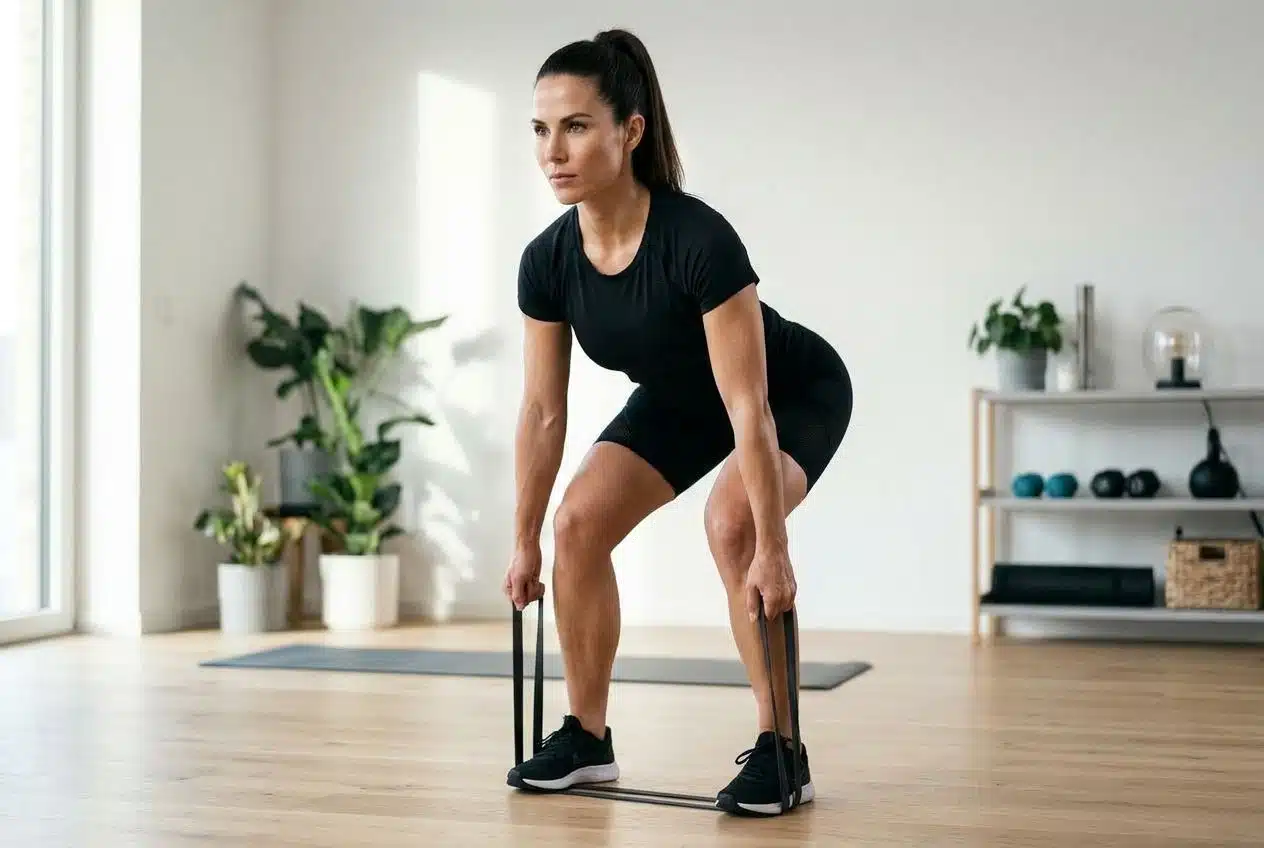
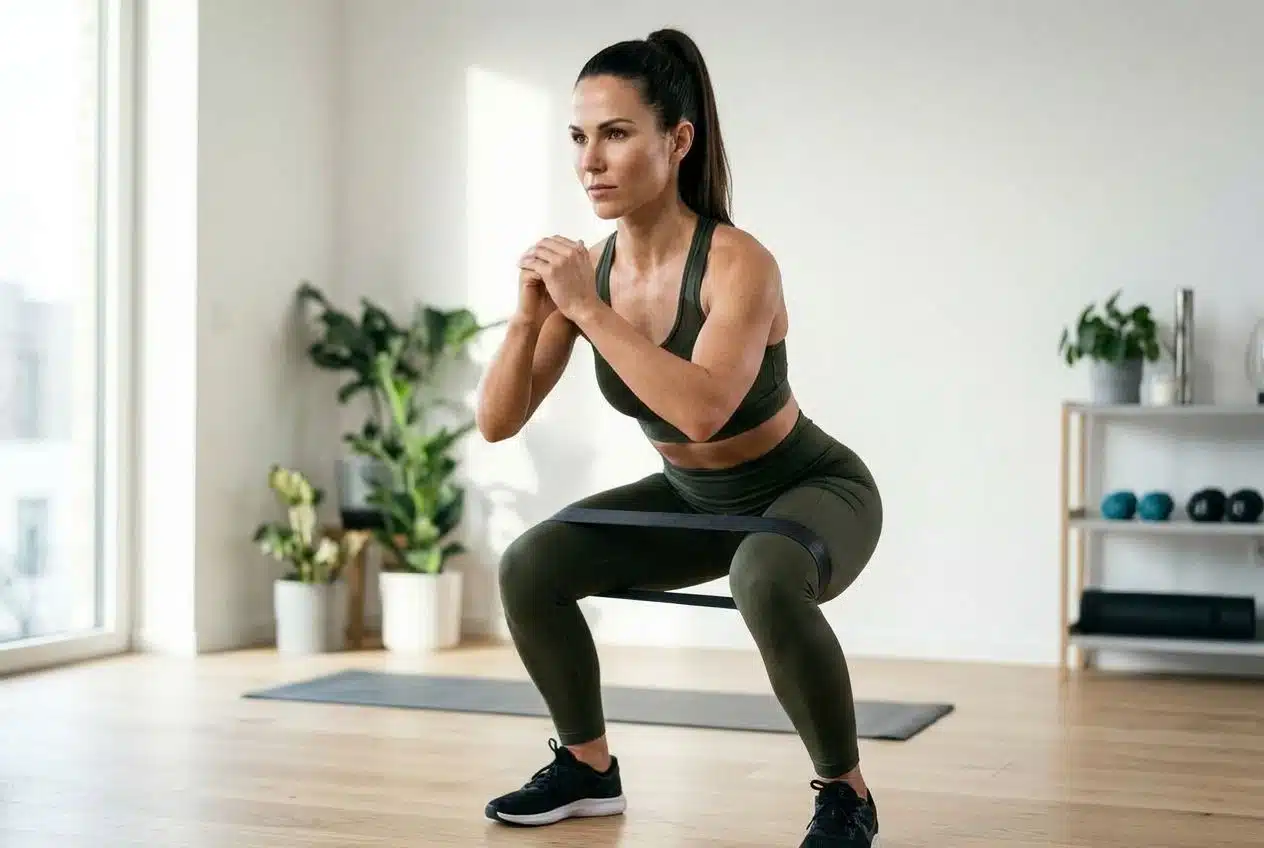
- Band squats — 12 reps
- Band Romanian deadlifts — 12 reps
- Lateral band walks — 10 steps each side
- Band glute bridges — 12–15 reps
- Standing band leg curls — 10 reps per side
Keep your knees aligned with your toes during squats and lateral walks. If the band pulls your knees inward, use a lighter band. This workout is low-impact but still challenging when done with control.
6. Glute-Focused Mini Band Routine
Mini bands are excellent for glute training because they force the hips to work during small, controlled movements.
Time: 15–20 minutes
Equipment: Mini loop band
Rounds: 3
Routine:
- Lateral band walks — 12 steps each side
- Banded glute bridges — 15 reps
- Clamshells — 12 reps per side
- Standing kickbacks — 12 reps per side
- Banded squat pulses — 12 reps
This routine burns quickly, but do not rush it. Fast reps usually turn into momentum. Slow reps keep tension where you want it. Use this as a standalone lower-body session or as a warm-up before squats and lunges.
7. Resistance Band Core Routine
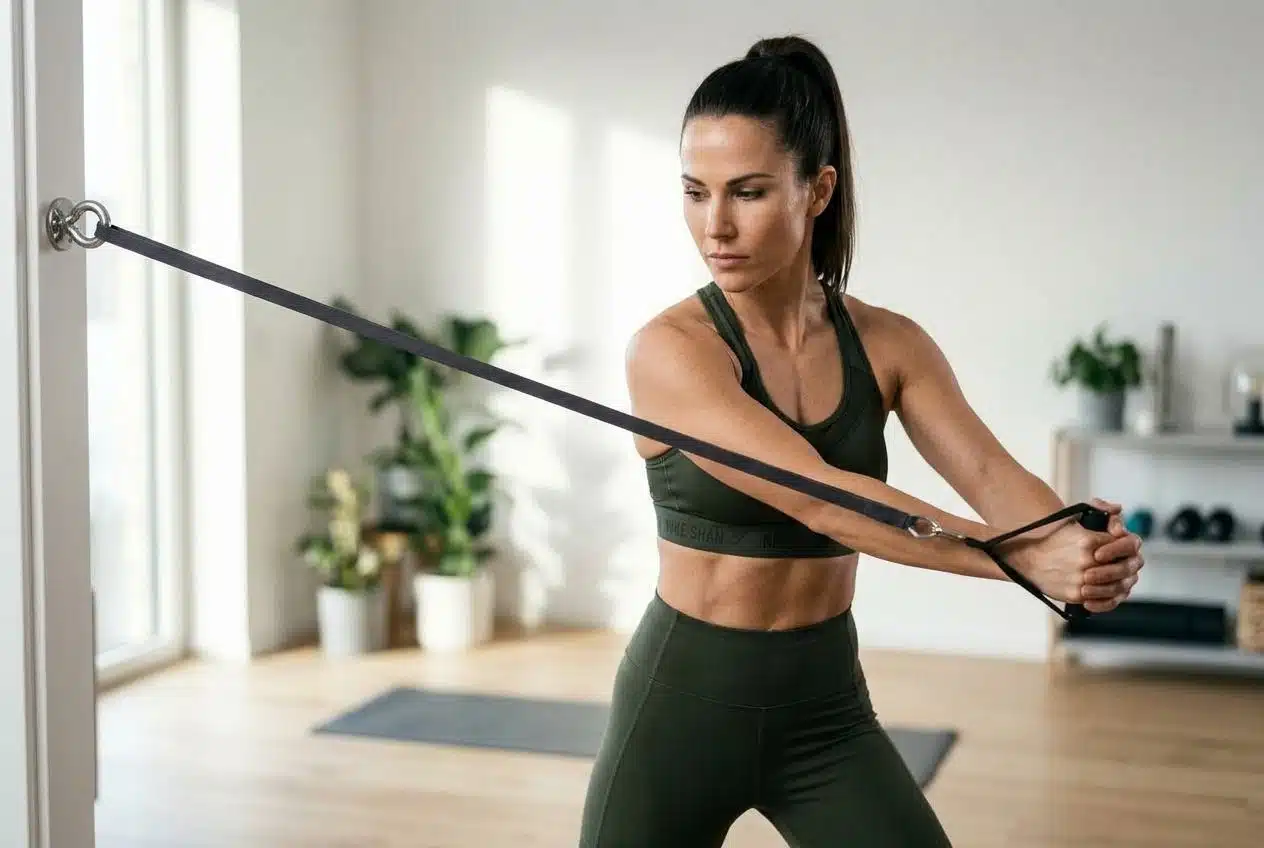
Bands are excellent for core training because they pull your body out of position. Your job is to resist that movement.
Time: 15 minutes
Equipment: Long band or tube band
Rounds: 3
Routine:
- Pallof press — 10 reps per side
- Band wood chops — 8–10 reps per side
- Band dead bugs — 8 reps per side
- Standing band marches — 20 total steps
- Side plank — 20 seconds per side
This routine trains your core without relying on crunches. It is useful for posture, balance, and better control during other exercises. For the Pallof press, stand tall and press the band straight forward. Do not let your torso rotate.
8. Back and Shoulder Band Routine
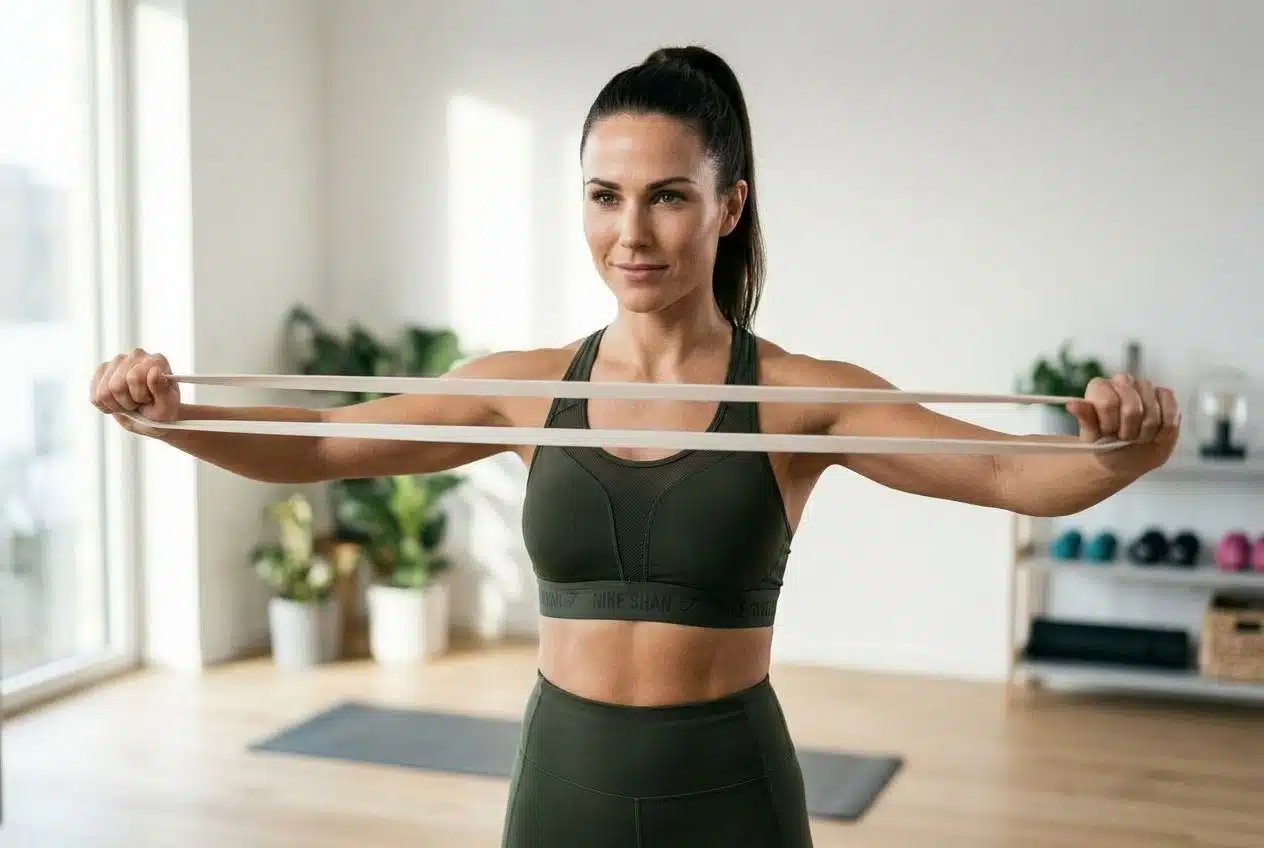
This workout is useful if your shoulders feel stiff or your upper back feels weak. It is not supposed to be heavy. It is about control and better movement.
Time: 15–18 minutes
Equipment: Light band
Rounds: 2–3
Routine:
- Band pull-aparts — 15 reps
- Band pass-throughs — 8–10 slow reps
- Face pulls — 12 reps
- External rotations — 10 reps per side
- Straight-arm pulldowns — 12 reps
Keep the movement smooth. If you feel shoulder pinching, reduce the range or skip that exercise. This is a useful add-on after a long workday or before an upper-body session.
9. Resistance Band Mobility Routine
Not every band routine has to be a strength workout. Bands can also help with warm-ups, stretching, and mobility.
Time: 10–15 minutes
Equipment: Long flat band
Rounds: 1–2 slow rounds
Routine:
- Band shoulder pass-throughs — 8 reps
- Banded chest opener — 30 seconds
- Banded hamstring stretch — 30 seconds per side
- Banded hip flexor stretch — 30 seconds per side
- Banded ankle mobility rocks — 10 reps per side
Use light tension. The band should help you move into a better position, not force your body into one. This routine works well before strength training or after sitting for long hours.
10. Quick 15-Minute Full-Body Band Workout
This is the routine for busy days. It is short, balanced, and easy to repeat.
Time: 15 minutes
Equipment: One medium band
Rounds: 3
Routine:
- Band squats — 12 reps
- Band rows — 12 reps
- Band chest press — 10 reps
- Band good mornings — 10 reps
- Band pull-aparts — 12 reps
Rest only when needed. Keep the pace steady, but do not sacrifice form. This is one of the easiest band training plans to use when you have limited time but still want a useful session.
11. Travel-Friendly Resistance Band Routine
Resistance bands are perfect for travel because they take up almost no space in a bag.
Time: 18–20 minutes
Equipment: One tube band or flat band
Rounds: 3
Routine:
- Band rows — 12 reps
- Band squats — 12 reps
- Band overhead press — 10 reps
- Band good mornings — 12 reps
- Band curls — 12 reps
- Standing band marches — 20 steps
If you cannot anchor the band safely, choose exercises where you stand on the band instead. The goal while traveling is not to destroy yourself. The goal is to maintain consistency.
12. Beginner Band and Bodyweight Combo
This routine mixes simple bodyweight exercises with band resistance. It is a good bridge between beginner home workouts and more structured strength training.
Time: 20–25 minutes
Equipment: Light or medium band
Rounds: 3
Routine:
- Bodyweight squats — 12 reps
- Band rows — 12 reps
- Incline push-ups — 10 reps
- Band glute bridges — 12 reps
- Dead bugs — 8 reps per side
- Band pull-aparts — 12 reps
This routine is practical because it does not depend entirely on the band. If one exercise feels awkward, the bodyweight movements keep the workout simple. If you are still building your base, start with beginner home workouts first, then use this as your next step.
13. Advanced Band Burnout Routine
This is the hardest routine in the article. Use it when you already understand band tension and want a short, intense finisher.
Time: 12–15 minutes
Equipment: Medium or heavy band
Rounds: 3
Routine:
- Banded squat pulses — 20 reps
- Band rows — 15 reps
- Band chest press — 12 reps
- Lateral band walks — 12 steps each side
- Band curls — 15 reps
- Band triceps pressdowns — 15 reps
This is not the routine to start with if you are new. It works better after a full-body workout or as a quick standalone session when you want a stronger burn. If the band pulls you out of position, the resistance is too heavy.
My Personal Recommendation: Best Resistance Band Exercises to Learn First
If you are new to bands, master the basics before trying harder routines.
Start with:
- Band row
- Band squat
- Band chest press
- Band pull-apart
- Band good morning
- Band glute bridge
- Pallof press
- Band external rotation
These exercises cover the most useful movement patterns. Once they feel natural, your band workouts become easier to build.
How to Progress Resistance Band Routines
Progression is where results happen. If you use the same light band forever and never change reps, sets, or tension, your body will adapt.
Here are simple ways to progress:
| Progression Method | Example |
| Add reps | Move from 10 reps to 12–15 reps |
| Add rounds | Move from 2 rounds to 3 rounds |
| Use a stronger band | Switch from light to medium |
| Step farther from the anchor | Increase band tension |
| Slow the return phase | Control the band instead of snapping back |
| Add pauses | Hold the hardest position for 1–2 seconds |
| Reduce rest | Rest 45 seconds instead of 60 seconds |
Do not change everything at once. Pick one progression method each week.
Common Resistance Band Mistakes to Avoid
Resistance bands are simple, but bad habits can still reduce results or make the workout unsafe.
Avoid these mistakes:
- Using a band that is too heavy
- Letting the band snap back
- Anchoring the band to something unstable
- Rushing through every rep
- Holding your breath during exercises
- Ignoring pain or joint discomfort
- Using damaged bands
- Choosing random exercises without a plan
The most common mistake I see is ego tension. People choose a band that looks impressive, but every rep becomes messy. Use the band that lets you control the full movement.
How Often Should You Do Band Workouts?
For general fitness, 2–4 resistance band sessions per week work well for many people. Start with 2 full-body sessions if you are new. Add a third day once recovery feels easy. This fits general strength guidance because adults are advised to include muscle-strengthening activity at least 2 days per week.
A simple weekly plan:
- Monday: Full-body band routine
- Wednesday: Upper-body pull and posture routine
- Friday: Lower-body band routine
- Saturday or Sunday: Mobility or core band routine
Leave at least one easier day between harder strength sessions when you are starting.
Where Resistance Bands Fit in a Home Fitness Plan
Resistance bands are not the only tool you need, but they fill an important gap. Bodyweight workouts are great for squats, push-ups, planks, and lunges. Bands add pulling, rotation, glute activation, shoulder work, and adjustable resistance.
If you are building a complete home training system, start with the best home workouts and use these resistance band routines as your strength-focused next step.
For a simple setup, you do not need much. A mat, a light band, a medium band, a loop band, and a water bottle are enough for most people. If you are building a small home fitness corner and want practical lifestyle products, you can check the Eco shop as part of your setup planning.
Final Thoughts: Resistance Band Routines Work When You Train With Control
The best resistance band routines are not about using the heaviest band or doing the fastest reps. They are about control, tension, consistency, and smart progression.
Start with the beginner full-body routine if you are new. Add upper-body pull work if you sit at a desk. Use lower-body and glute sessions when you want stronger hips and legs. Add core and mobility routines to move better and protect your form.
Bands are not magic. But they are practical, affordable, and easy to use at home. When you repeat the right routines and progress slowly, they can become one of the most useful tools in your home workout plan.
Frequently Asked Questions About Resistance Band Routines
1. Are Resistance Band Routines Good for Beginners?
Yes. Resistance bands are beginner-friendly because you can start with light tension and simple movements. They are also easy to store and use at home.
2. Can Resistance Bands Build Muscle?
Resistance bands can help build strength and muscle when you use enough tension, good form, and progressive overload. ACSM’s 2026 position stand includes elastic band resistance training among resistance-training methods that can improve strength.
3. How Many Times a Week Should I Do Band Workouts?
Most people can start with 2–3 band workouts per week. Beginners should begin with 2 full-body sessions, then add more if recovery feels good.
4. Are Resistance Bands Better Than Dumbbells?
They are not better or worse. They are different. Bands are portable and great for home workouts, pulling movements, glute work, and mobility. Dumbbells are easier to load precisely for heavier strength training.
5. What Band Should I Start With?
Start with a light or medium band. You should feel tension, but you should still control the movement from start to finish.
6. Can I Use Resistance Bands Every Day?
You can use light bands for mobility or activation almost daily, but harder strength sessions need recovery. If the same muscles are sore or tired, take an easier day.
























