
A strong Google ranking does not carry the same traffic promise it once did. For many informational searches, users now see an AI-generated summary before they reach the familiar list of organic results.
That summary may answer the basic question, compare several options, or suggest the next step. The user can continue searching without opening a website at all.
This is the practical issue behind how AI Overviews are changing SEO strategy. Ranking still matters, but it is no longer enough to know where a page appears. SEO teams also need to understand whether the page is visible inside generative results, whether that visibility produces a click, and what happens after the visitor arrives.
The response should not be to publish more content or rename ordinary SEO work “GEO.” The more useful response is to make each important page harder to replace with a short summary.
Search Now Has an Extra Answer Layer
The traditional search journey was relatively direct. A person entered a query, reviewed the available results, and chose a page.
AI Overviews add a step between the query and the publisher. Google may gather information from multiple pages, combine it into a response, and present supporting links alongside the answer.
For a straightforward question, that may be enough. Someone searching for the difference between two file formats, the meaning of a marketing term, or a basic troubleshooting step may not need to visit the original source.
More complex searches work differently. Google has documented a process called query fan-out, in which its systems issue multiple related searches across subtopics before assembling a response.
A search for international payroll software, for example, may lead the system to explore:
- supported countries;
- employee and contractor payments;
- tax documentation;
- employer-of-record services;
- integrations;
- data protection;
- pricing structures;
- onboarding and termination procedures.
A page may support one part of that answer even if it does not target the user’s exact wording.
This makes visibility less predictable. The page ranking first for the main phrase may not be the only page cited, and an AI Overview may use different supporting links from AI Mode. Generated responses can also vary by query wording, location, device, account context, and timing.
A Ranking Can Stay Stable While Traffic Falls
SEO reporting once treated ranking improvement as a reasonable proxy for traffic growth. That relationship is now weaker.
A page may retain a strong average position while its click-through rate declines. The ranking has not necessarily become less accurate. The surrounding search result has changed.
An AI Overview may appear above the organic listing. So might shopping results, videos, featured snippets, maps, discussion results, or other search features. The position number alone cannot show how prominent the standard listing was on the screen.
Independent research supports this concern, although the results should be interpreted carefully. A Pew Research Center study examined 68,879 Google searches made by 900 U.S. adults in March 2025. Users clicked a traditional result in 8% of visits when an AI summary appeared, compared with 15% when no AI summary appeared. Links inside the summary received a click in 1% of visits containing one.
Those numbers are not universal benchmarks. They came from one country, one participant group, and one period. Click behaviour will differ across industries, search types, countries, devices, and result layouts.
The broader lesson is more reliable: appearing in search no longer guarantees a proportional visit.
This will affect some pages more than others. A generic definition or short list is easy to compress. A current pricing page, original dataset, detailed product comparison, local service page, calculator, booking system, or technical guide with failure cases gives users more reason to open the source.
Commodity Content Is Under the Most Pressure
A large part of SEO publishing has relied on summarising information that is already widely available.
That approach becomes less defensible when a search engine can produce a competent summary from several sources in seconds. An article that rearranges the same definitions, tips, and product descriptions found on competing pages gives Google little reason to feature it and gives readers little reason to click it.
A useful page needs a clearer purpose.
That may come from original reporting, proprietary data, a transparent comparison process, expert analysis, a template, an interactive tool, or detailed instructions. It can also come from practical friction that most summaries leave out.
Consider two articles targeting “best CRM for a small construction company.”
The first lists ten familiar platforms and repeats features from their product pages: contact management, automation, mobile apps, and reporting.
The second examines how construction teams actually use a CRM. It looks at weak mobile connections on job sites, photo attachments, estimate follow-ups, missed calls, subcontractor records, staff permissions, and the handoff between sales and project delivery.
The second article may compare fewer products. It is still more useful because it evaluates the decision rather than reproducing the category.
That should be the editorial standard. A page does not need to be longer than every competitor. It needs to contain something that cannot be removed without making the answer worse.
Answer Quickly, Then Go Beyond the Summary
Some publishers respond to AI Overviews by delaying the main answer, hoping users will have to scroll further or spend more time on the page. That is poor service and unlikely to protect search traffic.
Readers should be able to confirm quickly that the page addresses their question. A direct answer near the beginning remains useful.
The rest of the page must earn attention by doing more:
- explain when the answer changes;
- identify exceptions and limitations;
- show realistic examples;
- compare alternatives using meaningful criteria;
- document important claims;
- explain common failure points;
- provide a tool, process, or next action.
A page explaining what canonical tags are may be summarized easily. A page showing how canonical errors occur across filtered ecommerce URLs, international pages, syndicated articles, and JavaScript-rendered sites has a stronger reason to be opened.
The distinction is not between short and long content. It is between content that finishes at the obvious answer and content that helps the reader use that answer correctly.
Keyword Research Must Follow the Decision
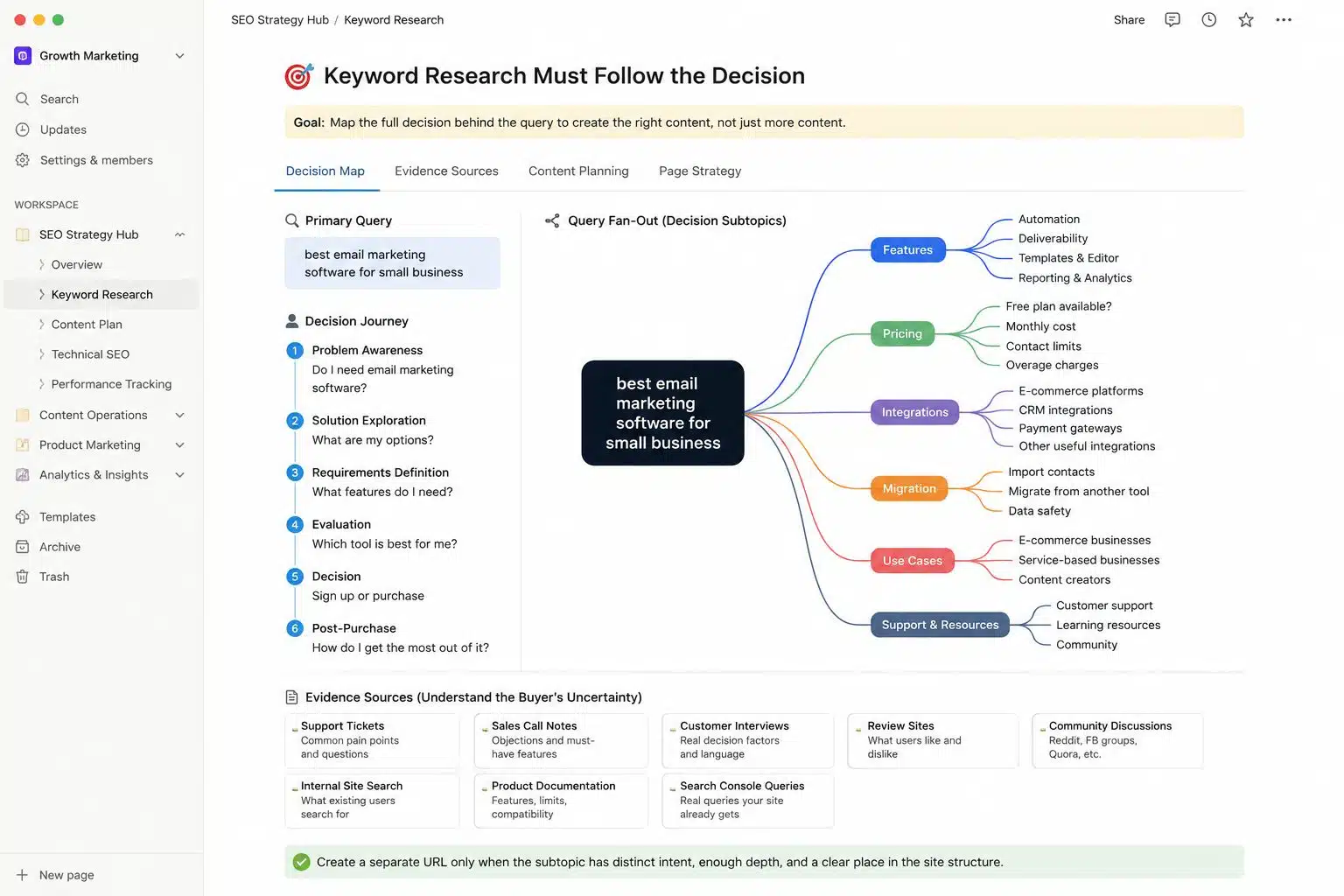
Query fan-out has encouraged a new type of content excess: creating a separate article for every related question in the hope that one will be selected as a supporting source.
That can produce hundreds of thin pages with overlapping intent.
A better approach is to map the full decision behind the query. The content team can then decide which questions belong together, which deserve dedicated pages, and which should be answered through product documentation, comparison pages, or support content.
For a business choosing email marketing software, keyword data may reveal searches about automation, deliverability, templates, pricing, contact limits, ecommerce integrations, migration, and reporting.
Search volume alone does not show which issues are most important to the buyer. Better evidence may come from:
- support tickets;
- sales-call notes;
- customer interviews;
- review sites;
- community discussions;
- internal site search;
- product documentation;
- Search Console queries.
These sources expose the uncertainty behind the search. That uncertainty often determines whether someone needs to click.
A separate URL makes sense when a subtopic has distinct intent, enough depth, and a clear place in the site structure. It does not make sense merely because a keyword tool found a slightly different phrase.
Make Important Claims Easy to Check
Content selected for an AI-generated answer does not automatically become trustworthy. Search systems can surface weak, incomplete, or outdated information, especially when the subject is changing quickly.
Publishers should make factual quality visible.
A well-edited page identifies who is responsible for the content, when it was published or revised, and where important evidence came from. A comparison should explain its criteria. A statistic should link to the underlying report rather than another article quoting it. Product details should distinguish current documentation from editorial opinion.
This is particularly important for:
- prices and subscription limits;
- software compatibility;
- platform policies;
- legal and financial information;
- cybersecurity instructions;
- health and safety advice;
- availability by country;
- figures that change over time.
A visible update date is useful only when the article was genuinely reviewed. Changing the date without rechecking the content creates the appearance of freshness rather than the substance of it.
AI-assisted drafting does not remove these responsibilities. Google’s policies do not prohibit content simply because automated tools were involved. The risk comes from publishing large volumes of unoriginal or low-value material primarily to influence rankings.
The final article still needs accountable human judgment: what to include, what to remove, which source to trust, and how strongly a claim can be stated.
Technical SEO Is Still the Entry Requirement
Generative Engine Optimization discussions often begin with citation tactics. That skips the more basic question: can Google reliably access and interpret the page?
For Google Search, AI Overviews do not require a special schema or separate submission process. Pages still need the same technical foundations expected for standard organic search.
The priority order is straightforward.
First, confirm that the important page can be crawled and indexed. Then check rendering, canonical signals, internal links, mobile usability, and the visibility of the main text. Structured data should match what users can see on the page.
Commercial publishers should also keep product feeds, prices, stock status, opening hours, location details, and Business Profile information current where those systems apply.
Several heavily promoted GEO tactics deserve less attention. Google does not require publishers to create an llms.txt file for Search, break every paragraph into artificial content chunks, or add excessive structured data in the hope of gaining an AI citation.
Structured data still has legitimate uses. It can help pages qualify for supported rich results and clarify page entities. It is not a special admission pass to an AI Overview.
A site with poor canonical handling or important content hidden from rendering has more urgent work than experimenting with speculative AI markup.
Measure Generative Visibility Separately
How AI Overviews are changing SEO strategy becomes most obvious when teams try to measure performance.
Google introduced dedicated Generative AI performance reports in Search Console in June 2026. At launch, the reports began rolling out to a subset of properties, so access and available detail may still vary.
The reporting is intended to give publishers a clearer view of impressions generated through AI Overviews, AI Mode, and relevant generative features in Discover. Google listed page, country, device, and date views among the available dimensions at launch.
That information is useful, but it does not remove the need for broader analysis. A useful reporting framework should separate four things.
Search Visibility
Monitor impressions, average position, index coverage, affected landing pages, and generative-search appearances where the report is available.
Qualified Traffic
Review engaged sessions, leads, sales, newsletter subscriptions, assisted conversions, and revenue. A smaller number of visitors can still be valuable when they arrive with stronger intent.
Brand Demand
Track branded searches, direct visits, returning visitors, and searches that combine the brand with a product or topic. A person may encounter a company in an AI-generated answer and return later without clicking the original supporting link.
Page Intent
Do not combine every page into one sitewide CTR figure. Definitions, tools, product pages, comparisons, original research, and local service pages face different risks.
A fall in traffic to a basic glossary page may have little commercial effect. A smaller decline on a pricing comparison or high-converting service page may deserve immediate attention.
Third-party AI visibility tools can help identify recurring citations and competitor patterns. Their results should be treated as directional rather than definitive. They do not have access to Google’s internal ranking systems, and generated answers can vary between repeated searches.
Audit Pages by Their Reason to Be Visited
A practical audit should begin with pages that have high impressions, relatively stable rankings, and declining CTR.
Do not start by adding more words. Start by asking what the page provides after the search result has already given the reader a summary.
Basic Definitions and Generic Tips
These pages face the highest risk of becoming unnecessary clicks.
Merge overlapping pages where appropriate. Keep the clearest explanation, then add examples, mistakes, practical applications, or links to a deeper tool or resource.
A definition page does not need to become a 3,000-word essay. It needs a useful next step.
How-To and Troubleshooting Guides
Basic steps may appear directly in search, but real troubleshooting rarely ends with the basic steps.
These guides become more valuable when they include version differences, menu locations, compatibility limits, likely error messages, security warnings, and what to try when the standard fix fails.
A guide that says “restart the device and clear the cache” is replaceable. A guide that explains when clearing the cache removes useful data, where the setting moved in the latest version, and what to check before resetting the app is more defensible.
Product Comparisons
Generic comparisons are particularly exposed because product descriptions are easy to summarise.
Use fewer products when necessary, but evaluate them using real decision criteria. State when the information was checked. Separate advertised capabilities from practical limits. Explain which buyer should pay more, which can use a cheaper option, and which product is a poor fit despite its popularity.
Original Research, Tools, and Data
These assets are harder to replace, but only when the underlying value remains accessible.
Publish the methodology. Keep datasets current. Make calculators usable on mobile devices. Provide enough context for people to understand what the output means.
An AI Overview may quote the headline finding. Readers still need the original source when they want to inspect the evidence.
Commercial and Local Pages
These pages should make the next action simple. Keep prices, availability, locations, opening hours, service areas, delivery conditions, and contact options accurate.
A visitor who has already read a summary does not need another long introduction. They need confidence that the product or service is suitable and available.
GEO Shortcuts Are Usually a Distraction
The market around generative search is full of confident claims about guaranteed citations, preferred sentence lengths, special files, and perfect content structures.
Most of these claims are stronger than the evidence supporting them.
Be cautious when a tactic promises predictable inclusion in AI Overviews. Generated answers are dynamic, and Google does not provide a guaranteed citation formula.
Artificial brand mentions are another poor investment. Paying for low-quality articles, fabricated discussion threads, or mass-produced guest posts may increase the number of pages mentioning a company without increasing genuine trust.
FAQ inflation has similar problems. Adding ten repetitive questions to every article may make the page longer, but it does not make the content more distinctive.
The most overrated GEO advice focuses on formatting tricks. The most underrated work is ordinary editorial maintenance: checking claims, updating product information, consolidating duplicate pages, improving internal links, and making the useful part of the page easier to find.
Final Thoughts
Understanding how AI Overviews are changing SEO strategy requires a cleaner distinction between ranking, visibility, clicks, and business results.
The first useful step is not a sitewide rewrite. Identify high-impression pages where CTR is falling despite stable rankings. Review the pages tied to leads, sales, subscriptions, or brand trust before spending time rescuing low-value traffic.
Then ask a harder editorial question: after a reader sees a competent summary in search, what remains on this page that is worth opening?
If the answer is original evidence, a useful tool, a careful comparison, current commercial information, or guidance that prevents a costly mistake, the page still has a strong role.
If the answer is another summary of information already available everywhere, a higher word count will not solve the problem.
AI Overviews raise the standard for earning a visit. The durable strategy is to publish fewer interchangeable pages and more content that helps people verify, compare, decide, and act.