
Finding climate actions that make a difference is harder than it should be. Most people are tired of being told to carry a reusable bottle while billion-dollar systems keep burning fossil fuels. They are also tired of advice that sounds good but barely moves the needle. Turn off the lights. Recycle more. Buy a bamboo toothbrush. Fine, but is that really where the biggest climate impact sits? The honest answer is no.
Personal climate action matters most when it targets the biggest parts of daily emissions: transport, home energy, electricity, food, waste, money, and civic pressure. The goal is not to make normal people feel guilty for existing. The goal is to stop wasting energy on tiny symbolic changes while ignoring the actions with real climate ROI.
This list focuses on practical climate actions that actually make a difference. Some save money. Some require planning. Some depend on where you live. Some are individual habits, while others push bigger systems to change. That mix matters because climate action is not only about personal purity. It is about reducing emissions where you can and increasing pressure where individual choices alone are not enough.
How I Chose These Effective Climate Actions
For this list, I avoided feel-good advice unless it had a real reason to be here. Each action had to meet at least one of these standards:
- It targets a major emissions category such as transport, home energy, food, or electricity.
- It can reduce repeated emissions, not just one small purchase.
- It offers a strong climate ROI for an individual household, renter, commuter, or consumer.
- It can influence wider systems, such as markets, workplaces, banks, utilities, or local policy.
- It is realistic enough for many people to act on, even if the exact version depends on income, location, climate, and infrastructure.
That means this is not a guilt list. It is a priority list.
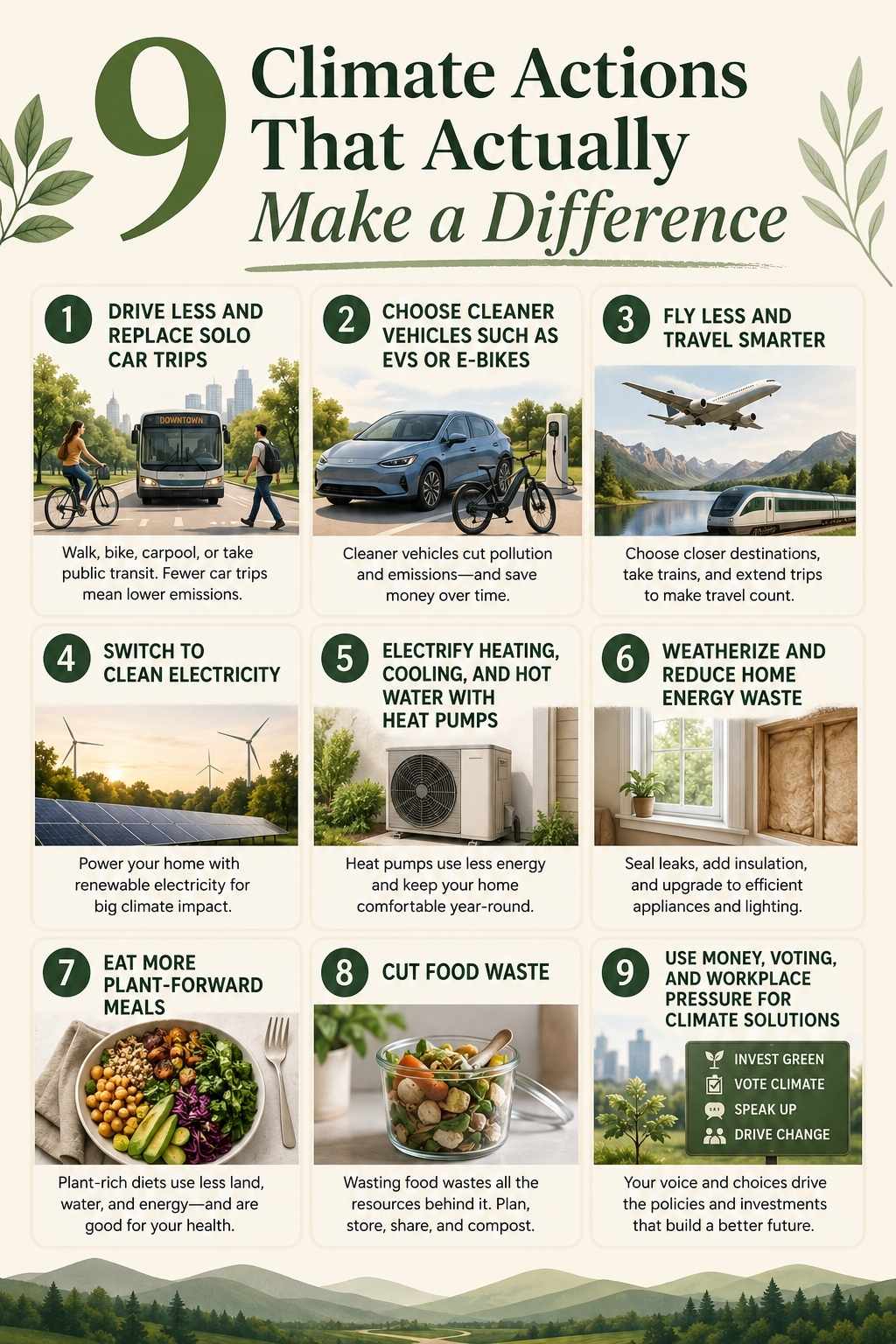
9 Climate Actions That Actually Make a Difference
The most effective climate actions are not always the most glamorous ones. In many cases, they are boring, practical, repeated choices that cut emissions month after month.
1. Replace Solo Car Trips Before You Worry About Tiny Lifestyle Tweaks
Transport is one of the biggest places where personal climate action can actually show up in the numbers. If you drive alone every day, even small changes to your weekly routine can matter more than dozens of tiny green swaps around the house.
The highest-impact move is not always selling your car tomorrow. For many people, that is unrealistic. The better first step is to reduce the trips that are easiest to replace: short errands, school runs, commutes that could be shared, or one weekly drive that could become a walk, bike ride, bus trip, train ride, or remote-work day.
This is where climate ROI becomes practical. One avoided car trip does not change the world. But a repeatedly avoided car trip becomes a habit, and habits are where emissions fall.
Start here: Choose one regular drive each week and replace it with walking, cycling, public transport, carpooling, or combining errands.
Why it matters: Driving less cuts fuel use directly and can also reduce traffic, air pollution, parking pressure, and household transport costs.
Reality check: This action depends heavily on infrastructure. If your area has no safe sidewalks, transit, or bike routes, your best individual action may be pushing local leaders for better mobility options.
2. Make Your Next Vehicle Electric, Smaller, or Less Car-Dependent
Not everyone can live car-free. That is why the “next vehicle” decision matters.
If you need a car, the climate-smart move is to make the next one electric, smaller, more efficient, or less frequently used. Electric vehicles are not impact-free. Batteries require mining, manufacturing, and electricity. But over their lifetime, EVs generally produce lower greenhouse gas emissions than gasoline cars, especially as electricity grids get cleaner.
The bigger point is this: do not replace a working vehicle early just to feel greener. The best time to switch is usually when your current car is actually due for replacement. For some people, the better “vehicle” may be an e-bike, cargo bike, scooter, or one shared household car instead of two.
A smart pick for: Drivers who cannot go car-free but can plan their next transport upgrade better.
High-impact move: Replace a gasoline car with an EV, plug into cleaner electricity where possible, and avoid upsizing into a heavier vehicle than you need.
Practical note: If your driving is already low, keeping a reliable existing car longer may beat buying a new vehicle too soon. Climate ROI depends on your mileage, electricity mix, and replacement timing.
3. Fly Less, Especially When a Trip Is Optional or Replaceable
Flying is one of the fastest ways for an individual to create a large emissions spike. That does not mean every flight is morally wrong. Families live across borders. Work happens. Emergencies happen. But frequent leisure flying, short-haul flights that trains could replace, and “because flights were cheap” trips deserve a serious rethink.
The most useful question is not, “Can I never fly again?” It is, “Which flight can I avoid, replace, combine, or take less often?”
A single avoided long-haul round trip can save more emissions than many small household swaps. This is why flying less sits high on almost every serious list of effective climate actions.
Works well for: Frequent flyers, business travelers, conference-goers, and people who take multiple short breaks by air.
Better options include: Taking trains where available, choosing fewer but longer trips, combining work travel, joining remotely, or replacing one annual flight with a closer destination.
The only catch: Aviation alternatives are not equally available everywhere. If trains are expensive, slow, or unavailable, the bigger solution also requires public investment.
4. Switch Your Home Electricity to Clean Power
Electricity is becoming more important because so many climate solutions depend on it: EVs, heat pumps, induction cooking, efficient appliances, and eventually cleaner industrial systems. So the cleaner your electricity becomes, the more powerful your other climate choices become, too.
For homeowners, rooftop solar may be the strongest option if the roof, local policy, upfront cost, and sunlight make sense. For renters or people without suitable roofs, community solar, renewable electricity plans, green power programs, or utility clean-energy options may be more realistic.
The climate ROI here depends on your current grid. If your electricity comes mostly from fossil fuels, clean power can make a bigger difference. If your grid is already fairly clean, the impact is smaller but still useful.
Ideal for: Households that can choose electricity suppliers, join community solar, install rooftop solar, or support clean-energy programs.
Start with: Check your utility options, local solar rules, community solar availability, and whether renewable electricity plans are credible.
Worth knowing: Not all “green energy” plans are equal. Look for clear information about renewable energy certificates, local generation, contract terms, and whether the plan supports additional clean power.
5. Electrify Heating, Cooling, and Hot Water When Old Systems Need Replacing
Heating and cooling are not exciting topics until the bill arrives or the furnace dies in the middle of winter. But home heating, cooling, and hot water are major climate opportunities.
Heat pumps are one of the most important technologies here because they move heat instead of generating it by burning fuel. That makes them far more efficient than many traditional heating systems. Air-source heat pumps can heat and cool a home, and heat pump water heaters can reduce energy use for hot water.
The key is planning. If you wait until a gas furnace, boiler, or water heater fails, you may end up panic-buying the same fossil-fuel system for another 10–20 years. The smarter climate action is to research replacement options before the emergency.
Best suited to: Homeowners, landlords, and anyone planning a major appliance replacement.
High-impact step: When a furnace, boiler, air conditioner, or water heater reaches the end of its life, compare heat pump options before defaulting to another fossil-fuel system.
Before you buy: Costs and savings vary by climate, insulation, electricity prices, fuel prices, rebates, and installer quality. Get more than one quote.
6. Weatherize Your Home Before Buying More “Eco” Products
A drafty home wastes energy quietly. You may not see emissions leaving through gaps, poor insulation, old windows, or inefficient heating settings, but your energy bill usually feels it.
Weatherization includes sealing air leaks, improving insulation, maintaining HVAC systems, using smart or programmable thermostats properly, sealing ducts, adding window treatments, and replacing inefficient appliances when they truly need replacement. These actions are not as visually appealing as rooftop solar, but they can reduce wasted energy year after year.
For renters, smaller steps can still help: draft stoppers, curtains, careful thermostat use, LED bulbs, efficient power strips, and talking to landlords about upgrades.
Especially useful for: Anyone with high heating or cooling bills, uncomfortable rooms, drafts, or older housing.
Good first moves: Seal obvious leaks, service heating and cooling equipment, use thermostat setbacks, switch to LEDs, and improve insulation where possible.
Small drawback: Some upgrades have upfront costs. Start with low-cost fixes first, then plan bigger improvements around rebates, repairs, or renovations.
7. Eat More Plant-Forward Meals, Starting With Beef and Lamb
Food choices matter, but the advice is often presented in the most annoying way possible. You do not have to become a perfect vegan overnight to reduce your food footprint. The biggest climate win for many diets is simply eating less high-impact meat, especially beef and lamb.
Ruminant animals produce methane, and livestock production also uses large amounts of land. That is why replacing some beef-heavy meals with beans, lentils, tofu, chickpeas, vegetables, grains, nuts, eggs, or lower-impact proteins can reduce emissions without turning food into a moral performance.
This is a high-impact climate step because it repeats every week. A single meal is small. A changed default is powerful.
Great match for: People who eat beef, lamb, or dairy often and want a practical food shift without extreme rules.
Try this first: Replace two beef meals a week with plant-forward meals you already like, such as lentil curry, bean chili, tofu stir-fry, chickpea salad, vegetable pasta, or mushroom tacos.
A quick reminder: Local food is nice, but what you eat usually matters more for climate than how far it traveled, especially for high-emissions foods.
8. Cut Food Waste Like It Is a Climate Action, Because It Is
Food waste is one of the most overlooked climate actions because it feels ordinary. A forgotten cucumber. Rice left too long. Leftovers no one wanted. Fruit bought with good intentions and abandoned like a gym membership in February.
But wasted food carries emissions from farming, processing, packaging, transport, refrigeration, cooking, and disposal. When food rots in landfills, it can also produce methane. That makes food waste reduction one of the rare climate actions that can save money and cut emissions at the same time.
The solution is not to become a perfect meal-prep machine. It is to build a kitchen system that matches your real life.
Most useful for: Households that regularly throw away leftovers, produce, bread, cooked rice, dairy, or forgotten freezer items.
Simple system: Plan three flexible meals, store leftovers where you can see them, freeze food before it spoils, use “eat first” boxes, and compost scraps where available.
Final buying note: The greenest groceries are the ones you actually eat.
9. Move Your Money, Workplace, and Vote Toward Climate Solutions
This is the one people forget because it does not look like a lifestyle habit. But money and civic pressure can have enormous climate leverage.
Your bank, pension, investment account, employer, city council, school board, utility regulator, and elected officials all shape the systems that decide whether clean energy, transit, building efficiency, and climate resilience get funded. Individual choices matter, but systems decide how easy or hard those choices become.
This does not mean everyone has to become a full-time activist. It means choosing one channel where your influence is real. Move your bank account if your bank heavily finances fossil expansion. Ask your workplace about clean electricity, business travel, suppliers, and retirement plan options. Vote in local elections. Support safer bike lanes, better buses, building efficiency rules, clean-energy permits, and climate-resilient infrastructure.
Recommended for: People who want their climate action to go beyond personal consumption.
High-ROI moves: Change banks if practical, review retirement fund options, support local climate policy, join a credible local group, and push your workplace to reduce emissions.
Reality check: Systemic change is slower than personal habit change, but it can unlock bigger emissions cuts than one household can achieve alone.
A Quick Overview of the Highest-Impact Climate Steps
| Climate Action | Impact Level | Best Starting Point |
| Drive less and replace solo car trips | Very high | Swap short car trips first |
| Make your next vehicle electric or car-light | High | Choose an EV, an e-bike, or a smaller, more efficient vehicle when replacing |
| Fly less and travel smarter | Very high for frequent flyers | Replace one avoidable flight |
| Switch to clean electricity | High | Rooftop solar, community solar, or renewable electricity plan |
| Electrify heating, cooling, and hot water | High | Heat pump when old systems need replacement |
| Weatherize and reduce home energy waste | Medium to high | Seal leaks, insulate, and improve thermostat habits |
| Eat more plant-forward meals | High | Reduce beef and lamb first |
| Cut food waste | High | Meal planning, freezer use, composting |
| Move money and civic pressure | Systemic high impact | Bank, vote, organize, and push local climate policy |
What Climate Actions Are Overrated?
Some climate actions are not bad, but they are often overhyped compared with their impact.
Recycling is useful, but it is not a substitute for using less material in the first place. Reusable bags are fine, but they matter less than transport, home energy, food, and flying. Buying “eco” products can help, but only when they replace something you actually need. Carbon offsets are complicated and should not be treated as permission to keep high-emission habits unchanged.
A good rule: if an action reduces repeated fossil-fuel use, food waste, high-emission consumption, or political pressure for dirty systems, it probably matters more than a one-time green purchase.
Best Climate Actions by Lifestyle Situation
| If You Are… | Start With This |
| A daily driver | Replace short solo car trips first |
| A frequent flyer | Avoid or replace one flight this year |
| A homeowner | Plan heat pump and insulation upgrades before systems fail |
| A renter | Choose clean electricity options, reduce food waste, and cut transport emissions |
| A meat-heavy eater | Reduce beef and lamb first |
| A student | Use transit, eat plant-forward meals, and organize locally |
| A parent | Cut food waste, plan efficient transport, and support climate-safe schools |
| A high earner | Look at flights, cars, investments, home energy, and political influence |
| A low-budget household | Start with energy waste, food waste, transit options, and repair habits |
How to Think About Climate ROI as an Individual
Climate ROI is about asking, “Where does one change create the most repeated impact?”
A reusable straw has low climate ROI because the emissions avoided are tiny. Replacing a daily car commute, avoiding an annual long-haul flight, switching to clean electricity, cutting beef-heavy meals, or installing a heat pump can have a much higher ROI because these choices affect repeated emissions.
The best personal climate plan usually follows this order:
- Find your biggest emissions category.
- Pick one high-impact action inside that category.
- Make it repeatable.
- Save money or improve comfort where possible.
- Use your voice to make the same choice easier for others.
That last part matters. Climate action should not become a private luxury project. The real win is making clean transport, clean energy, efficient homes, and low-waste food systems normal and affordable.
Final Thoughts
The climate actions that actually make a difference are not always the cute ones. They are the ones that change energy, transport, food, money, and systems.
Drive less where you can. Choose cleaner vehicles when replacement time comes. Fly less when a trip is optional. Switch to cleaner electricity. Electrify heating and hot water when old systems need replacing. Stop wasting home energy. Eat more plant-forward meals. Cut food waste. Move your money and civic voice toward climate solutions.
None of this requires perfection. Perfection is a distraction. The goal is repeated, high-impact action that fits real life and pushes bigger systems in the right direction.
For readers already exploring better buying choices, this guide also connects naturally with Editorialge’s broader list of best eco-friendly brands, because climate-smart living is not about buying more green products. It is about choosing better when you actually need something and cutting waste where it matters most.
Frequently Asked Questions About Climate Actions That Make a Difference
1. What climate actions make the biggest difference for individuals?
The biggest individual climate actions usually involve transport, home energy, flights, electricity, diet, and food waste. Driving less, flying less, switching to clean electricity, using efficient heating and cooling, eating fewer high-emission foods, and reducing food waste usually matter more than small symbolic swaps.
2. Are individual climate actions enough to stop climate change?
No, individual actions alone are not enough. Climate change also requires strong policy, clean infrastructure, corporate accountability, and large-scale energy transition. But individual choices still matter because they reduce demand, shift markets, build social pressure, and support bigger systemic change.
3. What is the best climate action if I do not have much money?
Start with actions that save money: reduce food waste, drive less when possible, use less heating and cooling energy, switch to LED bulbs, repair items, avoid unnecessary purchases, and use public transport or shared rides where available. Many high-impact actions are about using less wastefully, not buying expensive green products.
4. Is eating less meat really an effective climate action?
Yes, especially when you reduce beef and lamb. You do not have to become fully vegan to make a difference. Replacing some high-impact meat meals with plant-forward meals can lower your food-related emissions over time.
5. Should I buy an electric vehicle to reduce my carbon footprint?
An EV can be a strong climate choice if you drive regularly and your current car is due for replacement. But buying a new EV too early is not always the best move. If your current car is efficient and you drive little, keeping it longer or driving less may offer better climate ROI.
6. Do small climate actions matter at all?
Small actions matter when they build habits or support bigger changes. But they should not distract from high-impact steps. Recycling, reusable bags, and efficient habits are useful, but transport, home energy, flights, food, electricity, and civic action usually have much bigger climate value.