A teacher may know that one student is ready for harder work, another has missed a prerequisite, and a third understands the lesson but needs more time. Responding to those differences is part of good teaching. Doing it continuously for every learner in a large class is much harder.
Adaptive learning is designed to help with part of that workload. It uses evidence from a student’s activity to change what happens next. A system might offer a hint, adjust the difficulty of a task, return to an earlier skill, shorten unnecessary practice, or alert the teacher that a student appears to be stuck.
The technology can make practice more targeted. It cannot see the whole learner.
An adaptive platform does not know, unless someone tells it, that a student is tired, misunderstood the instructions, has limited proficiency in the language of the course, or used an unusual but valid solution. Its decisions depend on the data it collects and the assumptions built into the software.
For educators and school leaders, the important question is therefore not whether a product calls itself adaptive. It is whether the adaptation is instructionally sound, visible to teachers, accessible to students, and useful in the conditions where it will actually be used.
What Adaptive Learning Means
Adaptive learning is a technology-supported approach that adjusts part of a learning experience in response to evidence about an individual learner.
That evidence may include:
- correct and incorrect answers;
- the steps taken to solve a problem;
- repeated errors across related tasks;
- hints requested;
- diagnostic or mastery-check results;
- the number of attempts required;
- performance across connected skills;
- time spent on an activity.
A platform uses these signals to estimate what a learner may know, where uncertainty remains, and which activity or form of support should follow.
This makes adaptive learning one part of the wider field of personalized learning, not a substitute for it. Personalized learning may also involve individual goals, teacher-designed pathways, flexible scheduling, tutoring, project choices, small-group instruction, or different ways for students to demonstrate understanding.
A system is not adaptive merely because students can work at their own pace. Nor does releasing different lessons to different groups automatically make a learning management system adaptive. The defining feature is that learner evidence influences an instructional decision.
The Decisions Behind the Screen
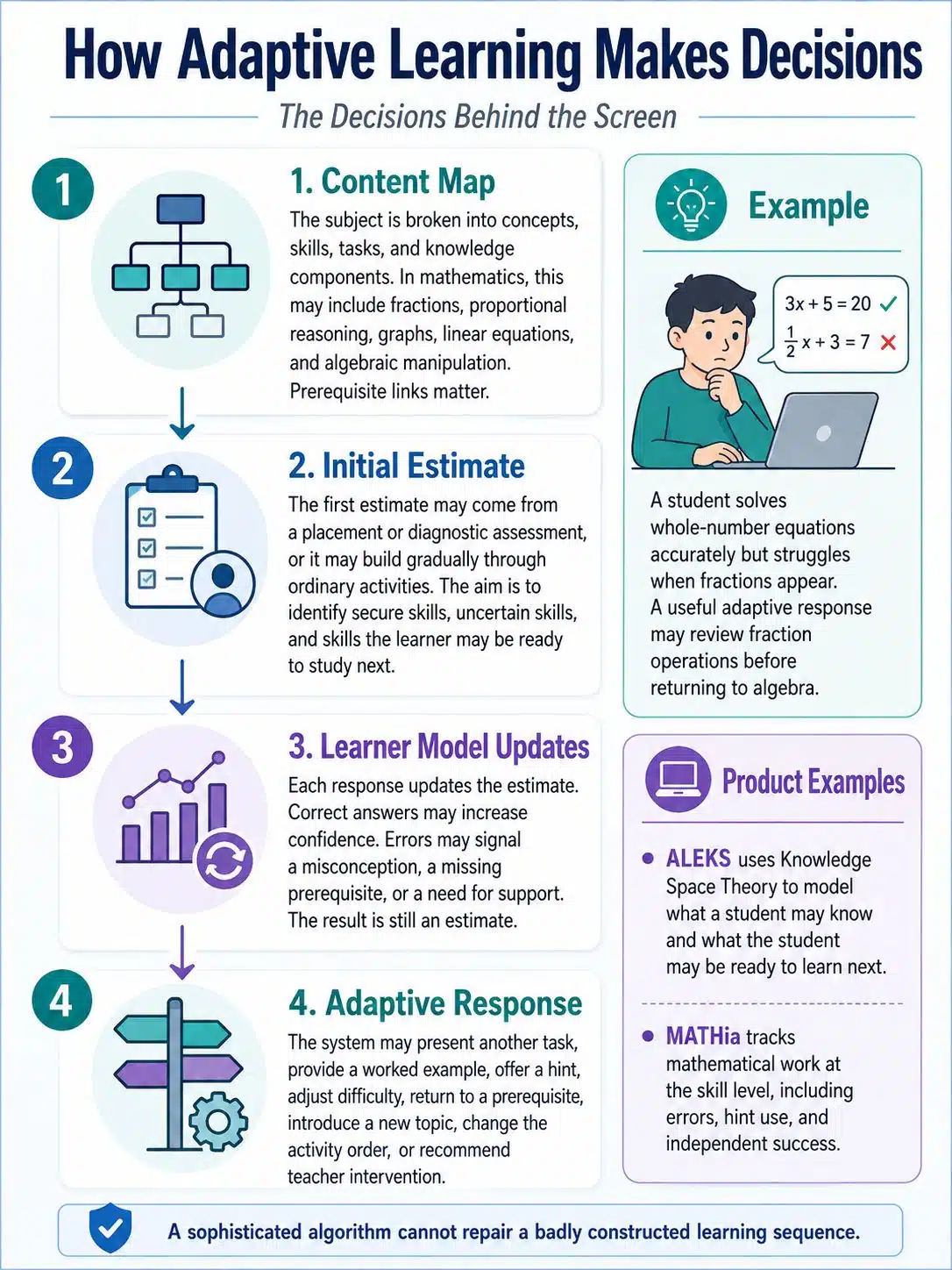
Most adaptive systems follow a recurring process: organize the content, collect evidence, update an estimate of the learner’s knowledge, and decide what should happen next.
The quality of that process varies considerably.
It Starts With a Content Map
Before software can recommend a next step, its designers must break a subject into concepts, skills, tasks, or knowledge components.
In mathematics, that map may include fraction operations, proportional reasoning, graph interpretation, linear equations, and algebraic manipulation. It must also represent the relationships among them. A student may understand the structure of an equation but fail repeatedly because fraction operations remain insecure.
This underlying map matters more than the polished dashboard a school sees during a sales demonstration. If skills are divided poorly, prerequisite relationships are inaccurate, or the content does not match the school’s curriculum, the system will make weak recommendations with great confidence.
A sophisticated algorithm cannot repair a badly constructed learning sequence.
The First Estimate May Come From a Diagnostic
Some systems begin with a placement or diagnostic assessment. Others build a learner profile gradually through ordinary activities.
The purpose is usually not to assign one broad label such as “beginner” or “advanced.” A useful system tries to identify knowledge at a more detailed level: which skills appear secure, which are uncertain, and which the student may be ready to learn next.
ALEKS is one example of a product built around a detailed knowledge model. Its documentation describes the use of Knowledge Space Theory to represent combinations of topics a student may have mastered and those the student may be ready to study.
That description explains the design of the product. It does not prove that every placement or recommendation will be accurate, and it should not be treated as independent evidence of classroom effectiveness.
Every Response Changes the Estimate
As a learner works, the software updates its model.
Several correct responses may increase the system’s confidence that a skill has been learned. A pattern of errors may indicate a misconception, a missing prerequisite, or a need for additional support. Some platforms also distinguish between independent success and an answer reached after several hints.
Products may use fixed rules, statistical models, knowledge tracing, machine learning, or combinations of these methods. Whatever the technique, the output remains an estimate.
A correct answer may be a guess. An incorrect answer may come from a typing error, an unfamiliar interface, unclear wording, or a moment of distraction. A system that ignores those possibilities can create a misleadingly precise picture of the learner.
The System Selects a Response
Once the model changes, the platform may:
- present another task on the same skill;
- provide a worked example;
- offer a targeted hint;
- adjust the level of difficulty;
- return to a prerequisite;
- introduce a new topic;
- change the order of activities;
- recommend teacher intervention.
Consider a student working on linear equations. The student solves whole-number equations accurately but repeatedly struggles when fractions appear. A useful adaptive response may assign a short review of fraction operations before returning to algebra.
A less capable system may simply provide more linear equations, leaving the real obstacle untouched.
Carnegie Learning’s MATHia is an example of a platform that describes its adaptation at the level of mathematical steps and individual skills. Its documentation explains that the system considers factors such as errors, hint use, and independent work. As with other vendor examples, these details show how the product is designed, not how well it will perform in every classroom.
What Can Be Personalized—and What Usually Cannot
“Personalized” is a generous word. Most adaptive platforms adjust only a limited number of features.
Pace
Students may spend less time on skills they can already demonstrate and receive more practice where their performance remains inconsistent.
That can reduce pointless repetition. It can also create problems when self-pacing has no boundaries. Some students rush through material without retaining it. Others remain on one unit for weeks or avoid difficult work whenever the platform allows it.
Adaptive pacing still needs deadlines, teacher check-ins, and clear expectations for progress.
Sequence
A platform may change the order in which lessons or tasks appear. This can be useful in subjects with identifiable prerequisite relationships, including mathematics, grammar, introductory programming, and some areas of science.
Sequence adaptation becomes less convincing when learning depends on interpretation, discussion, competing viewpoints, collaboration, or creative judgment. Those subjects do not always have one correct pathway.
Difficulty
The software may raise or lower the challenge based on recent performance.
Done well, this keeps work demanding without making it inaccessible. Done poorly, it traps struggling students in an endless stream of simplified exercises.
Difficulty should not be confused with quantity. Thirty easy questions are not necessarily more educational than ten carefully chosen ones.
Feedback
Some systems change the hint, explanation, visual representation, or worked example a student receives.
Immediate feedback is valuable during structured practice, especially when it helps students correct an error before repeating it. Too much intervention can weaken independence. If software responds to every hesitation, students may stop planning, checking their own reasoning, or tolerating productive struggle.
Teacher Alerts
The most useful adaptation may happen away from the student’s screen.
A dashboard might show that several students are making the same error. The teacher can then pause individual practice and teach a focused small-group lesson.
In that situation, the software organizes evidence. The educator decides what the evidence means.
Adaptive Learning Is Not Differentiated Instruction
Several educational approaches are routinely grouped together even though they solve different problems.
Differentiated instruction is generally directed by the teacher. The educator may adjust the text, grouping, support, task format, or expected output based on student needs.
Personalized learning is broader. It may involve individual goals, student choice, advising, flexible pathways, projects, or different speeds of progression.
Universal Design for Learning, or UDL, begins with the design of the learning environment. Instead of waiting for an individual student to encounter a barrier, it encourages educators to anticipate learner variability through different ways of engaging with content, accessing information, and demonstrating learning.
Adaptive learning reacts to evidence collected from an individual learner, usually inside a digital system.
These approaches can be used together. A lesson may be designed through UDL, include teacher-led differentiation, offer students meaningful choices, and use adaptive software for targeted practice.
None of those approaches removes the need for the others.
Where Adaptive Learning Earns Its Place
Adaptive systems tend to be most useful when content can be divided into identifiable skills and student responses can be evaluated with reasonable accuracy.
Common applications include:
- mathematics practice and prerequisite review;
- vocabulary and grammar development;
- reading fluency activities;
- introductory science concepts;
- programming syntax and structured coding exercises;
- professional certification preparation;
- course placement and readiness checks.
The approach can be especially helpful in a class with large differences in prior knowledge. Instead of assigning an entire review unit to everyone, a teacher may use diagnostic evidence to identify which learners need support with specific prerequisites.
It can also make blended instruction more manageable. While one group completes targeted practice, the teacher can work directly with students who need modelling, discussion, or guided problem-solving.
Its limits become clearer in open-ended work.
Adaptive software should not be the main instructional method for debate, extended writing, collaborative inquiry, laboratory investigation, creative production, or ethical judgment. A platform may support parts of those activities, but reducing them to automatically scored micro-skills can remove the reasoning and interaction that make them valuable.
The strongest use of adaptive learning is usually targeted rather than total. It is better at helping with structured practice than at designing an entire education.
What the Research Supports
Research on intelligent tutoring systems offers cautious reasons for optimism. It does not support the claim that any product carrying an adaptive label will improve learning.
A systematic review published in 2025 examined 28 K–12 studies involving 4,597 students. The studies generally reported positive effects on learning and performance. However, the advantage became smaller when intelligent tutoring systems were compared with other digital tutoring systems rather than with ordinary classroom conditions or no intervention.
The reviewed research also had important limits. The studies used quasi-experimental designs, varied in duration and quality, and did not always include large or diverse student groups. The authors called for longer studies, stronger experimental control, and more attention to ethical issues.
That qualification matters. A learner may benefit from a platform because it provides more practice, faster feedback, clearer explanations, or additional time on task. The adaptive algorithm may contribute, but it is rarely the only factor.
RAND’s research on personalized learning points in a similar direction. Participating schools showed encouraging achievement patterns, but their models involved much more than software. They used flexible grouping, individual support, student progress discussions, and teacher interpretation of data.
The study did not show that adaptive technology alone produced the gains. It also found competency-based progression difficult to implement consistently because schools still had to work within grade levels, assessment schedules, credit rules, and other institutional constraints.
The evidence supports thoughtful experimentation. It does not support buying a platform and expecting the algorithm to repair weak curriculum, limited teacher capacity, or poor implementation.
Teachers Need More Than a Dashboard
Adaptive systems can choose tasks. They cannot fully interpret a student’s circumstances.
A teacher may recognize that the learner misunderstood the directions rather than the concept. Language demands may be hiding subject knowledge. A disability may be affecting how the student uses the interface. The student may be tired, anxious, distracted, or discouraged after repeated remediation.
Two learners can also arrive at the same incorrect answer for very different reasons. Treating them as identical because the answer field matches is efficient for software and often unhelpful for teaching.
The US Department of Education has warned that many systems adapt mainly through task difficulty and lesson sequence. Human educators have a much wider view. They can connect instruction to a student’s experience, notice strengths that the software does not measure, support collaboration, and respond to moments that were not anticipated when the platform was designed.
A red warning on a dashboard is a prompt to investigate. It is not a diagnosis.
The Risks That Deserve Serious Attention
Students Can Become Trapped in Remediation
Extra practice is useful when it helps a learner return to meaningful, age-appropriate work.
It becomes harmful when the student remains indefinitely on simplified material. A platform may appear to be meeting the learner “at their level” while quietly reducing access to grade-level ideas.
Schools should ask what triggers advancement, how teachers can restore required content, and whether students with inconsistent performance are treated differently from those with a clear knowledge gap.
Activity Data Can Be Mistaken for Learning
Minutes logged in, tasks completed, hints requested, and badges earned are easy to display. They are not reliable proof of durable understanding.
Platform data should be compared with classroom work, teacher observation, written explanations, projects, delayed assessments, and performance outside the software.
A student who completes hundreds of exercises may still struggle to explain the concept or use it in an unfamiliar problem.
Student Data Needs More Than a Privacy Policy
Adaptive platforms can collect detailed records of answers, errors, progress, usage patterns, behaviour, and interactions with the system.
Schools need clear answers about:
- which data are collected;
- why each category is needed;
- how long information is retained;
- where it is stored;
- who receives it;
- which subcontractors are involved;
- whether data are used for advertising, product development, profiling, or model training;
- how records can be corrected or deleted.
Legal requirements vary by country and institution.
In the United States, FERPA regulates access to and disclosure of education records and personally identifiable information from those records. COPPA may separately apply to covered online services collecting personal information from children under 13.
Under the European Union’s GDPR, organisations need a lawful basis for processing personal data. Where consent is used for an online service offered directly to a child, the age at which parental authorisation is required varies among member states.
No school should accept “FERPA compliant” or “GDPR compliant” as a complete answer. Compliance is not a permanent product feature. It depends on how the service is configured, contracted, governed, and used.
Adaptive Does Not Automatically Mean Accessible
A product may adapt question difficulty while remaining difficult to operate with a keyboard, screen reader, switch device, magnification tool, captions, or voice input.
WCAG 2.2 provides current W3C guidance for web accessibility, covering areas such as keyboard operation, focus visibility, target size, authentication, and redundant data entry. Conformance documentation is useful, but it cannot establish that every student can complete the actual learning workflow.
Schools should test the platform with the devices and assistive technologies their students use. A vendor report should not be the only evidence.
Ordinary Infrastructure Can Defeat a Good Product
A platform may run perfectly during a demonstration and fail under school conditions.
Shared devices, old browsers, slow Wi-Fi, complicated logins, limited headphones, blocked domains, unreliable home internet, and weak technical support all affect whether the product is usable.
These are not minor implementation details. They often determine whether teachers continue assigning the platform after the first term.
What to Ask Before Buying
Start with the learning problem.
“We want adaptive learning” is a procurement preference. “Our Grade 7 teachers need a faster way to identify fraction gaps before starting algebra” is an educational problem that can be tested.
Ask vendors to explain:
- What changes for the learner: pace, sequence, difficulty, feedback, content format, or teacher intervention?
- Which data influence each change?
- How many responses are needed before the system alters a pathway?
- How does it distinguish a misconception from a careless mistake?
- What does the platform mean by mastery?
- Can teachers see why a recommendation was made?
- Can they override, skip, assign, or restore content?
- Does the content map match the school’s standards and teaching sequence?
- What independent evidence exists for students comparable to those in the school?
- What student data are collected, shared, retained, deleted, or used to improve other systems?
- How has the complete student workflow been tested for accessibility?
- What training, integrations, devices, and weekly instructional time are required?
A sales demonstration should include failure conditions, not only the ideal journey.
Ask what happens when a student guesses repeatedly, relies heavily on hints, stops working, enters the wrong grade level, changes classes, or fails to demonstrate mastery after many attempts.
The difficult cases reveal more about a platform than the polished pathway prepared for a presentation.
Pilot It Under Real Conditions
A limited pilot is safer than a school-wide commitment based on a feature list.
Choose one subject, a manageable number of classes, and a clearly defined instructional need. Decide in advance how success will be judged. Possible measures include prerequisite mastery, common assessment results, teacher planning time, intervention rates, student completion patterns, and access problems.
During the pilot, pay attention to what average usage figures hide:
- Do dashboard warnings match teacher judgment?
- Are advanced students receiving meaningful challenge?
- Are some learners caught in repeated remediation?
- Can students using assistive technology complete the same work?
- Do logins, devices, or network conditions waste instructional time?
- Does the platform’s data change what teachers do next?
- Can students apply the learning outside the product?
Do not use time on platform as the main measure of success. High usage may show that the school scheduled enough screen time. It does not show that students understood, retained, or transferred what they practised.
Final Thoughts
Adaptive learning is most valuable when it solves a defined instructional problem. It can identify possible prerequisite gaps, vary structured practice, provide timely feedback, and help teachers find students who may need direct support.
Its limitations should shape the way it is adopted. A learner model is an estimate. Automated remediation can narrow opportunity. Detailed dashboards can appear more certain than the evidence behind them. A technically impressive product can still fail because its content, accessibility, privacy terms, or classroom workflow are poor.
Schools should begin with one real learning need, examine how the system makes decisions, confirm that teachers can intervene, and test the product under ordinary conditions before expanding it.
Adaptive technology can support personalization. It should never decide, by itself, what a student is capable of learning.