If you feel like you are in a biological fog the moment the clocks turn back, you aren’t ‘lazy’; you are literally out of sync with the planet. In 2026, we finally stopped treating the winter blues as a mood swing and started treating it as a light deficiency. Mastering Circadian Lighting Habits for Seasonal Depression is no longer a wellness trend; it is a clinical necessity for anyone living north of the equator who wants to reclaim their brains from the winter gloom.
By 2026, research from institutions like Harvard and the Society for Light Treatment has solidified the link between light exposure and neurochemical stability. We now understand that “circadian misalignment” is a primary driver of seasonal mood disorders. Light is the primary signal for our internal clocks, and when we lose it, our bodies continue to produce sleep hormones like melatonin well into the morning, leading to that heavy, lethargic state known as the winter blues.
What Are Circadian Lighting Habits?
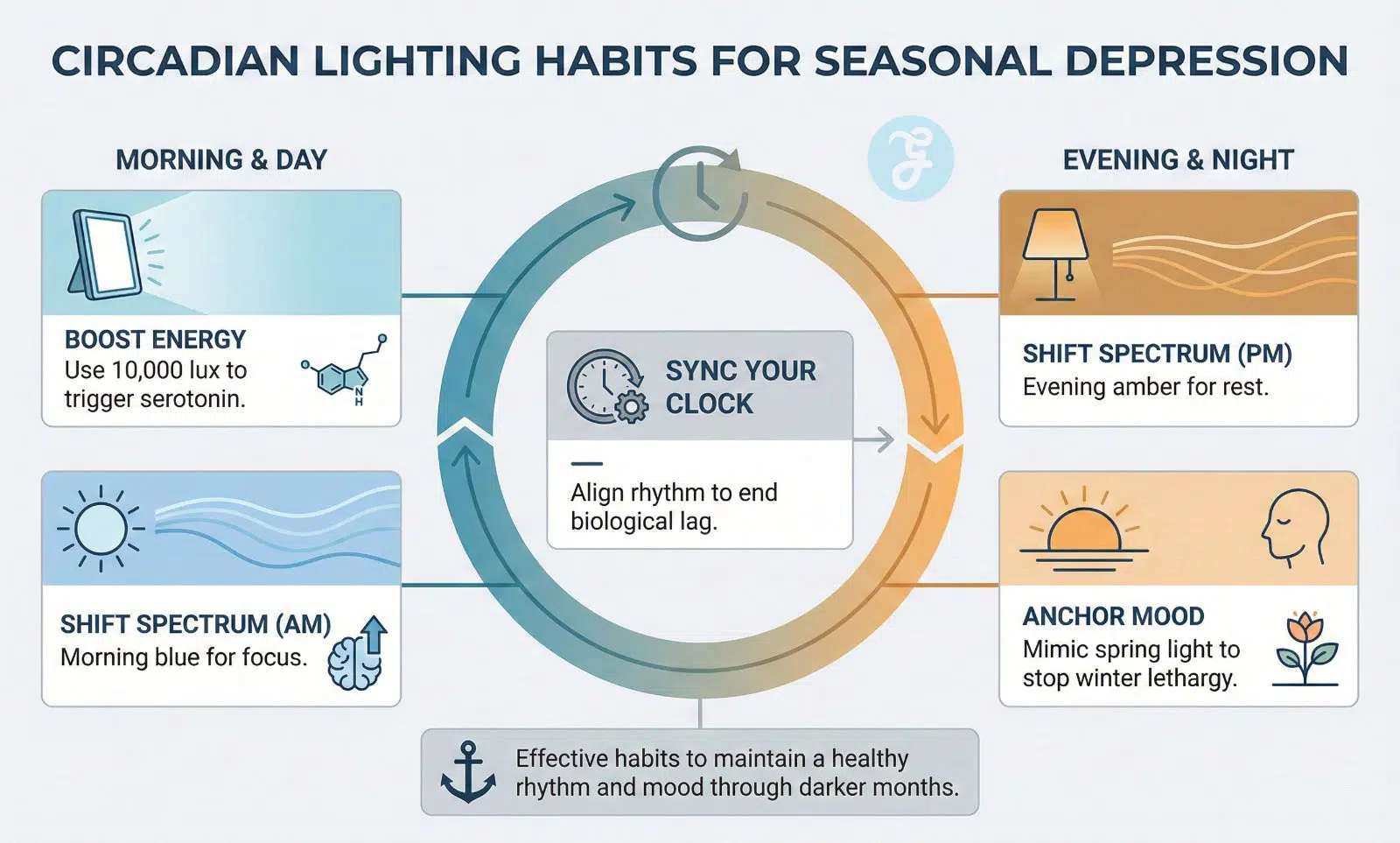
Circadian Lighting Habits are a set of intentional light-exposure practices designed to synchronise your body’s internal 24-hour clock with the natural solar cycle. For those with Seasonal Depression, these habits involve using specific intensities (lux) and wavelengths (colour temperatures) of light to signal the brain to stop producing sleep hormones like melatonin and start releasing energy-boosting neurotransmitters like serotonin. By strategically using bright light in the morning and warm, dim light in the evening, you effectively “anchor” your biological rhythm, preventing the lethargy and low mood caused by winter’s reduced daylight.
The Science of the “Internal Clock”
For decades, we thought Seasonal Affective Disorder (SAD) was just about “missing the sun.” Modern chronobiology tells a more complex story. Your brain has a master clock, the Suprachiasmatic Nucleus (SCN), that relies on specific wavelengths of light to produce serotonin (the “feel-good” hormone) and regulate melatonin (the sleep hormone). When the sun vanishes, your SCN gets “phase-delayed.” You are essentially living in a state of permanent jet lag.
Stop Chasing Pills, Start Chasing Photons
My stance is direct: we over-medicalise seasonal sadness while ignoring our prehistoric need for photons. You can take all the Vitamin D in the world, but if your retinas aren’t seeing 10,000 lux before 9:00 AM, your chemistry will remain stuck in “hibernate” mode. The following ranking isn’t just a list, it’s a biological recalibration.
The Biology of the Winter Blues
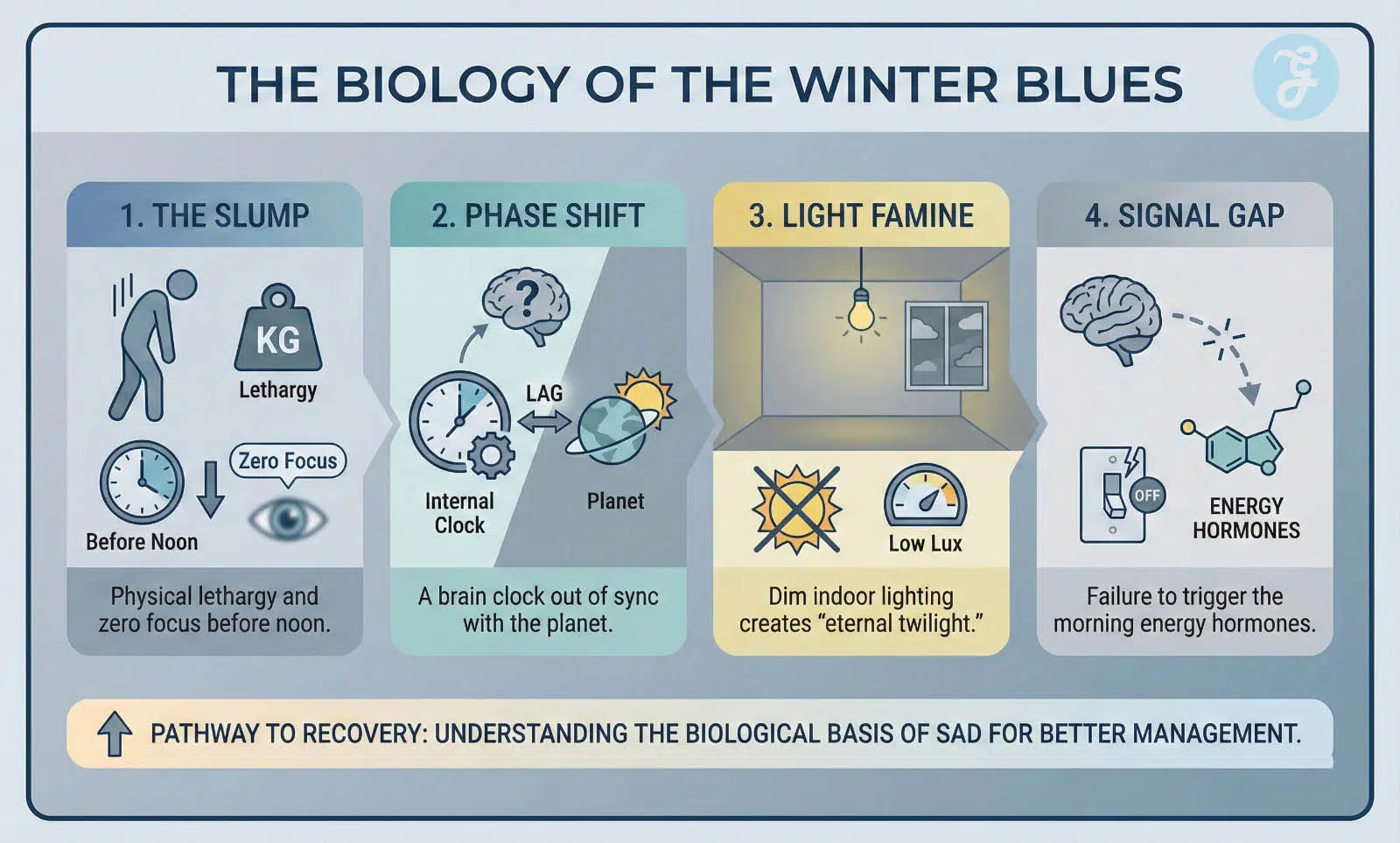
The “January Slump” is a physical weight. You feel it in your limbs, your cravings for carbohydrates, and your inability to focus before noon. This is Phase-Shift Disorder.
In the 2026 landscape of mental health, we recognise that our indoor centric lifestyles have created a light famine. Most of us spend 90% of our time under dim, static indoor lighting that registers at about 300 to 500 lux. To your brain, that is the equivalent of eternal twilight. This lack of signal prevents the Melatonin Offset, the process where your brain stops making sleep hormones and starts making energy hormones. Circadian Lighting Habits for Seasonal Depression are designed to bridge this gap, using technology to mimic the solar signals our ancestors lived by.
How We Rated These Habits
To create this definitive 2026 ranking, we didn’t just look at what “feels” good. We ranked these habits based on three rigorous pillars:
- Clinical Efficacy: Does peer-reviewed research (like the latest meta-analyses from the Society for Light Treatment and Biological Rhythms) prove it moves the needle on Hamilton Depression Rating Scales?
- Accessibility: Can a regular person implement this without a $10,000 home renovation?
- Sustainability: Is the habit “set and forget,” or does it require Herculean willpower every morning?
The Powerhouse: Bright Light Therapy (BLT)
If you do only one thing, make it this. Bright Light Therapy remains the Gold Standard because it is the only intervention that mimics the intensity of a spring morning.
The 10,000 Lux Standard
A standard light bulb is a candle compared to a BLT box. To trigger the melanopsin receptors in your eyes, the ones responsible for resetting your clock, you need an intensity of 10,000 lux. In 2026, the market is flooded with “sad lamps,” but many are underpowered. Ensure your device is large enough to cast light across your entire visual field.
In clinical settings, 10,000 lux is considered the “therapeutic dose” for light therapy. While smaller, portable lamps claim to reach this intensity, they often only do so if you are just a few inches away. A true clinical-grade box provides this intensity at a comfortable sitting distance, roughly 16 to 24 inches, ensuring the light reaches your peripheral vision where many of these circadian receptors are located.
The Math of Distance
Physics matters here. If you sit 2 feet away from a lamp rated for 10,000 lux at 6 inches, you are only getting about 600 lux. This is the Inverse Square Law: $E = I / d^2$. To get the clinical benefit, you must stay within the manufacturer’s recommended “effective zone,” usually 16 to 24 inches.
The Morning Window
Timing is everything. Using a light box at 4:00 PM will actually make your depression worse by delaying your sleep cycle. The “Magic Hour” is within 60 minutes of waking. This tells your brain, “The day has started. Stop the melatonin. Start the serotonin.”
The Gentle Wake: Dawn Simulation
While BLT is the “heavy hitter,” Dawn Simulation is the “silent supporter.” A dawn simulator is a bedside lamp that gradually brightens over 30 to 40 minutes before your alarm goes off.
The Cortisol Awakening Response (CAR)
Even through closed eyelids, your retinas detect the creeping light of a simulated sunrise. This triggers a gradual rise in cortisol, the hormone that gives you “get up and go.” Instead of being jolted awake by a screaming iPhone alarm which triggers a stress response, you wake up naturally. For those with Sleep Inertia, that heavy, “drugged” feeling in the morning, this habit is a game changer. It is highly effective because it requires zero effort once set up.
The “Always On” Environment: Blue-Enriched Daytime Light
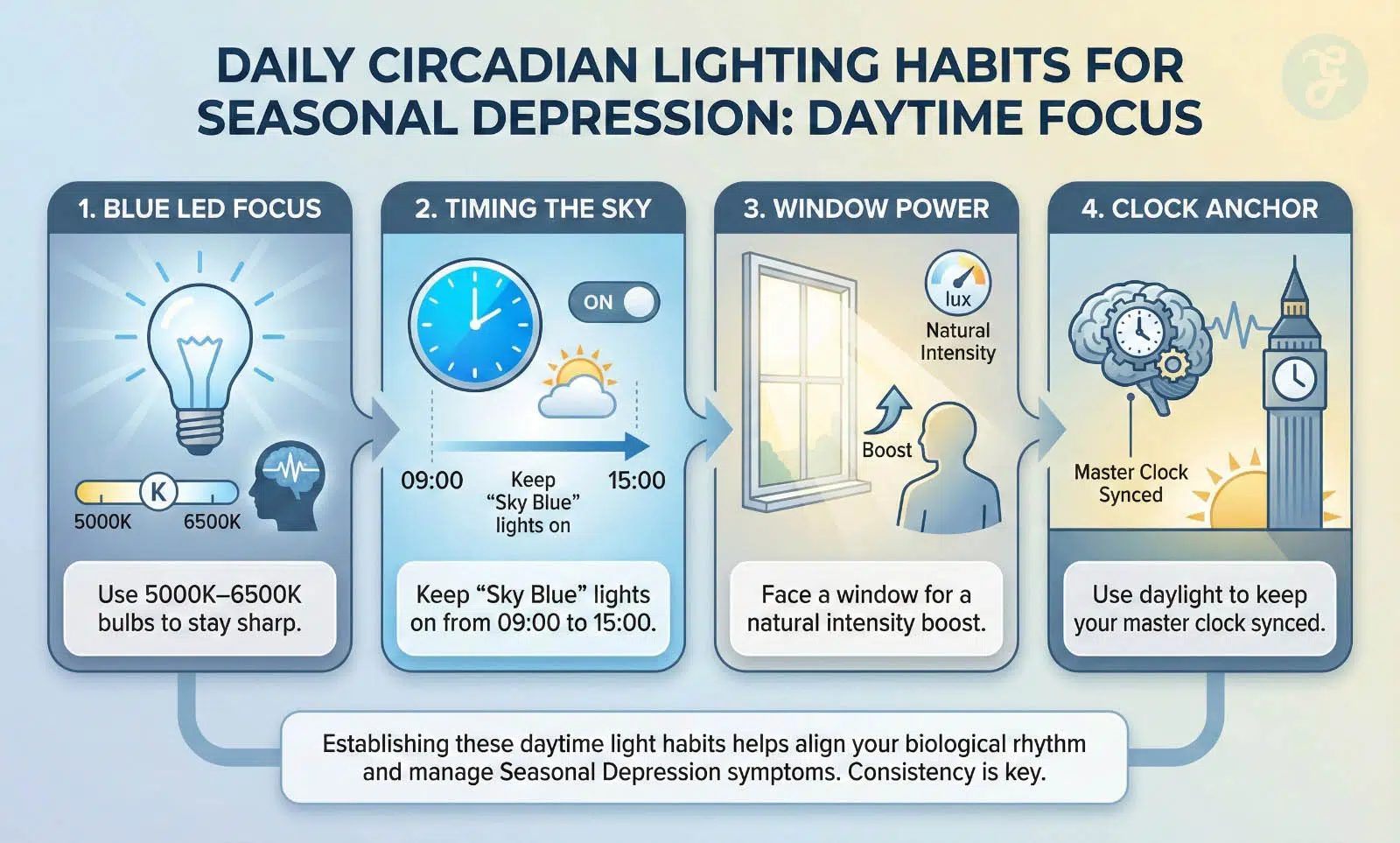
In 2026, we have moved past the idea that light therapy is something you only do for 30 minutes. Your entire environment should be “circadian-aware.”
Kelvin and Colour Temperature
Standard home bulbs are “warm” (2700K). This is great for cozy dinners, but terrible for midday productivity. For your workspace, you want Blue-Enriched LED bulbs (5000K–6500K). Blue light is the specific wavelength that suppresses melatonin most effectively. By keeping your “Sky-Blue” lights on from 9:00 AM to 3:00 PM, you prevent the midday slump that often leads to SAD-related oversleeping.
The Window Habit
Never underestimate the power of the sky. Even on a cloudy day, the lux level near a window is significantly higher than in the centre of a room. Position your desk so you are facing or adjacent to a window. This “Natural Lux Boost” provides the micro-adjustments your SCN needs to stay anchored to the actual time of day.
The Evening Shift: Melatonin Protection
The biggest mistake people make with Circadian Lighting Habits for Seasonal Depression is focusing only on the morning. If you blast yourself with blue light at 9:00 PM, you destroy the sleep quality you need to fight depression.
The “Sunset” Protocol
Two hours before bed, your house should undergo a “Digital Sunset.” Switch all overhead lights off. Use lamps with warm, amber-toned bulbs. In 2026, smart bulbs can do this automatically, transitioning from 6500K at noon to 2000K by 8:00 PM.
The Red-Light Strategy
Red light has a long wavelength that does not suppress melatonin. If you must read or work late, use red-shifted lighting. It allows your brain to begin the “wind-down” phase, ensuring that when you do hit the pillow, your sleep is restorative rather than fragmented.
Integrating Habits: A Sample 24-Hour “Circadian Protocol”
To make this lucid and actionable, here is how a “Pro-Circadian” day looks in 2026:
- 07:00 AM: Dawn simulator reaches 100% brightness. You wake up naturally.
- 07:15 AM: Eat breakfast in front of a 10,000 lux Light Box (30 mins).
- 09:00 AM: Open all blinds; turn on high-Kelvin “Daylight” bulbs in the office.
- 12:30 PM: A 15-minute walk outside (even if it’s raining) to get full-spectrum light.
- 04:00 PM: Dim the overhead lights; rely on task lighting.
- 08:00 PM: Smart lights shift to Amber/Warm tones. Phone goes into “Night Shift” mode.
- 10:30 PM: Total darkness (or a dim red nightlight if needed).
Troubleshooting & Advanced Tips
The Bipolar Warning: If you have a history of Bipolar Disorder, intensive light therapy can sometimes trigger hypomania. Always consult with a psychiatrist before starting a 10,000 lux regimen.
The “Winter Traveller”: If you travel across time zones in winter, your SAD symptoms will skyrocket. Use your light box to “pull” your rhythm toward your destination’s morning time three days before you leave.
Lighting the Path Forward
Seasonal depression is not a character flaw or a lack of willpower. It is a biological response to a planet that has gone dark. By implementing these Circadian Lighting Habits for Seasonal Depression, you are taking the “remote control” of your brain back from the seasons.
Start small. Buy a dawn simulator this week. Position your desk by the window next week. By the time the deepest part of February hits, your brain won’t even realise the sun is missing; it will be too busy basking in the 10,000 lux “sun” you built on your own desk.
Disclaimer: For educational use only; consult a doctor before starting light therapy.