

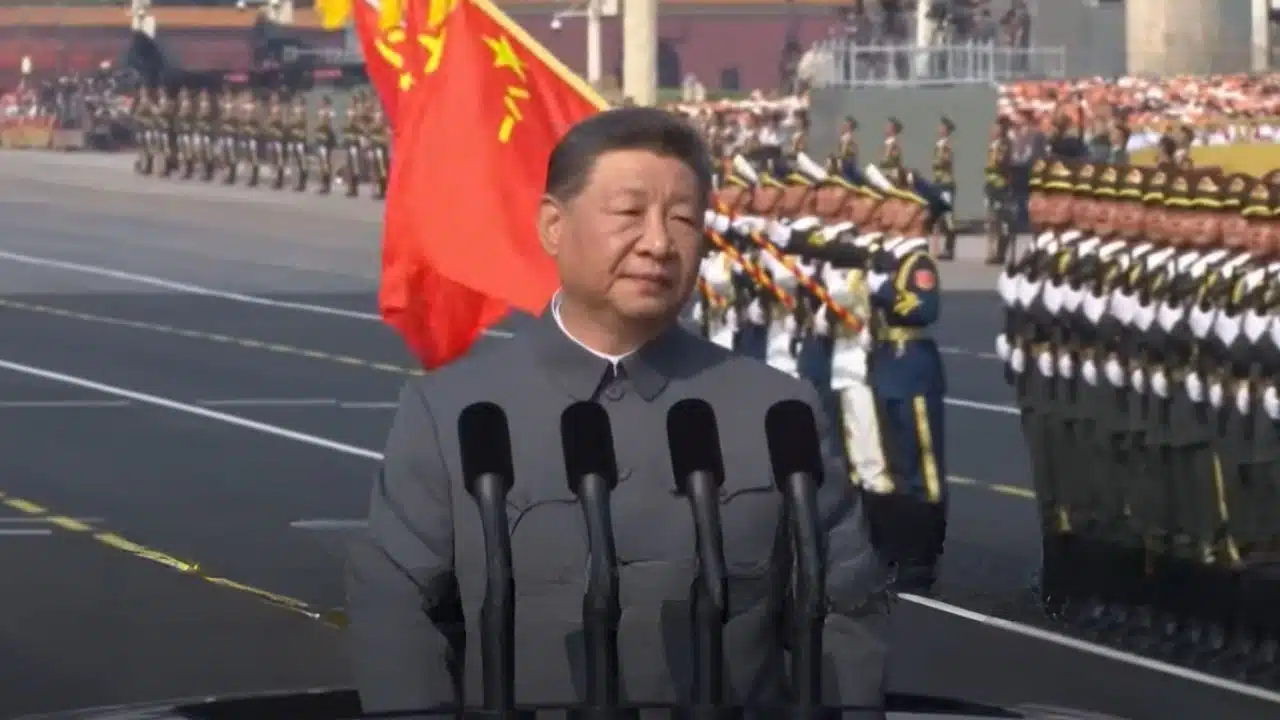
Beijing staged its most elaborate military parade in decades to commemorate the 80th anniversary of the end of World War II—known in China as the “War of Resistance Against Japanese Aggression.” Held in the vast Tiananmen Square, the parade was not only a commemoration of history but also a powerful showcase of modern Chinese military strength, signaling both pride in the past and ambition for the future.
More than 50,000 people filled the square, including foreign dignitaries, military officers, and carefully selected spectators. The event began with the solemn firing of an 80-gun salute, marking each year since Japan’s surrender in 1945. Soldiers marched in perfect unison, military trucks and tanks rumbled past the Forbidden City, and fighter jets roared overhead in synchronized formations, painting streaks of red, blue, and yellow across the Beijing sky.
The parade also featured cutting-edge Chinese military technology: long-range ballistic missiles, stealth fighters, unmanned aerial vehicles, electronic warfare systems, and cyber-security units. Observers noted the appearance of new hypersonic weapons and autonomous armored vehicles, evidence of China’s rapid investment in next-generation warfare. Official commentators emphasized that many of these systems were domestically developed, underscoring Beijing’s determination to reduce reliance on foreign technology.
Symbolically, the event concluded with the release of thousands of white doves—representing peace—and a cascade of colorful balloons, reinforcing Xi’s narrative that China’s growing strength is not meant for aggression but for safeguarding national sovereignty.
Xi Jinping’s Message: Peace, War, and the Global Crossroads
At the center of the event stood President Xi Jinping, delivering one of his most forceful speeches in recent years. Speaking from the iconic Tiananmen Rostrum, Xi warned that the world was once again at a critical juncture—facing a choice between peace or war, dialogue or confrontation, cooperation or rivalry.
Xi framed China as a nation that had endured hardship and foreign invasion, only to rise stronger. He stressed that China will never allow its sovereignty, territorial integrity, or national dignity to be compromised, a message widely interpreted as a veiled reference to Taiwan, which Beijing claims as its own.
He also pledged to strengthen China’s military modernization, highlighting the armed forces’ central role in defending not just China’s borders but also its place in an evolving world order. Xi cast China as standing “on the right side of history,” positioning his leadership as guiding the nation toward rejuvenation and global respect.
In contrast to Western narratives, Xi’s address downplayed the role of the United States and its allies in World War II, focusing instead on China’s sacrifices and resilience. This fits Beijing’s broader strategy of reshaping historical memory, portraying itself as the primary force in Asia’s victory against fascism, and presenting today’s China as the rightful leader of a new global balance.
A Gathering of Non-Western Allies: Putin and Kim Take the Stage
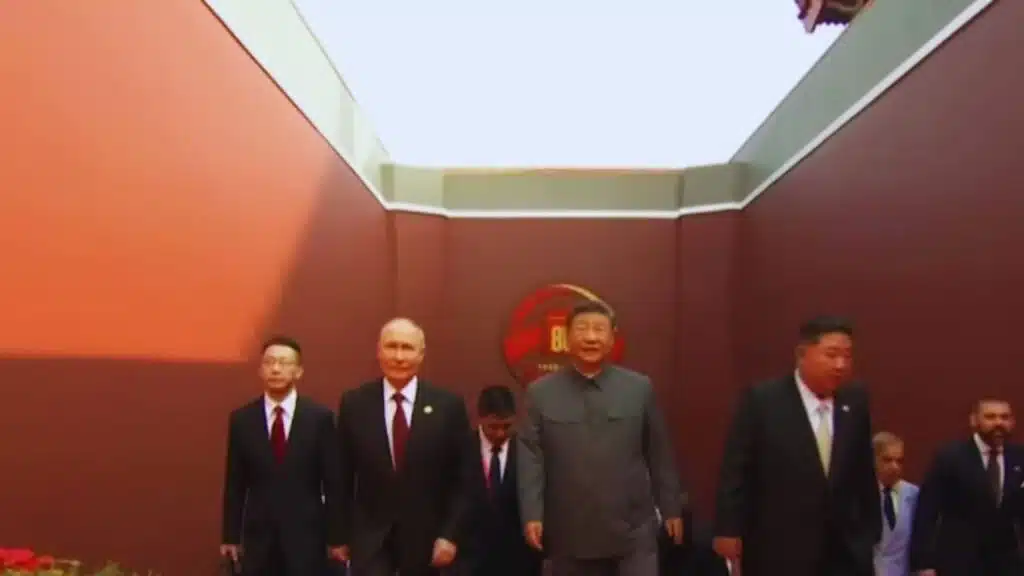
The parade was not only a Chinese domestic spectacle—it was also an international political statement. Sitting alongside Xi were Russian President Vladimir Putin and North Korean leader Kim Jong Un, creating a striking image of three leaders often positioned as rivals to the United States.
Putin’s attendance underscored the deepening ties between Moscow and Beijing, particularly as both countries face Western sanctions and military tensions with the U.S. and its allies. Just days before the parade, Putin and Xi had signed a long-awaited deal to construct the Power of Siberia 2 gas pipeline, further cementing energy and economic ties.
Kim Jong Un’s participation was equally significant. North Korea had recently drawn global scrutiny after reportedly sending troops and military support to Russia amid the Ukraine war. At the parade, Kim was accompanied by his young daughter, Kim Ju Ae, who for the first time appeared at a major international event. Analysts in Seoul noted her prominent placement beside her father as a strong signal that she is being groomed for eventual leadership, essentially treated as North Korea’s “second-in-command.”
Other notable guests included leaders from Southeast Asia, Central Asia, and Africa, demonstrating China’s growing diplomatic influence. Western leaders, however, were notably absent—highlighting the growing divide between Beijing and Washington’s spheres of influence.
Trump Responds: Sarcasm, Accusations, and a Warning
While Beijing showcased its military might, U.S. President Donald Trump responded from Washington with a sharp and sarcastic message posted on his Truth Social platform. He urged Xi to acknowledge the role that American soldiers had played in liberating China during World War II, reminding audiences that thousands of Americans had died in the Pacific theater.
Trump also accused China of aligning with America’s adversaries, writing that Xi should “give his warmest regards to Vladimir Putin and Kim Jong Un” as they “conspire against the United States.” His post mixed mockery with concern, portraying the Beijing gathering as a symbol of a strategic anti-U.S. bloc.
At the same time, Trump tried to soften his stance by noting that he still maintains a “very good relationship” with Xi personally, and said he does not view the parade itself as a direct threat. Nonetheless, his remarks reflected Washington’s unease about the deepening ties between China, Russia, and North Korea.
Trade Tensions, Diplomatic Shifts, and Regional Influence
Beyond the symbolic pageantry, the parade took place against a backdrop of tense U.S.-China relations. Earlier in the year, the two powers had imposed steep tit-for-tat tariffs, rattling global markets. Although both sides have since agreed to temporarily suspend most of these duties until mid-November, questions remain about whether the upcoming Trump–Xi meeting will produce meaningful progress on trade.
Meanwhile, analysts pointed out that China’s ability to bring leaders like Putin and Kim to Beijing while Western leaders stayed away illustrates the shifting gravitational pull of Chinese diplomacy. As some Asian nations hedge against U.S. unpredictability, Beijing has been positioning itself as an alternative hub for security and economic partnerships.
South Korea’s president notably declined Beijing’s invitation, reflecting Seoul’s closer coordination with Washington. But at the same time, eight leaders from Southeast Asia attended, highlighting China’s success in cultivating influence across its neighborhood.
Historical Memory: Rewriting the Past for Political Power
This year’s “Victory Day” commemoration also fits into Beijing’s broader campaign to reshape historical memory. By emphasizing its role in defeating fascism and downplaying U.S. contributions, China seeks to strengthen nationalism at home while weakening America’s moral authority in Asia.
State media and official narrators repeatedly underscored that the parade marked the “80th anniversary of the Chinese people’s victory over Japanese aggression and the world’s victory over fascism.” This phrasing deliberately links China’s suffering and sacrifice in World War II to its current global ambitions.
Xi’s government has long invested in war museums, school curricula, films, and ceremonies to promote the idea that modern China’s legitimacy stems from its wartime resistance and its role as a peacekeeper. The 2025 parade was a culmination of that narrative, combining patriotic symbolism with a forward-looking message of strength.
Broader Geopolitical Implications
The sight of Xi, Putin, and Kim together at Tiananmen Square sent a clear message to the world: China is consolidating its partnerships with countries that challenge the U.S.-led international system.
For Washington, the parade underscored the risks of a new geopolitical bloc aligned around China and Russia, with North Korea as a strategic partner. For China, the event showcased both technological progress and diplomatic clout, reminding the world that Beijing now sees itself not just as a regional power, but as a central player in shaping the global order.
The Information is Collected from CNBC and CNN.





















