

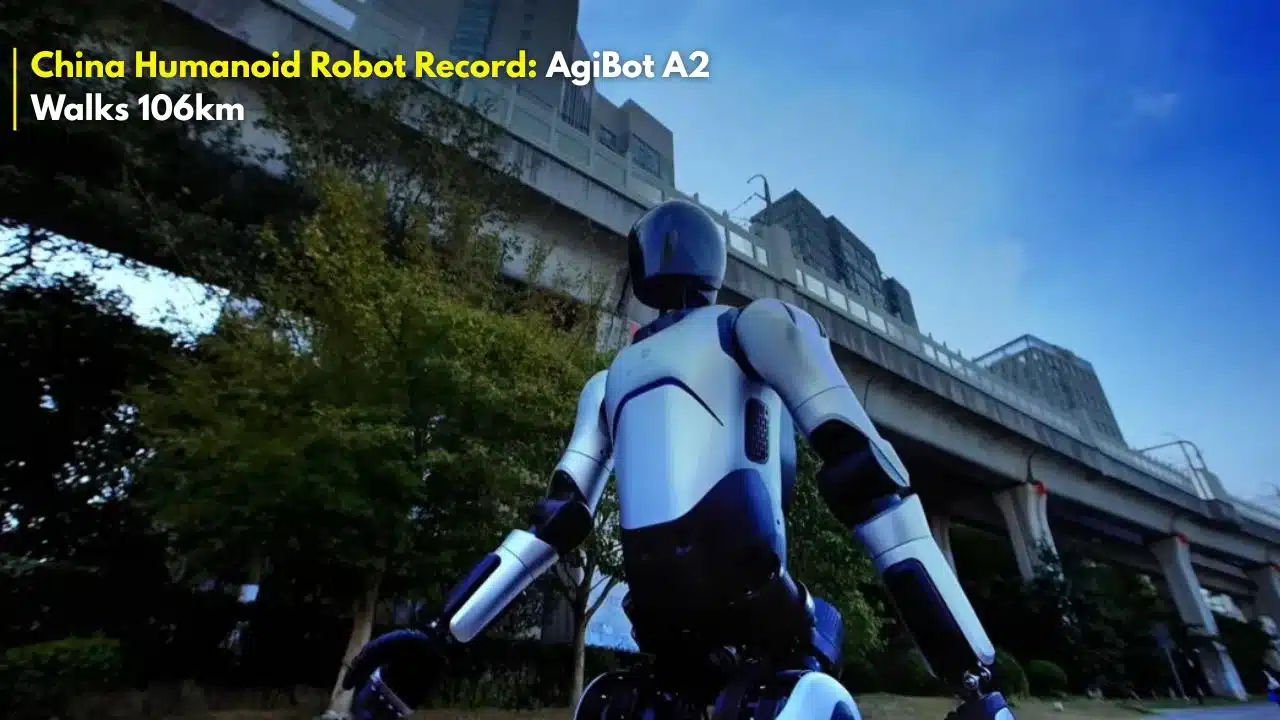
In a landmark demonstration that signals a definitive shift from laboratory experimentation to real-world utility, a Chinese-made humanoid robot has successfully completed a continuous 106-kilometer (66-mile) trek between two major cities. The feat, achieved by the AgiBot A2 (also known as Expedition A2), has set a new Guinness World Record for the farthest distance traveled by a quadruped/bipedal robot.
While the distance itself is headline-grabbing, the true breakthrough lies in the reliability of the engineering. For three days, the robot operated autonomously on public infrastructure, battling variable lighting, uneven terrain, and the unpredictability of open roads—a “stress test” that industry experts argue is the final barrier before mass commercial adoption.
Key Facts & Quick Take
-
The Record: Longest journey walked by a humanoid robot (106.286 km / 66 miles).
-
The Machine: AgiBot A2, a 175cm, 55kg bipedal robot developed by ex-Huawei “Genius Youth” Zhi Huijun.
-
The Route: From the scenic Jinji Lake in Suzhou to the historic Bund in Shanghai.
-
Critical Tech: A “hot-swappable” battery system allowed 70+ hours of continuous uptime without shutting down the OS.
-
Navigation: Employed a fusion of Real-Time Kinematic (RTK) GPS and Vision-SLAM (Simultaneous Localization and Mapping) to navigate complex urban topography.
The Trek: A 70-Hour Odyssey Through the Yangtze Delta
On the evening of November 10, 2025, the AgiBot A2 departed Suzhou, a city known for its blend of ancient canals and high-tech manufacturing. Its destination was Shanghai, the financial heart of China.
This was not a controlled environment. Unlike the pristine floors of a factory or the flat treadmills used in R&D labs, the 106-kilometer route presented a chaotic mix of variables. The A2 had to negotiate:
-
Tactile Paving: The yellow, textured bricks designed for the visually impaired are notoriously difficult for bipedal robots, often causing ankle instability. The A2 adjusted its foot placement dynamically to handle the ridges.
-
Elevation Changes: Bridges, wheelchair ramps, and curbs required the robot to constantly shift its center of gravity.
-
Environmental Noise: While the weather was favorable, the visual “noise” of traffic, pedestrians, and changing light conditions (from bright noon sun to streetlights) tested the robustness of its perception algorithms.
The “Impossible” Logistics
The robot did not stop to sleep. The operation was continuous. A support team followed the robot, but they did not intervene in its movement. When the battery levels dipped critically low, the team performed a “hot swap”—replacing the battery pack on the robot’s back in seconds. This architecture is vital; it means future industrial robots can work 24/7 shifts without 4-hour charging downtimes.
Technical Deep Dive: The Brain Behind the Brawn
How did it stay upright for 106 kilometers? The success of the AgiBot A2 relies on a bifurcated AI architecture, often described as a “Cerebrum and Cerebellum” system.
1. The Cerebellum (Motion Control)
This system handles the “subconscious” tasks: balance, gait generation, and reflex. It ensures that when the robot steps on a loose stone, it corrects its posture within milliseconds, much like a human does without thinking.
-
Tech: Model-based reinforcement learning (RL).
-
Result: The A2 maintained a steady walking pace of roughly 1.5 to 2 km/h, prioritizing stability over speed.
2. The Cerebrum (embodied AI)
This is the “conscious” planning layer. It processes data from the robot’s sensor suite—LiDAR (Light Detection and Ranging), depth cameras, and IMUs (Inertial Measurement Units).
-
Function: It identifies a traffic light, decides when to cross, and maps the path 10 meters ahead.
-
Innovation: The A2 utilized End-to-End Learning, meaning the AI learns directly from raw sensor input to motor output, rather than relying on rigid, pre-programmed “if-then” rules.
Expert Insight: “The challenge isn’t making a robot walk. It’s making it walk for 100,000 steps without a single catastrophic error. A 99.9% success rate means you fall every 1,000 steps. AgiBot achieved a reliability rate closer to 99.999%.” — Dr. Chen Yi, Robotics Systems Architect (Paraphrased).
The Man Behind the Machine: “Iron Man” Zhi Huijun
The credibility of this project stems largely from its founder, Peng Zhihui (known online as Zhi Huijun). A former prominent member of Huawei’s “Genius Youth” program, he left the tech giant to found AgiBot in 2023.
Zhi is a celebrity in China’s tech community (Bilibili), often compared to a younger Elon Musk for his hands-on engineering skills. His philosophy focuses on “Embodied Intelligence“—the idea that AI is useless without a physical body to interact with the world. Under his leadership, AgiBot has moved from prototype to mass-production readiness in under 24 months, a pace that rivals Silicon Valley startups.
Comparative Analysis: The Global Humanoid Race
China is not running this race alone. The sector is heating up globally. Here is how AgiBot compares to its primary rivals as of late 2025:
| Feature | AgiBot A2 (China) | Tesla Optimus Gen-3 (USA) | Boston Dynamics Atlas (USA) |
| Primary Focus | Reliability & Logistics | Factory Automation | Dynamic Agility (R&D) |
| Locomotion | Efficient Walking | Manufacturing Movement | Parkour / Heavy Gymnastics |
| Power System | Hot-Swappable Battery | Integrated Charge | Integrated Charge |
| Est. Cost | ~$30,000 USD | Target <$25,000 | Premium / High Cost |
| Key Milestone | 106km Distance Record | Autonomous Factory Tasks | 360-degree Joint Rotation |
While Boston Dynamics creates robots that can dance and do backflips, AgiBot is targeting the “boring” reality of industrial work: walking long distances on factory floors to move parts. The 106km trek serves as a brochure for factory owners proving that the robot won’t break down during a shift.
Economic Impact: Solving the Demographic Crisis
The timing of this record is not accidental. China is facing a severe demographic shift, with a shrinking workforce and an aging population. The Ministry of Industry and Information Technology (MIIT) has explicitly targeted 2025–2027 as the incubation period for humanoid robots to enter the workforce.
Why Endurance Matters:
-
Patrol Duties: Power plants and chemical facilities need 24/7 inspection. A robot that can walk 100km can patrol a massive facility indefinitely with battery swaps.
-
Last-Mile Delivery: In dense cities like Shanghai, wheeled robots struggle with stairs. A bipedal robot like A2 can navigate curbs and enter buildings.
-
Cost Reduction: AgiBot aims to bring the cost of the robot down to roughly 200,000 RMB ($28,000 USD). At this price point, the ROI (Return on Investment) for a factory replaces a human worker’s salary in roughly 18-24 months.
What to Watch Next
Following the successful arrival at the Bund on November 13, AgiBot has announced the next phase of the A2’s lifecycle:
-
Hand Manipulation Tests: Walking is solved. Now the robot must prove it can handle delicate objects (eggs, glass) and heavy tools (drills, boxes).
-
Open Source Data: AgiBot has hinted at releasing some of the movement data from the trek to help train the broader Chinese robotics ecosystem.
-
Mass Deployment: 1,000 units are currently being deployed in automotive factories in the Yangtze River Delta for pilot programs.
Conclusion
As the AgiBot A2 stood on the Shanghai Bund, contrasting against the futuristic skyline of Lujiazui, it represented a tangible step forward. We are no longer asking if humanoid robots can coexist in our physical spaces, but when they will become a common sight. By conquering 106 kilometers of asphalt and stone, AgiBot has proven that the age of the delicate, stumbling robot is over; the age of the endurance machine has begun.
























