
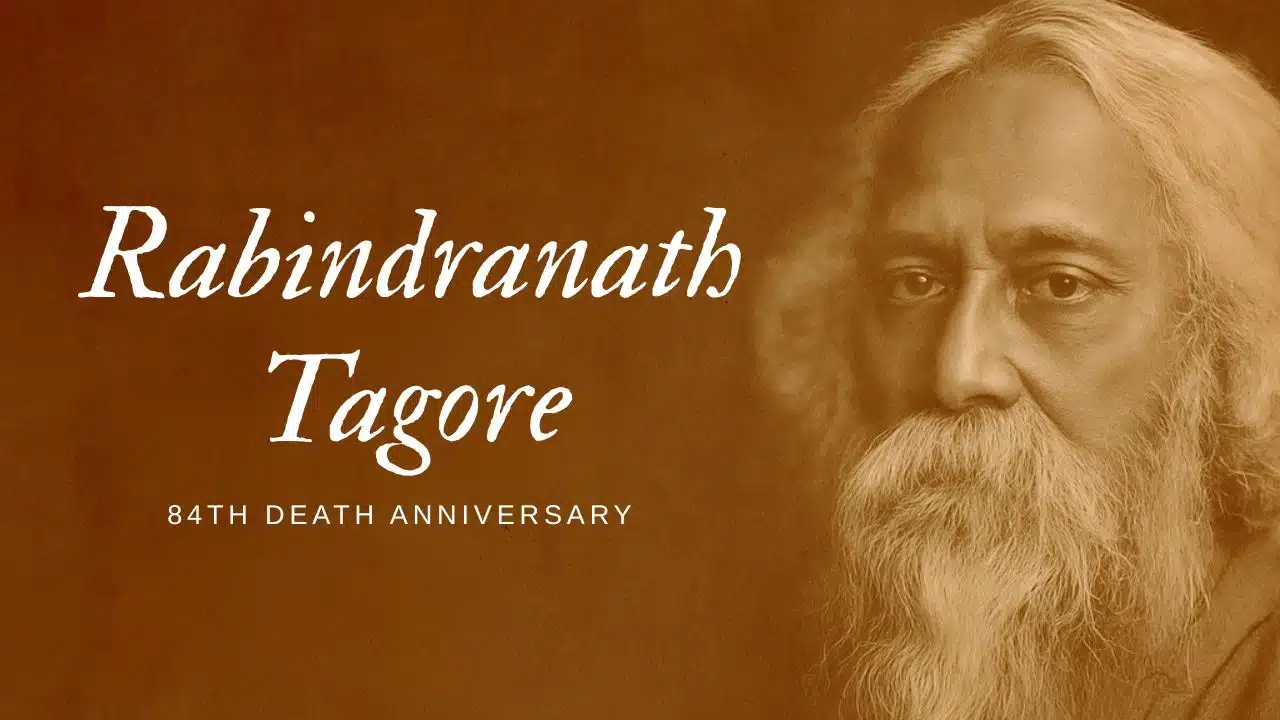
On this 22nd day of Shraban in the Bengali calendar, we observe the 84th death anniversary of Rabindranath Tagore—a name synonymous with creativity, wisdom, and profound human insight. Decades after his passing in 1941, the world still asks: Has anyone truly matched the genius of Rabindranath Tagore?
This is not just a question of literary talent but one of multidimensional mastery across poetry, music, education, art, and philosophy. As the world advances, the legacy of Rabindranath Tagore’s genius remains timeless, undiminished, and perhaps unmatched.
Rabindranath Tagore: A Bard Beyond Centuries
Tagore was not merely a poet or philosopher—he was a phenomenon who redefined what it meant to be a Renaissance man in the East. His contributions cannot be confined to a single genre or discipline.
Whether it was founding a new school of music, penning the national anthems of two nations, or reforming education through Visva-Bharati, Rabindranath Tagore’s genius stretched far beyond literary greatness. His vision touched the soul of Bengal while resonating deeply with the world at large.
The Dimensions of Tagore’s Genius
When we speak of Rabindranath Tagore’s genius, we must move beyond traditional definitions of creativity. His brilliance was not confined to one art form or intellectual discipline. Instead, it spanned literature, music, education, philosophy, and visual art—a rare harmony of emotional depth, intellectual rigor, and spiritual insight.
Tagore’s genius can be best appreciated by exploring the different domains in which he left an indelible mark.
A Literary Titan
The foundation of Rabindranath Tagore’s genius lies in his literary work. Over the course of his life, he authored more than 50 volumes of poetry, novels, short stories, plays, and essays—each marked by depth, lyricism, and philosophical insight. His early poems carried the romanticism of youth, while his later works reflected a more nuanced, spiritual outlook.
He pioneered the Bengali short story, bringing emotional complexity and psychological realism into works like Kabuliwala, The Postmaster, and The Homecoming. His novels, like Gora, Chokher Bali, and Ghare-Baire, confronted colonialism, gender roles, and spiritual conflict—making him not only an artist but also a social critic.
Nobel Laureate and Global Thinker
In 1913, Rabindranath Tagore became the first Asian Nobel Laureate in Literature for his English translation of Gitanjali (Song Offerings)—a moment that placed Indian literature on the world map. His Nobel win wasn’t simply for poetic style; it was for the universal humanism he infused into every word.
Tagore’s exchanges with intellectuals like Albert Einstein, W.B. Yeats, and Romain Rolland reflect how his philosophical depth extended across continents. His vision of a borderless world, where unity in diversity was celebrated, made Rabindranath Tagore’s genius not only literary but also deeply spiritual and political.
Musical Innovator and Cultural Architect
Few realize the sheer magnitude of his contributions to music. Tagore composed over 2,000 songs, collectively known as Rabindra Sangeet—a genre so unique and beloved that it forms a cornerstone of Bengali identity. His songs blend classical Indian ragas with folk tunes and lyrical poetry.
Even more astonishingly, he penned the national anthems of both India (Jana Gana Mana) and Bangladesh (Amar Shonar Bangla)—a feat unparalleled in world history and a testament to the emotional reach of Rabindranath Tagore’s genius.
In 1921, he founded Visva-Bharati University in Santiniketan—a place that embodied his philosophy of holistic, nature-based, and culturally inclusive education. Here, art and knowledge flourished in an environment free from colonial rigidity.
The Impact Tagore Left Behind
Tagore did not just create art; he created culture. He reimagined Bengal’s identity during a time of colonial crisis and gave it a global voice rooted in Eastern values. His influence shaped generations of artists, thinkers, educators, and reformers.
His literary works remain essential reading in universities around the world. His songs continue to be sung on national and personal occasions alike. His plays are still staged, his ideas still debated, and his paintings still admired.
Even in 2025, one feels the invisible thread of Rabindranath Tagore’s genius running through contemporary Bengali literature, Indian music, global poetry movements, and modern educational theory.
Has Anyone Matched His Genius Since 1941?
Eighty-four years have passed since Rabindranath Tagore left this world, yet the question remains as relevant as ever: Has anyone since 1941 matched the multifaceted brilliance of Rabindranath Tagore’s genius? To answer this, we must examine the cultural, literary, and intellectual landscapes of both India and the wider world.
In India and Bengal
Post-Tagore, Bengal and India have produced many brilliant minds—Satyajit Ray, Jibanananda Das, Sunil Gangopadhyay, and Amartya Sen, to name a few. Each has made significant contributions to their field, but none have embodied the same multidisciplinary brilliance.
Jibanananda Das may have surpassed him in modern poetic style. Satyajit Ray, a true polymath, shone in cinema and literature. Yet, their genius, however luminous, remained within narrower bounds. Rabindranath Tagore’s genius, on the other hand, sprawled across the arts, music, literature, and education like a banyan tree sheltering the intellectual spirit of a nation.
In the Global Literary Arena
Globally, figures like Gabriel García Márquez, Pablo Neruda, Octavio Paz, and Bob Dylan have achieved monumental success. Some won Nobels; others revolutionized genres. Yet none have combined poetry, music, art, education, and sociopolitical thought as seamlessly as Tagore did.
His contemporaries respected him as a visionary who bridged East and West. His spiritual and philosophical worldview remains relevant in today’s globalized yet fragmented society. His genius continues to defy imitation.
Why Tagore’s Genius Remains Unparalleled
The reason Rabindranath Tagore’s genius remains unparalleled is that he didn’t just master various forms of expression—he transformed them. He gave the Bengali language its poetic soul. He challenged colonial and narrow religious ideologies with a voice that was soft yet subversive. He created institutions, composed songs, painted canvases, and wrote words that still move the human spirit.
Even after 84 years, his works remain emotionally alive and philosophically deep. In an era of specialization, Tagore’s universalism stands as an ideal that very few dare—or are able—to pursue.
Tagore’s Immortality in a Changing World
84 years after he left this world, Rabindranath Tagore’s genius lives on—not just in libraries or museums but in everyday life: in the songs sung in homes, the lessons taught in classrooms, and the values passed from one generation to the next.
Perhaps no one has matched his genius because Tagore was more than an artist—he was a civilization in himself. His legacy is not merely remembered; it is lived. And that, more than anything else, is the mark of true immortality.
Final Word
In paying tribute on his 84th death anniversary, we don’t mourn what was lost—we celebrate what endures. For as long as there is music in the heart, poetry in the soul, and longing for truth in the mind, Rabindranath Tagore’s genius will continue to illuminate the world.