

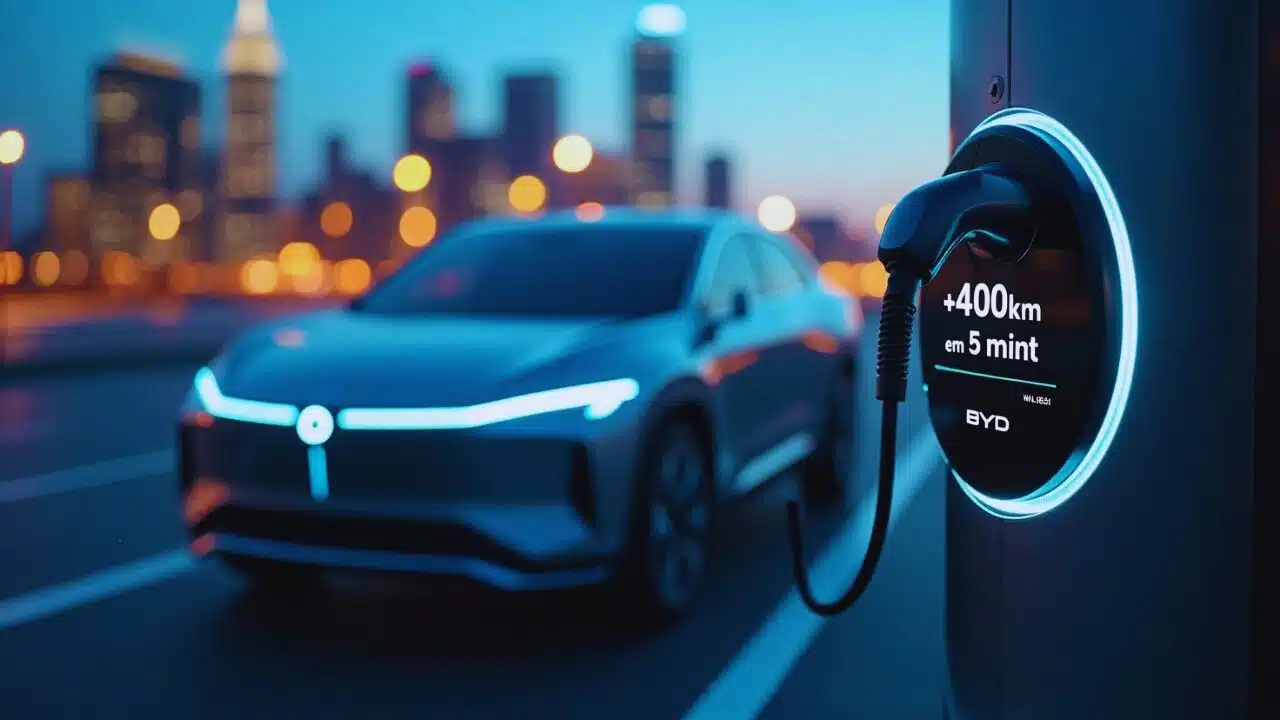
BYD 746-kilowatt charging was shown in a new real-world demo in China, where a Han L prototype/vehicle session peaked at 746 kW and added roughly 400 km of range in about five minutes—months after BYD unveiled its 1,000V “Super e-Platform” and promised megawatt-class charging aimed at making EV stops feel as fast as fuel refills.
What happened in the 746 kW demo
A newly circulated charging video from China shows a BYD vehicle hitting a peak charging power of 746 kW and rapidly adding close to 400 km of indicated range in around five minutes.
Reports describing the clip say the session captured a BYD Han L charging roughly from 10% to 70% in about five minutes at the 746 kW peak.
The same coverage frames the demo as an early in-the-wild proof point that BYD’s megawatt-charging concept can translate beyond a stage presentation—at least under controlled, high-power conditions.
Why 746 kW matters
A 746 kW peak is far above the charging power most public fast-charging sites deliver today, and it narrows the psychological gap between charging and refueling by compressing meaningful range gains into minutes.
BYD’s own messaging positions the end goal as solving charging anxiety by making charging time comparable to gasoline refueling time.
The earlier announcement it builds on
In March 2025, BYD announced its Super e-Platform, presenting it as a mass-produced full-domain 1000V high-voltage architecture designed to lift major vehicle systems to 1000V operation.
At that launch, BYD also introduced its Flash Charging Battery, stating it can reach 1000A charging current and a 10C charging rate, and pairing those with 1000V to target up to 1 megawatt (1000 kW) charging power.
BYD said the system could add 2 km of range per second—equating to about 400 km of range in five minutes—setting the benchmark the December 746 kW demo now appears to approach in practice.
Key claims BYD tied to Super e-Platform
BYD’s launch materials also highlighted a mass-produced 30,000 RPM motor (reported as 30,511 RPM) and next-generation automotive-grade SiC power chips rated up to 1500V as part of the ecosystem supporting higher-voltage, higher-power operation.
The company additionally described a liquid-cooled Megawatt Flash Charging terminal system with maximum output capability up to 1360 kW and said it planned to build over 4,000 megawatt flash-charging stations in China.
Vehicles and rollout: Han L and Tang L as the first testbed
BYD positioned the Han L sedan and Tang L SUV as the first models built on the Super e-Platform, with pre-orders opening in China around the March 2025 reveal and a planned April launch window.
Coverage ahead of the April launch said both models would support a 10C charging multiplier and that BYD planned early deployment of megawatt flash-charging stations, with a first batch of about 500 expected to be ready around the time the vehicles went on sale.
The same reporting outlined the electrical headline numbers—up to 1000V and 1000A (implying up to 1000 kW)—that underpin BYD’s megawatt framing for passenger-vehicle charging.
Timeline of the two linked developments
| Date (2025) | Development | What BYD/coverage said | Evidence |
| Mar. 17 | Super e-Platform unveiled | 1000V architecture; Flash Charging Battery; target 1 MW; 1 second for 2 km; 400 km in 5 minutes | |
| Late Mar. | Network buildout signaled | Plan for 4,000 stations; first batch ~500; stations to support 1 MW | |
| Dec. 22–24 | Real-world demo circulates | Peak charging around 746 kW; ~400 km in ~5 minutes; ~10% to ~70% in ~5 minutes (Han L referenced) | |
What needs to be true for five-minute EV charging to scale
BYD’s approach depends on aligning three pieces at once: vehicles built for 1000V-class charging, batteries engineered for very high current and fast ion transport, and charging sites capable of delivering megawatt-class power safely and repeatedly.
Even if vehicles can accept very high peak power, the broader rollout hinges on building enough high-output stalls—something BYD itself linked to deploying thousands of dedicated megawatt stations in China.
The December demo helps validate that the promised charging curve is achievable in at least some real charging sessions, but scaling that experience widely requires consistent hardware availability and site-level power delivery at many locations.
Snapshot: BYD’s stated technical pillars vs the demo result
| Item | BYD’s stated capability/plan | What the late-2025 demo showed | Evidence |
| Vehicle electrical architecture | Full-domain 1000V for passenger vehicles | Demonstration aligned with 1000V-class fast charging narrative | |
| Battery fast-charge targets | 1000A current, 10C rate; up to 1000 kW | Peak observed/reported around 746 kW | |
| Time-to-range headline | 400 km in 5 minutes (stated benchmark) | ~400 km in ~5 minutes (reported from video) | |
| Infrastructure plan | 4,000+ megawatt stations in China | Demo implies at least some stations already capable of very high power | |
Final thoughts
BYD 746-kilowatt charging is emerging as a practical proof-of-execution for the company’s March promise that megawatt-class charging can push EV stops into the minutes, not tens of minutes category.
The next decisive test is scale: whether BYD can deploy enough megawatt-capable stations, and whether Han L/Tang L owners can access these peak speeds routinely rather than occasionally.
If BYD’s infrastructure buildout keeps pace with vehicle deliveries, the competitive conversation could shift from who has the longest range to who can replenish meaningful range the fastest, especially in high-density markets where charging throughput matters.

























