

Treating a twelve-hour daily ranked marathon like a real job is an easy path to chronic wrist pain and profound burnout. Sure, climbing the matchmaking ladder serves a purpose by establishing your mechanical floor and basic spatial awareness. But actually building an esports career requires an entirely different operational playbook than simply logging thousands of solo matches and praying an influential scout accidentally glances at your dashboard.
To truly scale the competitive infrastructure, players must approach the industry like a calculated craft—marrying in-game execution with deep professional visibility, reputation management, and high-intensity structural training.
Why Pure Mechanical Talent Stalls Out Without Core Infrastructure
The competitive scene is littered with cracked aimers who cannot survive a single high-intensity team environment. It’s a brutal reality check. When professional rosters drop down into severe tournament stress, scoreboards take a backseat to behavioral endurance. Teams aren’t looking for isolated highlight reels anymore; they are tracking how your internal communication loops function when a match completely falls apart.
Organizations focus heavily on distinct operational traits that separate raw mechanical talent from roster assets:
-
Composed tactical callouts: Delaying personal frustration to deliver dense, zero-fluff positioning data inside the team channel during a chaotic crossfire.
-
Genuine coachability shifts: Absorbing blunt, unvarnished video assessments from team analysts without letting your ego get defensive.
-
Operational reliability: Arriving thirty minutes early for a scheduled scrimmage, completely warmed up, day in and day out.
-
Systemic flexibility: Willingly abandoning your preferred individual playstyle to execute an exhausting macro map rotation that guarantees a team victory.
Mapping out Your Professional Gaming Career Trajectory
Forcing yourself into a single, hyper-congested player lane often causes newcomers to miss massive organizational opportunities right in front of them. The modern competitive ecosystem supports an entire matrix of highly specialized vocational tracks.
| Professional Path | Primary Functional Focus | Core Prerequisites | Ground-Floor Entry Point |
| Professional Athlete | Competing for trophies at the absolute highest tier of live play. | Elite reflexes, deep meta knowledge, and massive stamina. | Open brackets, grassroots qualifiers, and community hubs. |
| Broadcasting Talent | Providing engaging live commentary and play-by-play analysis. | Vocal control, high energy, deep pacing awareness, and charisma. | Amateur online tournaments and local community broadcasts. |
| Strategic Coach | Tuning individual habits and building macro team strategies. | Advanced analytical data interpretation and empathetic leadership. | VOD review channels and volunteer coaching roles for amateur stacks. |
| Esports Analyst | Deconstructing enemy tendencies and reading patch-meta trends. | High-level pattern recognition, database tracking, and research. | Written strategy breakdowns, analytical blogs, and video essays. |
| Operations Staff | Managing logistics, scheduling, and player administrative pipelines. | Elite organization skills, project management, and conflict resolution. | Roster management or volunteer admin work at local LAN events. |
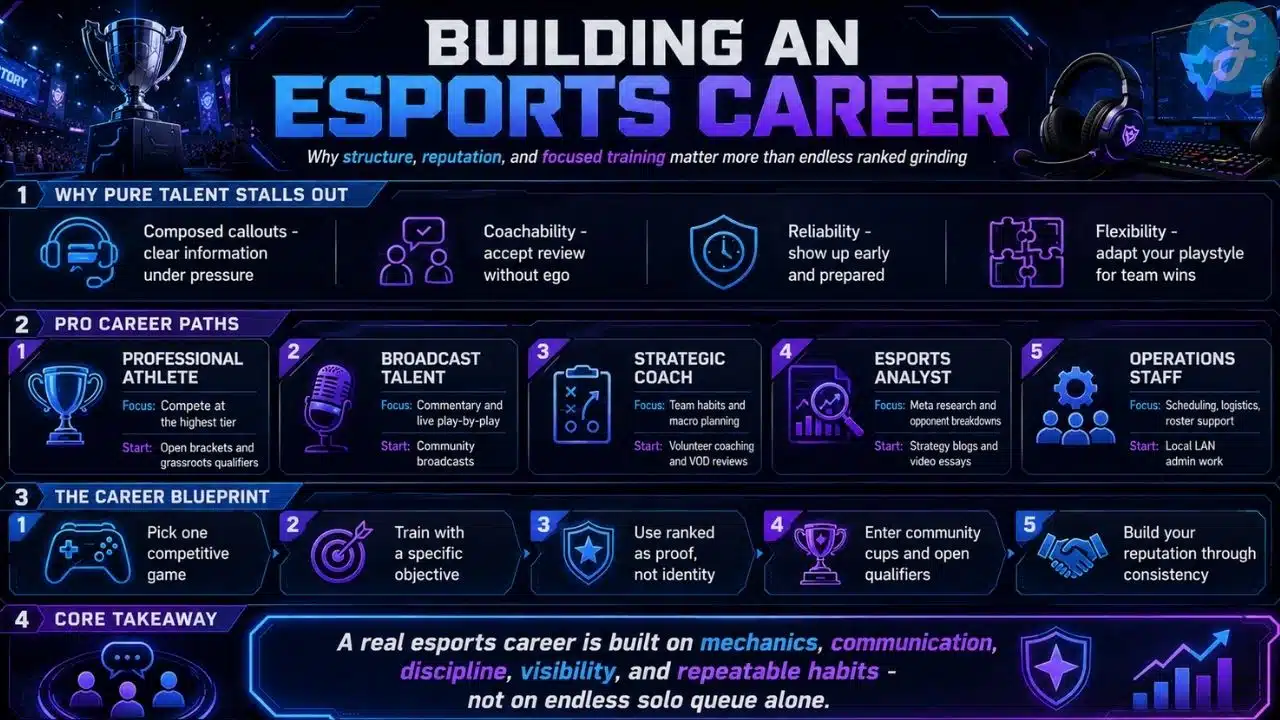
The Strategic Blueprint for Building an Esports Career
Before you can pitch your value to a tier-2 or tier-1 organization, you must treat your daily execution like a technical trade. This means moving away from mindless queue grinding and stepping into highly deliberate habit formation.
Anchor Your Focus to a Singular Competitive Domain
Splitting your cognitive load across three different genres is mechanical suicide. You cannot build true high-level reflex paths if you are bouncing between a tactical shooter and a hyper-paced battle royale on a weekly basis. Pick one game. Drill into its netcode nuances, physical recoil curves, and line-of-sight map geometry until the execution is pure instinct. Choose an ecosystem with a stable publisher path and a vibrant local grassroots layer.
Re-engineering Daily Practice Routines
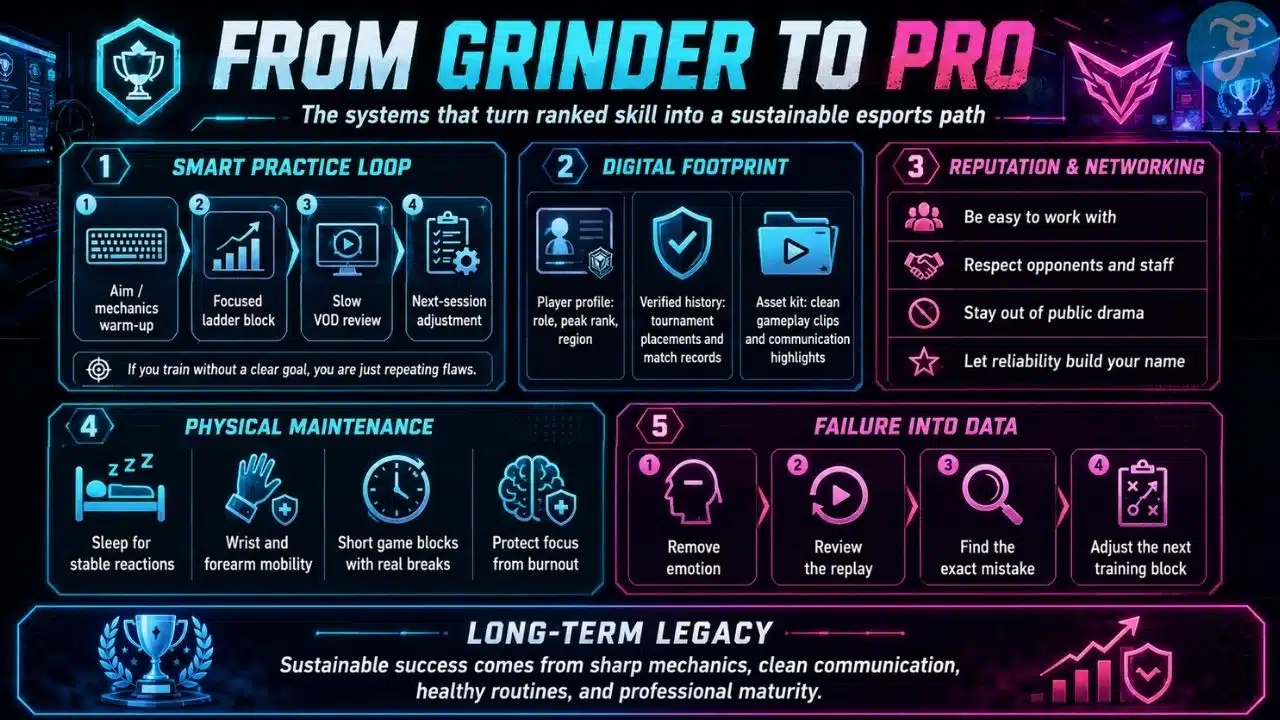
Mindless queuing isn’t practice; it’s just repetition of uncorrected flaws. Elite development means breaking your setup down into targeted, clinical blocks.
-
Spend twenty minutes isolating micro-tracking routines in an aim trainer before your server lobby even opens.
-
Dedicate specific ladder windows exclusively to tracking enemy cooldowns rather than your personal kill count.
-
Follow that up with ruthless, slow-motion VOD scrubbing.
If you sit down without an explicit, localized growth objective for the next two hours, you aren’t training. You’re just playing.
The Complex Realities of the Public Ladder
Leaderboard ratings are an exceptional resume piece, but they make for a terrible identity. Hitting the top tier proves individual mechanical pacing and an acute grasp of the current matchmaking meta. It checks a box. What it completely fails to simulate is the agonizing emotional drag of an offline open bracket, or the absolute tactical compliance demanded by an active coach during a grand final draft phase. Use the rank to get your foot in the door, but leverage amateur scrim environments to build your actual competitive reputation.
Jumping Into the Bracket Trial by Fire
Do not hide in the practice range until you feel flawless. Perfection is an illusion that shatters the moment you check into a real tournament lobby. Low-tier community cups, local LAN grids, and open qualifiers expose structural errors that standard ranked matchmaking naturally masks. They show you exactly how your hands shake when a round is on the line. They reveal the precise moment your communication becomes messy under fatigue. Embrace the early losses; they are data, not failures.
Establishing a Clean Digital Footprint
Investing your energy into building an esports career requires strategic visibility. You can be the most talented mid-laner or entry-fragger in your region, but if your accomplishments remain completely invisible, opportunities will pass you by. Cultivating a professional digital footprint ensures that when scouts or community managers search for talent, your record stands out cleanly.
Architecting a Clean, Quantifiable Player Resume
Ditch the long-winded paragraphs and establish a crisp, easily digestible digital profile. Serious teams look for clean data points, not inflated claims:
-
Core Vital Metrics: Main title, specific roster role, current peak rank, and your active server region.
-
Verifiable History: Past tournament placements, links to live match histories, and official team histories.
-
Technical Asset Kit: High-quality, unedited gameplay clips highlighting smart spatial awareness and communication over simple lucky moments.
True professional networking is just a side effect of showing unyielding reliability in high-level scrim pools. Show up early, respect your opponents during post-game handshakes, and completely isolate yourself from public community drama. Information travels instantly within tight competitive circles; being an easy, coachable asset makes you the first name captains drop when a roster needs an immediate substitution.
Physiological Maintenance for High-Performance Gamers
The esports ecosystem loves to romanticize sleep-deprived grinds. It’s a toxic narrative that ends promising careers before they even start. If your hands are cramping, your eyes are tracking slowly from lack of sleep, and your brain is utterly fried from screen fatigue, your performance floor tanks. Treat your body like a legitimate athletic asset. Lock in a daily wrist and forearm mobility routine to ward off repetitive strain injuries. Enforce strict, isolated game blocks separated by genuine cognitive resets away from your monitor.
Stripping the Emotional Noise From Competitive Failure
Defeats are the ultimate catalyst for mechanical growth, provided you treat them as clean telemetry rather than personal insults. A casual player immediately blames netcode latency, character balancing, or bad matchmaking luck. A true competitor isolates specific performance variables. Did you panic and blow a critical ability cooldown early? Was your positioning out of sync with your back-line support? Strip away the emotional tilt, extract the raw data from the replay file, and adapt your next training block accordingly.
Unlocking a Sustainable Professional Gaming Legacy
Transitioning from a casual matchmaking grinder into an industry mainstay requires a complete psychological shift. Success in building an esports career is ultimately measured by structural patience, a willingness to dismantle bad physical habits, and an unyielding commitment to the boring, repetitive mechanics of the daily grind. There are no shortcuts or hidden tricks. By marrying razor-sharp individual mechanics with exceptional communication, clinical data self-assessment, and absolute professional maturity, you build an ironclad framework that transforms a competitive dream into an undeniable lifestyle.