

Voting systems today face issues like fraud, low security, and mistrust. Blockchain technology offers a way to improve elections with better transparency and security. This blog explores ten blockchain-based voting systems that could change how we vote forever.
Keep reading to discover the future of democracy!
The Current State of Voting Systems
Modern voting systems face many problems. In the 2020 U.S. presidential election, voter turnout stood at 62%, slightly below the OECD average of 65%. Despite improvements, low participation remains a major issue in some regions.
Many countries still rely on traditional paper ballots or outdated electronic voting machines that lack proper security features.
Some places are making progress with digital tools. Estonia has offered blockchain-based e-voting since 2005 using secure digital IDs. Zug, Switzerland held a municipal vote via smartphone blockchain in 2018, showing how technology can enhance ease and access.
Yet challenges persist—fraud risks, limited transparency, and slow processes weaken confidence in electoral systems worldwide.
How Blockchain Technology Enhances Voting

Blockchain voting improves elections with secure, tamper-proof technology. It boosts faith in results by using encrypted data and digital signatures.
Security and Transparency
Votes are encrypted and time-stamped, making tampering nearly impossible. Each vote is securely recorded on a decentralized ledger, ensuring authenticity. Cryptographic techniques like digital signatures and hashes verify voter identities without exposing personal data.
Real-time auditing boosts election transparency. Blockchain networks allow anyone to verify the process while protecting privacy using tools like homomorphic encryption. Smart contracts automate countings, reducing human errors that might lead to disputes or fraud.
Accessibility and Inclusivity
Blockchain-based voting systems make voting easier for everyone. Voters can cast ballots online from anywhere with internet access, which helps people living overseas or those in remote areas.
These systems often include multi-language options, making it simple for non-native speakers to participate.
Many platforms also cater to disabled voters. Features like facial recognition and biometric authentication ensure secure voter participation without needing a polling station visit.
For example, Voatz supports military personnel and citizens with disabilities, boosting inclusivity while cutting costs and increasing turnout.
Fraud Prevention
Each vote on a blockchain voting system gets tied to a unique ID. This makes tampering and electoral fraud nearly impossible. Blockchain uses cryptographic methods, like private keys and zero-knowledge proof, to secure voter data.
These tools authenticate voters while keeping their identities secret.
For extra safety measures, systems like DemocracyGuard employ QR code-based validation. They also use deep learning algorithms to detect unusual voting patterns quickly. Biometric data, such as iris scans or Aadhaar numbers, adds another layer of protection in some platforms.
Together, these methods strengthen election transparency and cut down risks of fraudulent activities.
Top Blockchain-Based Voting Systems Revolutionizing Democracy
Discover ten groundbreaking blockchain voting systems reshaping elections—and see how they bring security, transparency, and trust to the process.
Voatz
Voatz made history in 2018 by conducting mobile voting during a U.S. Federal Election. It became the first smartphone-based voting app used in a U.S. Presidential Election in 2020.
Supported by blockchain technology, Voatz ensures election transparency and security for users. It employs voter authentication methods like biometrics and multifactor authentication to verify identities.
The app has served over 2.3 million voters across 125 elections in six countries. The Government Blockchain Association recognized it as a “Trusted Blockchain Solution.” Using cryptographic keys and smart contracts, Voatz secures votes against fraud while offering reliability through decentralized applications.
Its use of blockchain technologies builds trust within the electoral process, paving the way for future electronic voting systems worldwide.
Follow My Vote
Follow My Vote uses blockchain technology to create secure and transparent elections. It provides voter authentication via digital identities and ensures voter anonymity through cryptographic techniques like blind signatures.
The system prevents tampering by using the Bitcoin framework with ECC encryption and Proof-of-Work (PoW). Votes are securely stored, decentralized, and verified with consensus mechanisms.
This e-voting system offers election transparency by allowing open access to results without exposing private data. Its application of blockchain makes fraud prevention more effective and boosts accountability in online voting systems.
It also supports verifiable voting records while protecting sensitive information from being decrypted or altered.
Polys
Polys, developed by Kaspersky Lab, offers a secure blockchain-based online voting platform. It supports four different ballot types, making it suitable for diverse electoral processes.
The software operates in multiple countries as a private and for-profit entity. Its closed-source design ensures privacy while including tools like statistical data analysis and data export options.
This e-voting system uses blockchain security to enhance election transparency and prevent voter fraud. Polys also provides authenticated voter participation through cryptographic techniques.
By supporting internet voting, it aims to increase accessibility and inclusivity in elections worldwide.
Agora
Agora gained attention during Sierra Leone’s 2018 presidential election. It showcased the power of blockchain technology in secure and transparent voting. Using cryptographic techniques like secret sharing, it ensured voter data remained private while maintaining tamper-proof records.
This system uses consensus algorithms to enhance trust in e-voting systems. Its use of public keys and bit commitment adds another layer of security. Agora also supports election transparency by providing a clear audit trail for all votes cast electronically.
Luxoft
Luxoft, a founding member of the Crypto Valley Association, developed its e-voting platform using Hyperledger Fabric. This system uses a permissioned blockchain for secure and transparent elections.
To build trust, Luxoft plans to make its platform open-source.
The company partnered with the City of Zug and Lucerne University of Applied Sciences to test its system in real-world settings. Their focus on election transparency ensures better voter participation and authentication processes.
These efforts aim to reduce fraud while protecting voter anonymity during electronic voting.
Polyas
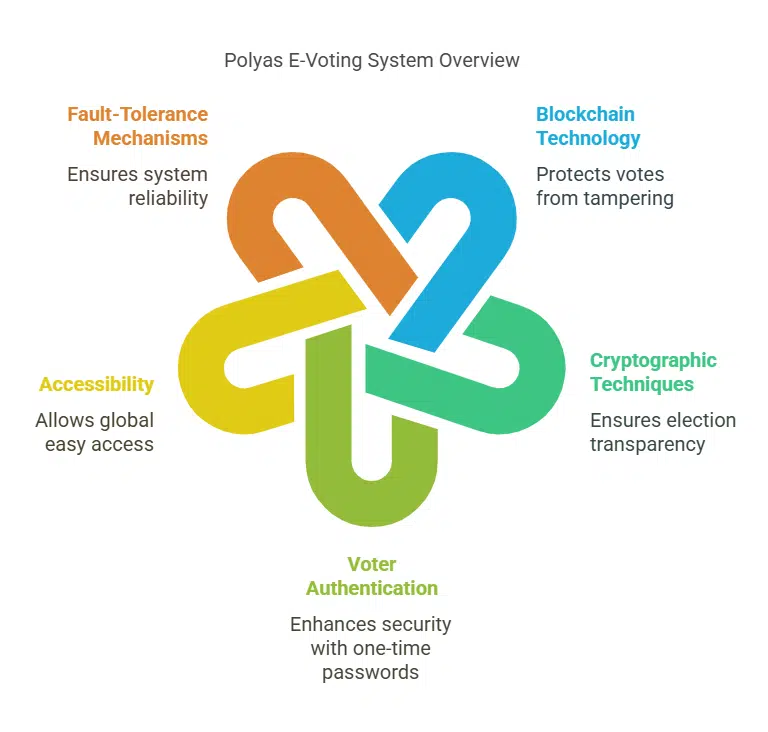
Polyas offers an advanced e-voting system designed for secure and transparent elections. It uses blockchain technology to protect votes from tampering and ensures election transparency with cryptographic techniques like a Merkle tree.
Voters authenticate themselves through one-time passwords, enhancing voter security without compromising anonymity.
This platform allows easy access for people across the globe. With its focus on accessibility, Polyas supports inclusive participation in democratic processes while using fault-tolerance mechanisms like PBFT (Practical Byzantine Fault Tolerance).
Its features ensure fair results and prevent fraud during electronic voting.
DemocracyGuard
DemocracyGuard uses the Ethereum blockchain and facial recognition for secure voter authentication. It includes biometric data capture during registration, verified by Azure Face API.
QR codes ensure a smooth verification process, enhancing electronic voting reliability.
This system relies on advanced cryptographic techniques and real-time anomaly detection. Transitioning from Proof-of-Work (PoW) to Proof-of-Stake (PoS) with Ethereum 2.0 reduces energy consumption by up to 99%.
This makes DemocracyGuard eco-friendly while improving election transparency and voter participation.
DLTVote
DLTVote uses blockchain technology to offer secure and transparent electronic voting. It ensures voter authentication through smart contracts, keeping the process trustworthy and tamper-proof.
Cryptographic techniques protect voter anonymity, allowing people to cast votes without risking their privacy.
This system prevents fraud by leveraging proof of work or proof of stake mechanisms, ensuring every vote counts. DLTVote enhances election transparency by creating a verifiable record for all participants.
Its e-voting systems aim to increase voter participation while reducing traditional barriers like physical polling stations.
Horizon State
Horizon State uses blockchain technology for secure and transparent voting. It ensures election transparency by recording votes on an immutable ledger. This prevents fraud or tampering, building trust in the process.
Voter authentication is handled carefully using cryptographic techniques to secure identities.
The platform promotes accessibility through electronic voting, making it easier for people worldwide to participate. Smart contracts automate and verify voting steps, reducing errors and human interference.
Tokens play a role in managing the system’s operations efficiently. Horizon State simplifies elections while boosting voter participation and trust globally.
SecureVote
SecureVote simplifies electronic voting with blockchain technology. It ensures election transparency by using cryptographic techniques to verify voter authentication and maintain voter anonymity.
The platform protects against fraud through smart contracts, guaranteeing that only eligible votes count. This system adapts well for large-scale elections, reducing reliance on paper ballots or VVPATs.
The use of IoT technologies boosts accessibility for remote voters. SecureVote also integrates machine learning tools to detect irregular patterns, enhancing security further. Its focus on user trust improves voter participation while safeguarding sensitive data from breaches or tampering.
Challenges and Opportunities of Blockchain Voting
Blockchain voting faces hurdles like scaling and maintaining privacy. Yet, it offers chances to boost fairness and trust in elections.
Scalability and Performance
Scalability remains a hurdle for blockchain-based voting systems. Bitcoin handles 4.6-7 transactions per second (TPS), showing low scalability due to its complex mining process. Ethereum fares better with 15 TPS but still struggles during high-demand periods, increasing costs to around $0.50 per transaction.
Hyperledger Fabric outshines them both, supporting up to 3,500 TPS without fees, making it a more scalable choice for electronic voting. Systems must address performance challenges like processing speed and network congestion to handle millions of votes smoothly in real time while ensuring election transparency and voter participation.
Voter Privacy and Anonymity
Protecting voter identity is key in blockchain-based voting. Strong cryptographic techniques ensure privacy during elections. Homomorphic encryption allows votes to be counted without revealing individual choices.
To enhance voter anonymity, multiple authorities handle decryption, protecting sensitive details from being exposed.
Many e-voting systems need better safeguards for user data. Research shows gaps in privacy measures require further work. Advanced applications of blockchain and smart contracts could close these gaps over time.
Ensuring voter trust depends on building secure systems that protect both data and identities effectively.
Political and Legal Resistance
Political leaders and election authorities often resist blockchain voting. Concerns about regulatory compliance create significant hurdles. Many governments lack clear legal frameworks for e-voting systems powered by blockchain technology.
Public trust also poses challenges, as many voters do not fully understand cryptocurrencies or cryptographic techniques.
Marketing campaigns and user education efforts are essential to build confidence in these systems. Funding sources like the Malaysia Ministry of Education and Universiti Kebangsaan Malaysia support research questions around this resistance.
Without public backing, adoption faces more obstacles, delaying widespread use of such technologies in elections.
The Future of Blockchain-Based Voting
Blockchain voting could transform elections globally. Decentralized ledgers can improve election transparency and fight fraud. Cryptographic techniques like Public Key Infrastructure (PKI) enhance security, while biometric authentication confirms voter identity securely.
Systems in Estonia and Zug, Switzerland, show early success with blockchain-based e-voting systems.
Artificial Intelligence (AI) may boost voter verification by analyzing data swiftly for accuracy. Smart contracts can automate vote tallying, reducing human error. Internet of Things (IoT) devices might make remote voting more accessible without risking security breaches.
With these innovations, blockchain makes democratic participation safer and easier worldwide.
Takeaways
Blockchain voting is changing elections worldwide. It boosts security, cuts fraud, and makes voting more open to all. Systems like Voatz and DemocracyGuard show how this tech can reshape democracy.
Though challenges remain, the potential for fairer and safer elections is huge. This new way of voting brings hope for a stronger democratic future.
FAQs on Blockchain-Based Voting Systems Revolutionizing Democracy
1. What is a blockchain-based voting system?
A blockchain-based voting system uses blockchain technology to secure electronic voting, ensuring voter authentication, anonymity, and election transparency.
2. How do smart contracts improve e-voting systems?
Smart contracts automate processes in e-voting systems, like counting votes or verifying voter participation, making elections faster and more reliable.
3. Can cryptographic techniques protect voter data?
Yes, cryptographic techniques safeguard voter information by securing identities and guaranteeing privacy during the election process.
4. How does blockchain increase election transparency?
Blockchain records every vote on an immutable ledger that researchers can review—this ensures accountability while preventing tampering.
5. Is it possible to use cryptocurrency wallets for voting?
Some systems connect cryptocurrency wallets with e-voting platforms through networks like the Bitcoin network or mix networks to enhance security and accessibility for voters.





















