The literary canon is not a static museum; it is a living, breathing landscape that constantly shifts to reflect the world it inhabits. When we examine the best 21st-century novels, we are not merely looking at entertaining stories. We are analyzing vital historical documents that capture our shifting societal anxieties, our beautifully fragmented realities, and our extraordinary resilience.
The past two-plus decades have fundamentally altered how we communicate, how we perceive truth, and how we understand our place within a rapidly globalizing world. Consequently, the authors defining this era refuse to be constrained by traditional, linear narratives. They are dismantling the boundaries of genre, blending historical fact with speculative fiction, and demanding radical empathy from their readers.
Whether you are an avid bibliophile or someone looking to understand the modern human condition through fiction, this comprehensive guide explores the literary masterpieces that have shaped the current century.
![Foundational Masterpieces [2000–2009]- best 21-century novels](https://cdn1.editorialge.com/wp-content/uploads/2026/05/Foundational-Masterpieces-2000%E2%80%932009-best-21-century-novels.jpg)
Foundational Masterpieces [2000–2009]
The first decade of the 21st century was marked by a brilliant blend of deep historical reflection and profound structural experimentation. Emerging from the shadows of the 20th century, authors began to experiment with voice and setting in ways that felt urgently new, effectively setting the stage for the diverse global voices that would dominate the coming years.
The Brief Wondrous Life of Oscar Wao by Junot Díaz [2007]
Bursting onto the literary scene with undeniable kinetic energy, this novel violently and beautifully collides Dominican history with profound American geek culture. It follows the life of Oscar, an overweight, lovelorn Dominican nerd growing up in New Jersey, while simultaneously tracing the brutal, multi-generational curse that has plagued his family since their time under the dictatorship of Rafael Trujillo.
Díaz radically decenters the traditional immigrant narrative, forcing the literary establishment to embrace a linguistic hybridity that reflects the true, lived experience of the diaspora. By utilizing extensive footnotes that are just as compelling and voice-driven as the main text, the novel demands an active, engaged reader, seamlessly blending Spanglish, comic book references, and magical realism.
The Road by Cormac McCarthy [2006]
Published in a post-9/11 world increasingly obsessed with societal collapse and ecological disaster, this novel follows an unnamed father and son navigating an ashen, post-apocalyptic landscape. They carry nothing but a scavenged cart, a pistol with limited ammunition, and a desperate, fragile love for one another. McCarthy strips the dystopian genre down to its absolute emotional core.
The prose is hauntingly sparse, mimicking the desolate, burned-out world the characters inhabit. It perfectly encapsulated millennial anxieties about the future, climate change, and the fragility of civilization. Yet, beneath the relentless bleakness, it remains one of the most profound meditations on paternal love.
The Shadow of the Wind by Carlos Ruiz Zafón [2001]
An international phenomenon that captured the hearts of millions, this gothic mystery is essentially a love letter to the written word. Set in Barcelona in the aftermath of the Spanish Civil War, it follows a young boy who discovers a mysterious book in the Cemetery of Forgotten Books, only to realize that someone is systematically destroying every copy of the author’s work.
Zafón masterfully blends elements of the thriller, historical fiction, and romance. Its global success signaled a massive reader appetite for immersive, atmospheric storytelling that celebrates the enduring power of literature itself.
The Kite Runner by Khaled Hosseini [2003]
Few books have shaped the global reading consciousness quite like this devastating tale of childhood betrayal and adult redemption. Set against the backdrop of a changing Afghanistan, from the fall of the monarchy to the rise of the Taliban regime, the novel follows Amir, a boy from a wealthy Kabul family, and his complex relationship with his servant and friend, Hassan.
Hosseini humanized a region that Western media had largely reduced to war-torn headlines. Its immense global impact proved that deeply personal, emotionally raw narratives possess the power to bridge vast cultural divides.

Defining Global Epics and Historical Reclamations
As the century progressed, literature began to reflect an increasingly interconnected global society. Authors began to look backward to tackle systemic issues with unprecedented ambition, rewriting histories that had long been suppressed or simplified.
The Known World by Edward P. Jones [2003]
This Pulitzer Prize-winning masterpiece intricately explores a deeply uncomfortable and often entirely overlooked reality: the history of Black slave owners in antebellum Virginia. Set in the fictional Manchester County, the novel revolves around the death of Henry Townsend, a Black farmer and bootmaker who, mentored by the very man who once owned him, becomes a slave master himself.
Jones profoundly disrupts traditional narratives of American slavery. He employs a non-linear, omniscient narrator who effortlessly jumps forward and backward in time, creating a devastating look at power, moral corruption, and the insidious way systemic evil infects everyone within its reach.
2666 by Roberto Bolaño [2004]
A monumental, posthumously published epic, this novel defies easy categorization and pushes the absolute boundaries of what fiction can encompass. Spanning continents and decades, its vast narrative is loosely centered around the unsolved, horrific murders of hundreds of women in Santa Teresa, a fictionalized version of Ciudad Juárez on the Mexican border.
Widely considered the defining Latin American novel of the century, Bolaño explores globalization, the failure of institutions, and the desperate search for meaning in a seemingly indifferent universe. It is philosophically dense and deals unflinchingly with extreme violence, making it a challenging but profoundly necessary read.
Pachinko by Min Jin Lee [2017]
This sweeping, deeply moving historical saga follows four generations of a Korean immigrant family fighting to control their destiny in 20th-century Japan. Beginning with a teenage girl’s unplanned pregnancy in a small Korean fishing village, the narrative expands into a rich tapestry of resilience, discrimination, and the pursuit of survival.
Lee highlights the concept of zainichi, Koreans living in Japan, and the systemic prejudice they face. The novel’s brilliance lies in its ability to make vast historical shifts feel intensely intimate, illustrating how the tides of history wash over ordinary lives.
Half of a Yellow Sun by Chimamanda Ngozi Adichie [2006]
Through the eyes of three distinct characters, a young boy from a poor village, a middle-class woman, and an English writer, Adichie crafts a breathtaking narrative about the Biafran War in 1960s Nigeria. As the country is torn apart by ethnic violence and the struggle for an independent republic, the characters’ lives intersect in ways that expose the devastating human cost of political conflict.
Adichie’s work is vital to the 21st-century canon because it reclaims African history from the often-sterile grip of Western historians, delivering a story pulsating with life, tragedy, and enduring hope.
Genre-Bending and Structural Innovations
Contemporary authors have realized that modern problems require modern architectures. The following masterpieces tore up the traditional rulebook of how a novel should be structured, mirroring the fragmented reality of the digital age.
A Visit from the Goon Squad by Jennifer Egan [2010]
This Pulitzer Prize-winning work is a brilliantly fragmented narrative that jumps erratically through time to explore the music industry, the loss of innocence, and how technology fundamentally alters our memories. The overarching story connects a cast of characters loosely orbiting an aging punk rocker turned record executive and his kleptomaniac assistant.
It’s deeply innovative format perfectly captures the rapid-fire essence of the digital age. The chapters function almost as interconnected short stories, utilizing different voices, styles, and even formats, most famously, an entire chapter delivered as a PowerPoint presentation.
Wolf Hall by Hilary Mantel [2009]
Historical fiction was entirely reinvigorated by this Booker Prize-winning novel. Mantel takes readers intimately inside the brilliant, calculating, and pragmatic mind of Thomas Cromwell, the blacksmith’s son who rose to become the chief minister to King Henry VIII. Instead of relying on a detached tone, Mantel utilizes a masterful present tense and a remarkably close third-person perspective.
We are trapped in Cromwell’s head, witnessing political survival, religious upheaval, and the active rewriting of history as it happens. By removing the distance of time, Mantel proves that the treacherous politics of the Tudor court are strikingly relevant to modern power dynamics.
The Three-Body Problem by Cixin Liu [2006/2014]
Hard science fiction experienced a monumental global resurgence with this mind-bending Chinese epic. Set against the backdrop of the Cultural Revolution, the story follows a secret military project that makes contact with an alien civilization on the brink of destruction.
The aliens plan to invade Earth, fracturing human society into distinct camps: those who welcome the alien overlords to fix a corrupt world, and those who plan to fight. Liu’s work introduced Western audiences to “cosmic sociology,” blending high-level theoretical physics with profound philosophical questions about humanity’s place in the dark forest of the universe.
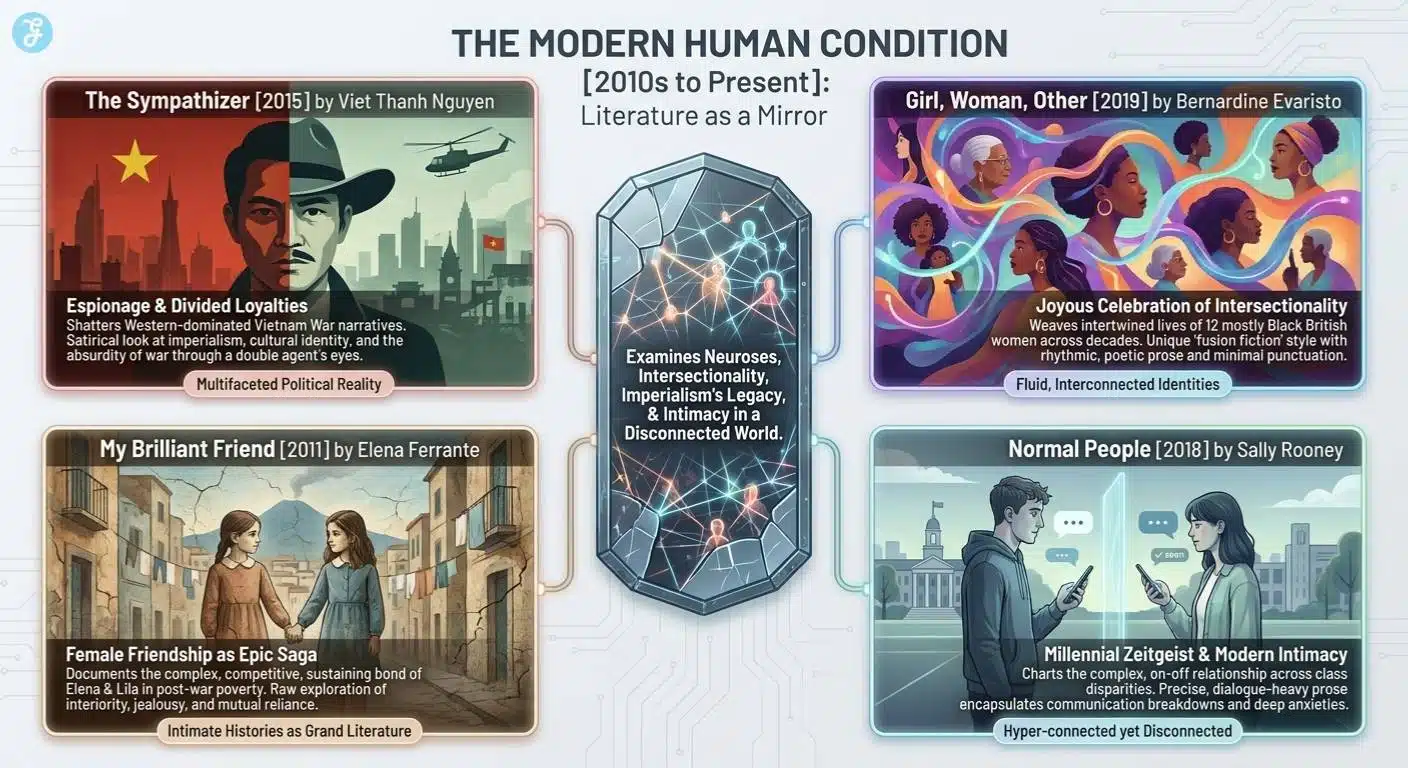
The Modern Human Condition [2010s to Present]
In recent years, the best literature has held a mirror up to our modern neuroses, examining intersectionality, the legacy of imperialism, and the complexities of human intimacy in an increasingly disconnected world.
The Sympathizer by Viet Thanh Nguyen [2015]
For decades, the cultural narrative of the Vietnam War was largely dominated by Western perspectives. Nguyen shattered that monopoly with this darkly comic espionage novel. Narrated by an unnamed, half-French, half-Vietnamese army captain who is secretly a communist double agent, the novel navigates the treacherous waters of divided loyalties in the immediate aftermath of the Fall of Saigon.
Nguyen offers a sharp, satirical examination of imperialism, cultural identity, and the absurdity of war, forcing readers to confront the multifaceted reality of political ideology.
Girl, Woman, Other by Bernardine Evaristo [2019]
This novel is a joyous, sprawling celebration of identity that profoundly expanded the boundaries of British literature. Rather than focusing on a single protagonist, Evaristo masterfully weaves together the intertwined lives of twelve different characters, predominantly Black British women, across several decades and social classes.
What is particularly striking is its unique “fusion fiction” style. Evaristo largely abandons traditional punctuation, allowing the prose to flow with a rhythmic, poetic momentum that mirrors the interconnected, fluid nature of the characters’ lives.
My Brilliant Friend by Elena Ferrante [2011]
The first in a wildly successful quartet, this novel sparked global “Ferrante Fever.” It fiercely documents the complex, competitive, and deeply sustaining friendship between two women, Elena and Lila, growing up in a poor, violent neighborhood in post-war Naples.
Ferrante elevated female friendship and domestic life to the level of an epic saga. The raw, unfiltered exploration of female interiority, jealousy, and mutual reliance struck a universal chord, proving that the most intimate personal histories carry the weight of grand, sweeping literature.
Normal People by Sally Rooney [2018]
Few authors have captured the millennial zeitgeist quite like Sally Rooney. This novel charts the complex, on-again-off-again relationship between Connell and Marianne, two teenagers from a small Irish town who carry their entangled dynamic into their university years in Dublin.
Rooney dissects the nuances of modern intimacy, class disparities, and the profound ways we alter one another’s trajectories. Her precise, dialogue-heavy, and unadorned prose perfectly encapsulates the communication breakdowns and deep anxieties of a generation hyper-connected yet struggling to truly understand each other.

Top Reader’s Choice: Global Fan Favorites
While critics and literary prize committees tend to favor structural innovation and massive historical scope, analyzing worldwide reader data reveals a distinct picture of what truly resonates on a global scale. When looking at the best 21st-century novels through the lens of widespread popularity, readers overwhelmingly gravitate toward emotional resonance over structural complexity.
Here are the novels that have dominated reader polls, book clubs, and bestseller lists across the globe:
The Kite Runner by Khaled Hosseini
A devastating tale of childhood betrayal and adult redemption set against the backdrop of a changing Afghanistan. Its immense global impact proved that deeply personal, emotionally raw narratives possess the power to bridge vast cultural divides.
Circe by Madeline Miller
A powerful, lyrical retelling of Greek mythology that follows a misunderstood goddess discovering her strength. Miller turned an ancient epic into an intimate, moving story of female empowerment that dominated book clubs for years.
Where the Crawdads Sing by Delia Owens
Combining mystery, romance, and coming-of-age storytelling, this novel about a marginalized girl growing up alone in the North Carolina marshes struck a massive chord with readers seeking stories of survival and the healing power of nature.
Project Hail Mary by Andy Weir
A masterclass in accessible, thrilling science fiction. Following a lone astronaut attempting to save Earth from an extinction-level event, it became a massive fan favorite for its relentless optimism, scientific problem-solving, and surprisingly heartwarming interspecies friendship.
The Night Circus by Erin Morgenstern
A spellbinding fantasy novel about two rival magicians bound in a magical competition set within an ever-changing circus. Its lush imagery and dreamlike atmosphere created a passionately dedicated global fanbase.
My Brilliant Friend by Elena Ferrante
The book that sparked global “Ferrante Fever.” It fiercely documents the complex, competitive, and deeply sustaining friendship between two women growing up in post-war Naples, proving that intimate female histories carry the weight of epic literature.
These fan favorites prove that in a century defined by rapid technological advancement and societal shifting, readers still turn to the novel primarily to find a profound sense of shared humanity and emotional catharsis.
My Personal Favorites: Books That Broke and Healed My Heart
After a long day, when I finally close my laptop and reach for a novel, I am searching for something profoundly different: pure emotional resonance and deep human connection.
While I deeply respect the structurally complex masterpieces that critics love, the books that have secured a permanent spot on my personal bookshelf are the ones that simply broke my heart and put it back together again.
Here are the 21st-century novels I return to time and time again:
The Kite Runner by Khaled Hosseini
Hosseini has an unparalleled gift for capturing the resilience of the human spirit against the backdrop of devastating turmoil. This novel is a gut-wrenching, raw exploration of childhood betrayal, guilt, and the desperate, lifelong search for redemption. Set against the tragic historical shifts in Afghanistan, it is a story that strips away geopolitical borders to focus on the deeply intimate, often painful complexities of loyalty and forgiveness. It is not just a book you read; it is a profound emotional experience that permanently alters your perspective.
A Thousand Splendid Suns by Khaled Hosseini
While his first novel focused on fathers and sons, this masterpiece is a breathtaking tribute to female endurance. It tracks the intertwining lives of Mariam and Laila, two women brought together by war and patriarchal oppression. The quiet, fierce bond they forge in the absolute darkest of times is one of the most beautiful relationships ever put to paper. It is a masterclass in showcasing how love and quiet sacrifice can serve as the ultimate acts of rebellion in a world designed to break you.
The Night Circus by Erin Morgenstern
Sometimes, you just need fiction to be pure, unadulterated magic. This book is an absolute sensory masterpiece. Morgenstern’s prose is so lush and beautifully atmospheric that you can almost smell the melting caramel and the bonfire smoke as you read. The slow-burn romance and the enchanting, monochromatic world of Le Cirque des Rêves make this my ultimate comfort read when I need a complete, beautiful escape from the heavy realities of the real world.
My Brilliant Friend by Elena Ferrante
There is no author who captures the messy, fiercely competitive, and entirely consuming nature of female friendship quite like Ferrante. Following Elena and Lila through the gritty, vibrant streets of post-war Naples feels so intensely intimate and real that it is easy to forget you are reading fiction. It is a brilliant, unflinching look at how the people we grow up with permanently shape the trajectory of our lives, for better or worse.
Normal People by Sally Rooney
This novel perfectly captures the quiet devastation of human miscommunication. Rooney’s stripped-back, highly observant style completely draws you into the tangled, frustrating, and incredibly tender dynamic between Connell and Marianne. It is a stunningly accurate portrayal of modern intimacy, social anxieties, and how two people can continually alter the course of each other’s lives without ever fully realizing it.
Where to Start Your Reading Journey
Diving into the best 21st-century novels can feel intimidating given their thematic weight and sheer volume. The key is to start with a novel that aligns with your natural reading preferences before branching out into more experimental territory.
For the Immersive Historian
Begin with Wolf Hall by Hilary Mantel. If you are captivated by political intrigue, sharp dialogue, and power struggles, this is the perfect gateway into modern historical fiction.
For the Sweeping Family Saga
Pick up Pachinko by Min Jin Lee. It is incredibly accessible, deeply moving, and offers a rich, character-driven narrative that spans generations.
For the Structural Explorer
Try A Visit from the Goon Squad by Jennifer Egan. It is the perfect introduction to non-linear, experimental storytelling because each chapter functions beautifully as a standalone piece of a larger, fascinating puzzle.
For the Sci-Fi Enthusiast
Dive into The Three-Body Problem by Cixin Liu. It is essential reading for anyone who loves grand ideas, physics, and cosmic mysteries.
For Emotional Realism
Start with Normal People by Sally Rooney or My Brilliant Friend by Elena Ferrante. Both offer razor-sharp, character-driven explorations of intimacy and relationship dynamics.
Beyond the Final Page: The Enduring Power of Modern Fiction
As we navigate an era defined by fleeting digital trends, algorithmic echo chambers, and rapid global shifts, the novel remains our most steadfast anchor. The masterpieces of the 21st century prove that literature is not retreating in the face of technology; rather, it is brilliantly evolving to meet the moment.
From the sweeping historical reclamations of Pachinko to the fragmented digital anxieties of A Visit from the Goon Squad, these contemporary authors demand that we slow down, pay attention, and step outside of our own lived experiences.
Ultimately, engaging with the best 21st-century novels is an act of radical empathy. These books do not always offer easy answers or comforting resolutions, but they provide something far more valuable: the rare opportunity to sit with discomfort, celebrate incredibly diverse identities, and process the overwhelming complexity of the modern human condition.
We are only a quarter of the way through this century, which means our modern literary canon is still in its infancy. The boundaries of storytelling will continue to expand, and the greatest stories of our era are, undoubtedly, still waiting to be written.
Frequently Asked Questions About The Best 21st-Century Novels
1. What defines a “classic” novel in the 21st century?
A 21st-century classic is generally defined by its ability to capture the unique complexities of the modern global era while pushing the boundaries of traditional storytelling. Unlike older classics that often followed linear, singular perspectives, modern classics frequently utilize fragmented narratives, polyphonic voices, and genre-bending structures to reflect our interconnected and often chaotic digital age.
2. Why are so many contemporary novels written with non-linear or fragmented structures?
Authors use fragmented structures to mirror the way we currently consume information and experience time. With the rise of the internet, social media, and constant digital connectivity, our attention and memories are often segmented. Novels like A Visit from the Goon Squad or The Known World use non-linear timelines to authentically replicate this modern cognitive experience, showing how past and present constantly collide.
3. What is the most widely read literary fiction book of the 21st century?
While exact sales figures fluctuate, Khaled Hosseini’s The Kite Runner and Carlos Ruiz Zafón’s The Shadow of the Wind are among the most widely read and translated literary fiction novels of the century. Both achieved massive, sustained global popularity by combining sweeping historical backdrops with deeply intimate, highly accessible emotional narratives.
4. How has climate change influenced 21st-century literature?
Climate change has given rise to an entirely new, rapidly growing subgenre known as “cli-fi” (climate fiction). Rather than treating the environment as just a setting, contemporary authors are making the natural world a central character. Novels in this space address ecological dread, mass extinction, and the profound moral responsibilities humans have toward the planet, shifting literature away from strictly human-centric conflicts.
5. Are massive, sprawling epics still popular in the digital age?
Yes, deeply immersive epics remain incredibly popular, serving as an antidote to short attention spans. Despite the dominance of bite-sized digital content, readers still show a massive appetite for long, challenging works like Roberto Bolaño’s 2666 or Min Jin Lee’s Pachinko. These doorstopper novels offer a level of deep, sustained immersion and intellectual rigor that social media and short-form video simply cannot replicate.
6. Which 21st-century novel should I read if I usually only like 19th-century classics?
Hilary Mantel’s Wolf Hall is an excellent bridge for readers who prefer traditional classics. It offers the grand historical scope, deep political intrigue, and meticulous character development found in the works of authors like Tolstoy or Dickens, but updates the delivery with a sharp, urgent present-tense narrative that feels distinctly modern.
7. Is autofiction taking over the modern novel?
Autofiction, where the lines between the author’s real life and the fictional narrative are deliberately blurred, is arguably the defining literary trend of the last decade. Authors are increasingly using themselves as the primary subject to explore broader societal issues. It has not completely taken over, but it has profoundly challenged the traditional concept of the “invented” novel, offering readers a raw, unfiltered illusion of absolute truth.