Traditional flashcard drills often lead to frustration and quick burnout for young children. Rote memorization requires abstract thinking skills that toddlers and preschoolers are still developing. When early learners are forced to sit quietly and memorize static cards, learning feels like a chore rather than an exciting discovery.
Young children retain information best through multi-sensory experiences that combine movement, touch, and play. Helping kids learn letters without flashcards builds stronger neural connections by engaging tactile, auditory, and kinesthetic learning channels simultaneously.
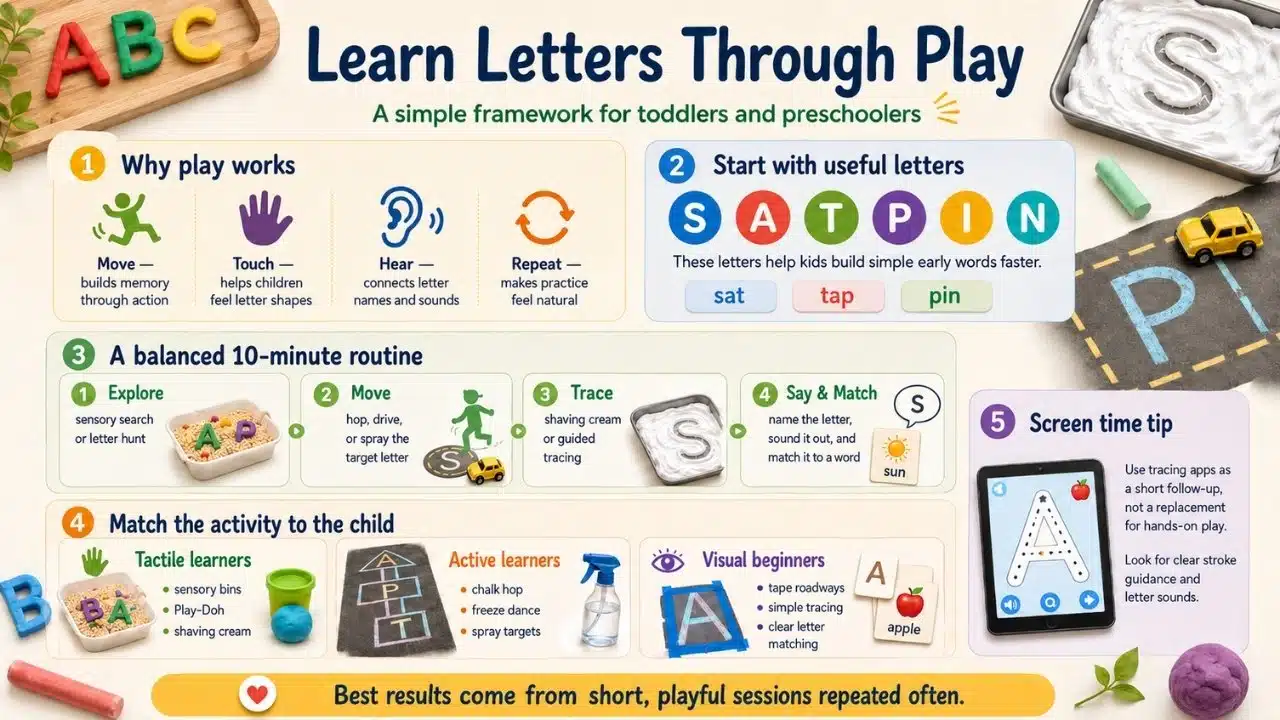
Here are seven interactive alphabet games that accelerate letter recognition and phonetic awareness through play.
7 Interactive Games to Learn Letters Without Flashcards
1. Sensory Bin Letter Scavenger Hunt
Sensory bins turn abstract letter shapes into physical objects kids can touch, dig for, and discover.
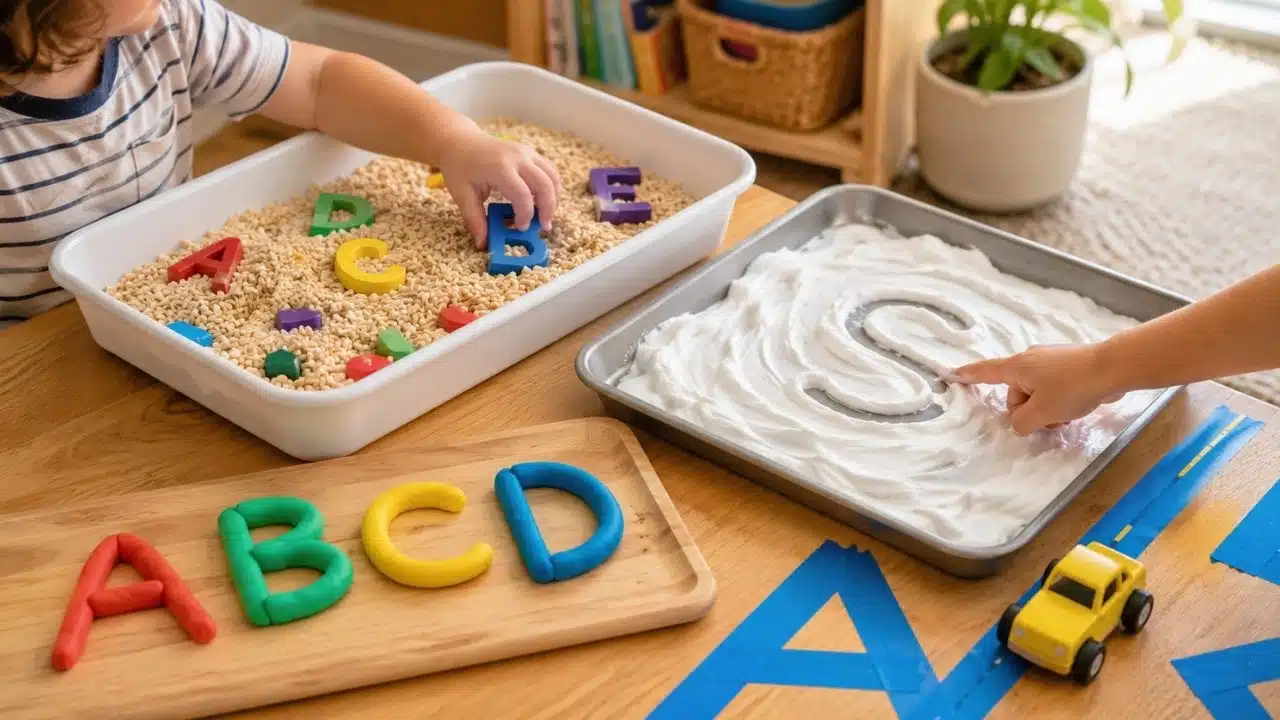
Fill a plastic bin with dried rice, beans, or kinetic sand, and bury magnetic or wooden letters inside. Provide your child with a matching sheet featuring printed letter outlines. As they dig up a hidden letter, have them say the letter name and its corresponding sound before placing it on the matching sheet. The tactile feedback of the bin keeps young learners engaged far longer than paper drills.
2. Sidewalk Chalk Alphabet Hop
Combining physical movement with letter identification activates muscle memory, helping children retain letter shapes faster.
Draw a large grid or circle of 6 to 8 letters on a driveway or sidewalk using colorful chalk. Call out a letter or a letter sound, and challenge your child to run, hop, or jump onto the correct target. To increase the challenge for older preschoolers, ask them to jump to a letter and name an animal or object that starts with that sound.
3. Play-Doh Letter Stamping and Sculpting
Building letters with dough strengthens fine motor control while embedding spatial awareness of letter formations.
Roll Play-Doh into long snakes and guide your child to bend them into uppercase and lowercase letter shapes. Alternatively, use alphabet cookie cutters or plastic stamps to press letters into flattened dough. Physical manipulation teaches children the structural curves, lines, and intersections that make up each letter.
4. Painter’s Tape Alphabet Roadways
For children who love toy cars and vehicles, turning letter formation into a mini race track turns play into an educational activity.
Use blue painter’s tape to construct large letter outlines across a hardwood floor or rug. Give your child a toy car and encourage them to drive along the tape path, following the correct stroke order for writing that letter. As they drive along the letter S, encourage them to make a sizzling or snake sound (/s/) to connect the shape with its phonics sound.
5. Freeze Dance Letter Matching
Freeze dance is an energetic indoor game that sharpens listening skills and visual recognition simultaneously.
Scatter letter cards or foam letters face-up across the living room floor. Play music and let your child dance around the room. When you pause the music, call out a target letter (such as “Find the letter B!”). Your child must locate and stand on that letter before the music turns back on. This active recall method keeps learning playful and dynamic.
6. Water Squirt Bottle Target Practice
Outdoor water games offer immediate visual feedback and are ideal for high-energy learners.
Use chalk to write targeted letters across a wooden fence, concrete wall, or patio. Hand your child a spray bottle or water squirt gun filled with water. Call out a letter name or sound and instruct them to aim and spray water to “erase” the letter from the wall. The physical act of aiming and spraying reinforces hand-eye coordination while anchoring letter recall.
7. Shaving Cream Tracing Trays
Tactile tracing allows children to feel the strokes required for writing letters before they ever pick up a pencil.
Spread a thin layer of non-toxic shaving cream or baking salt over a rimmed cookie sheet. Demonstrate how to write a letter using an index finger, then smooth out the cream to clear the canvas. The sensory feedback of smooth shaving cream reduces the anxiety associated with making mistakes on paper, making it easier for children to learn letters without flashcards.
What Most Early Literacy Guides Get Wrong
Many parenting resources encourage teaching the alphabet strictly in alphabetical order from A to Z. While singing the alphabet song is a common milestone, reciting letter names in order is merely a memorization exercise. It does not mean a child understands letter shapes or sounds.
Effective early literacy instruction focuses on high-frequency, actionable letters first. Introducing letters like S, A, T, P, I, and N early allows children to build simple words (such as sat, pat, or pin) almost immediately. Blending real words early builds confidence and accelerates reading readiness much faster than waiting until they reach the end of the alphabet.
Play-Based Literacy Strategy Matrix
Use this matrix to match alphabet games with your child’s specific learning style and developmental needs:
| Activity | Primary Learning Style | Best For Developing |
| Sensory Bin Search | Tactile / Visual | Spatial recognition and letter matching |
| Chalk Alphabet Hop | Kinesthetic / Auditory | Gross motor skills and fast sound recall |
| Tape Roadways | Visual / Tactile | Pre-writing stroke order and fine motor control |
| Shaving Cream Tracing | Tactile / Kinesthetic | Pre-writing confidence and letter formation |
Combining Physical Play with Guided Digital Tracing Apps
While hands-on tactile games provide essential physical engagement, digital learning tools can serve as a supportive extension for independent practice. When choosing screen time activities, selecting apps that reinforce proper stroke order and phonetic sounds ensures that screen usage remains educational rather than passive.
Interactive learning applications such as Alphabet Magic: Trace & Phonics offer guided finger-tracing mechanics alongside clear audio pronunciations. These structured digital exercises allow toddlers and preschoolers to practice letter formation with instant visual and auditory feedback. Integrating evaluated digital tools alongside physical motor games offers a balanced approach to early childhood literacy. For a detailed breakdown of features, usability, and learning mechanics, check out our comprehensive Alphabet Magic: Trace & Phonics review.
Final Thoughts on Alphabet Games
Teaching early literacy does not require boring drills or repetitive worksheets. By using engaging, play-based activities, you transform fundamental skills into enjoyable daily play. When children interact with letters through movement and touch, they learn faster, retain more, and build a lasting enthusiasm for reading.
Frequently Asked Questions (FAQs) About Learning Letters Without Flashcards
At what age should children start learning letters?
Most children begin exploring letter shapes and sounds between ages 2 and 4. Formal instruction is unnecessary at this stage; informal exposure through reading, singing, and play-based games provides a strong foundation before kindergarten.
Why is learning letters without flashcards considered more effective?
Flashcards rely heavily on abstract memorization, which can bore or stress young children. Interactive games engage multiple senses (touch, movement, sight, and sound), creating stronger neural pathways in developing brains and improving long-term retention.
Should I teach uppercase or lowercase letters first?
Focusing on lowercase letters first is often recommended because lowercase letters account for roughly 90% of written text in books. Learning lowercase shapes early helps children recognize familiar words faster when reading stories together.