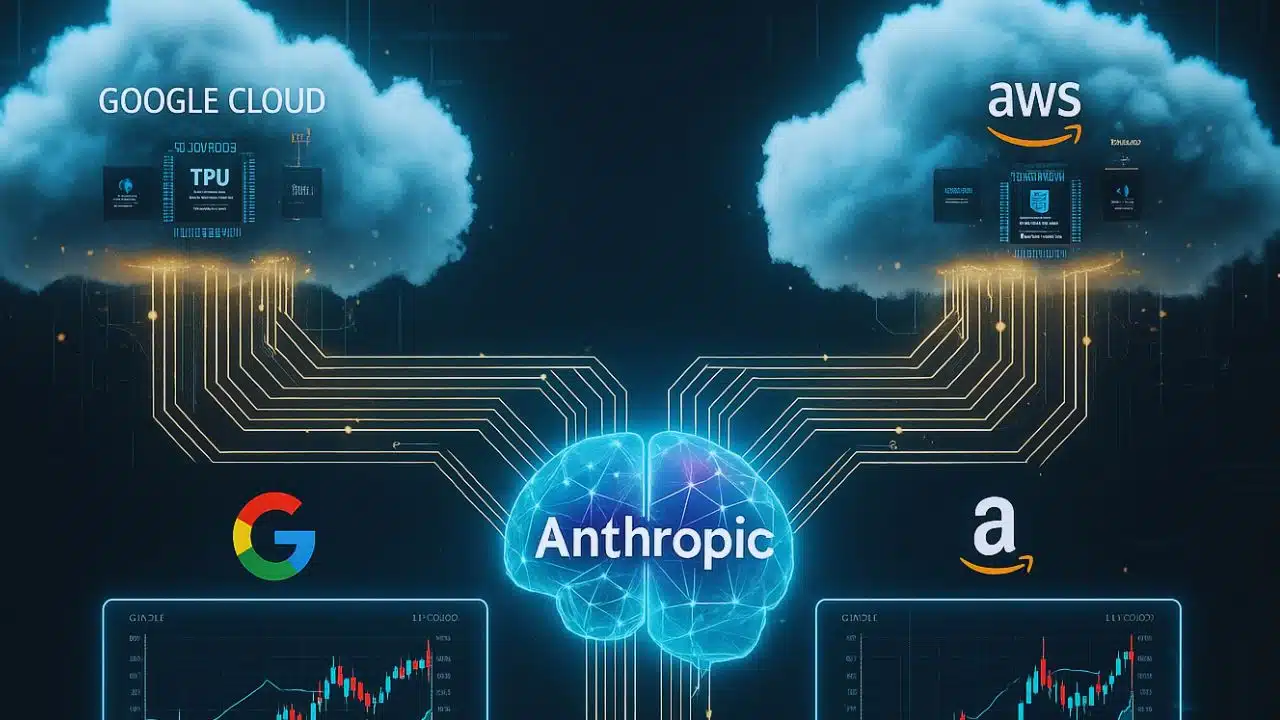
The generative AI gold rush has delivered its most staggering payday yet, not in product revenue, but in massive, unrealized profits for its biggest backers. Recent Q3 2025 earnings filings reveal that the Alphabet Amazon Anthropic stakes have yielded a combined $20.2 billion in paper gains, cementing the AI startup as one of the most valuable private companies in the world and validating the tech giants’ multi-billion dollar “co-opetition” strategy.
Alphabet, Google’s parent company, reported a $10.7 billion boost from its equity investments, largely from Anthropic. Not to be outdone, Amazon disclosed a $9.5 billion pre-tax gain from its own stake in the same AI firm.
This financial windfall is not from the sale of Anthropic’s popular “Claude” chatbot. Instead, it is the direct result of a mammoth $13 billion Series F funding round in September 2025, which catapulted Anthropic’s private valuation to an eye-watering $183 billion.
Under accounting rules, Amazon and Google must mark their private investments to market value, forcing these paper gains onto their balance sheets. The disclosures reveal the dual nature of these investments: they are simultaneously massive financial bets and, more critically, strategic anchors to secure Anthropic as a cornerstone customer for their respective cloud computing platforms, Amazon Web Services (AWS) and Google Cloud.
This complex relationship—investing in a company that competes with their own in-house AI, while also fighting to sell it the picks and shovels (computing power) for the AI gold rush—is now the defining feature of the generative AI landscape.
The Valuation That Shocked Silicon Valley
To understand the $20.2 billion windfall, one must look at Anthropic’s meteoric financial ascent.
Founded in 2021 by former OpenAI researchers with a focus on AI safety, Anthropic has positioned itself as the chief rival to the Microsoft-backed OpenAI. Its Claude family of large language models (LLMs) is widely considered a top-tier competitor to OpenAI’s GPT-4.
This rivalry has attracted unprecedented capital.
- Initial Investments: Google first invested $500 million in 2023, committing to a total of $3 billion. Amazon followed, announcing a commitment of up to $4 billion in September 2023 and completing its $8 billion total investment by November 2024.
- Valuation Growth: The velocity of its value creation is staggering. In March 2024, the bankrupt FTX estate sold its ~8% stake at an implied valuation of around $16.5 billion.. By March 2025, a Series E round valued the company at $61.5 billion.
- The September Surge: The most recent September 2025 Series F round saw Anthropic raise $13 billion from investors including Iconiq Capital and Fidelity, nearly tripling its valuation from just six months prior to $183 billion.
It is this new $183 billion “post-money” valuation that Amazon and Google used to re-calculate the worth of their stakes, resulting in the $20.2 billion combined paper gain reported in their Q3 earnings.
A Cloud-Compute “Arms Race”
These investments were never purely financial. They were down payments for securing a massive, power-hungry cloud customer. The cost of training and running frontier AI models is astronomical, and Anthropic is now locked in as a top-tier customer for both Google and Amazon, pitting the two cloud rivals against each other.
Amazon’s “Project Rainier”
Amazon’s $8 billion investment designated AWS as Anthropic’s “primary cloud provider.” This deal involves more than just standard cloud services.
Amazon is building out “Project Rainier,” a massive, bespoke AI compute cluster spread across U.S. data centers, specifically to power Anthropic’s future models. This infrastructure is built around Amazon’s in-house Trainium2 chips, and Anthropic is slated to use more than one million of these custom chips by the end of this year, according to source.
For Amazon, the $9.5 billion paper gain is vindication, but the real prize is locking in billions in future AWS revenue from Anthropic, proving its custom AI chips can compete with NVIDIA’s market-dominating GPUs.
Google’s TPU Counter-Attack
While AWS is the “primary” provider, Google is not a silent partner. On October 23, 2025, Anthropic announced a massive expansion of its partnership with Google Cloud.
In a deal reportedly worth “tens of billions of dollars,” Anthropic has committed to using up to one million of Google’s custom Tensor Processing Units (TPUs). This move will bring over 1 gigawatt of new AI computing capacity online for Anthropic by 2026.
This is a strategic masterstroke for Google. It ensures that its own custom AI hardware—the TPU—has an anchor tenant outside of Google’s internal products (like Gemini and Search). It diversifies Anthropic’s hardware supply chain, giving the AI firm significant leverage over both Amazon and Google.
In an official statement, Anthropic CFO Krishna Rao confirmed this multi-cloud strategy:
“Anthropic and Google have a longstanding partnership and this latest expansion will help us continue to grow the compute we need to define the frontier of AI… This expanded capacity ensures we can meet our exponentially growing demand while keeping our models at the cutting edge.
Anthropic’s “diversified approach,” using Google TPUs, Amazon Trainium chips, and NVIDIA GPUs, means it is the beautiful bride being courted by the world’s richest suitors, all of whom are also paying for the privilege.
A Stark Contrast to Microsoft and OpenAI
The $20.2 billion in paper gains for Amazon and Google stands in sharp, illuminating contrast to the financial relationship between Microsoft and OpenAI.
Microsoft has invested roughly $13.75 billion for a 27% stake in OpenAI. However, because of OpenAI’s complex “capped-profit” structure and the astronomical costs of its research, Microsoft’s most recent quarterly earnings reported a $3.1 billion reduction in net income, attributed to losses from its OpenAI investment.
This highlights two different investment theses:
- Microsoft/OpenAI: A deep, exclusive partnership where Microsoft bears the direct R&D and operational losses of its partner in exchange for deep product integration and leadership in the AI race.
- Amazon/Google/Anthropic: A “frenemy” model where the tech giants make a minority investment, securing a massive cloud customer who remains technically independent. The tech giants get to report massive paper gains on their investment’s soaring valuation, even as that same partner (Anthropic) is spending billions back with them on cloud compute.
For Amazon and Google, it is a virtuous cycle: their investment dollars and cloud credits help Anthropic build better models, which attracts more funding at higher valuations, which in turn allows them to book massive paper profits on their initial investment.
The $20.2 billion gain is a headline-grabber, but it remains “paper profit.” The only way for Amazon and Google to realize that cash is for Anthropic to be acquired or, more likely, go public in what would be one of the most anticipated IPOs in history.
Until then, the key metrics to watch are not just Anthropic’s valuation, but the cloud revenue it generates for its two biggest investors. The real battle is not just for AI model supremacy, but for which tech giant’s custom silicon—Amazon’s Trainium or Google’s TPU—will power the future of intelligence.
This quarter’s earnings reports have made one thing clear: in the new AI economy, you can make billions not only from building AI, but from owning a piece of the company that is paying you billions to use your computers.
The Information is Collected from Anthropic Newsroom and Yahoo Finance.