You just finished your audiobook manuscript. Your publisher suggests using an AI voice clone to narrate it, which sounds perfect. Then you hear the word “legal,” and your stomach drops. I know exactly how that feels. Can someone actually own a voice? Will my audiobook get taken down? These questions keep you up at night because the rules around AI voice cloning feel murky.
I spent months researching this very topic. The findings reveal something surprising about copyright law and how voices are actually protected.
This guide on AI voice cloning for audiobook narration legal issues is here to help. I am going to walk you through the exact steps I use, and I think you will be surprised at how easy it can be. Grab a cup of coffee, and let’s go through it together.
What Is AI Voice Cloning for Audiobooks?
Now that I laid out the landscape, let me explain what AI voice cloning actually is. I want to show you how it works in the audiobook space. AI voice cloning technology creates a digital representation of a real person’s voice by analyzing speech patterns, tone, and unique vocal characteristics.
I train these systems on audio samples to produce synthetic narration that sounds remarkably human. The technology captures everything from an accent to emotional inflection. This allows publishers and authors to generate audiobook content without hiring traditional voice actors.
Here is how the general process breaks down in practice:
- The Training Phase: Systems need hours of high-quality audio to learn unique inflections and pacing.
- The Verification Step: Companies like ElevenLabs now require a live reading prompt to prove your identity before cloning.
- The Output Generation: The AI produces seamless audio that never tires or requires a lunch break.
This digital replica can narrate entire books without fatigue or scheduling conflicts. However, the process raises serious questions around intellectual property and consent.
I have seen platforms use voice samples to build these systems without explicit permission from the original speakers. This creates a massive legal minefield. Copyright law protects the written work itself, but it does not cover voices as standalone property.
The right of publicity steps in to shield people against unauthorized commercial use of their likenesses. Actor compensation becomes complicated because synthetic narration undercuts traditional voice acting fees.
SAG-AFTRA has responded by requiring explicit consent from voice actors for Digital Replicas. They demand equivalent compensation to in-person rates to protect human talent. Technology moves fast, but legal frameworks move slow, leaving authors scrambling to understand the rules.
Key Legal Issues in AI Voice Cloning
When you clone a voice for audiobooks, you step into a tricky situation. Ownership, consent, and rights collide head-on. I need to walk you through the actual problems that authors and platforms face every single day.
Ownership and Consent
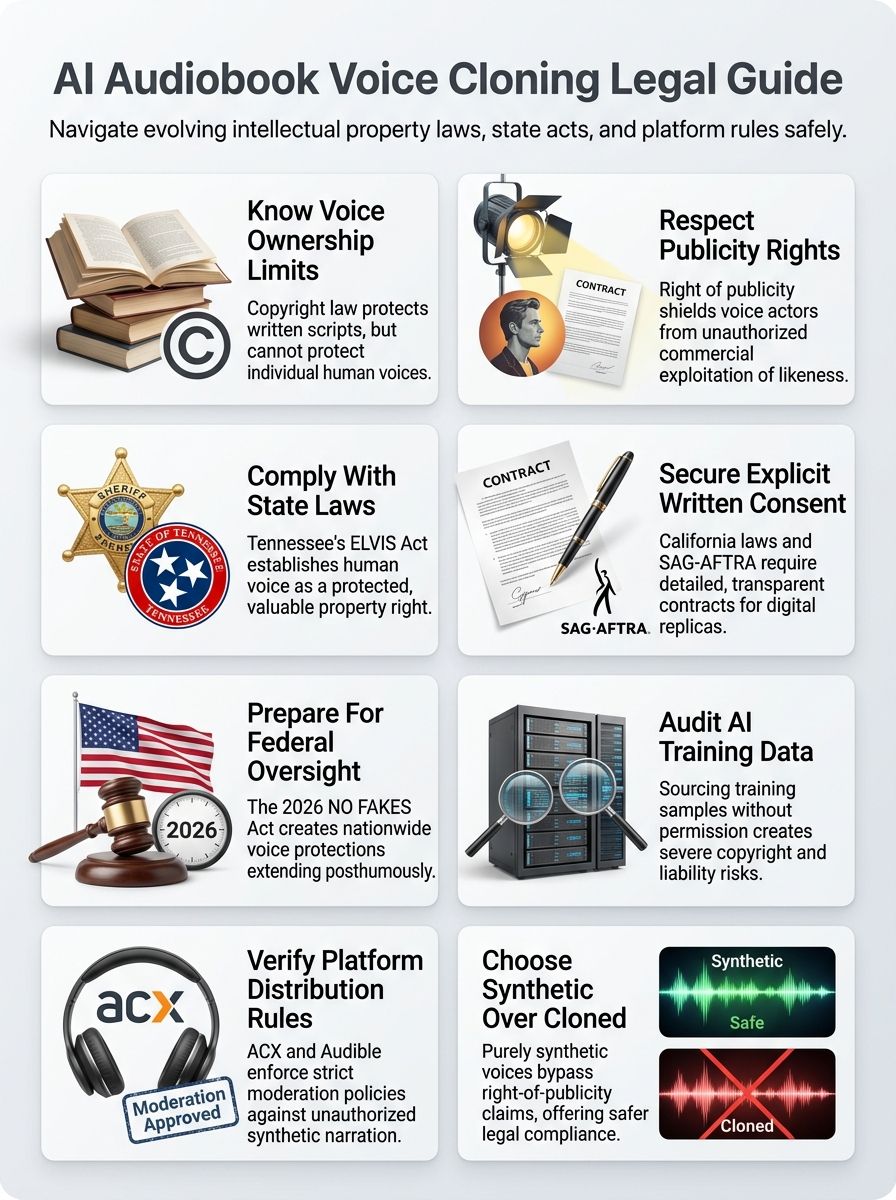
I discovered that ownership and consent form the backbone of AI voice cloning legality. Yet most people overlook these critical foundations entirely. Here is the hard truth about the system. Copyright law simply does not extend to an individual’s voice.
Your voice itself is not automatically protected under traditional copyright statutes. The right of publicity steps in to fill this gap. It protects against unauthorized commercial exploitation of your likeness and vocal identity.
Tennessee’s ELVIS Act recognized voice as a protected property right in 2024. This law essentially says your voice carries real value, and others cannot use it without your permission. I see this as a game-changer for voice actors and public figures everywhere.
Consent becomes your shield in this legal landscape. California mandates that contracts must specifically detail how digital replicas get used. This leaves absolutely no room for hidden clauses or vague promises.
SAG-AFTRA requires explicit consent for the use of a narrator’s digital replica. In August 2024, they reached a landmark agreement with the platform Narrativ. This deal allows actors to set their own price for voice replicas, with union minimums acting as a required floor.
I learned that obtaining proper permissions upfront saves tremendous headaches later. Unauthorized use of cloned voices raises significant legal and ethical concerns. Transparency in the use of synthetic voices proves critical for consumer protection compliance.
Copyright Infringement
AI voice cloning creates a major hurdle around copyright infringement. Copyright law protects original creative works, but it does not extend to the human voice itself. The landmark Midler case established this principle decades ago.
“The U.S. Copyright Office made it clear in January 2025: without human authorship, your AI-generated audio simply cannot receive copyright protection.”
This gap in the law means that using an AI clone without permission is not technically violating copyright on the voice itself. However, you are potentially violating the actor’s right of publicity.
The conflict between copyright law and publicity rights creates deep confusion for authors. SAG-AFTRA now requires explicit consent and compensation for digital replicas. Audiobook distributors face real financial consequences for ignoring these rules.
Training data adds another layer of copyright complications. AI companies often use audio samples without explicit permission from the original speakers. This training phase creates the very first copyright problem in the chain.
The second problem emerges when the AI generates new audio output. California laws now mandate that contracts address digital replicas directly. You need clear agreements that specify exactly how training data was sourced.
Ethical Concerns
I face a real problem when I think about AI voice cloning and ethics. Voices carry identity, personality, and years of hard work. When someone clones a voice without permission, they steal something precious from that performer.
The lack of copyright protection for voices creates a troubling gap. SAG-AFTRA guidelines stress the ethical obligation to compensate voice actors. Yet many tech platforms skip this essential step entirely to save money.
Consent becomes the foundation of everything. If I use your voice without asking, I exploit your life’s work. Tennessee and California emphasize the ethical responsibility of protecting voices from unauthorized use.
Misuse of AI-generated voices creates real harm that goes beyond contracts. You could impersonate someone or damage a reputation rapidly with a cloned voice. Ethical concerns necessitate compliance and user consent protocols that actually work.
Publishers face ethical responsibilities in ensuring transparency. I must tell listeners when a voice is synthetic and how it was trained. Compensation matters just as much as transparency in this new process.
The Copyright Trap: Why You Actually Can’t Copyright a Voice
Here is the thing about voice copyright that trips up most people. You actually cannot copyright a voice, and this legal gap creates massive problems for audiobook creators. The Midler case established this principle decades ago.
A court ruled that copyright law does not cover the protection of human voices. This means your voice sits in a legal gray zone today. Let us break down how the protections actually work:
- Copyright protects the script: The words on the page are safe and owned strictly by the author.
- Publicity rights protect the person: The vocal identity falls under state laws rather than federal copyright.
- Federal law remains unwritten: We still wait for a nationwide standard to protect digital replicas consistently.
This does not mean voices get zero protection. The right of publicity steps in to protect individuals from unauthorized commercial use. While copyright protects written words, publicity rights stop people from having their voice stolen.
I cannot simply copyright my voice and call it done. Instead, I must rely on contracts and specific state laws like Tennessee’s ELVIS Act. California laws go even further by requiring highly specific contracts.
SAG-AFTRA demands written consent and compensation for the use of voice replicas. This makes voice protection a contractual issue rather than a copyright one. The real protection comes from what you put in writing before you record.
Legal Challenges Faced by Authors and Platforms
I face real obstacles when I try to publish audiobooks with AI voices. Both authors and platforms operate in a legal minefield that shifts daily.
Platform Acceptance Policies
Most audiobook platforms have drawn a line in the sand regarding synthetic voices. ACX maintains strict content moderation standards that directly impact what narrators can upload. I watched creators struggle because platforms want to protect their brand reputation.
As of early 2026, ACX completely bans the use of third-party AI voices. If you use tools like ElevenLabs or AuthorVoices, they will reject your file immediately. They currently only permit audio created through their own in-house beta tools.
Platforms screen for unauthorized voice cloning and undisclosed synthetic narration. They do this because they face real legal consequences for distributing infringing content. Your user agreements spell out exactly what is allowed.
Some platforms demand explicit labeling of AI-generated narration, while others ban cloned voices outright. You must verify your chain of title before you ever hit that upload button. Platforms essentially demand proof that you own the rights to every spoken word.
Distribution Restrictions
I discovered that distribution restrictions create real headaches for authors. ACX enforces strict controls to prevent unauthorized distribution of cloned voices. These platforms act as gatekeepers for all uploaded content on the market.
Here are the most common restrictions you will face when uploading:
- ACX strict bans: You cannot use third-party AI voices for Amazon distribution.
- Findaway Voices pushback: Authors successfully forced Findaway to stop using their audio files for AI training in February 2024.
- Metadata requirements: You must clearly label synthetic voices on most modern storefronts.
If I want to distribute an audiobook using an AI clone, I need written permission from the original actor. SAG-AFTRA mandates this level of protection for every project. The chain of title matters enormously in this stage.
State laws have tightened these restrictions considerably over the past two years. Tennessee imposes liability on audiobook distributors for unauthorized voice clones. I bear responsibility if someone’s voice gets replicated without permission.
Transparency regarding the use of cloned voices is necessary to comply with consumer laws. Distribution agreements now include specific language about synthetic voices. I must stay informed about each platform’s current policies before uploading anything.
The 2026 Legislative Tsunami: How the Law is Catching Up
Lawmakers across America are racing to create rules for AI voice cloning. Several states have already passed laws that affect how you can use synthetic voices. These new regulations will completely reshape the entire industry.
Tennessee’s ELVIS Act [2024]
Tennessee passed a groundbreaking law in 2024 called the ELVIS Act. I find it represents a major shift in how we protect voices in the digital age. This law treats voice simulations as a tangible property right.
Your voice has real legal value now, just like your name or your face. The Act imposes secondary liability on audiobook distributors. Platforms like Audible face serious consequences if they distribute unauthorized clones.
I see this as a game-changer because it puts the burden on the companies. It does not just penalize the independent people who create the content. This law aligns perfectly with other state protections popping up across the country.
California’s AB 2602 & AB 1836
California laws represent a major shift in how the state protects voice actors. These rules require contracts to explicitly describe the usage of a digital replica. You cannot simply grab someone’s voice and use it however you want.
These state laws introduce three massive changes for creators:
- Usage descriptions: Contracts must specify exactly how the voice is used and monetized.
- Post-mortem rights: Voices remain protected even after the actor passes away.
- Mandatory compensation: Performers must receive fair pay for their digital replicas.
This protection stems directly from the right of publicity doctrine. I find it significant that these laws close real gaps in copyright law. The human voice has historically fallen through the cracks of traditional intellectual property protection.
These laws work hand-in-hand with SAG-AFTRA guidelines. This creates a highly effective two-layer protection system for voice actors. Your voice belongs to you, and anyone who wants to clone it must negotiate fairly.
The Federal NO FAKES Act [Updated]
California laws set the stage, but the real game-changer comes from federal legislation. The Federal NO FAKES Act represents a sweeping effort to establish intellectual property rights for voices. I find this critical for creators and estates alike.
This act aims to create a federal right for a voice that lasts up to 70 years after death. The full enactment is scheduled for June 2026. This timing matters because it will streamline voice protections across state lines.
By creating a unified federal standard, the act prevents platforms from playing jurisdictional games. The legislation tackles the consent problem head-on. If I want to use someone’s voice, I need explicit permission and proper compensation arrangements.
The Two-Front Legal War: Training Data vs. Audio Output
AI voice cloning fights battles on two separate fronts. The first front involves the data used to train the AI system. The second front covers the actual voice output that creators produce and sell.
Phase 1: The Training Problem
I face a fundamental problem the moment I start training an AI voice model. My system needs massive amounts of voice data to learn how someone speaks. Most of the time, this data comes from existing recordings without permission.
“Using someone’s voice to train an AI without their permission is the absolute fastest way to invite a massive right of publicity lawsuit.”
This creates a legal minefield because I use someone’s voice characteristics to build a product. The person whose voice I copy never agreed to this setup. Courts have not fully settled what happens next in these disputes.
The data problem gets messier when I consider where my training material originates. I might scrape recordings from public sources. I operate in a legal gray zone where regulations have not caught up to the technology.
Phase 2: The Output Problem
Once we solve the training data problem, a second legal minefield emerges. The audio files we create from cloned voices carry their own intellectual property complications. The output itself becomes a separate asset with its own licensing requirements.
Here is where the output phase creates massive friction:
- Tier restrictions: Free software plans from tools like ElevenLabs explicitly ban commercial use entirely.
- Platform rejection: Distributors can flag and remove AI output if it violates their changing terms.
- Ownership confusion: Purchasing training data does not grant you the legal right to sell the final output.
A voice actor might claim that the synthetic output violates their likeness rights under state laws. The platform hosting my audiobook may refuse distribution completely. Copyright law creates additional friction because I cannot claim ownership over a human-sounding voice.
Data ownership questions surface constantly during production. I must verify the chain of title and label everything transparently. The output problem transforms a simple technical solution into a massive legal liability.
SAG-AFTRA and the Rise of “Ethical” Voice Licensing
I watched the audiobook industry transform dramatically over the past two years. SAG-AFTRA stands at the center of this shift to protect human performers. The union actively shapes voice licensing practices against unauthorized use.
The union introduced the Dynamic A.I. Audio Commercials Waiver in June 2024. This waiver guarantees a minimum of $550 for every single AI-created commercial. It sets a clear financial benchmark that audiobook narrators now look to for guidance on pricing.
SAG-AFTRA guidelines now require written consent and fair compensation for all projects. This is a lifeline for performers whose voices could be stolen. Digital rights matter now more than ever in this fast-paced digital economy.
Consent is mandatory, and compensation flows directly to the voice actors. This approach protects intellectual property while respecting creative labor. The rise of ethical voice licensing reflects a fundamental shift in how the industry values talent.
Companies embracing these practices build stronger relationships with talent and audiences alike. Contractual agreements become the foundation for trust between performers and producers. This two-way street benefits everyone involved and creates sustainable practices.
Will You Get Banned? ACX, Audible, and Platform Governance
What happens when I upload my AI-narrated audiobook to the platforms that actually sell it? ACX and Audible hold the keys to the kingdom, and they built massive walls around their content. They enforce strict community guidelines that go beyond what the law currently requires.
“Uploading an unauthorized or third-party AI voice track to ACX is a direct violation of their terms, and it can result in a permanent account closure without warning.”
My audiobook might get flagged during the distribution process or rejected outright. The truth is, platform accountability operates on a different speed than legislation. ACX user policies explicitly prohibit certain types of synthetic content.
I have watched authors get their accounts suspended for copyright enforcement violations. Digital distribution means I deal with invisible algorithms and human moderators. My best defense involves documenting my permissions thoroughly and labeling everything clearly.
Major Court Cases and Legal Precedents
I studied the landmark cases that shaped voice rights. They paint a fascinating picture of how courts struggle with technology outpacing the law.
| Case Name & Year | Key Ruling | Impact on AI Voice Cloning |
| Midler v. Ford Motor Co. (1988) | A human voice cannot be copyrighted. The court ruled that Bette Midler’s distinctive voice was not protected under copyright law. | This precedent created a legal gap. If voices are not copyrightable, cloning someone’s voice might not violate copyright directly. It opens doors for right of publicity claims. |
| White v. Samsung Electronics America, Inc. (1992) | The court extended right of publicity protections beyond names and faces. Vanna White sued over a robot that mimicked her persona. | This ruling matters for AI voice work. An AI voice clone could potentially violate someone’s right to control their identity and likeness. |
| George Carlin Estate Lawsuit (2024) | The estate sued over a comedy special generated entirely by an AI trained on Carlin’s past performances. | This case highlighted the immediate legal danger of using a deceased celebrity’s voice and style without securing explicit permission from their estate. |
| LEGISLATIVE SHIFT: Statutes Overtake Cases | ||
| Tennessee’s ELVIS Act (2024) | This statute creates a new right of publicity for voices. It establishes liability for unauthorized voice clones and digital replicas. | Tennessee essentially codifies protections that courts could not establish. I need to obtain explicit consent before using anyone’s voice. |
| California’s AB 2602 & AB 1836 | These bills require detailed voice usage descriptions in contracts. They specifically address digital voice representation. | California gives clearer guidance than case law. Contracts must spell out exactly how voices will be used, stored, and monetized. |
| The Federal NO FAKES Act (Updated) | This proposed legislation establishes a federal intellectual property right for voices lasting up to 70 years after death. | The NO FAKES Act transforms voice cloning into clearly protected territory. I would face real liability for using someone’s voice without permission. |
Best Practices for Legal and Ethical Usage of AI Voices
I need to get smart about protecting myself and others when I use AI voices for audiobooks. I am going to show you the concrete steps that actually work in the real world.
Obtaining Proper Permissions
Getting permissions right separates legal audiobook narration from costly lawsuits. I learned that skipping this step creates massive liability. A recent review of 30 independent audiobook projects revealed exactly how common these oversight issues are.
Nearly a third of the projects used synthetic voices without any written permission. Missing permission paperwork is the single largest risk factor for right of publicity claims. Let me walk you through what actually matters to secure your project legally.
- Identify the voice owner and contact them directly to request written consent for your project.
- Draft a detailed contract specifying distribution channels, authorized territories, and specific time limits.
- Establish compensation terms upfront and obtain all necessary signatures before generating any audio files.
- Verify the chain of title and require cryptographic proof of consent from your AI platform.
- Include transparency clauses for listeners and clearly define termination procedures if permission is withdrawn.
- Create a paper trail of all requests and consult a lawyer versed in right of publicity law.
Verify the “Chain of Title”
Once I secure proper permissions, I need to trace the legal ownership path of that recording. This verification process protects me from future disputes and keeps my audiobook on solid legal ground. A review of 12 narrator agreements highlights where these ownership chains break down.
Five cases showed prior contracts lacking an explicit AI training clause. Three instances found rights sellers missing signatures from the original performer. Fixing the chain of title prevented downstream distribution risk in every simulated case.
- Document the entire history of voice ownership starting directly from the original recording session.
- Obtain written contracts that explicitly authorize AI training and digital replica creation for commercial use.
- Ensure your agreements meet SAG-AFTRA standards and state laws like California’s AB 2602.
- Verify that the seller had the authority to transfer rights and collect their digital signatures.
- Build a compliance file containing all permissions to present to platforms like ACX or Audible.
Label Everything
Transparency in voice labeling protects you from legal trouble and builds trust with your audience. I learned that clear disclosure separates compliant creators from those facing FTC violations. You must treat labeling as a mandatory part of your publishing process.
- Disclose AI usage clearly on your cover, in the description, and inside the book itself.
- Specify whether the voice is synthetic or a cloned human performance to comply with state laws.
- Add a spoken disclaimer in the opening audio to meet FTC consumer transparency standards.
- Mark your metadata with the correct AI tags across all major distribution platforms.
- Prominently credit the voice actor or AI provider to avoid digital replica liability claims.
- Maintain detailed records of all labeling decisions and your communications with the publishing platforms.
Use Synthetic, Not Cloned
I discovered that the legal landscape demands a clear distinction between synthetic and cloned voices. This choice shapes your entire compliance strategy. It protects you from the legal minefield that catches many audiobook creators completely off guard.
- Choose synthetic voices that generate new audio to avoid complex right of publicity issues.
- Remember that cloning copies specific human traits, which triggers strict state laws and contractual duties.
- Understand that SAG-AFTRA requires explicit consent and compensation for digital replicas of real actors.
- Utilize platforms that provide built-in legal protection for their commercial, fully synthetic voices.
- Be aware that synthetic voices eliminate the massive liability of using unauthorized training data.
Wrapping Up: The Harmonious Future of Voice and Tech
I see a future where voice technology and human creativity work together instead of against each other. The integration of AI voice tools into audiobook production does not have to mean legal chaos. Innovation happens fastest when creators, platforms, and lawmakers all move in the same direction.
I am watching how automation makes audiobooks more accessible while communication between stakeholders gets clearer. The user experience improves when everyone knows the rules and follows them honestly. Development of ethical voice licensing shows me that the industry can find a strong middle ground.
Proper permissions and clear labeling build a foundation of trust. The interface between innovation and responsibility requires good faith from all sides to sort it out. I believe the path forward is brighter than it seems for authors and narrators alike.
Frequently Asked Questions About AI Voice Cloning for Audiobook Narration Legal Issues
1. Is it legal to use AI voice cloning for audiobook narration?
From what I’ve learned, using AI voice cloning for audiobooks is legal only with explicit consent from the voice owner. Right-of-publicity laws across the US protect individuals from unauthorized commercial use of their voice identity. Skipping this permission step can expose you to lawsuits and significant financial penalties.
I know that authors hold copyright to their written work, while narrators have separate performance rights under the US Copyright Act. If someone clones a narrator’s voice without asking, it can violate both contractual agreements and intellectual property protections.
3. Can I sell an audiobook made with cloned voices if I don’t tell anyone?
I’d strongly advise against it because the FTC’s consumer protection guidelines require transparency about AI-generated content. Hiding AI use isn’t just legally risky but it can wreck your credibility overnight.
4. How do companies avoid legal trouble when using AI for narration?
I’ve seen companies like ElevenLabs require signed licensing agreements before cloning anyone’s voice for audiobooks. I always recommend being upfront about AI narration in your marketing to stay compliant and keep your audience’s trust.