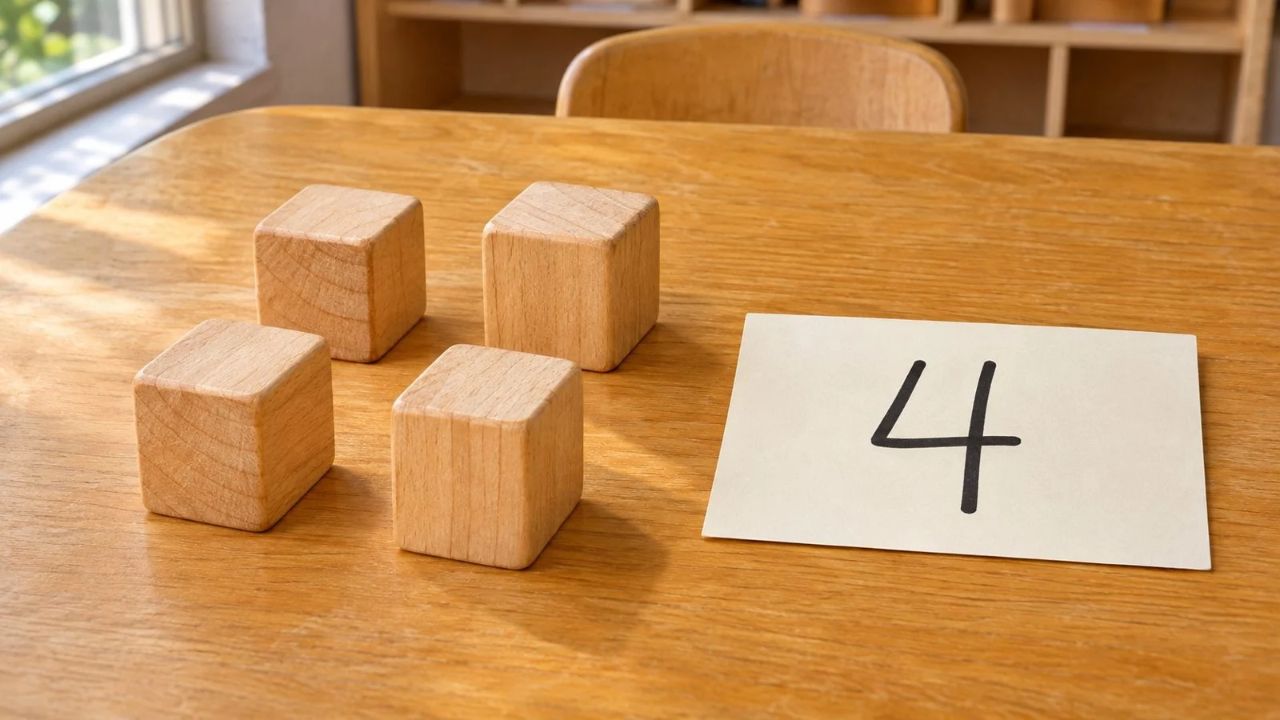
Set four cups on a table and ask a child to count them. Now put out a stack of cups and ask, “Could you bring me four?” Those sound like the same early math activity. They ask different things of the child. In the first, someone else has already chosen the set. In the second, the child starts with a number word, builds a set and decides when to stop.
That trip from one form of a number to another is worth looking for when choosing a preschool game, worksheet or app. A child might recognize the printed 4 on a card, for instance, and still want to count out the cups one at a time. Here are seven ways an activity can give four a meaning a child can see, hear or act on.
Research-Based Review Overview
The U.S. What Works Clearinghouse recommends teaching number concepts in a progression that builds on what young children already understand. One activity from the Institute of Education Sciences puts that into practice by pairing a numeral with dots in a ten-frame and asking children where the card belongs on a number path.
Each form gives the child a different way into the same question. When choosing an activity, look for at least one such connection. A simple game with cups and a handwritten card can do the job.
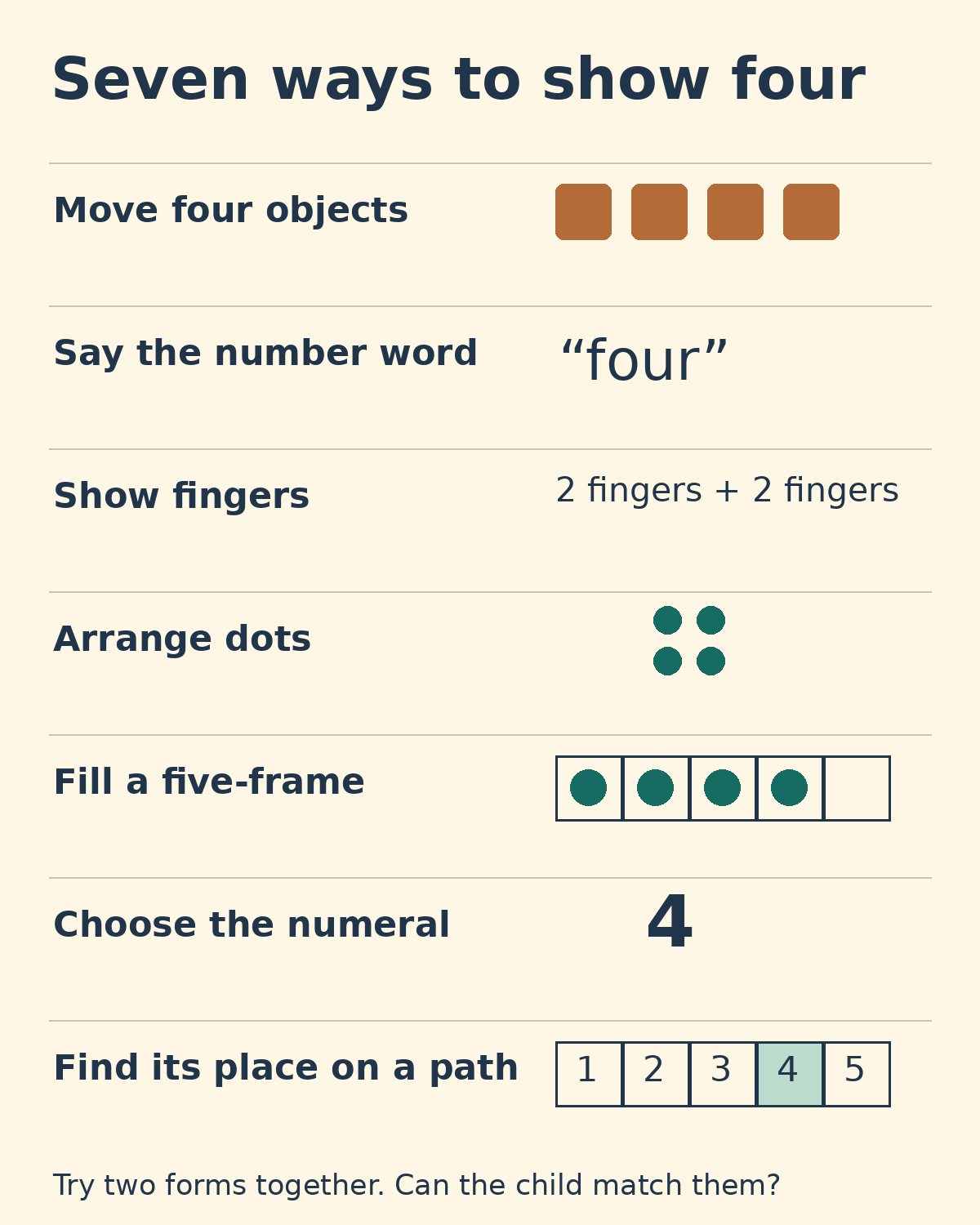
1. A collection the child can move
Four cups are a quantity a child can change with their hands. Give the child a stack and set out four toy animals for a pretend picnic. “Can everyone have a drink?” invites them to give each animal one cup. When an animal has two and another has none, the child has a reason to rearrange the cups. Ask how many cups the picnic needed after everyone has one.
Look for loose objects that can be moved aside as they are counted. That gives a child who keeps counting the same object twice a way to keep track. Once the four cups are on the table, spread them farther apart. Ask whether anyone needs another cup now. The question draws attention to what changed about the arrangement and what stayed the same about the guests.
2. A spoken number word that tells how many
Listen for the difference between a counting rhyme and a request. In a rhyme, “four” can be the word that comes after “three.” At the picnic, “four” tells someone how many cups to bring. After counting the cups aloud together, try saying, “Four cups. Could you bring four plates, too?” The child gets to use the last word of the count to make a fresh collection.
An audio activity can offer the same opportunity. Listen to one round before choosing it. Does the narrator say the quantity clearly and allow time for a response? Could a child answer by moving objects, pointing or using a number word in the language they speak at home? What you want to learn from this round is whether the child can make the requested set.
3. Fingers that can show the same amount in different ways
Hold up two fingers on each hand. Ask the child to show the same number any way they like. They might hold up four on one hand, copy your two pairs or touch each raised finger as they count. Put the two displays side by side and ask, “How could we check that we both have four?”
A game that accepts different finger patterns gives children room to notice that two and two make four. It also gives an adult something more informative to ask than “Which finger comes next?” If forming a particular hand shape is awkward, let the child point to a picture of a hand or match a counter to each of your raised fingers. The quantity question stays the same.
4. Dot patterns a child can recognize or count
Draw four dots at the corners of an imaginary square. On another card, draw three dots in a row with one underneath. Put both beside the four cups and ask, “Which card could tell someone how many cups to bring?” Both work. That makes this a particularly useful question for a child who knows four instantly on a die but hesitates when the dots move.
Recognizing how many objects are in a small group without counting each one is called subitizing. Leave both cards in view so the child can recognize, count or compare at their own pace. “I saw two on top and two underneath” tells you something that a fast tap on the correct card can’t.
5. A five-frame with a meaningful empty space
Draw one row of five equal boxes. Place one counter in each of the first four. Ask, “How many are here?” Then ask, “What would it take to fill the row?” The same display supports two answers: four counters are present and one more would make five. The empty box is doing part of the teaching.
A five-frame is especially useful when a child already counts four objects reliably and you want to explore four’s relationship to five. Try moving the last counter into the empty box. The gap changes position, but there are still four counters. On a worksheet, check that the borders are clear enough to tell an empty space from a filled one.
6. A written numeral that labels a quantity
A printed 4 takes up far less room than four cups. It can stand in for the whole collection, as long as the child knows what the symbol refers to. Turn that into a game of café orders. Set out cards marked 2, 3 and 4. One person picks a card, the other serves that many pretend drinks, and together they check the order. Swap jobs so the child also chooses the label.
For an app, look at what earns a correct answer. Matching a large 4 to another 4 practices recognizing its shape. Matching it to four cups asks the child to connect that shape to a quantity. Either task can have a purpose. Pick the one that fits what you want to practice, then try one order away from the screen. Editorialge’s guide to educational screen time offers more ways to carry a digital activity into everyday play.
7. A numbered path that gives four an address
Make a strip of five equal spaces numbered 1 through 5. Hand the child the four-dot card and ask where it belongs. Once the card is on 4, ask which space would match a card with one more dot. The path makes a relationship visible: 5 is one space beyond 4. The Institute of Education Sciences uses a related matching task in its small-group number-path activity.
Pay attention to the starting point when a game switches from matching to moving. Placing a toy directly on 4 is one task. Starting it on 1 and asking how many moves it takes to reach 4 is another. It takes three moves. Name the starting square and move the toy together once before asking the child to take over. Otherwise, an unclear game rule can look like a counting mistake.
How to choose an early math activity for tomorrow
Start with something the child already does comfortably and change one part. If they can say the count to four, hand them the stack of cups and let them decide when to stop. If they can serve four cups, give them a choice of numeral cards to leave beside the tray. If they can already do both, try the five-frame and ask how many more cups would fill it.
There’s no need to fit all seven representations into one sitting. Two can be enough for a good conversation. At the end of the pretend picnic, put the cups back in the cupboard and leave the order card on the table. “Could someone set this up again from your card?” gives the child a reason to use a number long after the counting is over.