

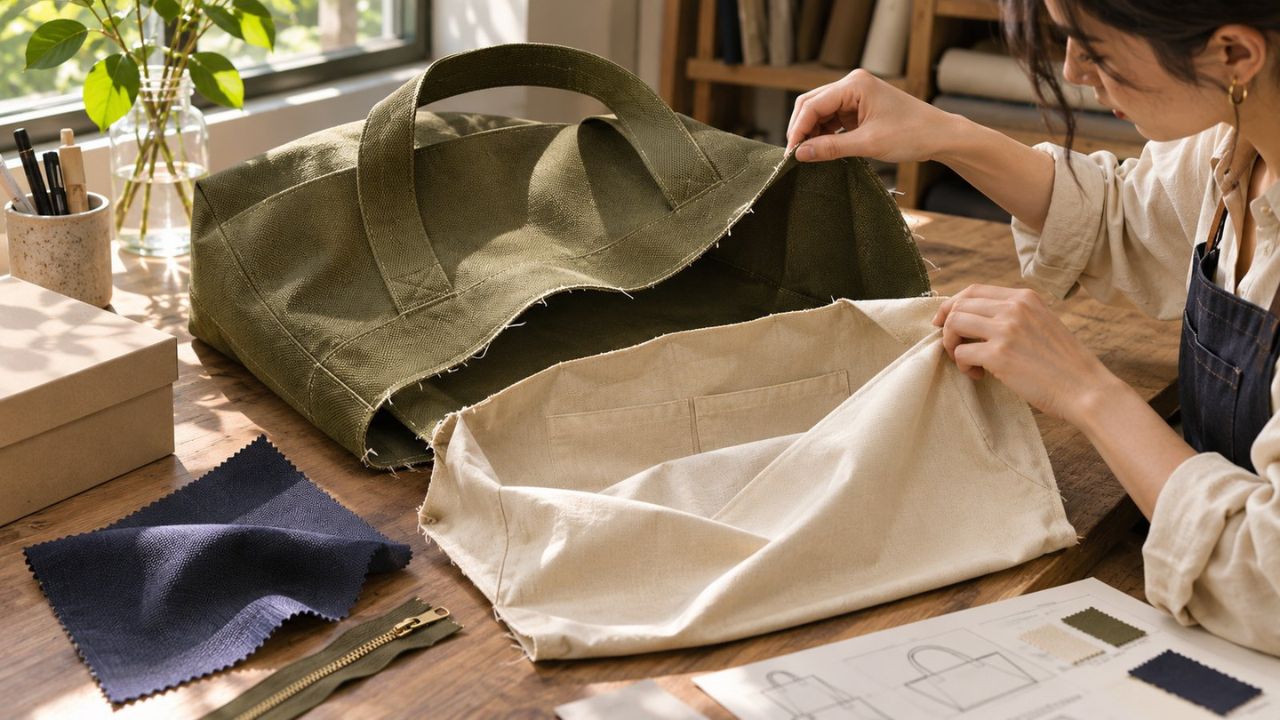
A product material description should tell shoppers what a product is made of and which part each claim describes. “Made with 60% recycled polyester” sounds specific until you ask what the 60% refers to. If the supplier’s documentation covers only the outer fabric, write “Recycled polyester makes up 60% of the outer fabric’s weight.” That one change tells shoppers what the number measures and gives your team a claim it can check against a record.
Start with the component, name the material, state the basis for any percentage, and check that the evidence covers the version the shopper can buy. Use the same wording wherever the claim appears, from the materials section to a badge on a product card.
Start your product material description with the parts shoppers care about
Read the bill of materials or product specification before drafting. For a tote, list the outer fabric, lining, handles, and hardware separately. For a table, distinguish the tabletop surface, the core underneath it, and the legs. Keep packaging on its own line. Then decide which facts a shopper needs to compare options, understand the construction, or choose the right variant.
Marketing can still lead with a readable sentence. “A zip-top tote with a canvas exterior and a cotton lining” gives shoppers a quick picture. The materials section can carry the specific fiber blend, hardware, and packaging details. This fits naturally alongside the other product page elements that help shoppers make a decision.
Watch for terms that leave the construction ambiguous. “Oak tabletop” can suggest solid oak. If the specification identifies oak veneer over plywood, put both in the sentence. If it identifies an oak-look laminate, name the laminate and use “oak-look” to describe the finish. A shopper should be able to picture what is under the surface before ordering.
Check what the evidence actually covers
A supplier specification may identify the fiber blend of one fabric. A test report may describe how a particular sample performed under stated conditions. A certificate may cover a particular material, facility, or set of products. Before using any of them, check the document revision or issue date and match its part number or product identifier to the item you sell.
For a shared product page, check that the claim applies to every selectable variant. A supplier may use different fabrics for a printed version and a solid color. If the record covers only navy, show the claim when navy is selected. If the same SKU is fulfilled from two suppliers, check both before writing copy that applies to every shipment.
| Claim you want to make | What to match before using it |
|---|---|
| “Cotton lining” | The lining part number and fiber composition in the current product specification |
| “60% recycled polyester by outer-fabric weight” | The outer fabric’s composition, documented recycled share, calculation basis, and covered variants |
| “Certified recycled outer fabric” | The certification program, covered material, validity, and permitted wording or mark use |
| “Water-resistant outer fabric” | The tested fabric, test conditions, and whether the claim describes fabric or the finished item |
| “90% recycled paperboard by carton weight” | The finished carton’s documented recycled share by weight, or a verified calculation covering the carton construction |
If a supplier sheet says only “contains recycled polyester,” ask for the share by weight before adding a percentage. If two records disagree, keep the disputed detail out of the listing until the supplier identifies which specification applies to the inventory being sold. Where a disclosure is required, resolve the discrepancy before using the new copy.
Give every percentage a denominator
A percentage on a fabric sheet could describe the recycled share of one fiber type or of the entire fabric. The difference matters. If a fabric is 80% polyester by weight and the supplier says 75% of that polyester is recycled, recycled polyester makes up 60% of the total fabric weight (80% × 75%). Use that calculation only when the records use compatible weight bases and cover the same fabric.
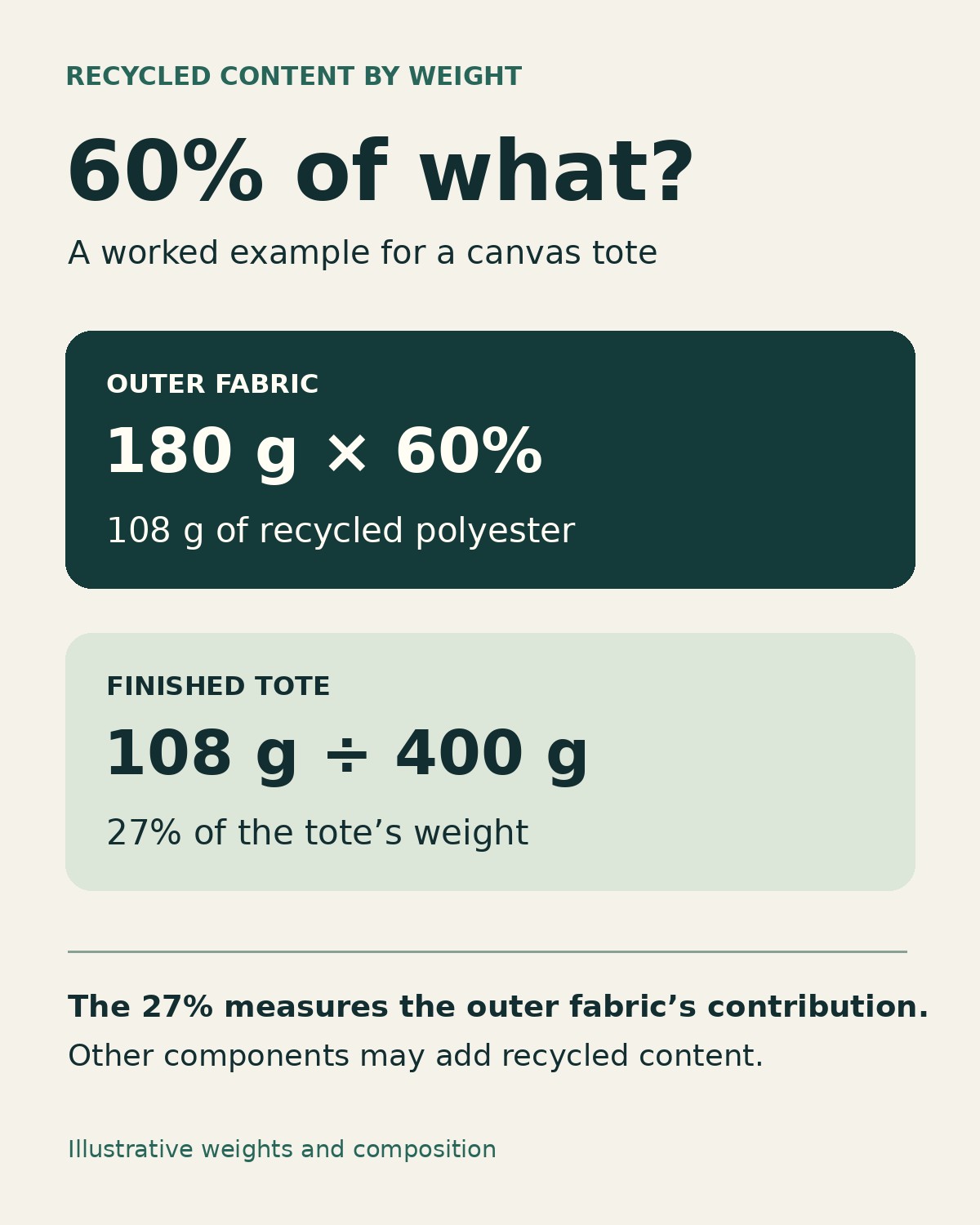
Now suppose the outer fabric weighs 180 grams and the finished tote weighs 400 grams. The outer fabric contributes 108 grams of recycled polyester, or 27% of the finished tote’s weight. That figure measures the contribution from the outer fabric. A claim about the tote’s total recycled content would also need support for the other components and their weights. If the outer fabric is the only part you can verify, the simpler line is “Recycled polyester makes up 60% of the outer fabric by weight.”
The U.S. Federal Trade Commission’s Green Guides summary advises marketers to identify whether an environmental claim applies to the product, its packaging, or a portion of either. It also advises qualifying recycled-content claims for items only partly made of recycled material so buyers can understand how much is recycled. Put the scope in the claim itself. “Shipping carton made with 90% recycled paperboard by carton weight” belongs with packaging details, separate from the tote’s material composition.
Show the same boundary in the headline, badge, and materials panel
Read the first screen of your product page as if you were shopping on a phone. If a badge says “60% recycled” and the words “outer fabric” appear only below the fold, the badge can suggest a whole-product claim. Use “Outer fabric: 60% recycled polyester by weight” if the layout has room. If it doesn’t, place the full statement in the materials panel and leave the numeric badge off.
Apply that check to images, marketplace listings, ad copy, and feeds as well. A marketplace may display a single bullet on its own. Put the component and the claim in the same bullet so the distinction survives when the text is reused. The same principle applies when you structure product information for search and AI discovery.
Keep category-specific labeling separate in your review. The FTC’s U.S. textile labeling guidance, for example, explains when the fiber content of a lining or filling incorporated for warmth must be disclosed separately. Check the applicable requirements for the product and market before copying a general materials layout to a regulated category.
Use this template to turn a specification into shopper copy
For each material line, fill in the component, the material or blend, and the percentage basis where needed. Add the variant to the line if shoppers can see several versions on the same page. Keep the evidence record beside the copy in your catalog or product information system.
Here’s a fictional example for a navy zip-top tote whose specifications match the details below.
Navy zip-top tote with a woven outer fabric and cotton lining. Recycled polyester makes up 60% of the outer fabric by weight.
| Component | Materials panel copy |
|---|---|
| Outer fabric | 60% recycled polyester and 40% cotton by outer-fabric weight |
| Lining | 100% cotton |
| Zipper pull | Zinc alloy |
| Shipping carton | 90% recycled paperboard by carton weight |
For the outer fabric line, the internal record could include the exact wording, the navy SKU, the matching fabric code, the supplier declaration and revision, and the person responsible for approving changes. A simple spreadsheet can do the job for a small catalog. The important test is whether a colleague could find the document and reproduce the percentage without asking the original writer.
Recheck the claim when the product changes
Build the materials review into the same workflow that approves a new supplier, revised fabric, redesigned carton, or new colorway. A zipper change might affect only the hardware line. A new outer fabric could affect the materials panel, recycled-content badge, marketplace bullets, and any ads that reuse the claim. If old and new stock ship together from a single listing, use wording that both versions support or distinguish the versions at the point of purchase.
Before approving a product material description, read each claim on its own and ask three questions. Which part does it describe? What does the percentage measure? Which record supports the version being sold? If those answers are easy to find, shoppers can compare the product, and your team can keep the copy accurate as the catalog changes.