
GEO for E-Commerce is no longer a future-facing idea. It is becoming a practical part of how online stores get discovered in 2026. Shoppers are not only typing short keywords into Google anymore. They are asking AI tools detailed questions like, “What is the best waterproof running shoe under $150 for flat feet?” or “Which coffee machine is easiest to clean for a small apartment?” These are not simple keyword searches. They are product discovery conversations.
That does not mean traditional SEO is dead. In fact, Google clearly says that SEO fundamentals still matter for AI Overviews and AI Mode. There are no separate “secret” technical requirements for appearing in these AI search features. Pages still need to be crawlable, indexable, helpful, and eligible to appear in Google Search.
The real change is this: product pages now need to serve both people and machines. A good e-commerce page must persuade the buyer, answer specific questions, provide clear product data, and make that information easy for search engines and AI systems to understand. That is where GEO comes in.
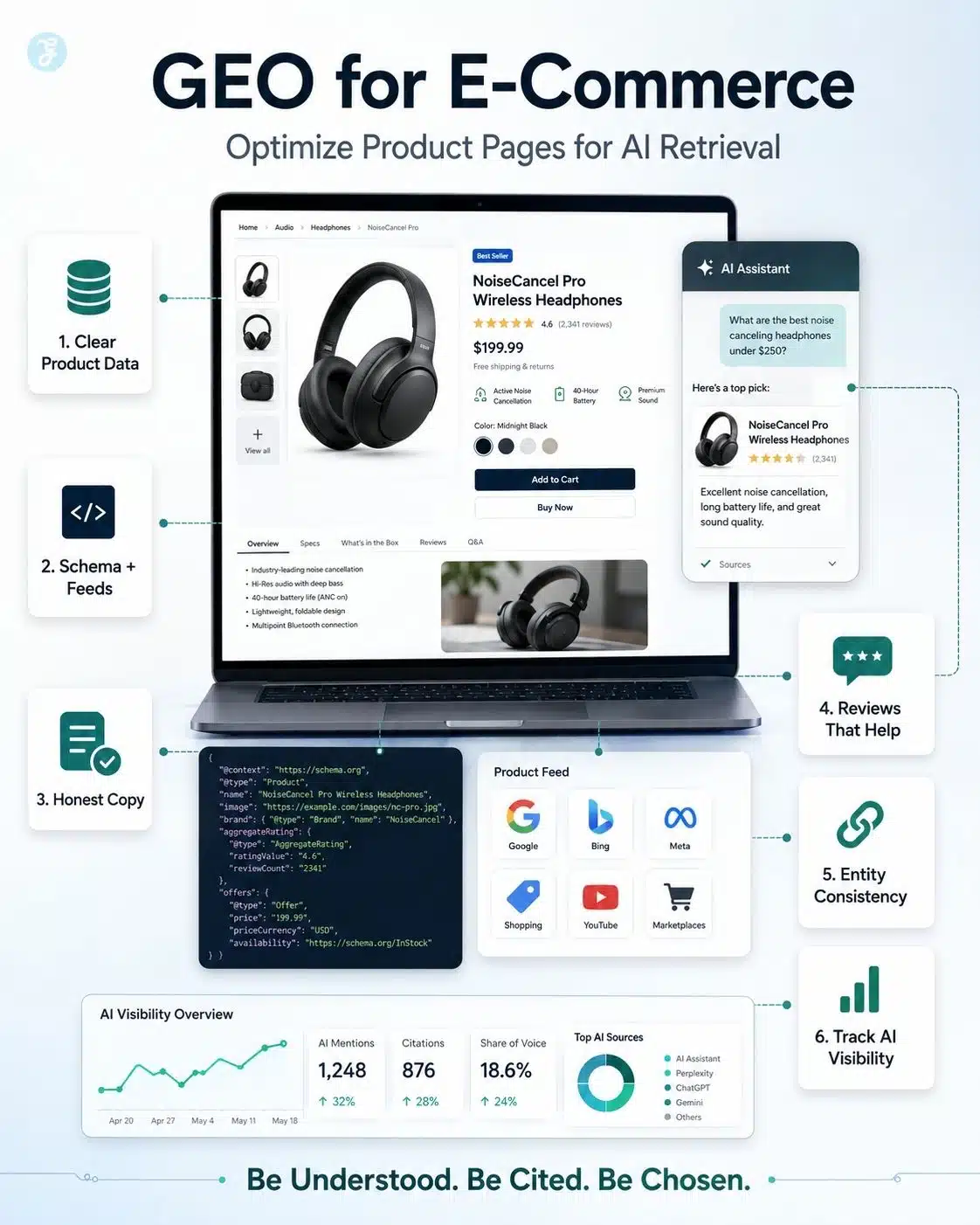
What GEO For E-Commerce Really Means In 2026
Generative Engine Optimization, or GEO, is the practice of making your content easier for AI systems to retrieve, understand, summarize, compare, and cite.
For e-commerce brands, this means your product pages should not only look good. They should also clearly explain what the product is, who it is for, what problem it solves, what makes it different, and what limitations buyers should know before purchasing.
A traditional SEO page might focus heavily on a target keyword, title tag, backlinks, and rankings. A GEO-ready e-commerce page goes further. It gives AI systems clean product facts, structured data, review signals, comparison points, use cases, and direct answers. The goal is not to replace SEO. The better way to think about it is this:
SEO helps your page get discovered. GEO helps your product get understood and recommended.
In Google Search, AI Overviews, and AI Mode may use different systems and may show different links depending on the query. Google also says AI Mode and AI Overviews can use “query fan-out,” meaning the system may issue several related searches across subtopics and data sources before building a response.
For e-commerce teams, that matters. Your product page may not be judged only against one exact keyword. It may be evaluated across related needs, comparisons, features, reviews, pricing, availability, and buyer intent.
How AI Product Discovery Is Changing Online Shopping
AI shopping discovery is becoming more conversational. A shopper may not start with a product name. They may start with a problem.
For example:
- “Best laptop for video editing under $1,000”
- “Comfortable office chair for lower back pain”
- “Best noise-canceling earbuds for small ears”
- “Non-toxic cookware for a family kitchen”
- “Best travel backpack for digital nomads”
In these searches, the AI assistant has to understand the buyer’s need, compare options, and explain why certain products fit better than others.
OpenAI’s shopping research feature is designed for decisions involving comparisons, trade-offs, preferences, and budget. It can ask follow-up questions about preferred brands, sizes, performance, comfort, style, and price to make suggestions more relevant.
This is why thin product pages are becoming weaker. If your page only says “premium quality,” “best design,” or “perfect for everyone,” AI systems do not have much useful information to extract.
A stronger product page says:
- Who the product is best for
- Who should avoid it
- What problem does it solve
- What size, material, compatibility, or technical details matter
- How it compares with similar products
- What verified customers mention repeatedly
- What price, shipping, return, and availability data is current
That is the foundation of e-commerce GEO.
Traditional SEO Vs GEO For E-Commerce
Traditional SEO and GEO are connected, but they do not measure success in exactly the same way.
| Area | Traditional SEO Focus | GEO For E-Commerce Focus |
| Main Goal | Rank higher in search results | Get retrieved, summarized, cited, or recommended by AI systems |
| Query Type | Short and keyword-based | Long, conversational, problem-based |
| Content Style | Optimized copy and metadata | Direct answers, clear product facts, comparison-ready content |
| Technical Layer | Crawlability, indexing, speed, and mobile usability | Crawlability, structured data, product feeds, entity consistency |
| Authority Signal | Backlinks, topical authority, brand trust | Verifiable data, expert content, reviews, mentions, and source consistency |
| Measurement | Rankings, clicks, impressions, conversions | AI citations, prompt visibility, AI referral traffic, recommendation context |
The big mistake is treating GEO as a replacement for SEO. It is not.
Google says pages that want to appear in AI features should still follow foundational SEO best practices, including allowing crawling, using internal links, providing good page experience, making important content available in text, and ensuring structured data matches visible page content.
So the right strategy is not SEO or GEO. It is SEO plus GEO.

Build A Product Page That Machines Can Read
A product page can look beautiful to a human but still be hard for AI systems to understand. Many e-commerce pages hide key information inside tabs, scripts, images, sliders, or vague marketing blocks. That can create problems when crawlers and AI systems try to extract details.
Google can process JavaScript, but JavaScript still needs to be implemented carefully. Google explains that it processes JavaScript pages through crawling, rendering, and indexing, and there are still optimization issues to consider.
For e-commerce sites, the safest approach is to make core product information available in clean HTML or properly rendered content. Important product details should not depend only on user clicks, hidden interactions, or scripts that crawlers may fail to process.
A GEO-ready product page should make these details easy to find:
| Product Data | Why It Matters |
| Product name | Helps identify the product as a clear entity |
| Brand name | Connects the product to a known business or manufacturer |
| SKU, GTIN, MPN | Helps avoid confusion between similar products |
| Price | Helps AI and search systems understand commercial relevance |
| Availability | Prevents users from being sent to unavailable products |
| Size, color, material, weight | Supports detailed comparison queries |
| Shipping information | Helps answer total-cost and delivery questions |
| Return policy | Builds buyer confidence and supports merchant listing features |
| Reviews and ratings | Adds real-world experience signals |
| Product images | Helps with visual discovery and product validation |
Google’s product structured data documentation highlights several useful e-commerce details, including ratings, shipping, availability, price drops, and return information.
Use Structured Data, But Do Not Treat It Like Magic
Structured data is one of the strongest technical foundations for e-commerce GEO. It helps search engines understand what each page contains.
For product pages, the most important structured data types usually include:
| Structured Data Type | Best Use |
| Product | Product identity, brand, description, images, SKU, GTIN, MPN |
| Offer | Price, currency, availability, seller, item condition |
| AggregateRating | Overall review score and review count |
| Review | Individual customer or editorial review details |
| ProductGroup | Variants such as size, color, pattern, or material |
| ShippingDetails | Shipping cost, delivery region, and timing |
| MerchantReturnPolicy | Return window, fees, and return method |
Google says e-commerce brands can provide rich product data by adding Product structured data, uploading Merchant Center feeds, or using both. Google also says using both structured data and Merchant Center feeds can maximize eligibility and help Google correctly understand and verify product data.
However, structured data does not guarantee visibility. Google clearly says that even correctly marked-up structured data is not guaranteed to appear as a rich result. So the goal is not to “trick” search engines with markup. The goal is to make your visible product content and your structured data match perfectly.
If the page says the product is out of stock, but your structured data says it is in stock, that creates trust problems. If your return policy is hidden or outdated, the markup alone will not save the page.
Product Feeds Are Now Part Of The GEO Conversation
In 2026, e-commerce GEO is not only about what appears on the product page. Product feeds matter too. OpenAI’s commerce documentation says merchants can provide structured product feeds so ChatGPT can accurately index and display products with up-to-date prices and availability. The documentation also says product feeds support accurate discovery, pricing, availability, and seller context.
This is a major shift for e-commerce teams. Your website copy, structured data, Merchant Center feed, marketplace listings, and ChatGPT product feed should all tell the same story. If one source says a product costs $129, another says $149, and another says it is out of stock, AI systems may not know which version to trust.
For better AI retrieval, keep these data points consistent across platforms:
- Product name
- Brand name
- SKU
- GTIN or MPN
- Price
- Sale price
- Availability
- Product category
- Shipping details
- Return policy
- Variant details
- Main product image
- Product description
Consistency is not glamorous, but it is one of the most important parts of e-commerce GEO.
Write Product Copy For Retrieval, Not Just Persuasion
Most e-commerce copy is written to sell. That is still important. But AI retrieval needs clarity more than hype. A phrase like “crafted for unmatched performance” may sound polished, but it does not tell the machine much. A sentence like “This 14-inch laptop has 16GB RAM, a 1TB SSD, and a dedicated GPU suitable for 4K video editing” is much easier to retrieve, compare, and summarize.
A strong GEO product description should answer five questions quickly:
- What is the product?
- Who is it best for?
- What problem does it solve?
- What proof supports the claim?
- What should buyers consider before purchasing?
Use short paragraphs. Use clear bullets. Add comparison blocks where useful. Include specific facts instead of empty adjectives.
Better product copy looks like this:
“This ergonomic office chair is best for remote workers who sit for six or more hours a day. It includes adjustable lumbar support, a breathable mesh back, 4D armrests, and a seat depth adjustment. It may not be ideal for users above 6 feet 4 inches because of the fixed headrest height”.
That kind of copy helps both the shopper and the AI system.
Add Honest Use Cases And Limitations
This is one of the easiest ways to improve e-commerce GEO. AI systems are designed to answer specific questions. If your product page only says the product is “best for everyone,” it sounds less trustworthy.
Instead, add sections like:
Best For
- First-time buyers
- Small apartments
- Budget-conscious shoppers
- Heavy users
- Beginners
- Professionals
- Parents
- Travelers
Not Ideal For
- Buyers who need premium materials
- Users above a certain height or weight
- People looking for professional-grade performance
- Customers who need international compatibility
- Shoppers who want the cheapest option
This does not weaken the product page. It makes it more credible. A product that clearly states its limitations is often easier for AI systems to match with the right user query.
Use Reviews As Real-World Evidence
Reviews are extremely important for e-commerce GEO because they provide a real human experience. OpenAI says ChatGPT may display product review summaries based on public reviews, but those summaries and ratings are not verified by OpenAI. That means e-commerce brands should work harder to collect detailed, useful, verified reviews.
A weak review says:
Great product.
A strong review says:
“I used this backpack for a 10-day trip through Italy. It fit under the airplane seat, held my laptop safely, and the shoulder straps stayed comfortable during long walks”.
The second review gives AI systems useful context. It connects the product to travel, laptop storage, airline use, comfort, and real-world durability.
Encourage customers to mention:
- How they used the product
- Their size, need, or use case
- What problem did it solve
- What they liked
- What they did not like
- How it compares with a previous product
- Whether they would recommend it to a specific type of buyer
Do not fake reviews. Do not over-mark up reviews. Do not hide negative feedback. A balanced review profile looks more natural and trustworthy.
Create FAQ Content, But Be Careful With FAQ Schema
FAQ sections are still useful for e-commerce pages because they answer long-tail buyer questions. However, the FAQ schema should not be treated as a guaranteed visibility tactic. Google reduced the visibility of FAQ rich results and says FAQPage rich results are generally shown only for well-known, authoritative government and health websites.
So the better strategy is this: Write FAQs for users and AI understanding first. Treat the FAQ schema as optional.
Good e-commerce FAQ questions include:
- Is this product compatible with [device/model]?
- What size should I choose?
- Is this product waterproof or water-resistant?
- How long does shipping take?
- What is the return policy?
- Does it work for beginners?
- Is it safe for children or pets?
- How does it compare with [competitor/product type]?
These questions match how people ask AI assistants for shopping help.

Map Conversational Prompts Before Writing Product Content
Keyword research still matters, but e-commerce brands now need prompt research too. Instead of only targeting “best running shoes,” think about the full buyer question.
For example:
| Traditional Keyword | AI-Style Prompt |
| best running shoes | What are the best running shoes for flat feet under $150? |
| office chair | Which office chair is best for lower back pain during remote work? |
| air fryer | What size air fryer should a family of four buy? |
| travel backpack | What is the best carry-on backpack for a two-week Europe trip? |
| protein powder | Which protein powder is easiest to digest for beginners? |
To optimize for these prompts, add specific product sections around buyer needs.
For example:
- “Best for small kitchens”
- “Best for long workdays”
- “Best for beginners”
- “Best for hot weather”
- “Best for frequent travelers”
- “Best for people with limited storage”
This is where GEO for E-Commerce becomes practical. You are not guessing what AI wants. You are answering the buyer’s real question in a format that machines can easily extract.
Strengthen Entity Consistency Across The Web
AI systems often cross-check information across many sources. That means your brand and product data should be consistent everywhere. Your website, Google Merchant Center feed, Amazon listing, Walmart listing, Shopify store, press releases, review sites, social profiles, and product feeds should all use the same product identity.
Pay close attention to:
- Brand spelling
- Product naming
- SKU format
- Color names
- Dimensions
- Material descriptions
- Warranty details
- Product category
- Model numbers
- Availability
If your own site says “EcoFlex Travel Bottle 750ml” but marketplaces call it “Eco Flex Water Flask 25oz,” AI systems may struggle to connect those as the same product. Clear entity consistency improves confidence. It also helps avoid a common e-commerce problem: AI recommending the wrong model, old version, or discontinued variant.
Do Not Block The Crawlers You Actually Want
Crawler access is now part of the GEO checklist. OpenAI says it uses web crawlers and user agents for its products and that webmasters can manage OAI-SearchBot and GPTBot separately through robots.txt. For example, a site owner may allow OAI-SearchBot for search visibility while disallowing GPTBot for model-training use.
This matters because some brands accidentally block AI-related crawlers at the CDN, firewall, robots.txt, or hosting level.
Before blaming AI tools for not seeing your product pages, check:
- robots.txt
- noindex tags
- canonical tags
- blocked scripts
- blocked structured data URLs
- CDN bot protection
- firewall rules
- server errors
- product feed errors
- slow or broken rendering
For Google AI features, the page still needs to be indexed and eligible to appear in Search with a snippet. Google says there are no extra technical requirements, but indexing and serving are not guaranteed.
How To Measure GEO Performance For E-Commerce
Traditional SEO metrics are still useful, but they do not show the full picture anymore. You still need to track:
- Organic clicks
- Impressions
- Rankings
- Revenue
- Conversion rate
- Product page engagement
- Search Console data
But e-commerce GEO needs additional tracking.
| GEO Metric | What It Shows |
| AI Citation Frequency | How often does your brand or product appear in AI answers |
| Prompt-Level Share Of Voice | How often you appear compared with competitors for target prompts |
| AI Referral Traffic | Visits from sources like ChatGPT, Perplexity, or other AI tools |
| Product Feed Accuracy | Whether price, availability, and product details are current |
| Recommendation Context | Whether AI tools describe your product correctly |
| Review Sentiment | What common positives and negatives AI may extract from reviews |
| Entity Consistency | Whether product facts match across platforms |
| Assisted Revenue | Sales influenced by AI discovery, even when the final visit comes later |
Do not only ask, “Did traffic increase?”
Also ask:
- Is the product being mentioned?
- Is it being described correctly?
- Is it recommended for the right use case?
- Are competitors appearing more often?
- Are prices and availability accurate?
- Are AI systems using outdated product information?
This gives a better view of AI search performance.
A Practical GEO Implementation Plan For E-Commerce Teams
You do not need to rewrite your entire e-commerce catalog at once. Start with the pages that matter most:
- Highest-margin products
- Best-selling products
- Products with strong reviews
- Products with clear comparison demand
- Products already ranking on page one or two
- Products often mentioned by customer support
- Products with high return rates due to unclear expectations
Then follow this process.
Step 1: Audit The Product Data
Check whether the page includes accurate product name, SKU, price, availability, shipping, returns, images, reviews, variants, and specs.
Step 2: Fix Structured Data
Add or improve Product, Offer, Review, AggregateRating, ProductGroup, shipping, and return policy markup where relevant.
Step 3: Align Your Merchant Feeds
Make sure Google Merchant Center, marketplace feeds, ChatGPT product feeds, and on-page product data are consistent.
Step 4: Rewrite The Top Section
Add a short answer-first product summary near the top of the page. Make it clear who the product is for and what problem it solves.
Step 5: Add Use-Case Sections
Create buyer-focused sections like “Best for,” “Not ideal for,” “Compatibility,” “Size guide,” and “Compared with similar products.”
Step 6: Improve Reviews
Ask verified buyers to leave detailed reviews based on actual use cases.
Step 7: Test AI Visibility
Run target prompts in major AI search and shopping tools. Track whether your product appears, how it is described, and which competitors are winning.
Step 8: Update Regularly
AI systems depend on fresh, consistent data. Update pricing, availability, review summaries, shipping policies, and product changes quickly.
Final Thoughts: The New Standard For Product Discovery
GEO for E-Commerce is not about chasing another SEO buzzword. It is about making your product pages clearer, more useful, and easier to trust.
The brands that win in AI product discovery will not be the ones with the most exaggerated copy. They will be the ones with clean data, honest product descriptions, detailed reviews, strong technical foundations, and consistent information across the web.
Traditional SEO still matters. Product feeds matter. Structured data matters. Reviews matter. Brand trust matters. The difference in 2026 is that all of these signals are now being interpreted inside more conversational, AI-driven discovery journeys. A product page should no longer be built only to rank. It should be built to answer, compare, verify, and convert. That is the real value of GEO.
Frequently Asked Questions About GEO For E-Commerce
1. What Is GEO For E-Commerce?
GEO for e-commerce means optimizing product pages and product data so AI systems can understand, retrieve, compare, and recommend your products. It includes clear copy, structured data, product feeds, reviews, and consistent information across the web.
2. Is GEO Replacing Traditional SEO?
No. GEO is not replacing SEO. Google says existing SEO best practices remain relevant for AI features in Search. GEO builds on those fundamentals by making content easier for AI systems to extract and summarize.
3. Does Product Schema Guarantee AI Visibility?
No. Product schema helps search engines understand your page, but it does not guarantee rich results, AI citations, or higher rankings. Google says structured data eligibility does not guarantee that a feature will appear in search results.
4. Should e-commerce Brands Use Product Feeds for AI Discovery?
Yes, product feeds are becoming more important. OpenAI’s product feed documentation says structured product feeds help ChatGPT index and display products with current price, availability, and seller context.
5. What Is The Most Important GEO Fix For Product Pages?
The most important fix is clarity. Make sure every product page clearly explains what the product is, who it is for, what problem it solves, what it costs, whether it is available, and why buyers should trust it.