
Most AI SaaS ideas fail for a simple reason. The founder builds a feature, not a fix for a problem people already pay to solve. Chatbot wrappers are easy to ship and easy to copy.
I work as chief technical advisor for ImagineLab AI, a live AI creative platform, and RankPilot AI, which is still in development. The AI SaaS ideas with high market demand below come from current market data and from problems I have seen while building AI products. Each has a clear buyer and a pain that exists today.
Quick List: AI SaaS Ideas With High Market Demand
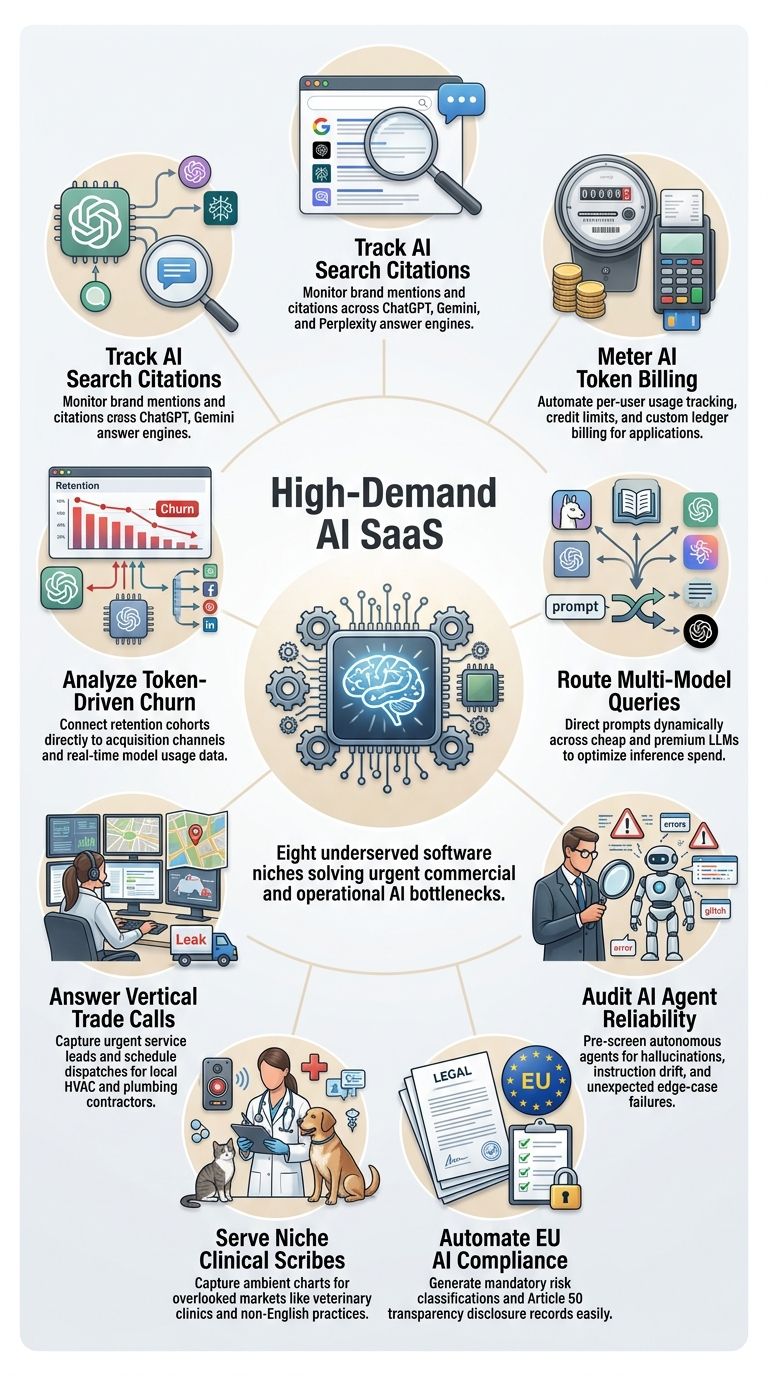
- AI search visibility tracking
- Token metering and billing for AI apps
- Model routing and cost control
- AI agent testing and evaluation
- AI Act compliance tools for EU sellers
- Niche AI clinical scribes
- AI phone answering for one trade
- Cohort and churn analytics for AI apps
- Support agents with outcome pricing
- AI localization for non-English markets
- Long video to short clip tools for small brands
- AI proposal and RFP responses
1. AI Search Visibility Tracking
Brands can rank first on Google and still lose traffic. A July 2025 Pew Research study found users clicked a normal result in 8% of visits when an AI summary appeared, compared with 15% without one. Ahrefs data from February 2026 showed the top result’s click-through rate falling 58% on queries with AI Overviews.
Marketers now ask: does ChatGPT, Gemini, or Perplexity mention my brand? Rank trackers were not built for that. A tool that tracks brand mentions, cited sources, and competitor share in AI answers has buyers today, from SEO agencies to in-house teams.
The hard part is running enough prompts, often enough, without the API bill eating your margin.
2. Token Metering and Billing for AI Apps
This one comes straight from experience. At ImagineLab, we built token-based billing early, and it was far harder than a normal subscription. Every request has a real cost. Different models cost different amounts. Users want to see what they spent and why.
The numbers show this is not just our problem. ICONIQ’s January 2026 The State of AI report projects average AI product gross margins of 52% in 2026, well below classic SaaS. The same survey found 37% of companies plan to change their AI pricing within a year.
A plug-in tool that tracks usage per user, sets credit limits, and bills cleanly would save small AI teams months. Payment processors handle the charge. The ledger logic before it is still a gap. See our AI SaaS pricing research for how teams are pricing this layer.
3. Model Routing and Cost Control
ICONIQ found companies use 3.1 model providers on average. That creates a routing problem. Which request goes to the cheap model, and which needs the expensive one?
At ImagineLab, we wrote a full decision record for an auto router because picking models by hand did not scale. A product that routes prompts by task, cost, and quality, then shows the savings, and sells to any team with a growing inference bill.
Open-source gateways compete here, so win on reporting and easy setup.
4. AI Agent Testing and Evaluation
Gartner predicts 40% of enterprise apps will include task-specific AI agents by the end of 2026. It also predicts over 40% of agentic AI projects will be canceled by the end of 2027, partly because of unclear value and weak risk controls.
That gap is a business. Teams need tools that test agents before release: Did it follow instructions? Did it make things up? Did it break on long inputs?
In one QA review of an AI writing assistant, the most serious issue was not a crash. It was the tool for inventing content. Normal tests miss that. Evaluation tools that flag fabrication, dropped content, and length problems fill a real hole.
5. AI Act Compliance Tools for EU Sellers
The EU AI Act’s transparency rules under Article 50 started applying on August 2, 2026. The Digital Omnibus, which entered into force on July 27, 2026, pushed high-risk system rules for standalone systems to December 2, 2027.
That gives compliance tools a clear runway. Small AI companies selling into Europe need help with disclosure labels, risk classification, and records. They cannot pay a large law firm for every update.
6. Niche AI Clinical Scribes
Ambient scribes, which listen to a visit and write the note, are already mainstream. Epic announced its own AI charting in February 2026, and AthenaHealth offers AthenaAmbient. Building a general scribe for large US hospitals is now a tough fight.
Smaller niches are still open. Think dental clinics, veterinary practices, physiotherapy, or clinics where patients speak a language other than English. A study of physicians in a California pilot listed limited function with non-English-speaking patients as a barrier to adoption. That is a gap a focused product can own.
Budget for healthcare privacy rules from day one.
7. AI Phone Answering for One Trade
The U.S. Chamber of Commerce reported that 58% of small businesses used generative AI in 2025, up from 40% in 2024. Phone answering is one of the clearest uses. Plumbers, HVAC firms, and dental offices lose jobs when calls go to voicemail.
General AI receptionists already exist. The better play is depth in one trade. An HVAC version should understand emergency calls, service areas, and the booking tools HVAC firms already use.
8. Cohort and Churn Analytics for AI Apps
At ImagineLab, we run retention analysis as SQL on our own tables, not in a product analytics tool. One cohort check changed our roadmap. Users from paid search churned by month two. Users from referrals, who joined in the same months, stayed. That led to a pricing change.
Most AI founders never see this split. Standard analytics tools track clicks, not token spend by cohort. A lightweight tool that connects to an AI app’s database and shows retention by channel, plan, and usage would help founders make better calls early.
9. Support Agents With Outcome Pricing
Customer support is the most proven AI agent use case. The open space is smaller helpdesks in specific industries, like e-commerce returns. Pricing is the angle. Charging per resolved ticket instead of per seat matches what buyers care about. It also forces you to get cost tracking right.
10. AI Localization for Non-English Markets
We publish in both English and Bengali. Machine translation handles words. It does not handle tone, local examples, or search terms people actually use.
A tool that adapts content for a market, not just translates it, can serve large online audiences in South Asia and beyond, where strong tools are fewer. Pair it with local keyword data and human review.
11. Long Video to Short Clip Tools for Small Brands
Small brands need short video but cannot afford editors. ImagineLab added Long Video Lab based on user demand, and our own launch video series showed how much work one tutorial set takes.
Clip tools already exist, so pick a niche. Course creators and B2B webinar teams need different cuts and captions.
12. AI Proposal and RFP Responses
B2B vendors spend days answering the same security and product questions. A tool that drafts answers from past proposals and flags anything needing human review saves real hours.
It is not flashy, but it is sticky. The tool improves as it stores more approved answers.
What Makes These Ideas Worth Building
The strongest AI SaaS ideas with high market demand share three traits:
- A buyer with a budget. Agencies, clinics, trades, and AI teams already pay for tools.
- A problem AI makes worse or newly solvable. Search changes, agent failures, and inference costs are all recent pains.
- Room for a small team. None require training your own foundation model.
If you want proof that narrow ideas can earn revenue, read about AI SaaS niches where founders hit $10K MRR.
Frequently Asked Questions (FAQs)
1. Which AI SaaS idea is easiest to start with?
AI phone answering for one trade or AI proposal responses. Both have clear buyers and a simple scope.
2. Do I need funding to build an AI SaaS product?
Not always. Many can launch with a small team and API-based models. Inference costs grow with usage, so plan cash flow carefully. If you raise, this guide on raising seed capital for SaaS covers the basics.
3. What is the biggest risk for AI SaaS startups?
Low margins. Every request costs money, so track cost per user from week one.
Final Thoughts
The best AI SaaS ideas with high market demand solve problems that got worse because of AI or that AI can finally fix at a fair price. Search visibility, inference costs, and agent reliability all fit.
Pick one idea. Talk to 10 possible buyers before you write code. If three of them ask when they can pay, you have something worth building.