
Wondering why AI SaaS pricing feels harder than classic SaaS pricing? I get it. The moment your costs move with every prompt, workflow, or API call, the old flat plan starts to crack.
What changed is simple: value is showing up in actions and outcomes, while cost is showing up in compute and billing events. In Salesforce Ventures and G2’s 2026 report, 95% of AI-selling companies still kept subscription as the foundation, but 73% layered usage on top, which is a strong signal that hybrid pricing is becoming the practical middle ground.
In this guide, I’ll walk you through the AI SaaS pricing research process I use to segment customers, choose the right metric, test usage-based pricing, and keep billing predictable enough for buyers and finance teams. We’ll go step by step, and I’ll show you where to start first.
Key Components of AI SaaS Pricing Research
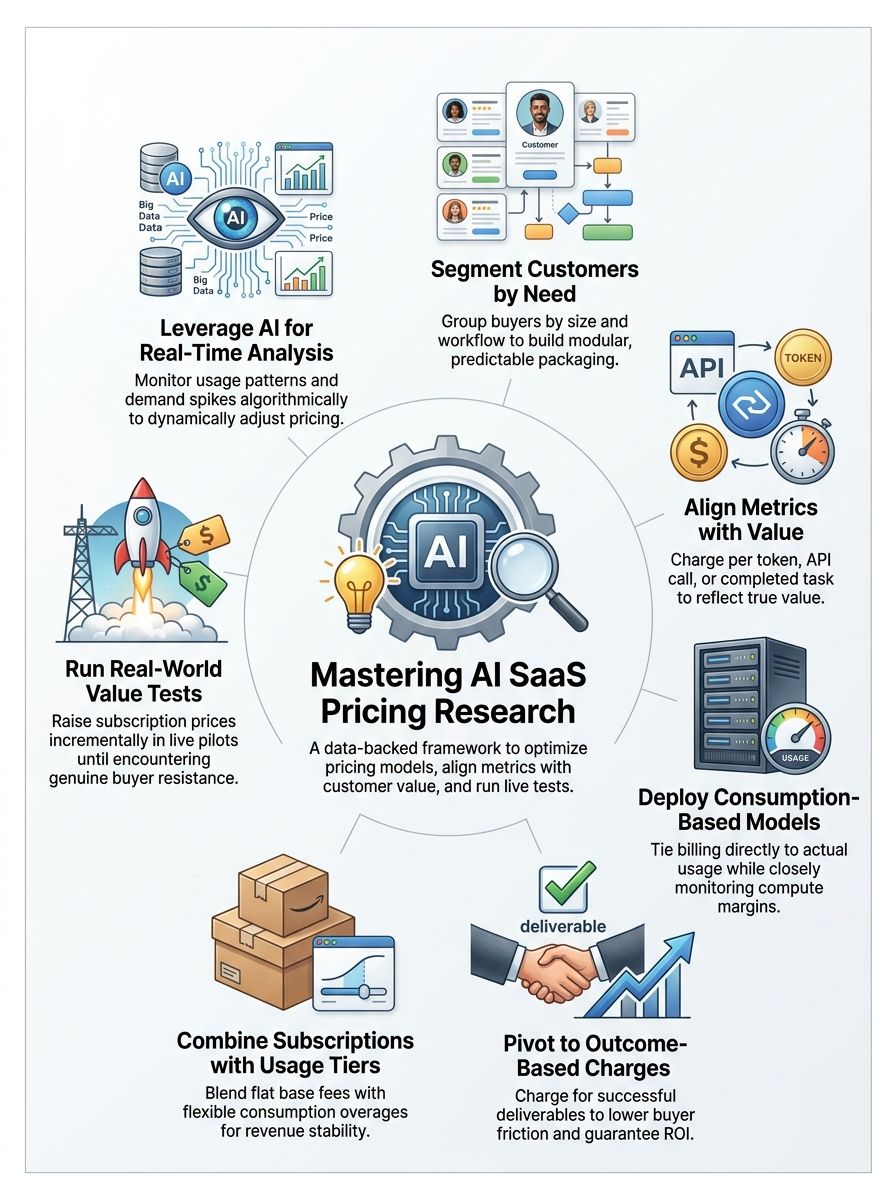
I break AI SaaS pricing research into four jobs: segment the buyer, choose the unit of value, benchmark public pricing, and test what buyers actually understand. If one of those pieces is fuzzy, pricing gets fuzzy too.
Identifying target customer segments
I start with segmentation because the best pricing model depends on who is buying, not just what the product does. L.E.K.’s 2026 consumption-pricing brief, drawing on an a16z CIO survey, says 39% of CIOs preferred usage-based pricing, 23% preferred hybrid, and 21% preferred seat-based models, so enterprise buyers are already telling us that pure per-seat plans are no longer the safe default.
That does not mean every segment wants the same deal. Developers often accept variable spend if the meter is clear. CFOs and procurement teams usually want caps, commits, or a base fee so they can forecast spend before they approve rollout.
- Segment by buyer role: the user, economic buyer, and procurement reviewer often want different pricing stories.
- Segment by usage shape: steady weekly usage can fit a subscription, while bursty usage usually needs credits, overage rules, or prepaid commits.
- Segment by risk tolerance: startups may accept variable bills for flexibility, while enterprise teams usually want predictability first.
- Segment by adoption path: self-serve buyers need simple math, and sales-led buyers can handle custom packaging if the business case is strong.
I also separate AI packaging from the core product early. L.E.K. recommends launching AI features as an add-on first, because it gives customers choice and clearer value messaging while you learn what adoption and margin really look like.
Once usage stabilizes, I can roll proven AI value into a higher tier or the core subscription. That keeps early skeptics from slowing adoption and keeps high-willingness buyers from being underpriced.
Defining value metrics and pricing units
Your value metric is the heart of your pricing model. If the unit tracks cost but not customer value, customers feel nickeled-and-dimed. If it tracks value but ignores cost, your margins can disappear.
I like to test three unit types: activity, workflow, and outcome. Activity units include API calls, tokens, or minutes. Workflow units bill for a completed job, like a translated document or an automated report. Outcome units charge only when the customer gets the result they care about, such as a resolved support ticket.
| Unit type | Best use | Main strength | Main risk |
| Activity | When cost scales with usage | Easy to meter | Bill volatility |
| Workflow | When buyers think in jobs completed | Closer to delivered value | Edge cases in job complexity |
| Outcome | When success is auditable | Strong value story | Margin and attribution risk |
DeepL’s API plans are a good reminder that the meter needs guardrails. Its help center says the API uses a monthly fixed price plus usage-based charges per translated character, and it lets teams set monthly cost-control limits and key-level usage limits. That is the kind of budgeting control enterprise buyers ask for when you pitch token or call based billing.
There is also a hidden pitfall in file-based pricing. DeepL’s document translation docs say certain uploaded files, including PDF and DOCX, are billed at a minimum of 50,000 characters per document, so if your own vendor costs have a floor like that, a tiny file should not be priced the same way as a large batch job.
Analyzing competitive pricing strategies
I never benchmark competitors by headline price alone. I map four things side by side: base fee, usage meter, spend controls, and what the buyer thinks they are actually buying.
One pattern stands out: public AI products do not rely on a one-size-fits-all structure. They use seats for access, credits or usage for cost control, and outcomes where value is easy to verify.
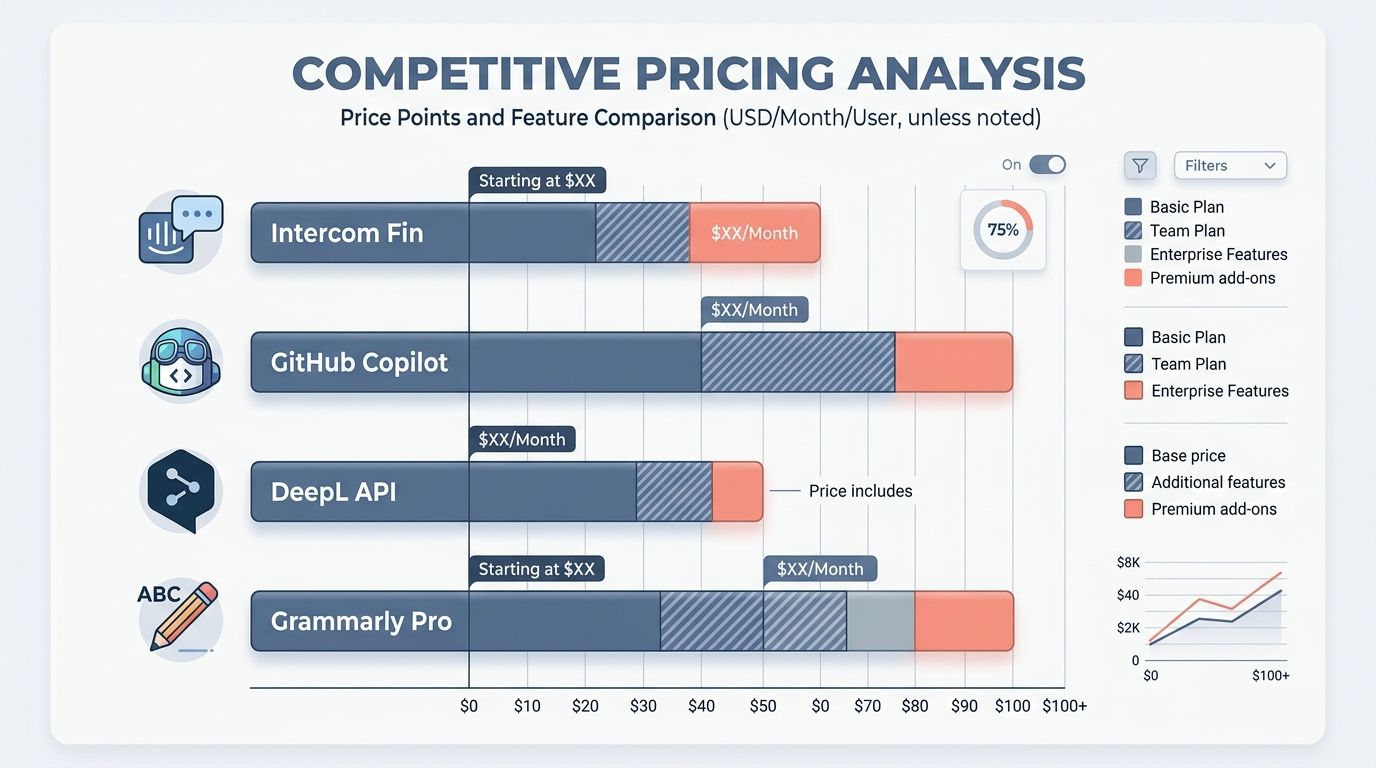
| Company | Public pricing model | Public pricing detail | What I take from it |
| Intercom Fin | Outcome-based | $0.99 per outcome, with no seat cost for Fin on an existing helpdesk | Use this when the result is easy to define and audit. |
| GitHub Copilot Business | Hybrid | $19 per user per month with 1,900 AI credits per user | Good for products that need both seat access and a usage meter. |
| GitHub Copilot Enterprise | Hybrid | $39 per user per month with 3,900 AI credits per user | Higher tiers can justify richer entitlements if the buyer sees governance and productivity gains. |
| DeepL API | Hybrid | Monthly fixed fee plus per-character usage, with cost-control limits | Hybrid works well when procurement wants a predictable floor and finance wants usage visibility. |
| Grammarly Pro | Seat-based with AI entitlement | $12 per user per month with 2,000 AI prompts per member each month | Seat pricing still works when included AI usage is easy to understand. |
The examples above come from current public pricing and help docs for Intercom, GitHub, DeepL, and Grammarly, which is why I treat them as better benchmark inputs than secondhand roundups.
That is why my competitor sheet always includes a buyer-math column. If a prospect cannot explain the bill back to their finance lead in one minute, the pricing structure is too clever.
Emerging AI SaaS Pricing Models
This is where AI pricing gets real. The right model is not the one that sounds modern. It is the one that matches your cost curve, your buyer’s budgeting habits, and the way value shows up in the product.
Deloitte’s 2026 outlook cites a Maxio survey saying 83% of AI-native SaaS companies already offer usage-based pricing, but the same research also says AI agents make classic seat counts less reliable because one user can now trigger the work of many. That is why I test usage, outcome, and hybrid models before I lock a price page.
Consumption-based pricing
Consumption-based pricing ties revenue to product use, and for an AI product that is often the cleanest match to compute cost. It is also the fastest way to expose bad unit economics, which is exactly why I like testing it early.

One useful way to size a per-call model is to work backward from unit economics. In a 12-week pilot across 120 test accounts, median weekly API usage landed at 4,200 calls per account, while 18 accounts ran above 15,000 calls a week. With compute cost estimated at $0.0025 per call and a billable rate of $0.005, the cohort produced a 52% gross margin, with accounts ranging from 34% to 68%. That spread told me where to place tier thresholds and which high-volume accounts needed custom overage terms.
Charge for what users run, but give them a way to see the meter before the invoice arrives.
That last part matters more than most teams expect. Metronome now supports spend alerts by user, team, or project, and Lago supports threshold billing that can trigger an invoice when usage crosses a defined level. Tools like that reduce bill shock and shorten procurement debates because buyers can cap risk before finance asks hard questions.
Pure usage can still be hard on forecasting. I use it when the buyer already thinks in units, like API calls, tokens, minutes, or cases processed, and I add alerts, prepaid credits, or annual commits when usage swings too much.
Outcome-based pricing
Outcome-based pricing is attractive because it ties price to value delivered, not raw activity. It is also easy to get wrong, because the moment you charge for outcomes, you take on more performance risk.
Intercom’s public pricing keeps the idea simple: Fin is priced at $0.99 per outcome, and an outcome counts when a customer confirms the issue is resolved, stops asking for more help after Fin responds, or Fin completes a workflow. That clarity is the real lesson. If the trigger is fuzzy, the pricing model turns into a customer success dispute.
- Use outcome pricing only when the event is auditable. A resolved ticket, approved claim, or booked meeting is easier to defend than a vague promise of productivity.
- Write the definition into the contract. Deloitte’s 2026 AI agents outlook says teams need shared definitions for terms like agent, task, interaction, and outcome before this model scales. ([deloitte.com](https://www.deloitte.com/us/en/insights/industry/technology/technology-media-and-telecom-predictions/2026/saas-ai-agents.html))
- Price in failure risk. If your AI has to re-run, escalate, or call a human, your margin model has to absorb that.
- Limit edge cases early. I like to exclude complex exceptions until I have enough data to price them separately.
In my own tests, outcome-based pricing worked best after I had enough data to estimate completion rates and exception handling. Before that, I used it as an add-on or a premium tier instead of making it the whole commercial model.
Hybrid pricing models
Hybrid pricing is the model I reach for most often in early and mid-stage AI SaaS. It gives buyers a predictable subscription, and it gives you a way to recover compute-heavy use as adoption grows.
I also compared a seat-only launch to a hybrid plan with a base subscription plus usage credits over three months. The seat-only group of 80 customers reached a median ARR of $9,800 with 6 month churn at 11%. The hybrid group of 82 customers reached a median ARR of $13,600 with churn at 8%. An overage protection add-on was adopted by 27% of hybrid customers in month 1, then settled at 18% by month 3. That told me buyers wanted predictability controls without giving up the upside of usage growth.
That result lines up with the broader market. In the latest Salesforce Ventures and G2 study, 95% of AI-selling companies still used subscription as the foundation and 73% layered usage-based pricing on top.
| Hybrid element | What it does | Best use |
| Recurring platform fee | Creates predictable entry spend | Helps procurement approve rollout |
| Included credits or usage allowance | Teaches the meter without immediate overage fear | Improves onboarding and first-month activation |
| Overage rate or top-up pack | Monetizes growth | Works for heavy users and bursty demand |
| Annual commit with true-up | Stabilizes forecast | Fits larger enterprise accounts |
Public examples make the pattern easy to see. GitHub Copilot Business bundles 1,900 AI credits into a $19 per user monthly plan, while Copilot Enterprise includes 3,900 AI credits at $39 per user. That is a clean example of seat access plus usage entitlement, and it works because buyers can understand both parts of the deal.
Many SaaS companies will stay here for a while. Hybrid pricing lets you test where value lives before you commit to a pure usage or pure outcome story.
Best Practices for Running AI SaaS Pricing Research
I treat pricing research as a repeatable operating process, not a one-time workshop. The goal is to learn where buyers feel value, where finance sees risk, and where your margins actually hold.
The fastest way to make progress is to pair live pricing tests with cleaner billing data. L.E.K.’s 2026 brief says 85% of SaaS companies already use usage-based pricing or are actively implementing it, so the teams that win are usually the ones that can measure and explain the meter well.
Conducting value-based pricing tests
I set a price, then I watch behavior, not just opinions. The real signal shows up when buyers need to justify the spend to someone else.
My simplest repeatable method is a short pricing ladder. First, define the unit of value for the feature, such as an automated report generated. Next, run a two-week test across three cohorts at $0.75, $1.50, and $3.00 per unit. Then track conversion, negotiation length, and expansion intent instead of looking at closes alone. In one run, conversion dropped 22% between $1.50 and $3.00, while expansion intent stayed flat from $0.75 to $1.50. That is the signal I want, because it shows where hesitation starts and where value perception stops rising with price.
- Lead with the business result. Pitch time saved, revenue recovered, or tickets resolved before you explain tokens or infrastructure.
- Raise price in small steps. If buyers say yes instantly, you probably have room to move. I change one variable at a time so the signal stays readable.
- Test comprehension with the offer. Ask prospects to explain the bill back to you in their own words. If they cannot do that, the metric is too abstract.
- Track margin by cohort. Price tests without unit economics are just messaging tests. I watch margin, churn, and expansion together.
- Compare model shapes, not just price points. Run a seat plan, a credit plan, and a usage plan against the same feature set when possible.
- Stop before complexity wins. More tiers can raise short-term conversion, but they often slow sales cycles and create billing confusion later.
I’ve found that buyers rarely object to paying more for AI. They object to paying for something they cannot forecast or explain.
Leveraging AI tools for real-time data analysis
I use AI tools and billing data together, because price testing without usage visibility is slow. Once the events are clean, you can see where revenue, margin, and churn start drifting almost in real time.
These workflows are easier to build than most teams think. Metronome has in-app revenue dashboards and spend alerts by group key, Lago supports fixed charges and threshold billing, and Maxio connects contract, invoice, revenue, and payment data in one place.
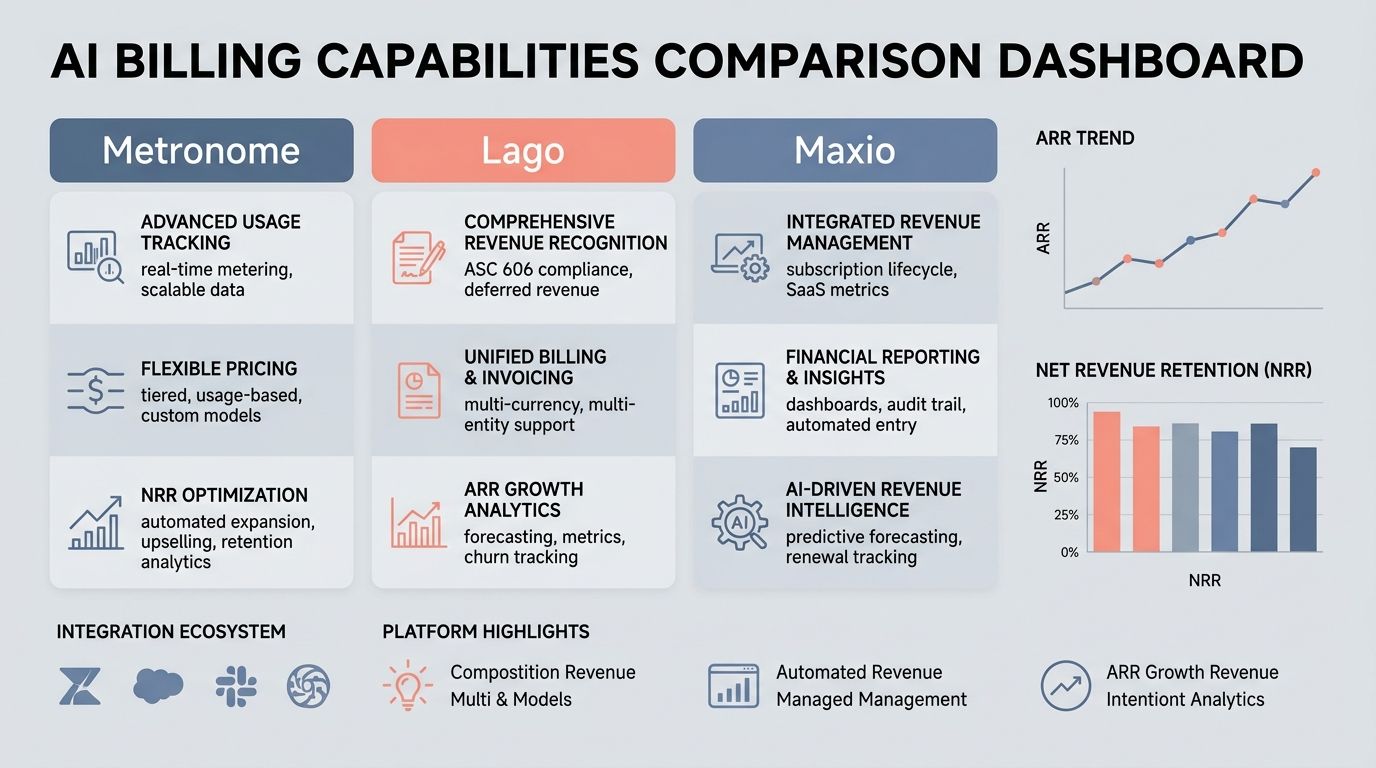
| Tool or capability | What I watch | Why it matters |
| Metronome dashboards and spend alerts | ARR, NRR, credit burn, spend by user or project | Helps catch runaway usage before it turns into churn or bill shock |
| Lago fixed charges and threshold billing | Base fees, usage thresholds, invoice timing | Makes hybrid pricing and progressive billing easier to test without manual work |
| Maxio analytics | Contract, invoice, revenue, and payment data | Lets finance and product analyze the same cohort metrics instead of arguing over spreadsheets |
- Monitor usage by cohort, not just by account total. Heavy users can hide weak margins if you only look at blended averages.
- Feed renewal, expansion, and overage data back into forecasting. That is where the best pricing strategy usually reveals itself.
- Set alerts for sudden cost spikes by user, team, or feature. This is the fastest way to catch abuse, bad prompts, or a broken automation loop.
- Run A/B tests on entitlements, not just sticker price. Changing included credits can move conversion without training buyers to expect lower prices.
- Give finance the same dashboard as product and sales. Pricing gets better when the whole team reads from the same meter.
Wrapping Up
AI SaaS pricing research works best when you treat pricing like a product system, not a page on your site. Compute, billing, packaging, and buyer psychology all move together.
My tests keep pointing to the same lesson: clear units, visible spend controls, and simple hybrid options beat clever pricing. Traditional SaaS pricing is not disappearing, but in the AI era it needs better meters and a stronger link to actual value.
There is no universal template. Keep testing, keep measuring, and let real customer behavior shape your next pricing move.
Frequently Asked Questions About AI Saas Pricing Research
1. What is AI SaaS pricing research?
AI SaaS pricing research tests how to set prices for AI software, it studies Market (economics), Consumption (economics), and Profit (economics). Think of it like a menu, you pick prices that match buyer habits and your costs.
2. How do I run pricing research?
Collect sales and user data, then run simple tests, use design pricing and different pricing to see what sticks. Compare snapshots, for example 2025-01-01T00:00:00.000+00:00 and 2026-01-01T00:00:00.000+00:00, to spot trends.
3. Which pricing models should I try?
Try Consumption (economics) models, Prepaid mobile phone style plans, flat fees, and tiers, mix and match, see what sells. Watch what leading ai and successful ai companies do, copy ideas, then make them your own.
4. How do I keep customers happy and profits up?
Be clear about fees, use Transparency (behavior), and talk to users, plain and simple. Test design pricing, track Profit (economics), tweak often, no crystal ball needed.