Building a company is not a singular milestone. It is a series of overlapping operational challenges that hit you simultaneously. One day your primary bottleneck is product-market fit; the next day it is decoding complex investor language, fixing a failing distribution pipeline, selecting corporate templates, or keeping your sanity intact when your brain is running on fumes.
Finding the best founder resources requires filtering past surface-level business advice and generic motivational quotes. You do not need polished marketing articles that repeat basic observations. You need unvarnished, data-grounded platforms and tactical playbooks built by operators who understand the raw realities of managing capital and scaling engineering teams.
The resource layout below maps out these assets directly by their operational clusters so you can jump straight to the tools matching your current company bottleneck.
| Resource Name | Core Strength | Primary Utility |
| Founder Mental Health Pledge | Structural wellness frameworks | Normalizing team mental health culture |
| Open Path Collective | Reduced-rate therapy networks | Accessible personal support tracks |
| 7 Cups | On-demand peer support networks | Low-friction anxiety venting spaces |
| How I Built This | Story-driven business case studies | Normalizing early corporate pivots |
| 20VC | Venture market data and interviews | Decoding investor evaluation logic |
| Lenny’s Podcast | Product-led growth teardowns | Tactical acquisition and retention loops |
| YC Startup School | Structured early building guides | Finding co-founders and early validation |
| Indie Hackers | Bootstrapped revenue tracking feeds | Validating capital-efficient software metrics |
| Product Hunt | Public launch discovery layers | Competitor research and launch tracking |
| Startup Grind | Localized global ecosystem chapters | Scaling networks outside tech hubs |
| Y Combinator | Fast-paced accelerator batches | Securing institutional capital and signal |
| Techstars | Mentorship-driven vertical cohorts | Industry pipeline validation models |
| 500 Global Accelerator | International growth engineering | Scaling user acquisition cross-border |
| First Round Review | Long-form operational interviews | Designing engineering and management systems |
| a16z Content | Sector macro trend forecasting | Aligning market narratives with venture attention |
| Paul Graham Essays | Foundational startup first principles | Stripping away fake progress metrics |
| YC SAFE Templates | Open-source investment structures | Closing angel rounds without high legal fees |
| Sequoia’s Pitching Guide | Strict ten-slide narrative cards | Formatting pitch presentations clearly |
| Lean Canvas Template | One-page business model grids | Mapping operational hypotheses quickly |
| SBA Business Plan Guide | Traditional financial planning steps | Securing traditional loans or grants |
| YC Startup School Course | Fundamental growth modules | Learning core launch and discovery rules |
| MIT OpenCourseWare | University-level venture mechanics | Rigorous academic opportunity evaluation |
| Stanford eCorner | Leadership case files and lectures | Navigating executive communication hurdles |
Protect Your Head Before the Startup Eats It
Founder mental health demands absolute operational priority. Startups regularly reward extreme obsession while quietly normalizing severe isolation, chronic sleep debt, and complete identity collapse. Prioritizing your psychological stability is a critical component of utilizing the best founder resources effectively, clearing your head before market pressures turn into an executive emergency.
1. Founder Mental Health Pledge
The Founder Mental Health Pledge reframes psychological well-being as a critical business infrastructure requirement rather than a hidden personal vulnerability. The platform encourages entrepreneurs and early venture backers to integrate active support systems directly into their company structures. By treating burnout and emotional pressure with the same operational seriousness as financial audits, it helps early teams minimize structural breakdowns.
The Operational Blindspot
This initiative operates primarily as a cultural awareness commitment framework rather than a clinical provider network. Signing the document signals alignment to your team and board, but it does not supply immediate psychiatric intervention or therapy access. Founders must establish separate, dedicated clinical pathways to handle acute operational anxiety or personal psychological needs before challenges mount. Early-stage teams looking to implement clear support tracks can focus on three internal boundaries:
-
Founder Alignment: Setting up transparent governance guidelines regarding workload limitations.
-
Board Communication: Normalizing transparency around stress milestones during quarterly reviews.
-
Team Culture: Integrating mental wellness resource budgets directly into the early corporate runway.
2. Open Path Psychotherapy Collective
Affordability remains the main barrier to mental health care for pre-revenue operators. Open Path Psychotherapy Collective connects users with licensed professionals offering deeply reduced session rates after a single, lifetime membership fee. This setup provides bootstrapped builders and solo software engineers with a practical way to maintain consistent therapy sessions without draining their personal operational runway or relying on high-margin insurance networks.
3. 7 Cups
The digital layout of 7 Cups provides round-the-clock emotional support through trained peer listeners alongside premium online counseling tiers. It serves as a low-friction outlet for founders who need to process day-to-day work anxiety outside normal business hours. The peer network works well for reducing immediate isolation, though it cannot replace clinical diagnostics when dealing with deep operational burnout.
Learn From Founder Conversations You Can Replay
Audio case studies offer significant utility because early-stage operators generally learn during stolen time. When assembling a dashboard of the best founder resources, high-value audio feeds provide direct context rather than empty motivation, breaking down exactly how technical systems failed, how distribution channels stalled, and what decisions altered corporate survival vectors.
4. How I Built This
Story-driven case validation forms the foundation of How I Built This. The narrative arcs break down the chaotic trajectories of established commercial brands, focusing heavily on early cash crunches, near-fatal operational errors, and sudden turning points. Listening to these case studies helps early builders normalize chronic uncertainty, illustrating that early structural failures are standard operational hurdles rather than signs of basic technical incompetence.
5. 20VC
Venture capital mechanics dictate early startup trajectories. The 20VC audio feed strips away institutional marketing to expose exactly how seed funds, growth equity partners, and angel networks evaluate founding teams. The interviews cover current valuation shifts, hiring metrics, and portfolio construction logic, giving operators a clear view of the investment landscape before entering priced equity rounds.
The Context Risk
The tactical advice shared on this network assumes a venture-backed growth roadmap where rapid hiring and market ownership take precedence over immediate capital efficiency. Independent bootstrappers or cash-conscious software creators must filter these discussions carefully. Chasing the aggressive headcount strategies discussed here without institutional runway will quickly lead to early capital exhaustion.
6. Lenny’s Podcast
Product-led growth loops and user retention mechanics form the core of Lenny’s Podcast. The interviews bypass high-level business theory to analyze specific operational plays used by fast-growing software companies. Episodes break down activation metrics, user onboarding workflows, and conversion experiments, providing tech founders with actionable product data.
Find People Who Understand the Messy Middle
Building a technology venture in total isolation distorts your strategic judgment. Active founder spaces allow builders to cross-reference operational metrics, gather early feedback, secure initial users, and discover functional workarounds from peers navigating identical scale bottlenecks.
7. Y Combinator Startup School
The digital platform of Y Combinator Startup School combines structured software lessons with weekly group accountability mechanics. Designed for early-stage builders turning raw concepts into functioning prototypes, the free curriculum guides teams through user discovery phases, capitalization math, and product launches while connecting them with a global network of peers.
8. Indie Hackers
Indie Hackers serves as a transparent destination for self-funded builders who prioritize revenue generation over venture capital approval. The community database is populated by operators who publish real monetization statistics, infrastructure costs, and organic distribution experiments. This uncensored data helps solo founders validate early pricing tiers using real bootstrap metrics.
9. Product Hunt
Product Hunt functions as a high-visibility discovery layer and early distribution channel for new software applications. Beyond launch day execution, the platform serves as a massive market research archive. Aspiring founders can use the commentary feeds to analyze competitor positioning, user objections, and landing page conversion tricks within their specific target market.
10. Startup Grind
The global architecture of Startup Grind links early-stage operators through localized chapters, educational events, and corporate mentoring networks. This setup is built for founders operating outside primary Silicon Valley hubs, helping teams secure early investor access and engineering relationships before they explicitly need to raise capital.
Compare Accelerator Paths Before You Apply
Accelerators programs can introduce operational focus and investor access, but a poor stage fit will cost you significant equity and time. Founders must evaluate cohorts based on explicit capital terms, geographic networks, and vertical specialization.
11. Y Combinator
The Y Combinator batch model accelerates company-building velocity by compressing years of operational growth into three months. The program injects 500,000 dollars using a standard structure: 125,000 dollars for a fixed 7 percent stake on a post-money SAFE, and 375,000 dollars on an uncapped note with a Most Favored Nation clause. The batch pushes founders to prioritize code deployment and user tracking above all corporate distractions.
Where the Advice Stalls
The structural signal and network access provided by the program are unmatched, but the model forces an extreme venture-backed velocity that may distort long-term product decisions. If your market requires slow, consultative enterprise sales validation rather than rapid viral distribution loops, the pressure to produce a hockey-stick growth narrative before Demo Day can lead to premature scaling mistakes.
12. Techstars
The three-month Techstars accelerator relies on a mentorship-driven network to prepare early software teams for institutional financing. The program combines capital investment with localized corporate partnerships, allowing founders to validate their product roadmaps directly against industry pipelines within specific geographic verticals.
13. 500 Global Flagship Accelerator
The Flagship Accelerator from 500 Global prioritizes growth engineering metrics and cross-border distribution models for tech companies entering international markets. The operational curriculum focuses heavily on scalable user acquisition pipelines and localization strategies, making it a functional fit for teams scaling beyond their domestic boundaries.
Follow Startup Writing That Still Teaches Judgment
High-value startup literature provides founders with analytical frameworks rather than shallow motivational summaries. The best editorial feeds retain their utility over time, allowing operators to revisit historical entries to solve entirely new scaling friction points as their organizations expand.
14. First Round Review
The editorial desk at First Round Review avoids vague strategic essays to print detailed tactical operator frameworks. The long-form articles profile the explicit systems used by early product managers, engineering directors, and growth leads to solve specific bottlenecks. The repository serves as an operational manual for founders scaling past their first ten team members.
15. a16z
The media output from Andreessen Horowitz provides a strategic macro view of technology markets, sector shifts, and regulatory trends. The content maps out long-term trajectories in fields like artificial intelligence, enterprise infrastructure, and digital networks, helping founders align their product narratives with moving venture capital focus areas.
16. Paul Graham Essays
the historical essay archive written by Paul Graham examines the first-principles logic of tech startup creation. The entries dissect the psychological traits of resilient founding teams, the mechanics of organic user delight, and the necessity of executing tasks that do not scale during early validation phases.
The Reading Trap
The philosophical clarity of these essays makes them highly engaging, which turns the archive into a prime destination for intellectual procrastination. Reading about the theory of wealth creation can easily feel like real progress, allowing founders to use conceptual strategic alignment as a shield to avoid messy customer acquisition calls or uncomfortable software deployments.
Keep Templates Ready Before Chaos Starts
Standardized administrative templates reduce early decision fatigue and eliminate basic operational overhead. Maintaining an indexed library of functional frameworks ensures your team avoids starting from a blank page when structuring equity rounds or mapping business hypotheses.
17. Y Combinator SAFE Financing Documents
The standardized post-money SAFE legal templates eliminate extensive negotiation friction during early funding rounds. By removing maturity dates and complex interest calculations, these open-source templates allow founders to secure capital commitments instantly from angel investors without spending precious runway on corporate legal overhead.
18. Sequoia’s Pitching Guide
The structural pitch architecture provided by Sequoia Capital forces founders to distill their commercial thesis into ten logical slides. The framework demands immediate clarity on problem definition, market size, and unit economics, systematically stripping out decorative feature lists to ensure investors grasp the core commercial engine.
19. Lean Canvas Template
The Lean Canvas functions as an agile, one-page business validation grid designed to map core operating hypotheses rapidly. The template visualizes customer segments, early cost structures, and unique value propositions side-by-side, preventing teams from writing long, obsolete business plans before finding true market demand.
20. SBA Business Plan Guide
The Small Business Administration guide details the formal financial and organizational structures required to secure traditional capital, corporate partnerships, or government grants. The framework provides early founders with explicit instructions on modeling traditional cash flow statements and operational hierarchies.
Build Your Founder Basics Without Paying First
Open education initiatives provide structured technical and operational logic before teams lock in expensive corporate coaching or advisory structures. These resources are best used alongside real-world customer validation tracks and rapid iteration cycles.
21. Y Combinator Startup School Course
Operating also as a self-paced learning track, the extended Startup School curriculum maps out core operational frameworks over a multi-week timeline. The modules drill down into early metrics tracking, distribution pipeline construction, and engineering prioritization rules, giving pre-seed builders a clean path to establish operational momentum.
22. MIT OpenCourseWare Entrepreneurship
The academic database of MIT OpenCourseWare opens up university-level engineering and venture formation materials for self-paced study. The technical syllabi detail new venture dynamics, innovation economics, and corporate financial structures, giving analytical founders a rigorous framework to evaluate market opportunities.
23. Stanford eCorner
Stanford eCorner aggregates video case files, lectures, and interviews from tech industry leaders detailing operational setbacks and entrepreneurial breakthroughs. The archive provides founders with realistic leadership perspectives, showing how veteran executives handle product failures and scale organizational communication models.
The Detail Readers Usually Miss With Best Founder Resources Lists
The hidden risk of accumulating digital resource archives is the comforting illusion of operational progress. Bookmarking extensive tool directories, downloading financial templates, and reading long-form strategy essays can easily become a psychological substitute for real execution. A pre-built spreadsheet or a beautifully organized database will not fix a product that users fundamentally do not want.
Every resource must be aggressively parsed through your immediate operational reality. Applying an elaborate engineering management system designed for a late-stage corporate entity will completely paralyze a two-person pre-seed startup. Frameworks are built to reduce administrative starting friction, not to replace direct customer conversations and rapid code iteration loops.
Choosing Your Primary Baseline Tools
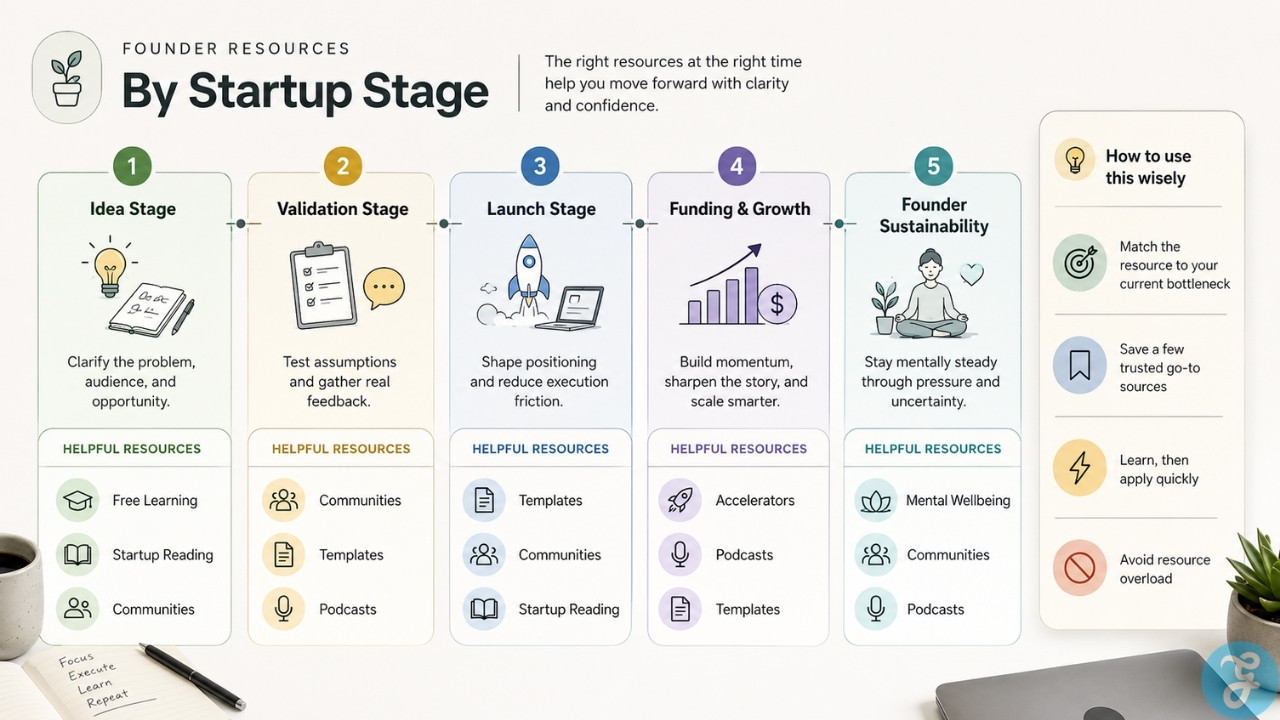
Selecting the right resource to deploy depends entirely on the primary metric bottleneck blocking your current week. If your founding team is navigating early corporate formation or dividing equity stakes, your immediate priority is studying the structural vesting clauses within official legal templates. If your prototype has found early active users but your retention curve is flat, focus your attention on Lenny’s product-led growth data drops to isolate your leak.
Audit your current team deficiencies, isolate the single operational problem preventing your next release milestone, and select one targeted framework from your master collection of the best founder resources to clear the track. Avoid building an elaborate corporate architecture before you have validated something that real customers find valuable.
Frequently Asked Questions (FAQs) About Best Founder Resources
What are the best founder resources for early-stage startup founders?
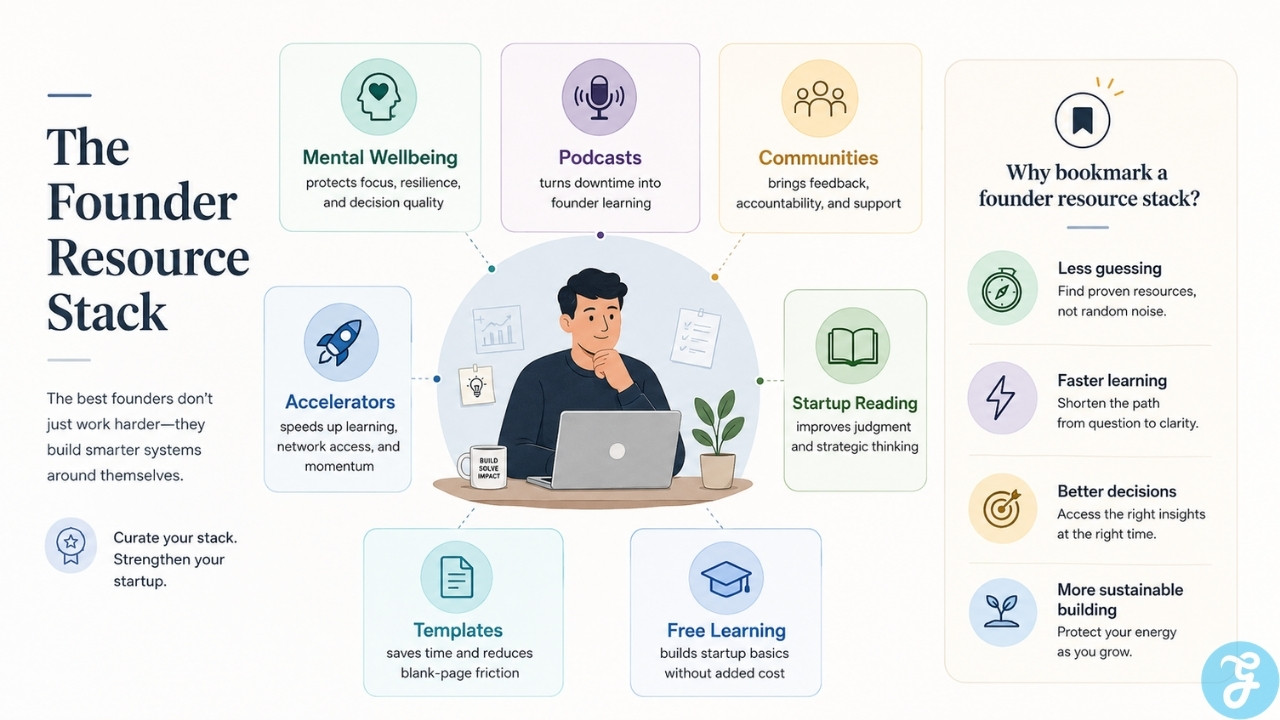
The best founder resources for early-stage founders usually include startup learning platforms, founder communities, practical templates, podcasts, and mental health support. These resources help founders validate ideas, avoid common mistakes, learn from experienced operators, and stay mentally steady while building.
Why should founders bookmark startup resources?
Founders should bookmark startup resources because company-building often moves faster than their ability to search from scratch every time. A saved resource stack helps founders find trusted advice, templates, communities, and learning materials when they face real decisions.
Are free founder resources enough to start a company?
Free founder resources can be enough to understand startup basics, validate an idea, and begin building with more clarity. However, founders may still need paid tools, legal advice, accounting support, coaching, or accelerator access as the company becomes more complex.
Which founder resources are best for mental health and burnout?
Mental health resources, peer support platforms, therapy directories, and founder-focused wellness initiatives are useful for founders dealing with stress, isolation, or burnout. They should be treated as support systems, not last-minute fixes after the pressure becomes unmanageable.
How do I choose the right founder resource for my startup stage?
Choose founder resources based on your current bottleneck. If you are still testing an idea, focus on free courses, startup reading, and communities; if you are launching or fundraising, templates, podcasts, accelerators, and investor-focused resources become more useful.