
Sifting through the internet for actionable tactical advice can feel like a full-time job. Most curation lists point you toward generic content mills or corporate marketing feeds that repeat basic observations. When you are looking for the best startup blogs, you do not need generic motivational quotes or surface-level summaries. You need unvarnished, data-grounded insights from operators who have actually scaled pipelines, managed painful engineering bottlenecks, and structured priced equity rounds.
The resource ecosystem has split into distinct structural disciplines. To maximize your reading time, it helps to understand what each publication specializes in before adding it to your weekly feed.
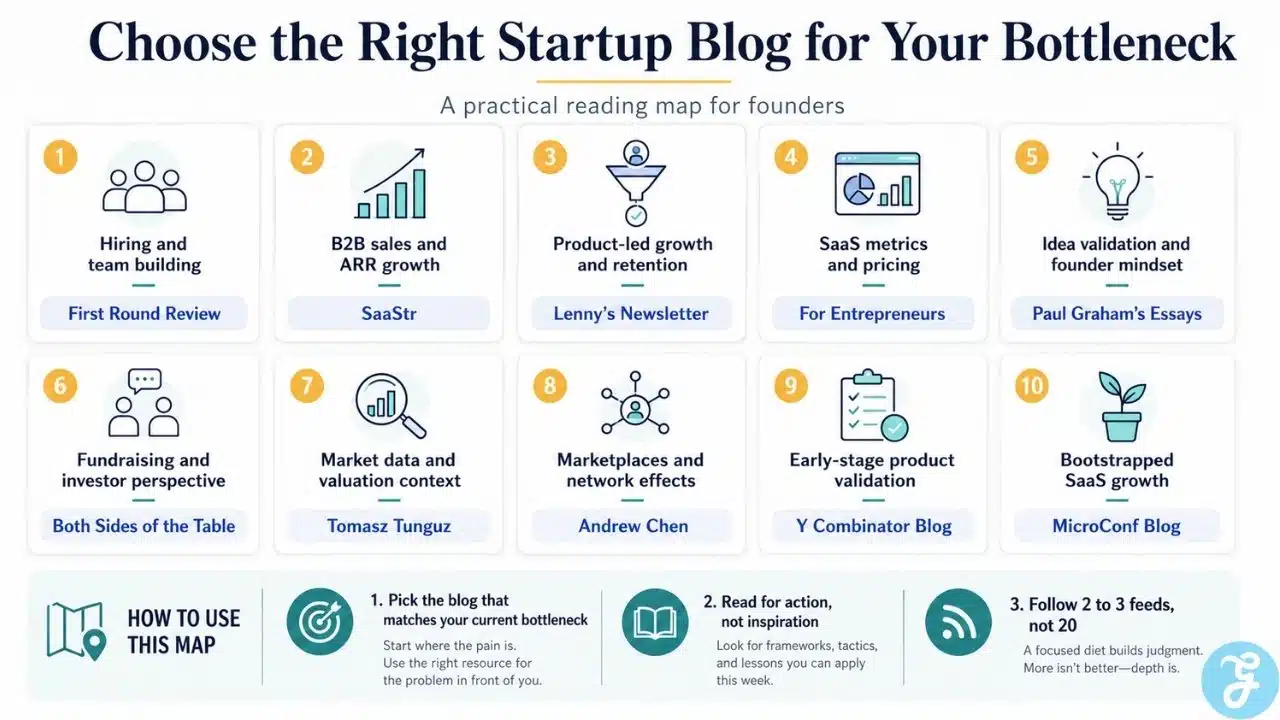
| Blog Name | Core Structural Strength | Best Used For |
| First Round Review | Long-form tactical interviews | Hiring and team management |
| SaaStr | High-frequency GTM breakdowns | B2B sales execution and metrics |
| Lenny’s Newsletter | Product-led growth teardowns | Product management and retention loops |
| For Entrepreneurs | Seminal SaaS metrics manuals | CAC, LTV, and cohort modeling |
| Paul Graham’s Essays | Philosophical first principles | Validating ideas and market fit |
| Tomasz Tunguz | Regression analysis and data points | Venture modeling and financial logic |
| Andrew Chen | Growth engineering playbooks | Consumer acquisition and network loops |
| Both Sides of the Table | Transparent VC mechanics | Pitching and running board meetings |
| Y Combinator Blog | Tactical early-stage verification | Pre-product-market fit execution |
| MicroConf Blog | Capital-efficient SaaS guides | Bootstrapping without VC pressure |
The 10 Best Startup Blogs for Early-Stage Founders Compared
The resources selected below reject surface-level business advice. Finding the best startup blogs requires filtering for actionable execution strategies. This curated startup blogs list intentionally abandons symmetrical layouts to reflect the uneven depth of each publication, mixing deep-dive manuals with rapid data points to give operators targeted execution paths.
1. First Round Review: The Operator’s Playbook
First Round Review avoids high-level strategic theory by interviewing the specific executives and early hires who built dominant tech companies. Published by First Round Capital, this publication treats company building like a series of engineering problems. Instead of profiling a famous CEO, an entry might detail how an early product manager at Slack refined internal iteration speeds or how an executive coach helps founders navigate team trust breakdowns. The writing relies on deep, conversational case studies backed by concrete frameworks, making it an essential read for team builders.
The Operational Blindspot
The vast majority of their frameworks are sourced from venture-backed, Silicon Valley corporate environments. If you are operating a highly lean, bootstrapped team outside a major tech hub, their heavy emphasis on specialized executive hiring and elaborate matrix organizational structures will introduce unnecessary operational overhead. Furthermore, because these pieces are massive case studies, they require significant processing time. They are built for long-term strategic planning, not for solving immediate, burning engineering or distribution bugs. Early-stage teams dealing with execution friction particularly benefit from isolating their technical tracks:
-
Engineering Culture: Tactics for scaling code review architectures without triggering product development delays.
-
Exec Hiring: Practical frameworks for profiling your first non-technical leadership hires before reaching series A.
-
Internal Communication: De-risking organizational misalignment during rapid workforce expansion phases.
2. SaaStr: The B2B SaaS Bible
Founded by veteran operator Jason Lemkin, SaaStr is the undisputed hub for business-to-business software advice. The blog focuses heavily on the mechanics of scaling from zero to $100 million in Annual Recurring Revenue (ARR). Lemkin writes with a direct, opinionated style that strips away corporate politeness. A typical article addresses urgent, granular questions—such as whether post-sales client success functions should report directly to your head of sales, or how to systematically set up your first two quota-carrying sales representatives to enable effective internal testing.
The Context Risk
Because Lemkin posts at an incredibly high frequency, the blog frequently recycles core tenets from the mid-2010s venture boom. Some of the assumptions regarding aggressive outbound sales headcount expansion do not hold up cleanly under stricter capital constraints. Despite marketing itself to early-stage builders, the meat of SaaStr’s value kicks in only after a company clears $1 million in ARR. If you are still trying to figure out your core value proposition, their regular columns on sales commission structures will act as a structural distraction.
3. Lenny’s Newsletter: Product-Led Growth Mastery
Lenny Rachitsky has built one of the most operationally useful growth resources on the web. Transitioning from engineering and product leadership roles into full-time research, Rachitsky builds highly technical analyses of how products scale. The content relies on data collections from hundreds of fast-growing startups to isolate hidden growth loops, product-market fit indicators, and user retention strategies. If your startup relies on low-friction user acquisition or digital network loops, the detailed case studies provided here cut right past standard growth-hacking tropes.
Where the Advice Stalls
While the public essays are dense and valuable, the absolute best tactical playbooks, template drop-downs, and access to the curated community are locked behind a paid subscription model. Sourcing growth data from companies like Airbnb, Uber, and Figma means the insights skew heavily toward environments with preexisting brand equity. A pre-seed founder attempting to deploy a growth loop from these archives without an established user base will frequently hit a wall due to pure lack of traffic.
4. For Entrepreneurs: The Definitive SaaS Metrics Hub
David Skok, a five-time entrepreneur turned venture capitalist at Matrix Partners, built the definitive manual for software economics on his site, For Entrepreneurs. Unlike active daily feeds, this publication functions essentially as a timeless digital textbook. Skok’s seminal breakdowns on multi-axis pricing strategies, customer acquisition costs (CAC), and customer lifetime value (LTV) models provide founders with the mathematical proof needed to evaluate if their software company is fundamentally sustainable or burning cash on broken assumptions. It requires slow, study-like consumption rather than casual browsing.
5. Paul Graham’s Essays: Foundational First Principles
As a co-founder of Y Combinator, Paul Graham’s regular long-form essays serve as the intellectual bedrock for the modern technology startup ecosystem. Graham ignores temporary marketing trends to examine first-principles logic: how to evaluate if a weird idea is actually viable, how to survive the emotional gauntlet of early-stage failures, and why chasing organic user delight matters more than premature corporate optimization. The prose is clean, clear, and intensely practical for builders still sitting in the pre-product-market fit stage.
The Reading Trap
Because Graham’s essays are beautifully written and highly philosophical, they are highly addictive to read but dangerously comforting. It is incredibly easy for a founder to spend an afternoon reading about the nature of startup ideas as a form of intellectual procrastination, using his grand theories to avoid the messy, uncomfortable work of cold-calling real users.
6. Tomasz Tunguz: Data-Driven Venture Analysis
Tunguz is a venture capitalist who completely discards narrative startup advice in favor of rigorous statistical modeling. This blog is highly niche, very short, and completely objective. He uses regression analysis and public tech market data to chart macro shifts in enterprise software, public valuations, and net revenue retention limits. If you do not have a firm grasp on corporate finance or corporate equity tracking, these data drops will feel dense and unreadable. It is an essential weekly health check for founders preparing for late-stage venture rounds, but largely irrelevant for pre-revenue software builders.
7. Andrew Chen: Growth Engineering and Network Effects
Andrew Chen’s publication focuses intensely on user acquisition mechanics, tech trends, and consumer loops. Now a partner at Andreessen Horowitz after leading growth initiatives at major marketplaces, Chen’s writing breaks down why classical marketing frameworks fail in software ecosystems. His deep-dive essays cover how to survive the cold start problem when launching a two-sided platform and how to combat customer acquisition friction when your organic loops begin to slow down.
8. Both Sides of the Table: The Unfiltered VC Perspective
Mark Suster of Upfront Ventures writes Both Sides of the Table to demystify what happens behind closed doors during institutional capital raises. Suster’s posts function as a transparent tactical guide for founders learning how to manage board dynamics, format pitch decks, and handle difficult investor negotiations. The perspective is sharp and direct, warning early-stage executives about common equity mistakes and structural terms that can derail a company during subsequent funding rounds.
9. The Y Combinator Blog: Tactical Early-Stage Verification
The official Y Combinator feed serves as a highly practical manual for technical builders trying to launch products from scratch. The blog systematically archives actionable tools, like founder-led growth playbooks and frameworks for speeding up your early discovery phases. Rather than pushing corporate public relations, the articles emphasize raw validation tactics—such as how to build a functional version-one customer success model without expanding your payroll prematurely.
10. MicroConf Blog: The Bootstrapper’s Capital-Efficient Manual
While venture-backed paths dominate major news feeds, the MicroConf blog and its adjacent resources focus entirely on independent, self-funded software entrepreneurs. Tailored for builders who want to scale profitable software companies without selling large equity chunks to institutional funds, this feed specializes in low-overhead execution. The articles detail how to manage solo development pipelines, optimize high-margin pricing tiers, and generate repeatable inbound leads without massive marketing budgets.
The Detail Readers Usually Miss With Founder Blogs
The hidden risk of spending hours browsing an entrepreneur blogs collection or adding dozens of popular founder blogs to your RSS feed is the illusion of progress. Reading about a growth framework designed by an executive at a multi-billion-dollar enterprise will not solve your pre-revenue validation problems. Many high-profile posts assume you already possess a dedicated marketing department or millions in institutional runway.
Early-stage teams must filter every piece of advice through their specific operational context. A distribution playbook that works perfectly for an enterprise SaaS product in North America can completely fail when applied to a lean, developer-focused tool in a localized market.
Choosing Your Best Startup Blogs for Execution
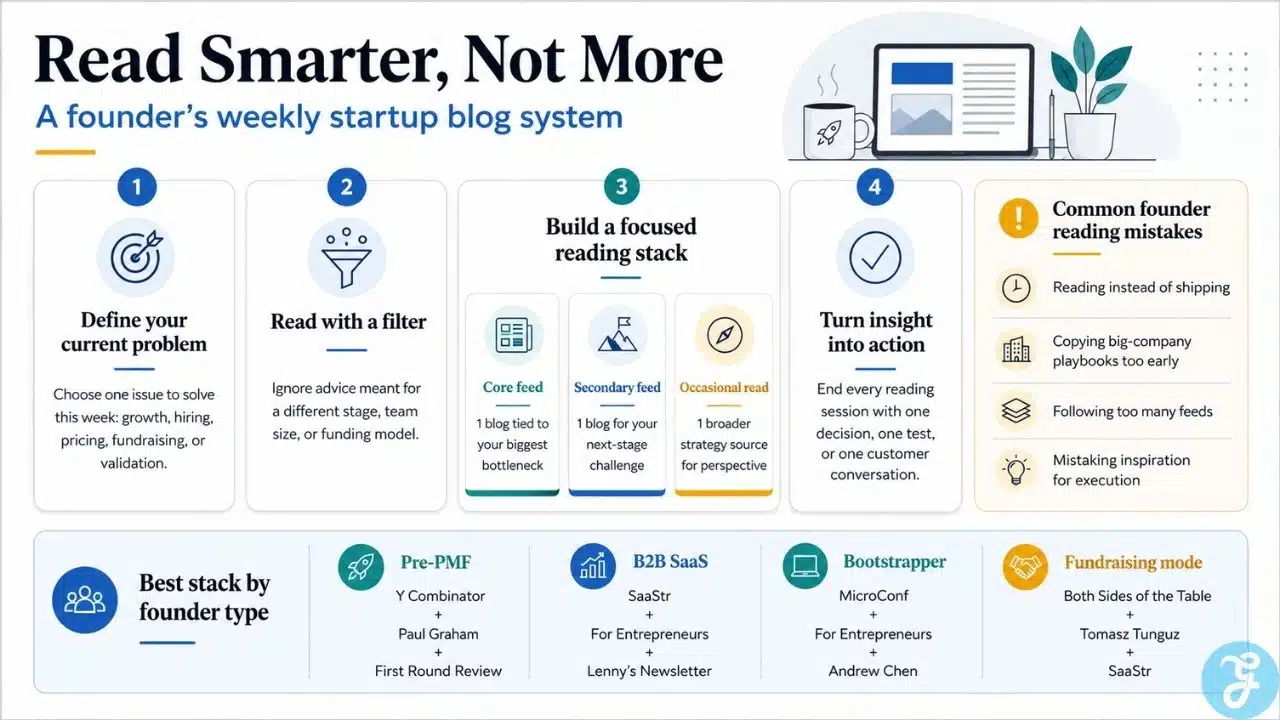
Selecting the best startup blogs to monitor depends entirely on your immediate execution bottleneck. If you are struggling to build a sustainable, mathematically sound pricing structure, spending a week reading David Skok’s financial models is an efficient use of your time. If you are navigating early hiring friction, the case studies on First Round Review offer immediate utility.
Audit your team’s primary metric deficiencies, isolate the specific operational problems blocking your next milestone, and select one or two targeted feeds to guide your execution. Avoid treating industry essays as a replacement for direct customer conversations.
Frequently Asked Questions(FAQs) on the Best Startup Blogs
The short answer is no, not if you are still looking for basic product validation. Premium platforms offer exceptional, highly technical value regarding retention loops and advanced data metrics, but these frameworks are designed for platforms that already possess baseline market traction. If you are struggling to find your first ten users, paying for enterprise monetization templates introduces unhelpful complexity. Stick to free, first-principles essays until your software establishes steady weekly usage.
Where can founders find authentic startup failure analyses instead of standard success stories?
Most prominent entrepreneur networks prioritize massive exit announcements and funding milestones because positive news drives clicks. To find objective post-mortems and product autopsies, operators must bypass standard content hubs to look at specialized data projects like the CB Insights failure database or independent developer forums. These spaces archive real transparency notes written by technical teams detailing exactly how unhedged infrastructure costs or toxic cofounder splits collapsed their companies.
How should busy operators index startup articles to avoid passive reading traps?
Never read a tactical business article unless you are actively experiencing the exact problem it covers. Reading about complex equity distribution strategies or international payroll structures when you do not even have an active prototype turns educational material into a form of active procrastination. Use these publications strictly as a searchable manual—bookmark the guides, close the browser tabs, and only open them when a metric drop or an operational bottleneck demands an immediate structural change.
Which publications specialize in scaling without relying on institutional venture capital?
If your goal is sustainable, independent cash preservation, look for alternative tech resources like the MicroConf feed or indie hacker bootcamps. These platforms discard venture capital benchmarks completely to focus on low-overhead execution: high-margin tier strategies, organic SEO acquisition, self-serve onboarding funnels, and lean engineering frameworks that keep your software profitable without a board of directors.
Can early-stage companies pitch these publications for direct PR exposure or feature reviews?
Do not try to pitch operator-focused blogs like SaaStr or Lenny’s Newsletter for standard product launch publicity. These platforms are not news networks like TechCrunch; they function as strict educational archives for software builders. They only feature startups as long-form case studies or technical data teardowns. Unless your company has unique, data-driven growth insights or specialized engineering infrastructure to share with the wider developer community, your public relations outreach will be ignored.