A waitlist can make a SaaS launch feel safer than it really is.
The number looks good in a dashboard. Two thousand signups. Five thousand signups. A neat chart moving upward before the product is even public. Then launch day comes, the email goes out, and the response is thin. A few people click. Fewer activate. Almost nobody replies.
That usually means the waitlist was treated as a signup counter, not as part of the launch system.
A SaaS waitlist launch should help you learn who actually cares, which promise gets attention, what objections appear before users touch the product, and which people deserve first access. The email list matters, but the quality of the signal matters more.
This guide explains how to build a waitlist that does useful work before launch: clearer positioning, better qualification, warmer leads, cleaner beta access, and fewer surprises when the product opens.
A Waitlist Is Interest, Not Demand
A waitlist signup is not the same as a purchase. It is not even the same as serious intent.
People join for many reasons. The headline sounds useful. The founder has an audience. The product looks new. The signup form takes two seconds. Someone wants to watch the category without making any commitment.
That does not mean the person will connect a data source, invite a teammate, migrate a workflow, use the product twice, or pay later.
Still, a waitlist is valuable when it helps answer practical questions:
- Which customer segment responds first?
- Which pain point gets the clearest reaction?
- What are people already using instead?
- Do signups reply when asked why they joined?
- Which channels bring qualified prospects?
- Who should be invited into the first beta group?
- What does the product need to explain better before launch?
For SaaS, this matters because adoption often means changing a workflow. A buyer may like the idea but hesitate because the team already uses a spreadsheet, a CRM field, a Slack channel, a Notion database, or a messy internal process that still “works well enough.”
A good waitlist should reveal some of that friction before launch.
Plan the SaaS Waitlist Launch Around One Sharp Promise
The first version of a waitlist page should not sound like a product roadmap.
Weak pre-launch pages often try to cover everything:
“AI-powered workspace for modern teams.”
That could describe hundreds of tools.
A stronger version is narrower:
“Turn customer call notes into product feedback summaries your team can act on.”
Now the visitor knows the product’s job. It handles customer calls. It creates feedback summaries. It is probably for product, customer success, or founder-led teams.
Before writing the page, define three things:
- The user who feels the problem most often
- The task that user is trying to finish
- The delay, manual work, confusion, or risk your product reduces
A product for “all startup teams” is hard to sell before anyone can use it. A product for “customer success managers who need to turn onboarding calls into reusable playbooks” is easier to understand, easier to share, and easier to qualify.
You can widen the positioning later. Pre-launch is not the time to sound universal. It is the time to become clear enough that the right reader thinks, “Yes, that is my problem.”
What the Waitlist Page Needs
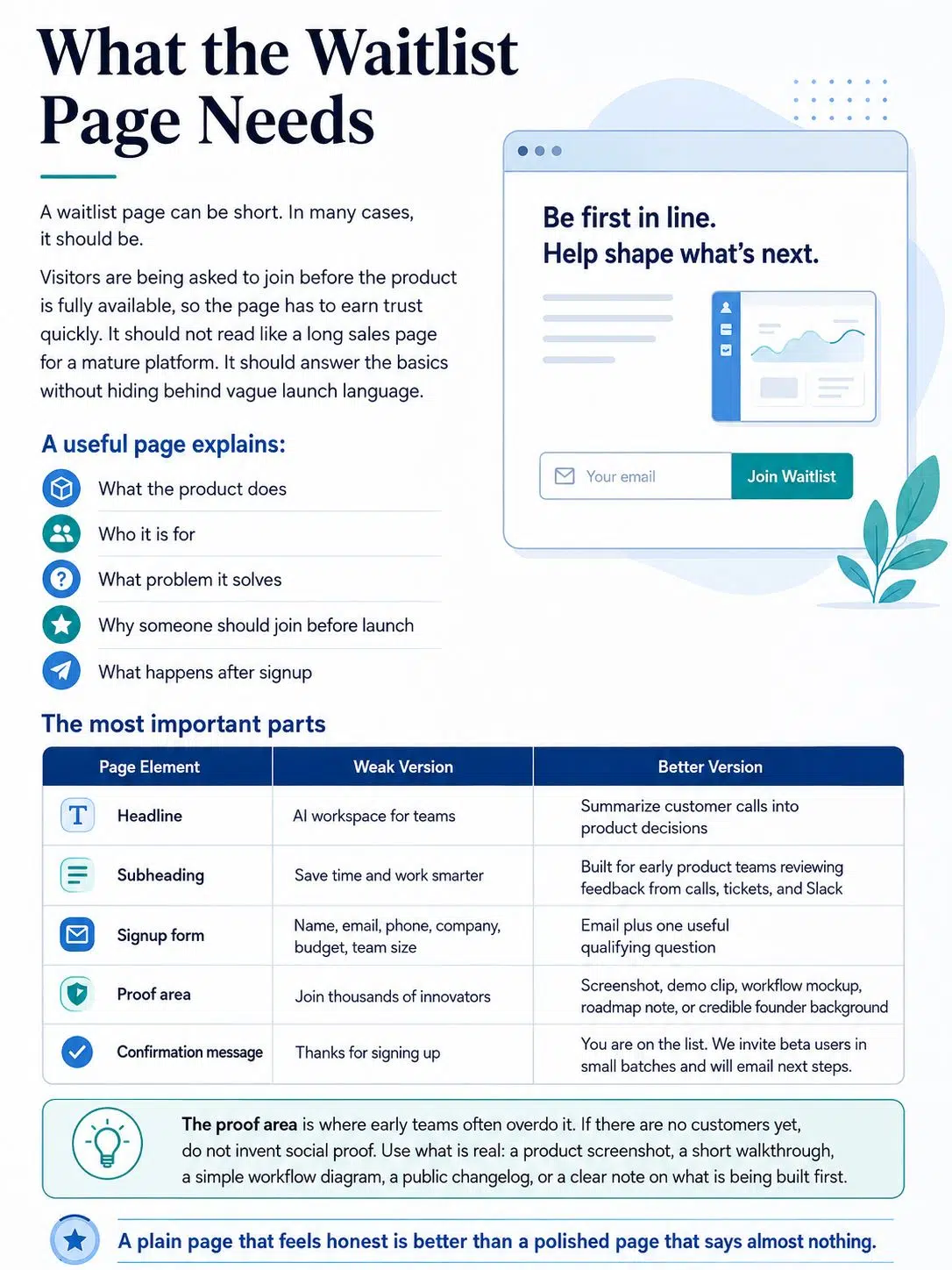
A waitlist page can be short. In many cases, it should be.
Visitors are being asked to join before the product is fully available, so the page has to earn trust quickly. It should not read like a long sales page for a mature platform. It should answer the basics without hiding behind vague launch language.
A useful page explains:
- What the product does
- Who it is for
- What problem it solves
- Why someone should join before launch
- What happens after signup
The most important parts are the headline, subheading, form, proof area, and confirmation message.
| Page Element | Weak Version | Better Version |
|---|---|---|
| Headline | AI workspace for teams | Summarize customer calls into product decisions |
| Subheading | Save time and work smarter | Built for early product teams reviewing feedback from calls, tickets, and Slack |
| Signup form | Name, email, phone, company, budget, team size | Email plus one useful qualifying question |
| Proof area | Join thousands of innovators | Screenshot, demo clip, workflow mockup, roadmap note, or credible founder background |
| Confirmation message | Thanks for signing up | You are on the list. We invite beta users in small batches and will email next steps. |
The proof area is where early teams often overdo it. If there are no customers yet, do not invent social proof. Use what is real: a product screenshot, a short walkthrough, a simple workflow diagram, a public changelog, or a clear note on what is being built first.
A plain page that feels honest is better than a polished page that says almost nothing.
Do Not Turn the Signup Form Into a Survey
The form should match the product’s maturity and sales motion.
For a simple solo-user SaaS tool, an email address may be enough. For a B2B workflow product, one or two extra details can save time later. The danger is asking for so much information that good prospects leave before joining.
Useful qualifying questions include:
- What are you using now?
- What best describes your role?
- How often do you deal with this problem?
- How many people would use this in your team?
- What is the main outcome you want from this tool?
Do not ask all of them at once.
For most early B2B SaaS waitlists, a good starting point is email plus one qualifying question on the page. Ask a better follow-up question in the welcome email. That keeps the signup easy while still giving you enough context to prioritize serious users.
The form should create just enough friction to improve signal. Too little friction fills the list with curiosity. Too much friction blocks people who may have been a good fit.
Pick the Waitlist Style That Fits the Product
Not every waitlist should work the same way.
A simple interest list works when the product is lightweight or the founder is still testing the idea. It is easy to set up, but the signal is weak. Many people will join casually.
A qualified beta list is better for B2B SaaS, workflow tools, analytics products, collaboration software, and anything that needs onboarding. It helps the team decide who should get early access first.
A referral waitlist can work for consumer SaaS, creator tools, and products that naturally spread through social sharing. For serious B2B SaaS, it is often overrated. A person who invites friends to move up the queue may still have no budget, no authority, and no urgent need.
Founder-led access is less glamorous but often more useful. If the product touches customer data, reporting, finance workflows, internal operations, team collaboration, or technical setup, early users may need help. Manual onboarding does not scale forever, but it reveals what the self-serve product must eventually explain without the founder in the room.
Paid early access is the riskiest option. It can work when the founder already has trust with a specific audience or when the pain is urgent. It should not be used to sell a vague promise for a product that is not close to useful.
For most SaaS founders, the qualified beta list is the safest first choice. It gives the team a real audience without pretending the product is ready for everyone.
Distribution Comes Before the Page Goes Live
A waitlist page captures demand. It does not create demand on its own.
The first signups usually come from places where the founder, team, or brand already has some access:
- Founder posts on LinkedIn, X, Reddit, Indie Hackers, Hacker News, or niche communities
- A small newsletter
- Direct outreach to people already discussing the problem
- Comments under relevant posts where the product can be mentioned naturally
- Private Slack, Discord, or Circle communities
- Demo calls with a signup link afterward
- Partner newsletters
- Educational articles aimed at the problem, not just the product name
The channel should match the buyer. A developer tool may get better early traction from technical communities, GitHub discussions, open-source circles, or Hacker News. A marketing operations product may perform better through LinkedIn, operator communities, tactical blog content, and partner newsletters. A creator SaaS may need short visual demos much earlier.
Cold outreach can work, but only when it is specific. “Join our exciting waitlist” is easy to ignore.
A better message would sound more grounded:
“Your team publishes a lot of onboarding content, and it looks like you run customer calls every week. We are building a tool that turns onboarding call notes into reusable playbooks. Would you want early access when we open the beta?”
That message is still outbound, but it gives the recipient a reason to believe it was meant for them.
The Welcome Email Should Start a Conversation
The welcome email is part of the launch, not an administrative receipt.
The person has just raised a hand. They still remember why they joined. That attention fades quickly if the only message they receive is a generic confirmation.
A strong welcome email should confirm what they joined, explain what happens next, set expectations honestly, and ask one useful question.
Good questions include:
- What are you currently using to solve this?
- What made this worth joining?
- What would this need to do before you would invite a teammate?
- What would make this useless for your workflow?
The last question may sound negative, but it can be valuable. It can reveal missing integrations, confusing setup steps, pricing concerns, security worries, or a workflow assumption the team has not considered.
Replies matter more than open rates during pre-launch. A reply tells you the person is thinking about the problem. It can also give you better language for the landing page, onboarding screens, launch posts, demo scripts, and help docs.
Keep the List Warm Without Manufacturing Hype
A waitlist goes cold when people hear nothing for weeks. It also gets tired when every update sounds like a launch announcement without access.
Pre-launch emails do not need to be long. They need to be useful.
Good reasons to email the list include:
- A short product progress note
- A screenshot with a clear explanation
- A beta opening for a specific user group
- A practical lesson related to the problem
- A request for feedback on a workflow
- A short demo video
- A launch announcement when the product is actually ready
Avoid vague teaser copy. “Something big is coming” rarely helps a SaaS buyer. “We added CSV import because beta teams wanted to bring old reports into the first dashboard” is more credible.
The email rhythm depends on the timeline. Weekly updates may work for a public build-in-progress. Every two to four weeks may be enough for a slower product cycle. What matters is whether each email gives the reader a reason to keep paying attention.
Measure the Signals That Predict Launch Quality
Total signups are useful, but they are not enough.
A large waitlist from a giveaway may perform worse than a small list of qualified prospects who reply, accept beta access, and complete onboarding. Track the signals that show fit, not only reach.
The most useful metrics are:
- Visitor-to-signup rate: Is the page promise clear enough?
- Signup source: Which channels bring relevant users?
- Reply rate: Are people willing to describe the problem?
- Qualified signup percentage: Are the right roles, teams, or use cases joining?
- Beta invite acceptance: Do people still care when access opens?
- Activation after invite: Do users reach early value?
- Paid conversion after beta: Does interest connect to revenue?
Activation deserves more attention than many founders give it.
For a project management tool, activation might mean creating a project, adding real tasks, and inviting one teammate. For an analytics product, it might mean connecting a data source and viewing a report that answers a real question. For an AI writing product, it might mean generating, editing, and exporting usable content.
A login is not activation. A dashboard view is not activation. A shallow click can show curiosity, but it does not prove the product delivered value.
A Practical Pre-Launch Timeline
A SaaS waitlist launch does not need six months of theatre. For many early products, four to eight weeks is enough to test the message, recruit early users, and prepare the first launch group.
Six to eight weeks before launch, write the positioning, build the page, set up the form, create the confirmation message, and prepare the welcome email. Decide who should receive first access and why.
Four to six weeks before launch, start sharing the page quietly. Use founder posts, direct outreach, community comments, advisor networks, and relevant newsletters. Test a few versions of the message. If the wrong people are joining, fix the positioning before adding more traffic.
Two to four weeks before launch, invite beta users in batches. This is usually better than opening access to everyone at once, especially when onboarding is still rough. Small batches make it easier to spot confusing setup steps, missing integrations, unclear empty states, weak documentation, or pricing hesitation.
During launch week, segment the list. Strong-fit prospects should get a clearer access message than casual signups. Some people may need a demo. Others may need a use-case email. Not everyone should receive the same launch note.
If Product Hunt is part of the plan, prepare the page, assets, maker comment, support coverage, and launch-day messaging ahead of time. Product Hunt can bring attention from early adopters, but it should not be treated as the entire launch strategy. Also avoid directly asking people to upvote. Ask for feedback and participation instead.
After launch, email people who did not activate. Ask why. Some will be busy. Some will not remember signing up. Some will mention a missing integration, unclear setup, or a mismatch between the waitlist promise and the product experience. Those answers can be more useful than polite compliments.
Compliance and Trust Basics
A waitlist collects personal data, usually at least an email address. Treat that seriously from the start.
For a global SaaS waitlist launch, the practical standard is simple: tell people what they are joining, avoid adding them to unrelated campaigns without a proper basis, make unsubscribing easy, and collect only what you need.
Email and privacy rules vary by country. In the United States, commercial email requirements include accurate sender information, non-deceptive subject lines, a valid physical postal address, and a clear way to opt out of future marketing messages. Opt-out requests also need to be honored within the required timeframe.
For users covered by GDPR or UK GDPR standards, consent needs more care. It should be freely given, specific, informed, and based on a clear affirmative action. If the waitlist will receive product marketing, say that clearly. Do not hide promotional emails behind a vague “updates” label.
This is not legal advice. A SaaS company selling globally, collecting sensitive data, or targeting regulated industries should get proper legal review. Still, even a small pre-launch page can follow a better standard: clear copy, visible privacy notice, no surprise emails, and easy unsubscribe.
Trust starts before the product opens.
Mistakes That Make Waitlists Look Better Than They Are
The biggest mistake is confusing attention with demand. A clever post can drive signups from people who have no real reason to change tools.
A few other mistakes show up often:
- Asking too many questions on the first form
- Offering rewards that attract the wrong audience
- Hiding what the product actually does
- Waiting too long before sending the first email
- Sending every signup the same message
- Treating all signups as equally qualified
- Launching before onboarding is understandable
- Measuring signups but not activation
- Using fake scarcity
- Promising access dates the team cannot meet
Fake scarcity deserves special caution. “Only 100 beta spots” is fine if there are really 100 seats because the team plans high-touch onboarding. It feels dishonest when the same page keeps accepting unlimited users for months.
Scarcity should reflect a real constraint, not a marketing trick.
When a Waitlist Is Not the Right Move
A waitlist is useful when pre-launch learning will improve the product, message, or launch plan. It is less useful when it delays real customer contact.
If the product is already usable and the audience is narrow, direct sales calls may teach more. Ten serious conversations with buyers can be better than hundreds of passive email signups.
If the product requires deep setup, the waitlist should lead into guided onboarding. Otherwise, users may get access, fail to configure the product, and never return.
If the product is simple and self-serve, a small public launch may be better than a long waiting period. Let people use it, watch behavior, fix the gaps, and improve the message.
A waitlist is not automatically more professional. Sometimes it is just a delay with a nicer form.
Before You Publish the Waitlist Page
Before sending traffic to the page, check the basics:
- Does the headline explain the product’s job clearly?
- Can the right user recognize themselves within a few seconds?
- Is the form short enough for the stage you are in?
- Does the confirmation message explain what happens next?
- Is the welcome email ready before the first signup arrives?
- Do you know who should get beta access first?
- Is there a privacy notice or clear data-use explanation?
- Is the unsubscribe path ready for marketing emails?
- Are you tracking source, signup quality, replies, and activation?
- Is the first access experience understandable without the founder explaining everything live?
That last point is often where the real launch risk appears. A waitlist can bring people to the door. It cannot rescue a confusing first session.
Final Thoughts
A strong SaaS waitlist launch is built on clarity, not noise.
The list is only one asset. The more valuable assets are the replies, objections, use cases, activation data, and language you collect before release. Those inputs can sharpen the product, improve onboarding, and make the public launch less uncertain.
Do not celebrate the waitlist too early. Look at who joined, why they joined, whether they reply, and what they do when access opens. If the waitlist helps you find serious early users and understand what they need before they convert, it has done its job.