
Most articles die too early. A team spends hours researching, writing, editing, formatting, publishing, and promoting one article. Then it gets shared once or twice, added to the archive, and quietly forgotten while everyone rushes to create the next thing from scratch.
That is a waste.
Good content repurposing does not mean copying the same article everywhere. It means taking a strong idea and reshaping it for different reader habits, platforms, formats, and stages of the audience journey. The best repurposing strategies for articles can support are not lazy duplicates. They are smarter ways to reuse the research, arguments, examples, and structure you already worked hard to create.
A good article can become a newsletter, a short video, a LinkedIn carousel, a podcast outline, a lead magnet, a comparison page, a social thread, a webinar segment, or a refreshed evergreen guide. The trick is knowing what to extract and where it belongs.
Our Selection Criteria
We selected these strategies based on usefulness, editorial value, and realistic execution for publishers, bloggers, agencies, SaaS teams, and content marketers.
| Criteria | What We Looked For |
|---|---|
| Reuse value | Does the strategy extend the life of an existing article? |
| Audience fit | Does it adapt the idea for how people actually consume content? |
| Editorial quality | Does it add value instead of recycling the same words? |
| Channel fit | Does the repurposed format make sense for email, social, video, search, or sales? |
| SEO support | Can it strengthen internal linking, topical authority, or content freshness? |
| Practical workload | Can a small team repeat it without creating more chaos? |
Who This Is For
These strategies are useful for content teams, publishers, bloggers, niche site owners, SaaS marketers, newsletter editors, social media managers, agencies, and founders who want more value from every article they publish.
They are especially useful if your team has a growing article archive, limited production capacity, or strong long-form content that is not getting enough distribution.
10 Repurposing Strategies for Articles That Actually Work
Before you reuse an article, ask one simple question: what is the strongest reusable asset inside it?
Sometimes it is the research. Sometimes it is the framework. Sometimes it is the examples, checklist, quotes, visuals, data, or argument. Repurposing works best when you extract the useful part instead of dragging the whole article into a new format.
1. Turn the Article Into a Newsletter Edition
A good article can become a strong newsletter, but not by pasting the introduction and adding a link.
The better approach is to turn the article into a short editorial briefing. Start with the main reader problem, summarize the most useful idea, include two or three key takeaways, and then link to the full article for depth. This works especially well for guides, opinion pieces, trend articles, listicles, and explainers.
For publishers, this is one of the simplest article reuse strategies because the article already gives the newsletter a clear angle.
Best Feature/For:
- Best for turning published articles into direct audience touchpoints
- Great for publishers, newsletters, SaaS blogs, and editorial brands
Why We Chose It:
- Gives the article a second distribution life
- Helps convert casual readers into repeat readers
- Makes newsletters easier to produce consistently
- Allows editors to add timely context without rewriting the full piece
Things to consider:
- Do not send the full article unless that is your newsletter format
- Add a fresh editor’s note or useful takeaway so the email feels intentional
2. Break the Article Into Social Media Posts
Most articles contain several ideas that can stand alone as social posts. A single guide may include a strong warning, a useful checklist, a sharp opinion, a short framework, a mistake to avoid, and a practical example.
Each of those can become a separate post.
This works better than posting “new article live” with a link. Instead, turn the article into native platform content. A LinkedIn post can focus on the core argument. An X thread can break down the steps. An Instagram carousel can show the framework. A short Facebook post can highlight the practical takeaway.
Best Feature/For:
- Best for extending article reach across social channels
- Great for creators, publishers, agencies, and B2B teams
Why We Chose It:
- Turns one article into multiple platform-specific assets
- Helps test which ideas get attention
- Makes social posting less dependent on new ideas every day
- Gives readers useful value before asking them to click
Things to consider:
- Rewrite for the platform instead of copying article paragraphs
- Pull one clear idea per post so the message does not feel crowded
3. Convert the Article Into a Short Video Script
Many article sections can become short videos. A “mistakes” section can become a quick warning video. A checklist can become a tutorial. A comparison can become a short explainer. A strong opinion can become a talking-head clip.
The key is not to summarize the whole article. Choose one useful slice.
For example, an article about content repurposing could become a short video on “three signs an article is worth repurposing.” A technical guide could become a screen-recorded walkthrough. A listicle could become a “top three picks” video.
Best Feature/For:
- Best for turning written ideas into visual discovery content
- Great for YouTube Shorts, TikTok, Instagram Reels, LinkedIn video, and webinars
Why We Chose It:
- Reaches people who prefer watching over reading
- Helps complex ideas feel more accessible
- Lets teams reuse article research without starting from zero
- Creates assets for social, email, landing pages, and product education
Things to consider:
- Keep the video focused on one article idea
- Avoid reading the article aloud like a script
4. Build a Checklist or Downloadable From the Article
If an article teaches a process, it can often become a checklist, worksheet, scorecard, template, or one-page guide.
This is one of the strongest repurpose content tactics because it turns passive reading into action. A launch guide can become a launch checklist. A headline article can become a headline review sheet. A content strategy guide can become a planning worksheet. A comparison article can become a decision matrix.
This format works especially well for lead generation, but it must be genuinely useful. A weak PDF that repeats the article will not impress anyone.
Best Feature/For:
- Best for turning educational articles into practical resources
- Great for lead magnets, onboarding, sales enablement, and newsletter growth
Why We Chose It:
- Makes the article more actionable
- Creates a useful downloadable asset
- Helps capture email subscribers or qualified leads
- Gives readers something they can reuse later
Things to consider:
- The downloadable should save time or improve decision-making
- Keep it short, practical, and visually clean
5. Refresh the Article Into an Updated Evergreen Version
Repurposing is not only about changing format. Sometimes the best reuse is updating the original article.
Old articles often contain outdated examples, weak introductions, stale links, missing sections, thin explanations, or old screenshots. A refresh can improve the article’s usefulness without creating a new URL or competing page.
This is especially important for evergreen articles, tool lists, strategy guides, statistics pages, and “best” content. Instead of creating a new version every year, improve the existing page when the topic still fits.
Best Feature/For:
- Best for improving existing SEO assets
- Great for evergreen guides, listicles, comparison posts, and resource pages
Why We Chose It:
- Protects and improves older content value
- Reduces unnecessary duplicate articles
- Helps maintain reader trust
- Makes old research and structure useful again
Things to consider:
- Update meaningfully, not cosmetically
- Check whether the search intent has changed before refreshing
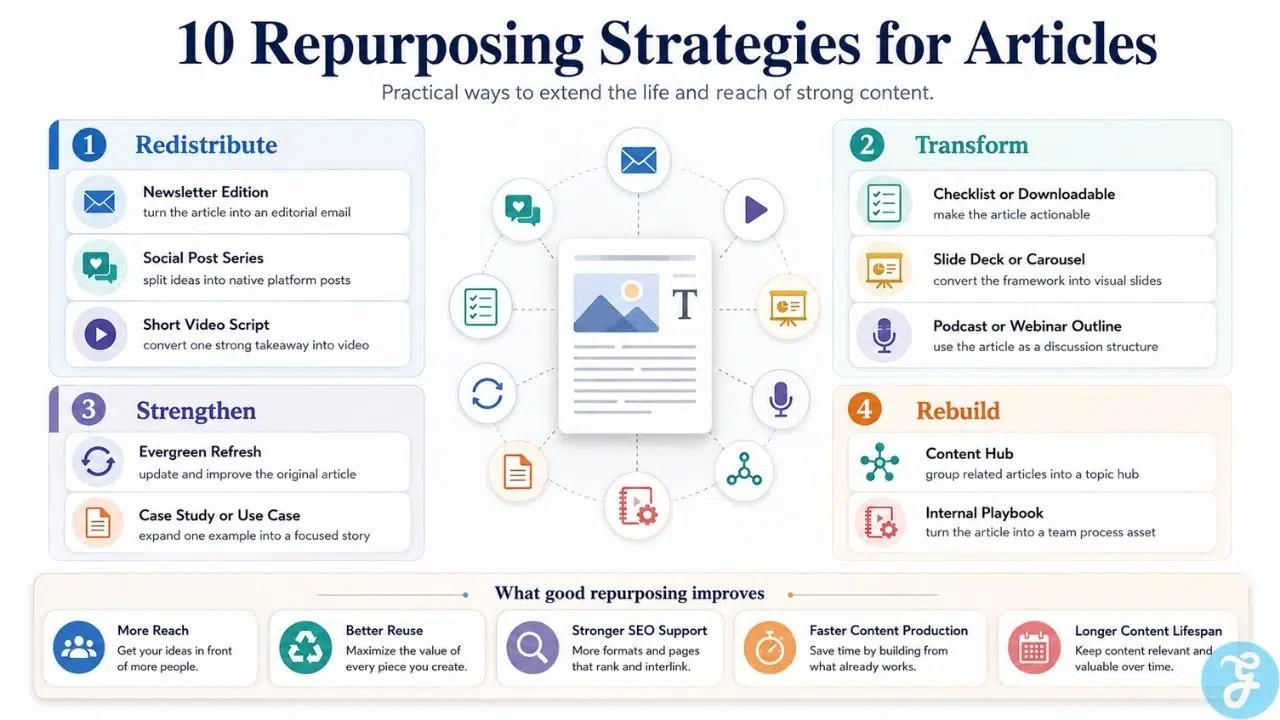
6. Combine Multiple Articles Into a Content Hub
If several articles cover related subtopics, they may belong inside a larger content hub.
A content hub organizes related articles around a central topic. For example, several posts about newsletter growth, subject lines, segmentation, and deliverability could support a larger hub on publisher email strategy. This helps readers explore the topic in a logical order instead of bouncing through random posts.
This is one of the best long-term article reuse strategies because it turns scattered content into structure.
Best Feature/For:
- Best for building topical authority from existing articles
- Great for SEO teams, publishers, SaaS blogs, and niche content sites
Why We Chose It:
- Turns article archives into organized topic systems
- Improves internal linking
- Helps readers move from broad learning to specific answers
- Supports pillar pages and cluster content strategies
Things to consider:
- Do not create a hub just to list links
- Add clear summaries, pathways, and internal context
7. Turn the Article Into a Slide Deck or Carousel
A strong article framework can become a slide deck, LinkedIn carousel, Instagram carousel, webinar deck, or internal training presentation.
This works especially well when the article includes a step-by-step process, comparison framework, checklist, or numbered list. Each slide should carry one idea, one example, or one practical takeaway. The goal is not to shrink the whole article onto slides. The goal is to make the structure easier to scan.
For B2B teams, this can also support sales and customer education. A guide can become a sales explainer. A strategy article can become a client deck. A research post can become a webinar opener.
Best Feature/For:
- Best for visualizing article frameworks
- Great for LinkedIn, Instagram, sales decks, webinars, and internal training
Why We Chose It:
- Makes article ideas easier to scan visually
- Gives teams social and presentation assets
- Helps repurpose frameworks without rewriting everything
- Works well for educational and strategic content
Things to consider:
- Use fewer words than the article
- Design around one idea per slide
8. Extract Examples Into a Case Study or Use-Case Post
Many articles include examples that deserve more space. A small paragraph inside a guide can become a full case study, use-case article, or example-led post.
This is useful because examples often carry the most credibility. Instead of writing another abstract strategy piece, expand one strong example into a practical story: the problem, the decision, the process, the trade-offs, and the result.
This strategy works for SaaS, business, marketing, education, editorial, and product-led content.
Best Feature/For:
- Best for turning examples into trust-building content
- Great for B2B brands, SaaS companies, agencies, and expert blogs
Why We Chose It:
- Adds depth to ideas that were only briefly covered
- Supports sales and product education
- Makes abstract advice feel more concrete
- Gives readers proof, not just instruction
Things to consider:
- Do not invent results or fake case studies
- Be clear when an example is hypothetical
9. Use the Article as a Podcast or Webinar Outline
A well-structured article can become the backbone of a podcast episode, webinar, live session, or expert interview.
The article gives you the flow, but the audio or live format should add something new. Add stories, disagreements, examples, expert comments, audience questions, or behind-the-scenes context. If the podcast simply repeats the article, people have no reason to listen.
This works especially well for opinion pieces, strategy articles, research summaries, industry explainers, and tutorials.
Best Feature/For:
- Best for turning written expertise into conversation
- Great for podcasts, webinars, expert interviews, and live events
Why We Chose It:
- Gives hosts a ready-made structure
- Adds personality and nuance to written content
- Creates audio, video, clips, and transcript assets
- Helps reach audiences who prefer listening
Things to consider:
- Add new perspective, not just narration
- Pull short clips from the session for extra reuse
10. Turn the Article Into an Internal Playbook
Not every repurposed asset has to be public.
Some of the best article reuse happens inside the business. A strong guide can become a team checklist, onboarding document, editorial standard, sales note, training resource, or content QA process.
For example, an article about headline formulas can become an internal headline review checklist. A guide on newsletter strategy can become an editorial playbook. A piece on technical SEO audit tools can become a client audit workflow.
This is especially useful when your articles reflect how your team actually works.
Best Feature/For:
- Best for turning public knowledge into internal systems
- Great for agencies, editorial teams, SaaS companies, and marketing departments
Why We Chose It:
- Helps teams reuse expertise operationally
- Improves consistency across writers, editors, and marketers
- Turns content into training material
- Makes published knowledge useful beyond traffic
Things to consider:
- Remove public-facing fluff and turn advice into steps
- Update internal playbooks when your process changes
A Quick Overview
These repurposing strategies work best when you match the article’s strongest asset to the right format. A process-heavy article may become a checklist, while an opinion piece may work better as a newsletter or podcast discussion. A group of related articles may deserve a hub, while an old evergreen page may need a serious refresh before it gets reused anywhere else.
Overview Comparison
| Strategy | Best Use | Main Benefit | Best Fit |
| Newsletter edition | Direct audience distribution | More repeat readership | Publishers, SaaS blogs |
| Social media posts | Multi-channel reach | More visibility from one article | Creators, agencies |
| Short video script | Visual discovery | Reaches watch-first audiences | Social and video teams |
| Checklist or downloadable | Actionable reuse | Lead generation and utility | B2B, education, SaaS |
| Evergreen refresh | SEO improvement | Better long-term performance | Blogs, publishers |
| Content hub | Topic organization | Stronger internal structure | SEO and editorial teams |
| Slide deck or carousel | Visual explanation | Easier scanning and sharing | B2B, LinkedIn, training |
| Case study or use-case post | Example expansion | More trust and specificity | SaaS, agencies |
| Podcast or webinar outline | Conversation format | More depth and personality | Experts, publishers |
| Internal playbook | Operational reuse | Better team consistency | Agencies, content teams |
Our Top 3 Picks and Why
1. Refresh the Article Into an Updated Evergreen Version
This is often the highest-value starting point because it improves the original asset. If the article already has search visibility or business value, updating it may deliver more impact than spinning it into five weaker formats.
2. Combine Multiple Articles Into a Content Hub
This turns scattered content into a real strategy. A hub helps readers navigate related ideas and gives your site a stronger topical structure.
3. Build a Checklist or Downloadable From the Article
This works because it turns information into action. Readers appreciate useful tools, and teams can use downloadables for email growth, lead generation, or customer education.
How to Choose the Right Repurposing Strategy
Do not repurpose every article the same way. Choose the strategy based on the article’s purpose, quality, and strongest reusable part.
If the article teaches a process, create a checklist. If it has a strong opinion, create a newsletter, LinkedIn post, or podcast outline. If it contains useful data, turn it into visuals, slides, or a research summary. If several articles cover one topic, build a hub. If the article is old but still valuable, refresh it first.
A simple selection framework:
- Pick newsletter edition when the article has a timely or useful takeaway.
- Pick social posts when the article contains several standalone ideas.
- Pick short video when one section can be explained visually.
- Pick downloadable when the article teaches a repeatable process.
- Pick evergreen refresh when the article is outdated but still valuable.
- Pick content hub when several articles belong together.
- Pick case study when one example deserves deeper treatment.
- Pick internal playbook when the article reflects a repeatable team process.
Final Checklist Before Repurposing an Article
Before reusing an article, ask:
- Is the original article strong enough to deserve repurposing?
- What is the most reusable part: framework, data, checklist, example, opinion, or process?
- Which channel fits that idea best?
- Will the new version add value, or just repeat the same content?
- Does the repurposed asset point readers toward a useful next step?
- Can the team repeat this workflow without overloading production?
- Should the original article be refreshed before anything else?
Repurposing Works Best When It Respects the Reader
The best repurposing strategies for articles can support are built on usefulness, not volume.
Repurposing is not a trick to flood every platform with the same idea. It is a way to respect the effort behind strong content and the different ways audiences consume information. Some people want the full guide. Some want the short version. Some want the checklist. Some want the video. Some want the discussion.
One article can serve all of them, but only if you reshape it with care.
Do that well, and content repurposing stops being a recycling habit. It becomes a smarter editorial system.
Frequently Asked Questions (FAQs) on Repurposing Strategies For Articles
What are repurposing strategies for articles?
Repurposing strategies for articles are methods for turning existing written content into new formats, channels, or assets. Examples include newsletters, social posts, videos, checklists, slide decks, updated evergreen guides, content hubs, and internal playbooks.
What is content repurposing?
Content repurposing means reusing all or part of an existing piece of content in a new way. For articles, that may mean changing the format, updating the original, extracting examples, or turning the content into a different asset for another channel.
How do you repurpose an article without duplicating content?
Repurpose the idea, not the exact wording. Add new context, change the format, adapt the message to the channel, and make sure the repurposed version serves a clear reader need.
Which articles are best for repurposing?
The best articles for repurposing usually have strong frameworks, evergreen value, original examples, useful data, practical checklists, or clear opinions. Weak articles should usually be improved before being repurposed.
Can repurposing articles help SEO?
Yes, especially when repurposing includes refreshing outdated content, improving internal links, building topic hubs, or creating useful supporting assets. It helps less when teams create thin duplicate pages from the same source article.