

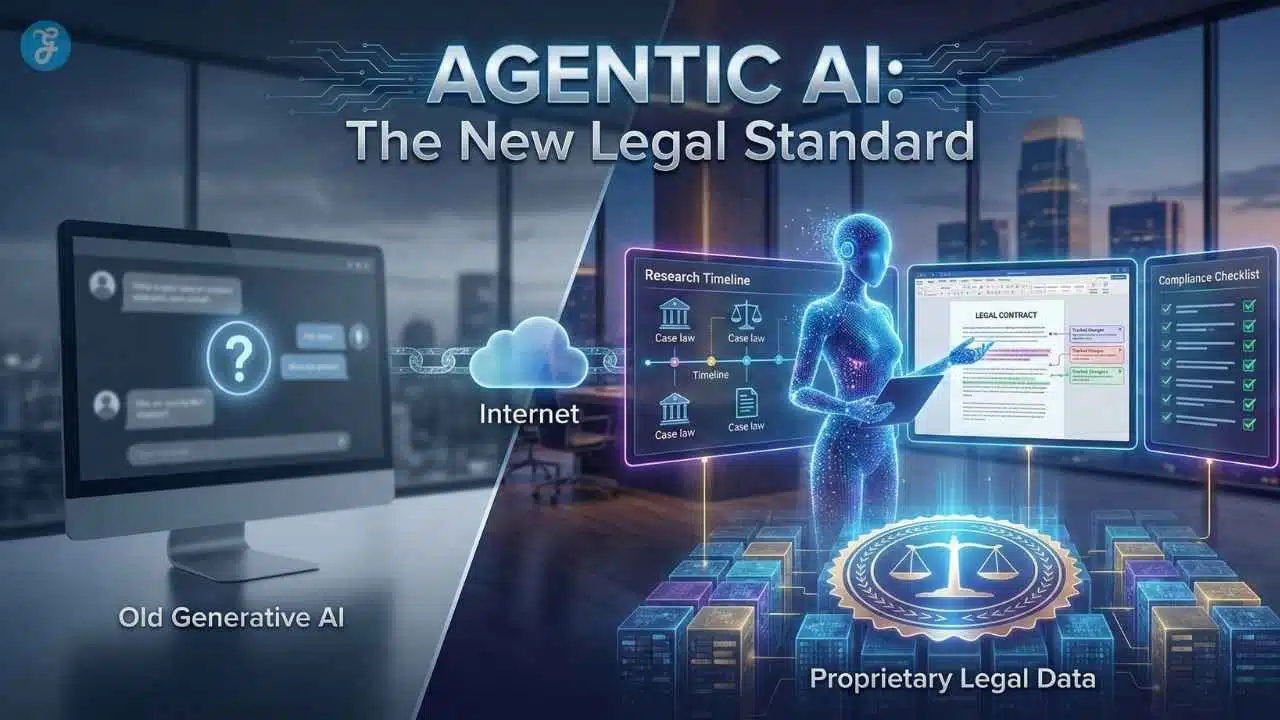
The legal technology landscape has officially crossed the threshold from “Generative” to “Agentic.” Today, Wolters Kluwer Legal & Regulatory announced the launch of the Libra Legal AI Workspace in the Netherlands, marking the first major product deployment following its November 2025 acquisition of Berlin-based startup Libra Technology GmbH.
This launch is not merely an update to existing tools; it represents a fundamental shift in how legal work is architected. By embedding autonomous “agents” into a unified workspace grounded in Wolters Kluwer’s massive proprietary database, the company is attempting to solve the “last mile” problem of legal AI: moving from chatting with a bot to trusting it to perform complex, multi-step work.
Martin O’Malley, CEO of Wolters Kluwer Legal & Regulatory, positioned the launch as a direct response to the market’s fatigue with generic AI tools. “Our customers don’t just want text generation; they want reliable execution,” O’Malley noted. “Libra combines the agility of autonomous agents with the authority of Wolters Kluwer’s content.”
Key Takeaways
-
Pivot to “Agentic”: Moves beyond simple text generation to autonomous agents that plan and execute complex legal workflows.
-
Grounded Accuracy: Eliminates hallucinations by anchoring AI reasoning exclusively in Wolters Kluwer’s verified legal content.
-
The “Workspace” Moat: Integrates directly into Word/Outlook, preventing users from needing separate “assistant” apps.
-
EU-First Security: Features ISO 27001 certification and strictly local EEA data processing to satisfy EU AI Act compliance.
-
Economic Shift: Automates junior-level tasks (research, initial drafts), forcing a market shift from hourly billing to value-based pricing.
Background: The Acquisition that Fueled the Pivot
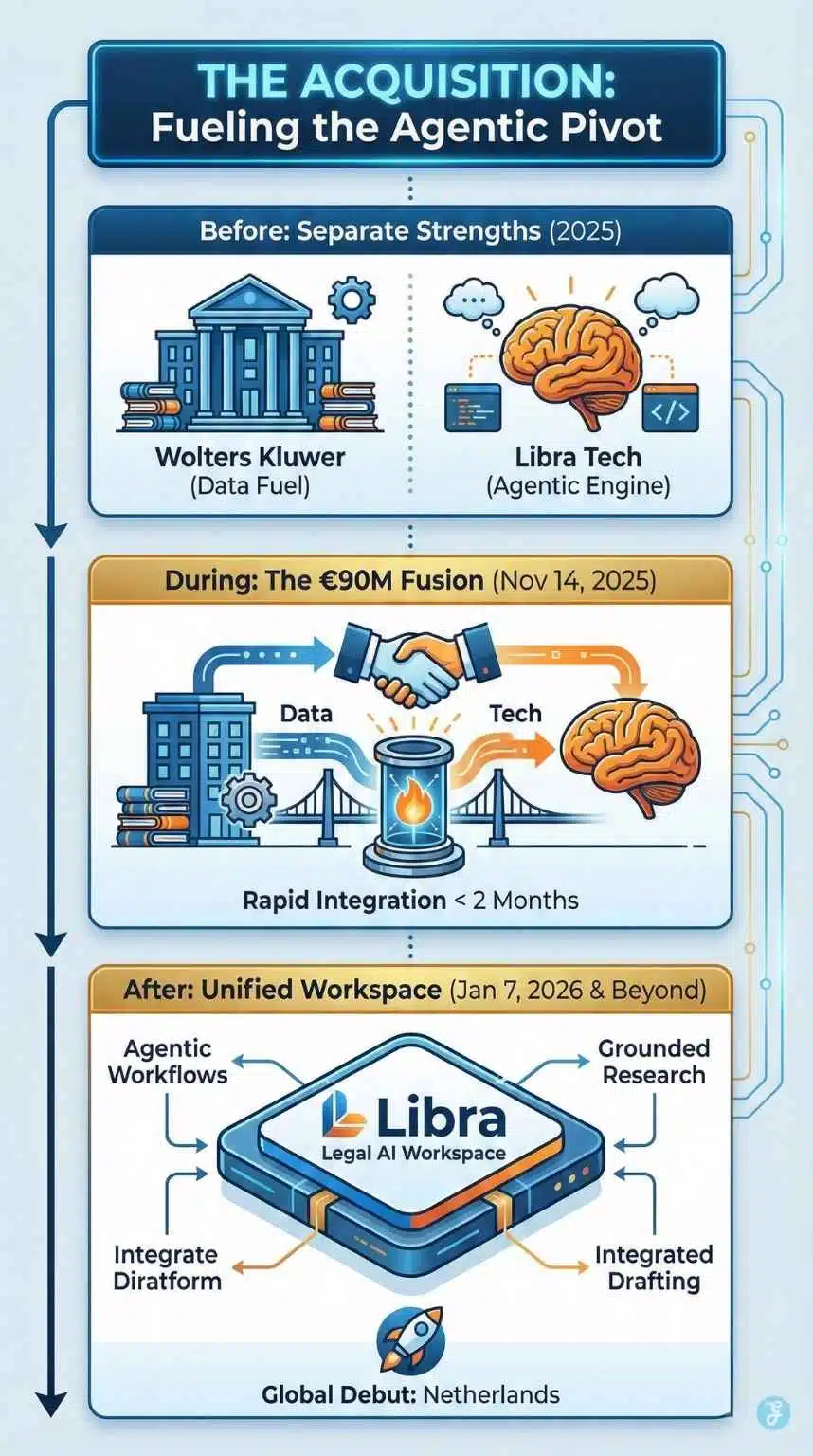
To understand the significance of today’s launch, one must look back to November 14, 2025, when Wolters Kluwer signed the agreement to acquire Libra Technology GmbH for up to €90 million.
At the time, Libra was a rising star in the Berlin tech scene, founded in 2023 by Viktor von Essen and Dr. Bo Tranberg. Unlike competitors who were building wrappers around ChatGPT, Libra focused on “Agentic workflows”—systems capable of reasoning through a legal problem rather than just predicting the next word in a sentence.
The Strategic Logic:
-
Wolters Kluwer had the “Fuel”: A vast, trusted repository of legislation, case law, and expert commentary.
-
Libra had the “Engine”: A proprietary reasoning architecture designed to navigate that data autonomously.
The rapid integration, less than two months from acquisition to product launch, demonstrates an aggressive push by Wolters Kluwer to capture the market lead before competitors like Thomson Reuters or LexisNexis can fully pivot their own generative tools into agentic ones.
Deep Dive: What is “Agentic AI” in Law?
The term “Agentic AI” is the centerpiece of this announcement. It is crucial to distinguish this from the “Generative AI” that dominated 2023-2025.
Generative AI is passive; it waits for a prompt and responds. Agentic AI is proactive; it is given a goal, and it figures out the steps to achieve it.
Comparative Analysis: Generative vs. Agentic AI
| Feature | Generative AI (Standard Chatbots) | Agentic AI (Libra Workspace) |
| Primary Function | Predicting text based on patterns. | Executing tasks based on reasoning. |
| Workflow | One-shot: User prompts $\rightarrow$ AI answers. | Multi-step: User sets goal $\rightarrow$ AI plans, researches, drafts, critiques, and finalizes. |
| Autonomy | Low. Requires constant human prompting. | High. Can self-correct and loop through steps until the goal is met. |
| Data Source | “The Internet” (high hallucination risk). | Grounded: Wolters Kluwer Proprietary Content (high trust). |
| Output | A draft that often needs heavy editing. | A completed work product (e.g., a memo verified against a playbook). |
The “Workspace” Concept
Libra is not sold as a “tool” but as a “Workspace.” This is a critical distinction. It integrates directly into the environments where lawyers spend 90% of their time, Microsoft Word and Outlook. By living inside the document editor, the Agentic AI can “read” the contract being drafted, cross-reference it with the firm’s “playbook” (internal rules), and autonomously suggest redlines without the lawyer ever leaving the window.
The Competitive Landscape: The “Agentic” Arms Race
Today’s launch places Wolters Kluwer in direct confrontation with the industry’s other giants, particularly Thomson Reuters and LexisNexis. The battleground has shifted from “Who has the best data?” to “Who has the best agent?”
1. Thomson Reuters (CoCounsel)
Thomson Reuters has aggressively pushed “CoCounsel” (acquired from Casetext) as the premier legal assistant.
-
The Difference: CoCounsel has historically operated as a sidebar “Assistant”—a very smart chatbot that sits alongside your work.
-
Libra’s Attack: Wolters Kluwer is betting on deep integration. By positioning Libra as a “Workspace” that practically takes over the Word interface, they are trying to make the AI the environment rather than just a helper.
2. LexisNexis (Lexis+ AI)
LexisNexis has focused heavily on “Argument Generation” and extractive summarization.
-
The Difference: Lexis+ excels at finding needles in haystacks.
-
Libra’s Attack: Wolters Kluwer is focusing on workflow automation. While Lexis finds the case, Libra is designed to find the case, write the memo, and email it to the partner for review.
For mid-sized firms in Europe, who may not have the budget for custom implementations of CoCounsel, Libra’s “plug-and-play” nature (tailored specifically to European jurisdictions like the Netherlands and Germany) creates a compelling value proposition that American-centric competitors may struggle to match immediately.
The “Build vs. Partner” Strategy (Libra vs. Harvey)
While Wolters Kluwer has acquired Libra to build its own “Workspace,” it is simultaneously maintaining a content licensing partnership with Harvey (the OpenAI-backed legal AI). This reveals a sophisticated “hybrid” strategy.
-
The Distinction: Wolters Kluwer is positioning Libra as the workflow layer (the interface lawyers live in) while using Harvey as a distribution channel for their data in the U.S. and Germany.
-
Why it Matters: By owning Libra, Wolters Kluwer avoids becoming just a “data utility” for other AI models. They own the “last mile” of the user experience—the screen where the lawyer actually types the contract. This prevents commoditization. If they relied solely on partnering with Harvey or CoCounsel, they would eventually lose the direct connection to the customer’s daily workflow.
Regulatory Analysis: The “EU AI Act” Factor
Launching in the Netherlands in 2026 is a calculated move regarding compliance. With the EU AI Act now in full enforcement (as of mid-2025), law firms are terrified of non-compliant AI tools.
1. Data Sovereignty as a Feature
Wolters Kluwer has architected Libra to ensure that data processing remains strictly within EU borders. Unlike many US-based LLMs that route data through American servers (triggering GDPR anxieties), Libra uses localized inference models. This “Data Sovereignty” is not just a technical detail; it is a primary sales feature for European corporate counsel.
2. The “High-Risk” Classification
Under the EU AI Act, AI systems used in “administration of justice” are often classified as High Risk. This imposes strict requirements on transparency and human oversight.
Compliance Strategy: Libra includes a mandatory “Citation Audit” feature. Before any document is finalized, the Agentic AI generates a “Truth Report”—a side-by-side comparison of its claims against the actual source text in the Wolters Kluwer database. This automated audit trail is designed specifically to satisfy the EU AI Act’s requirement for explainability.
The “Liability Firewall”: Human-in-the-Loop Architecture
For European law firms, “cool features” are secondary to “compliance.” The Libra launch emphasizes specific technical certifications that many US-based competitors lack.
ISO 27001 Certified: Libra ships with full ISO 27001 certification, the gold standard for information security management.
Data Residency: Crucially, Wolters Kluwer has confirmed that all data processing and hosting for Libra occurs strictly within the European Economic Area (EEA). There is no data routing to US servers, which effectively nullifies concerns regarding the EU-US Data Privacy Framework legal challenges. This “sovereign cloud” approach is a massive selling point for EU corporate counsel who are forbidden from using tools that send data across the Atlantic.
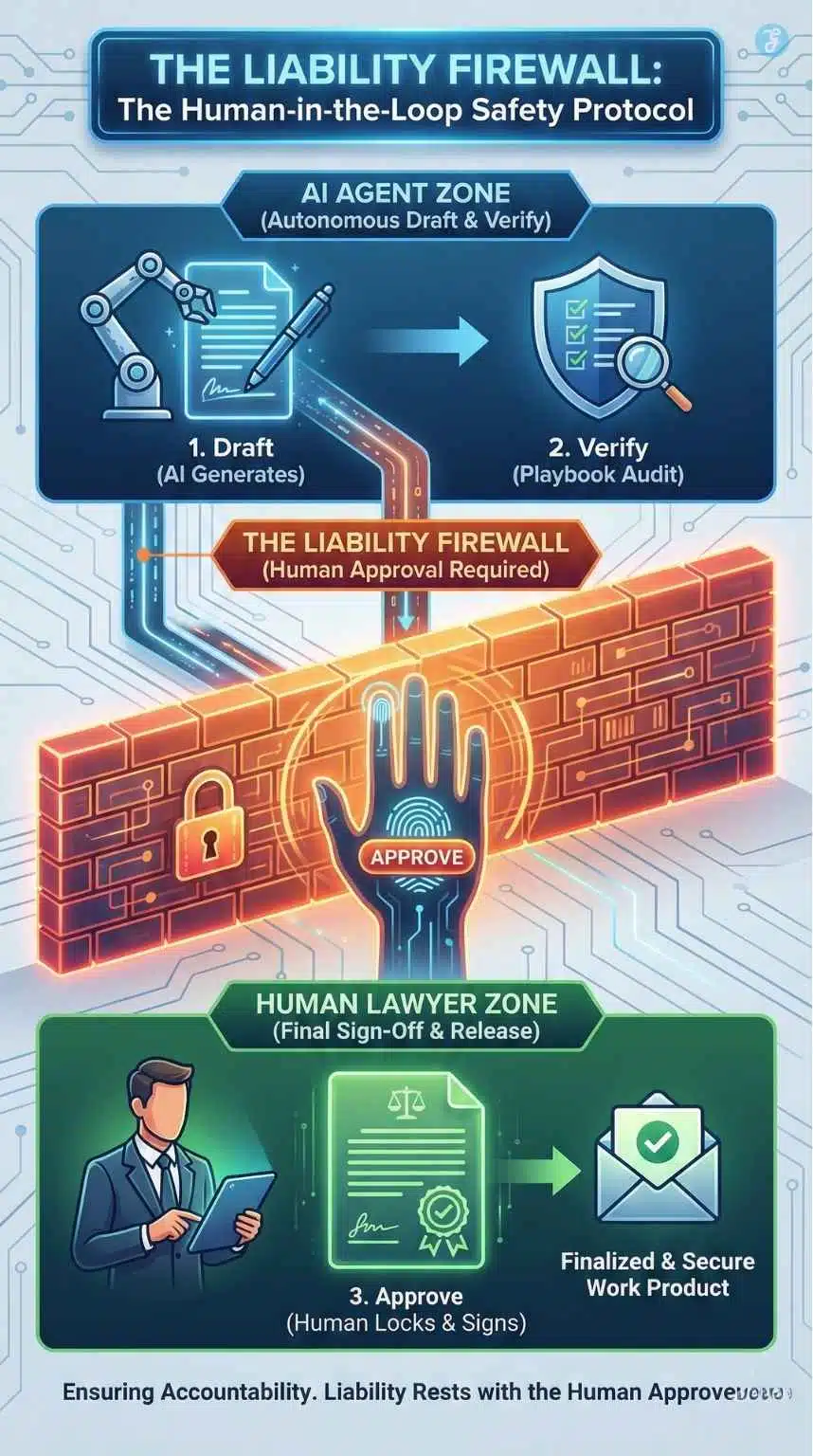
The greatest fear for any law firm partner is an AI “hallucination” leading to a malpractice suit (reminiscent of the Mata v. Avianca disaster of 2023). Libra addresses this with a feature dubbed the “Liability Firewall.”
How it works:
The “Agent” cannot finalize a document on its own. It operates on a Draft $\rightarrow$ Verify $\rightarrow$ Approve cycle.
-
Draft: The Agent creates the content.
-
Verify: The Agent runs the content against the firm’s specific “Playbook” (a set of non-negotiable legal rules defined by the partners).
-
Approve: The system locks the document and prevents sending/filing until a human lawyer clicks a physical “Approve” button, which digitally signs the audit trail.
Why this matters:
This shifts the psychological burden. It tells lawyers, “The AI does the work, but you hold the keys.” It effectively insures the firm against “rogue AI” actions by hard-coding a human checkpoint into the software’s logic.
Operational Reality: The “Associate” Problem
While the technology is impressive, the deployment of Libra poses a massive Change Management challenge.
The “Hollow Middle”
Libra is designed to automate the work typically done by first- and second-year associates (document review, initial drafting, legal research).
-
The Crisis: If an Agentic AI does the work of three junior associates, how do law firms train the next generation of partners? Junior lawyers learn by doing the “drudgery.”
-
The Shift: Firms adopting Libra will likely need to restructure their training programs. Instead of teaching associates how to write a contract, they will need to teach them how to review an AI’s work. This requires a higher level of critical thinking skills earlier in a lawyer’s career.
The Economic Threat
This technology poses a direct threat to the traditional billable hour model. If Libra can do 5 hours of junior associate work in 5 minutes, firms cannot bill for 5 hours.
-
Prediction: The widespread adoption of Libra will accelerate the industry’s shift toward Value-Based Pricing or Flat Fees. Clients, aware of these tools, will refuse to pay hourly rates for research and drafting.
The “Dutch Sandbox” & Pan-European Roadmap
The choice of the Netherlands is not just because it is Wolters Kluwer’s HQ; it is a strategic “Sandbox.”
- The Roadmap: Search data confirms that following the Dutch launch, the rollout includes a specific list of civil law jurisdictions: Poland, Belgium, Italy, the Czech Republic, Romania, Hungary, and Slovakia.
-
The “Civil Law” Advantage: Most Legal AI (like Harvey or CoCounsel) is trained primarily on US/UK “Common Law.” Libra’s architecture is specifically optimized for “Civil Law” systems (codified statutes), giving it a native advantage in continental Europe that Anglo-centric models struggle to replicate.
What to Watch Next
The industry will now be watching the rollout in Germany (Libra’s original home) to see if the “Agentic” promise holds up in one of the world’s most complex regulatory environments.
Final Thought: The Shift from Conversation to Execution
The launch of the Libra Legal AI Workspace is a watershed moment. It signals the end of the “hype cycle” where legal AI was a novelty, and the beginning of the “execution cycle” where AI becomes a reliable partner.
For Wolters Kluwer, this is a masterful strategic play. They have successfully weaponized their greatest asset—their boring, reliable, massive content library—by pairing it with the most cutting-edge agentic tech available. The result is a product that doesn’t just “chat” about the law, but actually does the work.
























