Game testing used to mean tired humans replaying the same level until the bugs finally surrendered. That still happens, but the smarter studios are now asking a better question: what if some of those repetitive runs, edge-case hunts, balance checks, and gameplay data reviews could be handled by agents, automation, and AI-assisted analysis? That is why AI-Powered Playtesting is becoming one of the most important quality trends in U.S. game development.
Our Selection Criteria
This list started with the country choice. I compared the United States, China, and Japan as the three strongest gaming markets, then narrowed the research to companies that could actually be verified as SME/startup-style providers working around AI-powered game QA, playtesting automation, AI agents, game-test analytics, or automated player simulation.
The companies were selected using these filters:
- Headquartered, incorporated, or operationally rooted in the United States.
- SME, startup, private company, or specialist gaming service provider rather than a Big Tech division.
- Clear relevance to AI-assisted playtesting, automated game testing, AI agents, QA intelligence, player insight analysis, or playtest data automation.
- Publicly visible website, product page, company profile, or credible third-party coverage.
- Relevant to game studios, developers, QA teams, publishers, XR studios, or live-ops teams.
- Excluded pure human QA vendors with no AI or automation angle, generic software QA companies with no gaming use case, and large public game publishers using internal tools only.
Why the United States and not China or Japan?
China and Japan are huge gaming markets, but the U.S. is stronger for this specific SME/startup niche because more independent companies publicly market AI game testing, game QA automation, AI-agent testing, and playtest intelligence tools. China has strong internal publisher-led automation, and Japan has deep game production expertise, but both are harder to verify at the SME/startup vendor level for this exact category.
Here is the country comparison used before selecting the final market:
| Country Considered | Gaming Market Strength | Fit for Gaming SME AI-Powered Playtesting | Final Assessment |
|---|---|---|---|
| United States | Very strong game market, startup funding, AI infrastructure, and game-engine talent | Strongest visible concentration of verified startups and private vendors around AI game QA, automation, and playtest intelligence | Selected |
| China | Massive gaming market with strong publisher-led AI and QA systems | Strong internally, but fewer independently verifiable SME/startup vendors visible for global buyers | Not selected |
| Japan | World-class game development culture and major studios | Strong production culture, but fewer visible AI-powered playtesting SMEs at this niche level | Not selected |
10 U.S. Gaming SMEs Using AI-Powered Playtesting to Improve Game QA
The companies below do not all solve the same problem. Some build AI agents that play games. Some automate regression testing. Some analyze player behavior. Others help studios combine real-player playtests with AI-driven insight. That spread matters because playtesting is not one job; it is a stack of quality, design, usability, performance, progression, and retention questions.
1. Filuta AI
Headquarters: Austin, Texas, United States
Website: https://filuta.ai
Email: Not publicly listed
Filuta AI builds autonomous assurance tools, including a game QA product that uses AI-powered planning agents to play through games, explore paths, and find bugs without traditional test scripts. Its strongest appeal is for studios that need goal-driven testing, such as reaching a location, completing a quest, failing a quest, or checking whether progression can break. Unlike simple scripted automation, Filuta’s planning-agent approach is designed to adapt when game states change. For complex games with branching paths, that makes it one of the clearest fits for this list.
Best Feature/For:
- Best for autonomous game QA using planning agents.
- Strong for studios testing open-ended progression, quests, and complex player paths.
Why We Chose It:
- Directly markets AI-powered planning agents for game QA.
- Uses agentic testing instead of only scripted regression.
- Relevant for studios that need broader coverage across changing builds.
- Verified U.S. presence with an Austin headquarters and gaming QA focus.
Things to consider:
- Studios may need onboarding work to define useful test goals.
- Best suited for teams with enough game complexity to justify autonomous agents.
2. Regression Games
Headquarters: Philadelphia, Pennsylvania, United States
Website: https://regression.gg
Email: Not publicly listed
Regression Games is a startup focused on AI agents and automated testing for games, especially Unity workflows. Its product direction is highly relevant to AI-powered playtesting because it aims to let teams create and run automated test agents instead of relying only on manual QA repetition. The company has also been associated with low-code and AI-driven tooling for gaming. For small and mid-sized studios that want testing automation without building a full internal QA engineering team, Regression Games is a natural fit.
Best Feature/For:
- Best for Unity game teams exploring AI-agent testing.
- Useful for indie and mid-sized studios that need automated smoke and regression coverage.
Why We Chose It:
- Clear U.S. startup profile.
- Built around AI agents for games.
- Strong relevance to automated QA and repeatable playtest workflows.
- Useful for teams trying to reduce repetitive manual testing.
Things to consider:
- Product maturity and platform support should be checked before adoption.
- Studios using engines outside Unity should confirm compatibility.
3. GameDriver
Headquarters: Martinez, California, United States
Website: https://gamedriver.io
Email: Not publicly listed
GameDriver specializes in automated testing for video games, XR, Unity, Unreal Engine, and interactive 3D applications. It is not a “press one button and AI plays your whole game” tool, but it matters because automated testing is one of the foundation layers that AI-powered playtesting builds on. GameDriver helps studios create repeatable tests that can run across builds, reducing the amount of manual checking required after every change. For teams that need structured automation before moving into more advanced agentic testing, GameDriver is one of the most practical U.S. options.
Best Feature/For:
- Best for automated testing in Unity, Unreal, XR, and interactive 3D projects.
- Strong for QA teams that need reliable repeatable test coverage.
Why We Chose It:
- Specialist video game testing automation company.
- Verified U.S. private company profile.
- Works close to game-engine development workflows.
- Helps studios reduce repetitive regression testing.
Things to consider:
- It is more test-automation focused than fully AI-agent focused.
- Teams still need QA planning and technical test design discipline.
4. Epoch
Headquarters: San Jose, California, United States
Website: https://www.epochml.com
Email: Not publicly listed
Epoch is a smaller U.S. company connected to game testing workflows, tester collaboration, and software-agent infrastructure. Its game-testing positioning has focused on making game testing easier, faster, and less painful for studios. While its current public website has broadened into autonomous software agents and real-world AI tooling, its game-testing roots still make it relevant to this niche. It is best viewed as an early-stage, flexible player in the AI-assisted testing and playtest operations space.
Best Feature/For:
- Best for teams interested in lightweight playtest organization and AI-adjacent testing infrastructure.
- Useful for smaller studios looking for more structured testing workflows.
Why We Chose It:
- U.S.-based startup profile with game-testing positioning.
- Public materials connect the company to game testing and tester workflow improvement.
- Fits the SME/startup filter better than large QA outsourcers.
- Relevant to the operations side of AI-powered playtesting.
Things to consider:
- Public product details are less specific than stronger dedicated AI QA tools.
- Studios should request a current demo before evaluating fit.
5. General Intuition
Headquarters: New York, New York, United States
Website: https://www.generalintuition.com
Email: Not publicly listed
General Intuition is an AI company building foundation models and agents using large-scale gameplay data. It is not a conventional playtesting vendor, but it belongs in this market conversation because AI-powered playtesting is moving toward embodied agents that can understand game states, navigate environments, and act across interactive worlds. The company’s connection to gameplay clips and spatial-temporal reasoning makes it relevant to future game-agent evaluation and player-behavior simulation. For studios watching the long-term future of autonomous playtest agents, General Intuition is one of the most serious U.S. companies to track.
Best Feature/For:
- Best for understanding the future of gameplay-trained AI agents.
- Strong for studios and investors watching world models, embodied agents, and synthetic player behavior.
Why We Chose It:
- U.S.-based AI gaming company with major gameplay-data roots.
- Focuses on agentic systems for interactive environments.
- Relevant to the future of autonomous playtesting and simulation.
- Represents the frontier side of the category rather than standard QA outsourcing.
Things to consider:
- It is not a plug-and-play game QA vendor.
- Its commercial use cases may sit beyond ordinary playtesting for now.
6. iXie Gaming
Headquarters: Cupertino, California, United States
Website: https://ixiegaming.com
Email: Not publicly listed
iXie Gaming is a game services and QA provider with automated game testing capabilities and AI-core engineering language across QA, art, development, and live-ops workflows. Its automated game testing work covers gameplay scenarios, UI testing, game configurations, performance validation, and regression support. iXie is useful for studios that want a managed service model rather than buying a self-serve tool and running it internally. It is not a pure AI-agent startup, but its automation and game QA depth make it relevant for U.S.-linked AI-powered playtesting buyers.
Best Feature/For:
- Best for studios needing managed game QA plus automated testing support.
- Strong for mobile, PC, console, VR, and cross-platform testing workflows.
Why We Chose It:
- Strong game QA specialization.
- Publicly visible automated game testing services.
- Uses AI-core engineering positioning across gaming services.
- Useful for studios that need external QA capacity and automation together.
Things to consider:
- It operates globally, so buyers should clarify delivery location and team structure.
- It may be better for service-led QA than self-serve AI agent experimentation.
7. Side
Headquarters: U.S. presence in Marina del Rey, California; global headquarters outside the U.S.
Website: https://side.inc
Email: Not publicly listed
Side, formerly PTW, is a global game services company with strong U.S. operations and a clear AI-assisted playtesting story through its hybrid playtest and QA work. Its collaboration with Razer brought attention to AI-supported playtest data analysis, where gameplay and sentiment data can help improve QA findings. Side is larger than a typical SME, so it is the edge case in this list, but it remains relevant because its AI-driven playtest workflow is one of the more visible real-world examples in the market. For developers wanting a managed, human-in-the-loop playtest operation with AI assistance, Side is a major reference point.
Best Feature/For:
- Best for larger studios needing real-player playtests plus AI-driven QA insight.
- Strong for hybrid human and AI playtest workflows.
Why We Chose It:
- Directly tied to AI-assisted playtesting and QA workflows.
- Strong gaming services background.
- Offers playtesting, QA, automation, and player insights.
- Important market signal for where playtesting services are moving.
Things to consider:
- It is not a small startup, so buyers seeking only SMEs may prefer smaller vendors.
- Pricing and process may suit larger studios more than indie teams.
8. Euphoria XR
Headquarters: Cedar Park, Texas, United States
Website: https://euphoriaxr.com
Email: Not publicly listed
Euphoria XR is a U.S.-based XR and game development company that discusses AI-assisted testing as part of game quality workflows. Its relevance comes from combining immersive development, gaming experience, and AI-assisted QA language around faster, smoother releases. For VR, AR, and interactive simulation projects, testing is especially difficult because bugs can appear in input handling, spatial interaction, device behavior, and user comfort. Euphoria XR fits the list as a smaller U.S. development partner that can bring AI testing thinking into game and XR production.
Best Feature/For:
- Best for XR, AR, VR, and interactive game projects needing AI-aware QA support.
- Useful for teams building immersive experiences where normal testing is not enough.
Why We Chose It:
- U.S.-based gaming and XR development presence.
- Publicly discusses AI-assisted testing for better game quality.
- Relevant to immersive projects where playtesting is technically harder.
- Good fit for studios that need development and testing support together.
Things to consider:
- It is not a pure AI playtesting platform.
- Studios should confirm exactly which AI testing methods are used in delivery.
9. QASource
Headquarters: Pleasanton, California, United States
Website: https://www.qasource.com
Email: Not publicly listed
QASource is a U.S.-headquartered QA and testing company that offers AI-driven QA and has published on game automation testing. It is broader than gaming, but its game-testing materials and AI-augmented testing capabilities make it a reasonable fit for studios that need structured QA support rather than a niche game-only tool. The company can be especially useful for teams that want process maturity, automation strategy, and AI-assisted validation across complex software. In this category, QASource is less “AI plays the game” and more “AI helps the QA system keep up.”
Best Feature/For:
- Best for studios needing broader AI-driven QA strategy and test automation support.
- Useful for game teams with enterprise-style release and validation needs.
Why We Chose It:
- U.S. headquarters and private QA services profile.
- Public positioning around AI-driven QA and test automation.
- Has game automation testing content and game QA relevance.
- Useful for studios that need QA process depth, not just a tool.
Things to consider:
- Gaming is not its only specialization.
- Buyers should ask for game-specific AI testing examples before signing.
10. Test.ai / Sauce Labs Ecosystem
Headquarters: San Francisco, California, United States
Website: https://saucelabs.com
Email: Not publicly listed
Test.ai became known for AI-powered autonomous mobile app testing and later became part of the Sauce Labs ecosystem. While it is not a standalone gaming SME today, its inclusion is useful because mobile game testing often depends on the same AI-driven UI recognition and autonomous interaction ideas that game playtesting is now adopting. For mobile game developers, AI-assisted device testing, UI flow validation, and automated interaction checks can help catch issues before human playtesters spend time on deeper design feedback. This is the least pure gaming entry on the list, but its technology direction is directly relevant to AI-powered mobile game validation.
Best Feature/For:
- Best for mobile game teams thinking about AI-powered UI and device testing.
- Useful for app-like games with heavy onboarding, menus, purchase flows, and live-ops interfaces.
Why We Chose It:
- U.S.-rooted AI testing technology.
- Relevant to autonomous interaction and mobile game QA.
- Helps cover the mobile testing side of AI-powered playtesting.
- Useful for studios where UX flows matter as much as core gameplay.
Things to consider:
- It is not a dedicated game playtesting startup now.
- Use it for mobile validation logic, not full creative gameplay feedback.
A Quick Overview
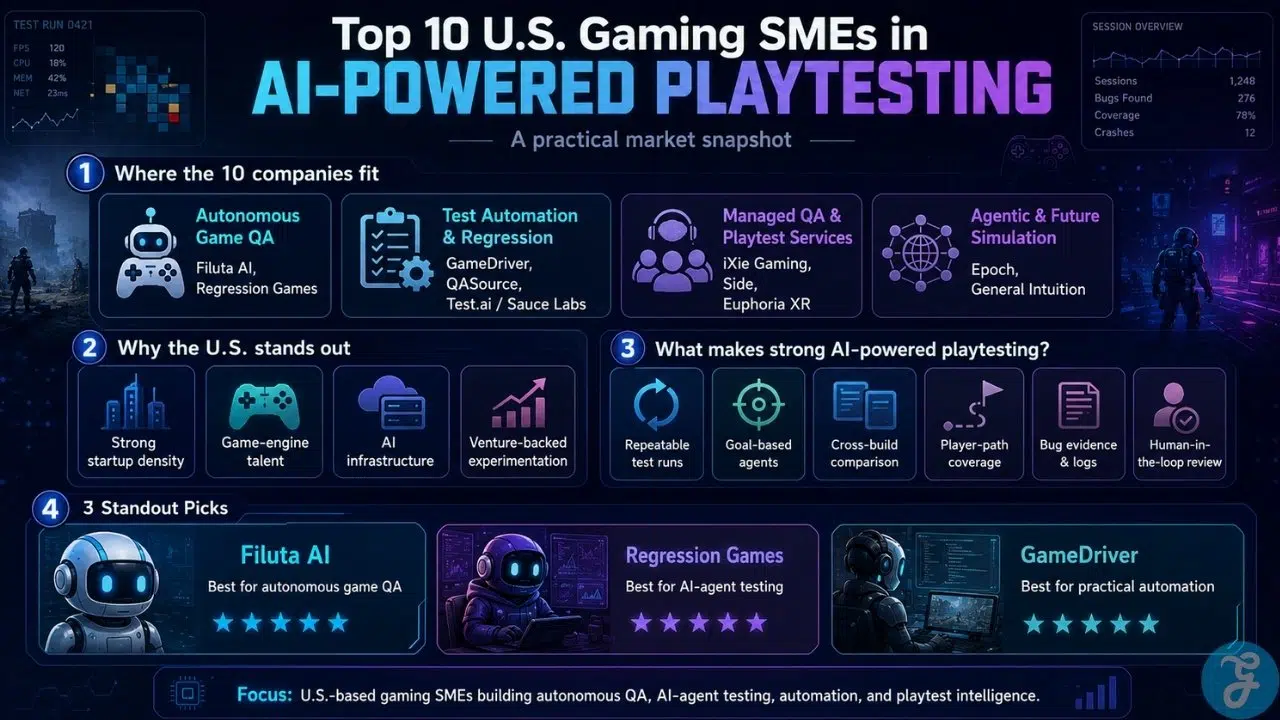
The U.S. market is not cleanly divided into “AI playtesting companies” and “not AI playtesting companies.” It is more of a spectrum. On one side are agentic tools like Filuta AI and Regression Games. In the middle are automation and managed QA providers like GameDriver, iXie Gaming, and QASource. On the other side are frontier agent companies like General Intuition that may shape the next generation of autonomous game testing.
Overview Comparison Table
The comparison below helps separate the companies by the type of problem they solve, because choosing the wrong category is how studios waste money on tools they are not ready to use.
| Company | Best Fit | Core Strength | Strongest Buyer Type |
| Filuta AI | Autonomous game QA | AI planning agents for goal-based game testing | Mid-sized and complex game studios |
| Regression Games | AI agent testing | Automated game testing and AI agents for Unity workflows | Indie and Unity-focused studios |
| GameDriver | Game test automation | Repeatable automated tests for Unity, Unreal, XR, and 3D apps | QA teams and technical producers |
| Epoch | Playtest workflow infrastructure | Tester collaboration and AI-adjacent software-agent tooling | Small studios and early adopters |
| General Intuition | Future agent simulation | Gameplay-trained agents and world-model research | Investors, advanced studios, AI teams |
| iXie Gaming | Managed game QA automation | Game QA services with automation and AI-core engineering | Studios outsourcing QA operations |
| Side | Hybrid playtesting and QA | Real-player playtests with AI-assisted insight analysis | Larger studios and publishers |
| Euphoria XR | AI-aware XR testing | Immersive game and XR QA support | VR, AR, and simulation teams |
| QASource | AI-driven QA strategy | AI-augmented testing and automation process maturity | Enterprise-style game teams |
| Test.ai / Sauce Labs | Mobile validation | AI-assisted UI and app-flow testing | Mobile game developers |
Our Top 3 Picks and Why?
The best pick depends on whether the studio wants autonomous agents, structured automation, or managed playtest intelligence. For this article, I ranked the top three by direct relevance to game testing and AI-assisted playtesting workflows.
| Rank | Pick | Why It Stands Out |
| 1 | Filuta AI | Best direct fit for autonomous game QA because its planning agents are designed to play, explore, and find bugs. |
| 2 | Regression Games | Best startup pick for AI-agent game testing, especially for teams interested in Unity-centered automation. |
| 3 | GameDriver | Best practical automation pick because many studios need stable repeatable testing before advanced AI agents. |
Why are AI-Powered Playtesting Tools Booming in the United States
AI-powered playtesting tools are booming in the United States because game development has become too complex for old QA habits. Modern games ship across platforms, update constantly, depend on live-ops systems, and include huge volumes of content, menus, quests, monetization flows, network behavior, and player progression states. Manual QA still matters, but it cannot carry the entire load alone.
What’s their secret sauce?
The strongest U.S. companies are combining game-engine knowledge, AI infrastructure, startup funding, cloud testing, player data analysis, and automation culture. That combination is powerful because playtesting is no longer only about finding whether a door opens. It is about whether a player can finish the tutorial, whether the economy breaks after a patch, whether an NPC blocks a quest, whether a crash appears on one device family, or whether onboarding causes players to quit.
The real secret sauce is not replacing human testers. It is using AI to remove the worst parts of repetitive testing so human testers can focus on judgment. Humans are still better at feel, frustration, humor, pacing, fairness, emotional tone, and whether a game is actually fun. AI is better at repetition, coverage, pattern detection, build-to-build comparison, log review, and running the same test at 3 a.m. without complaining in Slack.
The Future Belongs to Human-Led, AI-Scaled Playtesting
My honest view is that AI-powered playtesting is both necessary and overhyped. It is necessary because game QA has become too expensive, too repetitive, and too fragile for manual testing alone. It is overhyped because no AI agent truly understands fun the way a human player does.
The uncomfortable truth is that many studios will use AI testing badly at first. They will treat it like a magic bug vacuum, cut human QA too aggressively, and then wonder why their polished automated reports missed the thing that made players angry. A bot can finish the tutorial. That does not mean the tutorial feels good.
The future of AI-Powered Playtesting in the United States will probably settle into a hybrid model. AI agents will run repeatable routes, search for edge cases, test builds overnight, analyze player footage, cluster feedback, and flag suspicious behavior. Human testers, designers, and researchers will still decide what matters. The companies that win will not be the ones promising to replace playtesters. They will be the ones that help studios use human judgment where it has the most value.
Frequently Asked Questions (FAQs) About AI-Powered Playtesting
What is AI-powered playtesting?
AI-powered playtesting uses automation, machine learning, AI agents, or AI-assisted analytics to support game testing. It can include bots playing builds, automated regression checks, player behavior analysis, feedback clustering, and bug-report generation.
Can AI replace human game testers?
No, not fully. AI can reduce repetitive testing and improve coverage, but humans are still needed for feel, fun, fairness, emotional response, and creative judgment.
Why did the United States win the country selection?
The United States has the strongest visible mix of gaming startups, AI infrastructure, private QA vendors, game-engine talent, and AI-agent companies working around automated playtesting and game QA intelligence. China and Japan are powerful gaming markets, but their independent SME vendor visibility is weaker in this exact niche.
Which company is best for autonomous game QA?
Filuta AI is one of the strongest direct fits for autonomous game QA because it uses planning agents that can play through goals and find bugs without traditional scripts. Regression Games is also strong for AI-agent testing, especially around Unity workflows.
What should studios check before choosing a tool?
Studios should check engine compatibility, setup time, cost per test run, reporting quality, video evidence, privacy, build security, integration effort, and whether the tool supports the specific type of game they are building. A good demo should use a real build, not a polished sample project.