Most websites do not fail because they lack content. They fail because their content sits in scattered piles. A blog post here. A guide there. A few tool pages, a few listicles, some outdated explainers, and maybe a landing page pretending to be a strategy. Readers cannot follow the path. Search engines cannot easily see the depth. Editors keep publishing more without knowing what the whole system is supposed to become.
That is where pillar content strategies matter.
A strong pillar strategy turns disconnected content into a structured authority system. It helps readers move from broad understanding to specific answers. It also helps publishers, brands, and SEO teams decide what to create, what to update, what to connect, and what to stop producing.
The best approach depends on your business model, audience maturity, search intent, and content inventory. A SaaS company does not need the same hub content strategy as a media site. A beginner education site does not need the same pillar page tactics as a B2B comparison engine.
Our Selection Criteria
We compared these approaches based on practical usefulness, SEO value, editorial depth, and long-term maintainability.
| Criteria | What We Looked For |
|---|---|
| Search intent fit | Does the strategy match how readers search and learn? |
| Topic authority | Can it help a site build visible depth around a subject? |
| Internal linking value | Does it naturally connect pillar pages, cluster pages, and related assets? |
| Reader journey | Does it guide users from broad education to specific action? |
| Business fit | Can it support leads, sales, subscriptions, affiliate revenue, or audience loyalty? |
| Maintenance load | Can the team realistically update and improve it over time? |
Who This Is For
These pillar content strategies are useful for SEO teams, publishers, SaaS marketers, affiliate site owners, niche bloggers, B2B content teams, course creators, agencies, and editorial brands building long-term topical authority.
They are especially useful if your site already has many articles but weak structure. They also help if you are planning a new content program and want to avoid publishing random articles that never support each other.
8 Pillar Content Strategies Compared for Better Topic Authority
Before choosing a strategy, remember the main rule: a pillar page should not be a bloated article with too many links. It should organize a topic clearly, explain the big picture, and guide readers toward deeper supporting content.
1. The Classic Topic Cluster Pillar Content Strategy
The classic topic cluster model uses one broad pillar page as the central hub, then connects it to several deeper cluster pages. The pillar gives readers a complete overview, while the supporting pages answer narrower questions in more detail.
This is one of the most reliable content pillar approaches for SEO because it creates clean topical structure. It works well for subjects with many subtopics, such as technical SEO, email marketing, personal finance, sustainable travel, or AI workflows.
Best Feature/For:
- Best for building topical authority around a broad subject
- Great for SEO teams, SaaS blogs, agencies, and educational sites
Why We Chose It:
- Creates a clean hub-and-spoke structure
- Makes internal linking easier and more intentional
- Helps readers move from overview to detailed guidance
- Works well for long-term organic search growth
Things to consider:
- The pillar page must stay broad without becoming shallow
- Cluster pages need real depth, not thin spin-offs
2. The Ultimate Guide Pillar Page
The ultimate guide approach turns one pillar page into a deep, comprehensive resource. It aims to answer the major questions on a topic in one place, often with sections, examples, visuals, FAQs, and links to deeper articles.
This is useful when readers need a strong starting point before they explore related content. It works well for beginner-friendly topics, complex subjects, and evergreen education.
Best Feature/For:
- Best for broad educational topics
- Great for blogs, publishers, learning centers, and authority sites
Why We Chose It:
- Gives readers a complete entry point
- Can earn links when it is genuinely useful
- Supports many internal links to supporting content
- Helps define your site’s point of view on a topic
Things to consider:
- Long does not automatically mean useful
- It needs regular updates or it becomes a dated monster page
3. The Problem-Solution Hub Content Strategy
A problem-solution hub organizes pillar content around the reader’s pain points rather than broad topic labels. Instead of “Email Marketing,” the hub might focus on “How Publishers Grow Newsletter Subscribers” or “How SaaS Teams Reduce Customer Churn.”
This strategy works because real readers usually search through problems, not taxonomy. It is especially useful when the audience has a clear pain, decision, or goal.
Best Feature/For:
- Best for practical, conversion-friendly content hubs
- Great for SaaS, B2B, service businesses, and niche publishers
Why We Chose It:
- Matches reader intent more directly
- Helps connect education to action
- Supports stronger CTAs and lead paths
- Makes the hub feel useful instead of academic
Things to consider:
- Do not make the problem too vague
- Each supporting page should solve a specific subproblem
4. The Product-Led Pillar Strategy
A product-led pillar strategy uses content to educate the reader while naturally connecting the topic to a product, tool, platform, or service. The pillar page explains the larger problem, then the cluster content shows workflows, use cases, comparisons, templates, and implementation steps.
This is common in SaaS and B2B content because the goal is not only traffic. The goal is qualified readers who understand the problem well enough to consider a solution.
Best Feature/For:
- Best for connecting education to product demand
- Great for SaaS companies, platforms, tools, and service providers
Why We Chose It:
- Supports lead generation and product education
- Helps readers understand use cases clearly
- Works well with demos, templates, calculators, and case studies
- Builds a natural bridge between content and conversion
Things to consider:
- Keep the content genuinely helpful
- If every section becomes a sales pitch, trust drops fast
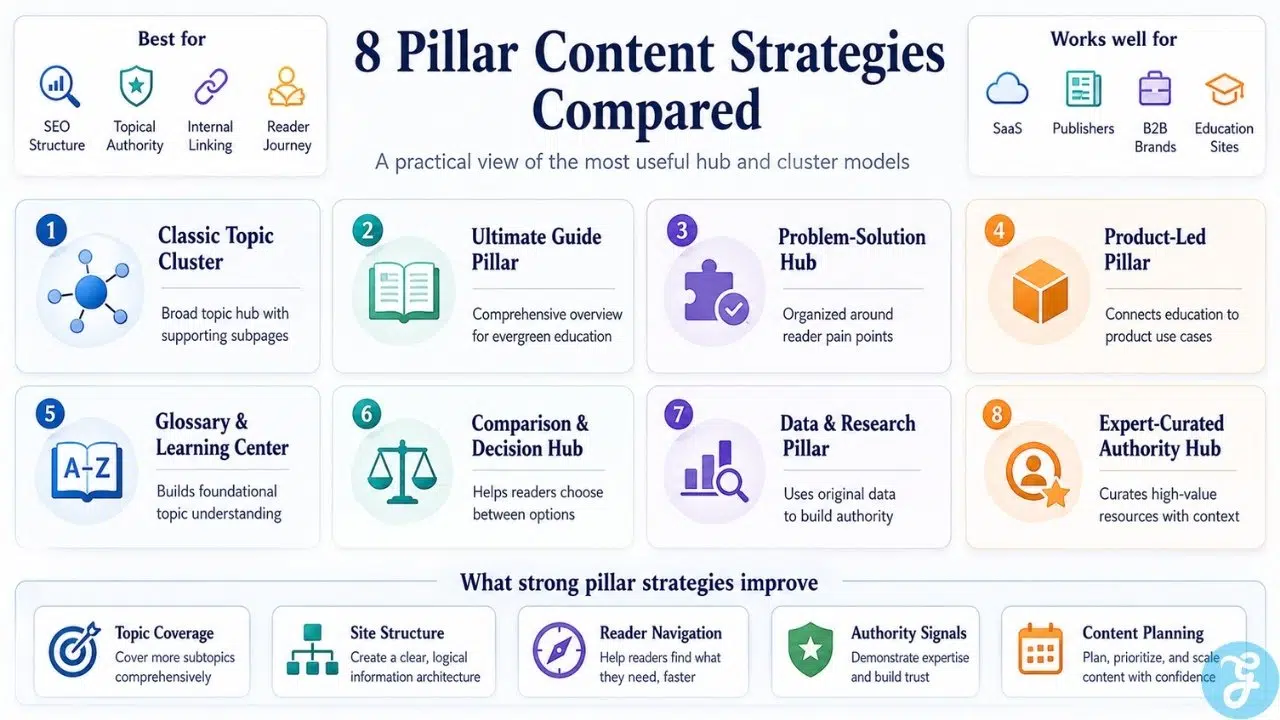
5. The Glossary and Learning Center Pillar Approach
A glossary or learning center pillar organizes definitions, beginner explainers, and foundational concepts into a structured educational library. It is useful for complex industries where readers need help understanding terms before they can make decisions.
This approach works well for finance, healthcare, legal topics, SaaS, cybersecurity, AI, marketing, and technical niches. It can also support internal linking because each definition can connect to deeper guides, examples, and comparison pages.
Best Feature/For:
- Best for beginner education and complex terminology
- Great for technical industries, niche publishers, and B2B brands
Why We Chose It:
- Helps beginners enter the topic safely
- Builds foundational topical coverage
- Creates many natural internal linking opportunities
- Can support featured snippets and long-tail search demand
Things to consider:
- Avoid thin dictionary-style entries
- Add examples, context, and next-step links
6. The Comparison and Decision Hub
A comparison hub helps readers choose between tools, products, strategies, vendors, methods, or alternatives. Instead of publishing random “X vs Y” articles, the pillar page becomes a decision center that connects comparison pages, buyer guides, review content, and use-case recommendations.
This is one of the strongest pillar page tactics for affiliate sites, software review sites, B2B brands, and buyers near the decision stage. It works because the reader already has intent. They are not just browsing. They are narrowing choices.
Best Feature/For:
- Best for decision-stage search intent
- Great for affiliate sites, SaaS comparison pages, and buyer guides
Why We Chose It:
- Helps readers make faster decisions
- Supports commercial and affiliate content naturally
- Creates strong internal linking between alternatives
- Works well with comparison tables and selection frameworks
Things to consider:
- Be honest about trade-offs
- Weak or biased comparisons can damage trust
7. The Data and Research Pillar Strategy
A data pillar is built around original research, benchmarks, statistics, surveys, or industry analysis. Instead of only explaining a topic, it gives the audience something worth citing.
This strategy can be powerful for authority building because original data gives other writers, journalists, and creators a reason to reference your page. It works best when the data is useful, clearly explained, and updated on a reliable schedule.
Best Feature/For:
- Best for link earning and authority building
- Great for research-led brands, publishers, agencies, and B2B companies
Why We Chose It:
- Creates original value beyond basic explanations
- Can attract backlinks and citations
- Supports thought leadership and PR
- Gives your cluster content stronger evidence
Things to consider:
- Data needs methodology and context
- Outdated statistics can hurt credibility
8. The Expert and Curated Authority Hub
An expert-curated hub organizes high-quality resources, expert insights, interviews, examples, tools, and recommended reading around a topic. It works especially well when the best information is scattered across many sources or when the audience needs a trusted filter.
This approach is useful for publishers, newsletters, professional communities, and niche sites. The value comes from editorial judgment: what belongs, what does not, and why the reader should care.
Best Feature/For:
- Best for niche authority and editorial trust
- Great for publishers, expert blogs, communities, and newsletters
Why We Chose It:
- Saves readers time
- Builds trust through selection and explanation
- Works well for fast-moving or fragmented niches
- Can support newsletters, resource pages, and expert roundups
Things to consider:
- Add original commentary, not just links
- Audit resources regularly so the hub stays useful
A Quick Overview
These pillar content strategies work best when the structure matches the reader’s journey. Some approaches are better for education, some for conversion, some for decision support, and some for authority building. The strongest sites often use more than one approach, but each hub should still have one clear purpose.
Overview Comparison
| Strategy | Best Use | Main Benefit | Best Fit |
| Classic topic cluster | Broad SEO authority | Clean hub-and-spoke structure | SEO blogs, SaaS, education sites |
| Ultimate guide | Evergreen education | Complete topic overview | Publishers, learning sites |
| Problem-solution hub | Practical reader pain | Strong intent match | B2B, SaaS, service brands |
| Product-led pillar | Product education | Content-to-conversion path | SaaS, tools, platforms |
| Glossary and learning center | Beginner education | Foundational coverage | Technical and complex niches |
| Comparison and decision hub | Buyer decisions | Commercial intent support | Affiliate, SaaS, review sites |
| Data and research pillar | Original authority | Links and citations | Agencies, publishers, B2B brands |
| Expert-curated hub | Trust and filtering | Editorial authority | Newsletters, communities, niche sites |
Our Top 3 Picks and Why
1. Classic Topic Cluster
This is the safest starting point for most SEO teams because it creates a clear structure. It helps organize broad topics, connect related content, and build authority over time.
2. Problem-Solution Hub
This approach deserves more attention because it starts with reader pain, not internal categories. It works especially well when the goal is leads, conversions, or practical audience value.
3. Data and Research Pillar
This is harder to produce, but it can create stronger authority than another recycled ultimate guide. Original research gives people a reason to cite, share, and return to your site.
How to Choose the Right Pillar Content Strategy
Do not choose a pillar format because it sounds impressive. Choose it based on your audience, your business goal, and your existing content gaps.
If your topic is broad and messy, start with a classic topic cluster. If your audience is new to the subject, build an ultimate guide or learning center. If your audience is trying to solve a painful problem, build a problem-solution hub. If your business sells a tool or service, a product-led pillar may work better. If your topic has strong commercial search intent, build a comparison hub. If you have access to original data, build a research pillar.
A simple selection framework:
- Pick classic topic clusters when you need SEO structure.
- Pick ultimate guides when readers need a broad starting point.
- Pick problem-solution hubs when the audience has a clear pain point.
- Pick product-led pillars when education should support conversion.
- Pick learning centers when your niche has many terms and concepts.
- Pick comparison hubs when readers are choosing between options.
- Pick data pillars when you can publish original research.
- Pick expert-curated hubs when your audience needs a trusted filter.
Final Checklist Before Building a Pillar Page
Before publishing a pillar page, ask:
- Is the pillar topic broad enough to support multiple cluster pages?
- Does the page help readers understand the topic clearly?
- Are the internal links useful, crawlable, and contextually placed?
- Do the supporting pages answer specific subtopics in depth?
- Is there a clear next step for the reader?
- Can your team update the hub regularly?
- Does the strategy support business goals without sacrificing trust?
Strong Pillars Make Content Easier to Understand
The best pillar content strategies do not exist to make a site look bigger. They exist to make the topic easier to navigate.
That is the real value. A good pillar page gives readers a map. A good cluster gives them depth. A good internal linking system helps them move between the two without getting lost.
Random content creates noise. Structured content builds authority.
If your site already has dozens of scattered articles, do not start by publishing more. Start by asking what should become the hub, what should support it, what should be updated, and what should be removed.
That is how pillar content turns a content archive into a content strategy.
Frequently Asked Questions (FAQs) on Pillar Content Strategy
What are pillar content strategies?
Pillar content strategies are structured ways to organize broad topics, pillar pages, cluster content, and internal links. They help readers understand a subject and help websites build stronger topical authority.
What is the difference between a pillar page and a content hub?
A pillar page is usually the main comprehensive page on a broad topic. A content hub is the larger structure that includes the pillar page, supporting cluster pages, internal links, and related resources.
What is a hub content strategy?
A hub content strategy organizes related articles, guides, tools, videos, or resources around one central topic. The goal is to make the topic easier for readers to explore and easier for search engines to understand.
Which pillar content strategy is best for SEO?
The classic topic cluster strategy is usually the best starting point for SEO. It creates a clear hub-and-spoke structure and helps connect broad pillar pages with deeper supporting content.
How many cluster pages should support a pillar page?
There is no fixed number. A small hub may need five strong cluster pages, while a large topic may need dozens. The better question is whether each cluster page answers a real subtopic that deserves its own page.