


There was a time when the deal between Google and publishers was at least understandable. Publishers created useful content. Google indexed it. Users searched. Google sent traffic. Publishers monetized that traffic through ads, subscriptions, affiliate links, memberships, leads, or simple brand loyalty. It was not perfect. It was not always fair. But the basic exchange made sense.
That deal is now collapsing.
Google is killing the Open Web not because one algorithm update went badly, or because some publishers wrote mediocre content, or because users suddenly stopped caring about independent websites.
That is the real Google AI Overviews impact. It is not merely a new search feature. It is not a cute box at the top of the results page. It is a power shift.
The old Google said, “Here are the best answers. Go visit them.”
The new Google says, “Here is the answer. We read the websites for you.”
That may be convenient for users. Of course it is. Nobody is pretending users wake up in the morning desperate to click through eight recipe blogs, three coupon pop-ups, and a newsletter modal just to learn how long to boil an egg. But convenience is not the whole story. Convenience can also be the velvet glove over a very large fist.
For publishers, the problem is brutal: Google still needs their work, but it needs their clicks less.
That is not innovation. That is extraction with better branding.
AI Overviews Are a Death Sentence for Publishers
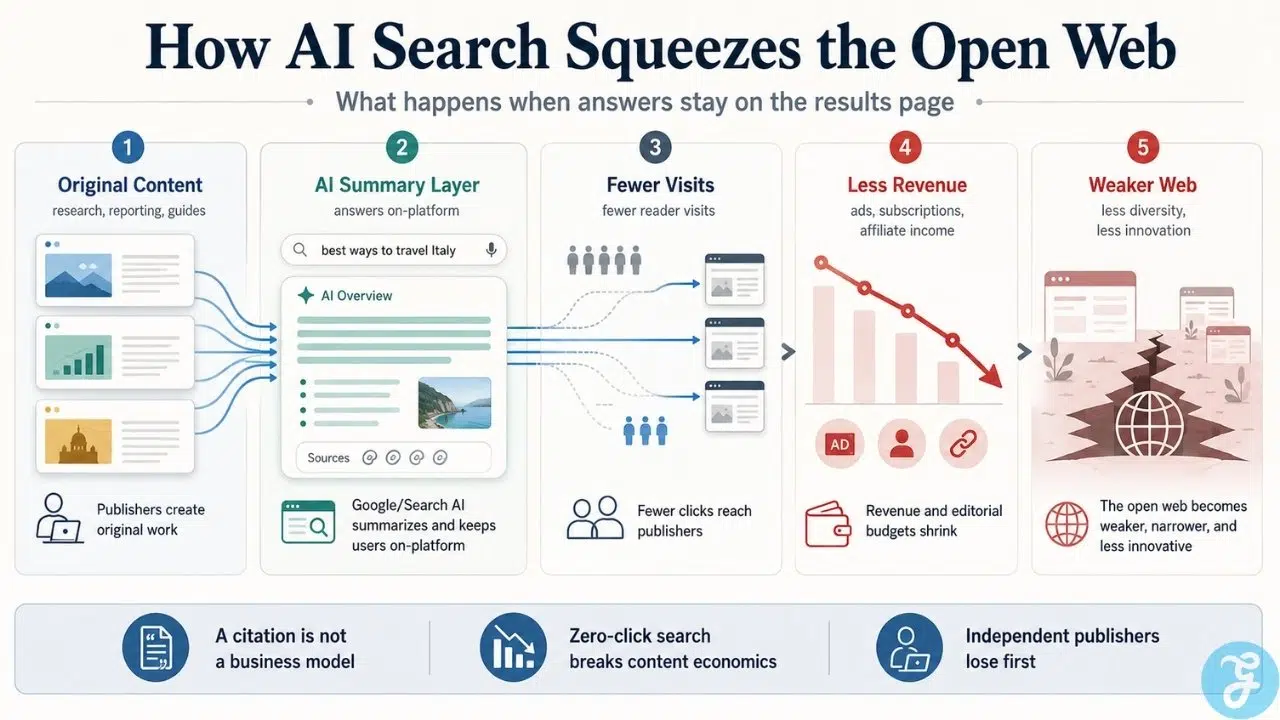
AI Overviews are dangerous for publishers because they attack the one thing publishers cannot live without: the visit.
A citation is not a visit. A source link is not a reader. A tiny hyperlink buried under an AI-generated answer is not a business model. Publishers cannot pay writers, editors, developers, hosting bills, reporting costs, legal reviews, photographers, designers, and audience teams with “visibility.” Exposure, as every freelancer has learned the hard way, remains the currency of people who do not want to pay.
Google insists that AI Overviews help users explore more and that the clicks they do send are higher quality. That sounds comforting until you remember who gets to define “quality.” Google does. Convenient, isn’t it? The landlord has checked the building and found the rent perfectly reasonable.
The publisher’s concern is simpler. If an AI Overview answers the user’s question on the results page, many users will stop there. Why would they click? Curiosity is not infinite. Attention is not charity. If Google gives the user enough information to feel satisfied, the original publisher becomes a ghostwriter for the search page.
And this is where the moral insult gets added to the economic injury. Publishers are not merely losing traffic to competitors. They are losing traffic to a system built on the existence of their work. Google can summarize because others researched, wrote, tested, explained, reported, compared, and updated. The machine looks magical only because millions of humans already did the hard part.
This is why Google is killing the Open Web is not just a dramatic headline. It describes a business model where publishers still create the value, but Google increasingly captures the attention, the answer, and the advertising opportunity before the reader ever reaches the source.
The death sentence is not immediate for every publisher. Big brands will survive longer. Sites with strong direct audiences will survive longer. Publishers with loyal communities, subscription power, or diversified revenue will absorb the shock better.
But for the broad middle of the web, especially publishers built around informational search, AI Overviews are not a minor product tweak. They are a structural downgrade to the value of being clicked.
And once the click loses value, the open web loses oxygen.
Why Zero-Click Searches Will Break Content Economics
Zero-click search is not new. Google has been answering questions directly for years through featured snippets, knowledge panels, weather boxes, sports scores, calculators, maps, and all the other little conveniences that slowly trained users not to leave Google.
At first, publishers tolerated it because the broader traffic machine still worked. Yes, Google took the weather query. Yes, Google answered the celebrity age question. Fine. Publishers still had enough deeper queries, product searches, explainers, reviews, guides, and news searches to justify the bargain.
AI Overviews change the scale of the theft. Sorry, “transformation.” We must use polite words while the furniture is being carried out.
The issue is not that users sometimes get fast answers. The issue is that Google is expanding the category of “fast answer” into territory that used to belong to publishers. A basic fact is one thing. A synthesized explanation is another. A multi-step summary that compresses several sources into one answer box is not just search. It is publishing.
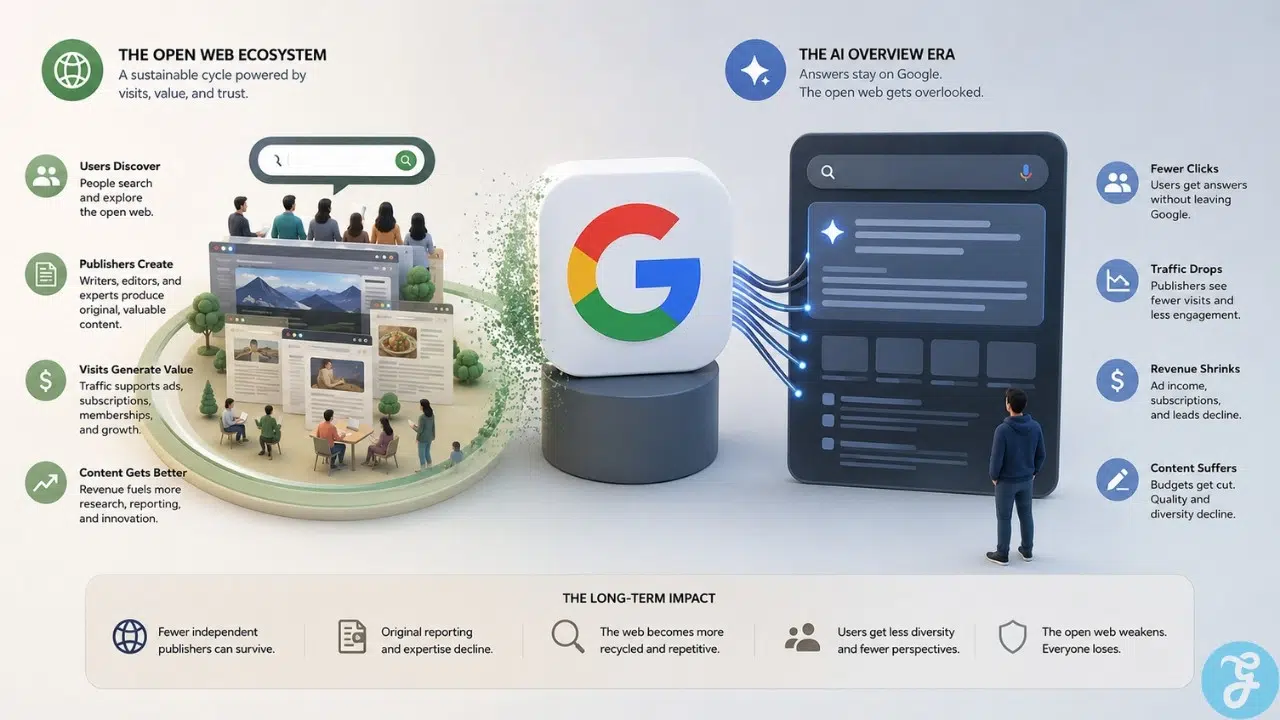
That matters because content economics are built on a chain.
A user has a need. The publisher meets that need. The visit creates monetizable attention. That revenue funds more content. More content feeds the web. The web gives search engines something worth searching.
Break the visit, and the chain starts to snap.
This is why SEO traffic decline is not just a publisher complaint, and why Google is killing the Open Web has become the uncomfortable diagnosis publishers can no longer avoid. It is an ecosystem warning. If fewer visits reach original sources, fewer publishers can justify producing original work. If fewer publishers produce original work, Google has less fresh material to summarize. If Google has less fresh material, the search experience gets thinner, more recycled, and more dependent on the same large institutions and user-generated platforms.
That is how the open web dies: not with one dramatic shutdown, but with a thousand editorial budgets quietly being cut because the traffic no longer pays for the work.
Google may argue that people search more when AI appears. That may be true. But “more searches” is not the same as “more sustainable publisher revenue.” A restaurant does not survive because more people smell the food from the sidewalk. Someone has to come inside and order.
Zero-click search converts publishers into unpaid ingredients in Google’s answer machine. And then everyone acts shocked when the kitchen starts closing.
The “Helpful Content Update” Was Never About Helpfulness
The phrase “Helpful Content Update” deserves a tiny award for corporate comedy.
On paper, the idea was noble. Google said it wanted to reward people-first content and reduce low-value material created mainly to attract clicks. Reasonable enough. The web had a spam problem. Anyone who has searched for a simple answer and landed on a 3,000-word fog machine knows that.
But in practice, the helpfulness conversation became a convenient fog of its own.
Publishers were told to be original, useful, experienced, trustworthy, and reader-first. Many tried. Some improved. Some cut fluff, added expert review, improved page experience, updated old articles, removed thin content, and invested in better editorial standards.
Then many watched their rankings collapse anyway, while large brands, forums, Reddit threads, institutional pages, and content with questionable usefulness gained visibility.
So let’s ask the rude question: helpful to whom?
Helpful to the reader? Sometimes.
Helpful to Google’s risk management? Often.
Helpful to publishers who actually invested in better content? Not reliably enough.
The deeper problem is that “helpfulness” became whatever Google’s systems decided it was after the fact. If a small publisher lost traffic, the industry answer was usually the same: improve your content. Add experience. Build authority. Don’t chase search. Be more helpful. In other words, keep feeding the machine and blame yourself when it bites.
That advice has become insulting.
Yes, bad content should lose. Spam should lose. Scaled junk should lose. Parasite SEO should lose. Nobody serious is defending the garbage pile. But the Helpful Content era did not simply punish garbage. It exposed how little control publishers actually have over their own fate when one platform can redefine quality, redistribute visibility, and offer only vague recovery advice afterward.
For small and mid-sized publishers, “be helpful” became less a strategy and more a prayer.
And prayer is not a business model either.
Why Small Publishers Can’t Compete Anymore
Small publishers are not failing only because they are worse at content. Many are failing because the game has become structurally hostile to them.
A small publisher can produce a deeply researched guide, but a giant brand can outrank it with a thinner page because the brand carries more trust signals. A niche expert can write from genuine experience, but a forum thread can outrank it because Google now appears obsessed with “authentic voices.” A careful independent site can update its articles regularly, but a household-name domain can publish broad, safe, lightly edited material and still dominate.
This is not a meritocracy. It is reputation laundering at scale.
The common SEO fairy tale says the best content wins. That was always too simple, but now it sounds almost childish. The best content does not automatically win. The safest entity often wins. The biggest brand often wins. The platform Google already trusts often wins. The result that protects Google from embarrassment often wins.
Small publishers can still succeed in pockets, but the margin for error has become viciously small. They face rising content costs, falling search traffic, unstable algorithm updates, AI summaries, higher competition, and a search results page increasingly crowded with Google-owned features.
And when traffic drops, the advice arrives like clockwork: build a brand.
Thank you, professor. Very helpful. Shall the small publisher also build a private space program while we are here?
Building a brand requires time, money, repetition, distribution, and trust. Search used to be one of the few ways smaller publishers could earn that trust by being genuinely useful at the moment of need. If Google removes or reduces that discovery path, it is not merely telling small publishers to “build a brand.” It is pulling up the ladder and then complementing the people already on the roof.
This is where the open web death becomes visible. Not because every website disappears, but because the web becomes less open to new entrants. Fewer strange little expert sites. Fewer independent reviewers. Fewer niche publications. Fewer passionate obsessives explaining things better than the big brands ever will.
A web dominated by a few trusted giants, a few massive platforms, and Google’s own answer layer may be cleaner. It may be safer. It may even be more convenient.
It will also be duller, narrower, and easier to control.
The SEO Industry Is in Denial About What’s Happening
The SEO industry has a problem: telling the full truth about Google would be bad for business.
That does not mean SEO professionals are useless. Many are smart, honest, and painfully aware of what is happening. Technical SEO still matters. Content strategy still matters. Site architecture, topical authority, schema, page speed, internal linking, crawl efficiency, and editorial quality still matter.
But the industry’s public language is often trapped in denial because its business model depends on hope.
Every disaster becomes a “shift.” Every collapse becomes an “opportunity.” Every publisher traffic drop becomes a “wake-up call.” Every Google change becomes a chance to “adapt.” Adapt to what, exactly? A search environment where the search engine increasingly answers the query itself? That is not a normal market adjustment. That is the referee deciding to play striker.
SEO discourse is full of soothing phrases. Optimize for AI. Create helpful content. Build topical authority. Focus on user intent. Strengthen E-E-A-T. Diversify traffic. Add unique value. Refresh old pages. Become the source.
Fine. Do those things. But do not confuse tactics with power.
A publisher can do everything right and still lose because the distribution layer changed the rules. A site can be technically sound, editorially strong, and genuinely useful, yet still bleed traffic because Google decided the answer belongs on Google.
That is the truth the industry struggles to say loudly: SEO is becoming less about earning traffic from the open web and more about negotiating visibility inside Google’s increasingly closed environment.
There is still money in SEO. There is still work to do. There are still wins available. But the old promise is broken.
Rank high, get traffic, grow business.
That sentence now needs so many disclaimers it should come with legal counsel.
Google’s Trust in Big Brands Is Killing Innovation
Google loves to talk about trust. And trust matters. Nobody wants medical advice from a mystery blog with eleven pop-ups and a logo made in Microsoft Paint. Nobody wants financial guidance from a website that also reviews air fryers and celebrity divorces. Standards are necessary.
But Google’s version of trust increasingly feels like institutional comfort dressed up as quality.
Big brands get the benefit of the doubt. Major platforms get visibility. Legacy authority gets reinforced. Meanwhile, smaller publishers must prove themselves again and again, often against competitors with weaker content but stronger names.
That is bad for innovation because innovation rarely begins inside the safest institution. It often begins at the edges. It begins with the niche expert, the small editorial team, the obsessed reviewer, the independent analyst, the local reporter, the hobbyist who knows more than the generalist, the weird little site that exists because someone cared before the market noticed.
The open web was powerful because it allowed those voices to surface. Search, at its best, made discovery more democratic. You did not need to be a media empire to answer a question well. You needed to be useful, crawlable, relevant, and trusted enough.
Now the trust threshold has hardened.
A system that over-rewards big brands does not just hurt small publishers. It makes the web less interesting. It narrows the range of answers. It turns search results into a corporate conference room where everyone has the same haircut and nobody says anything risky.
Worse, it encourages the very behavior Google claims to dislike. If independent publishers cannot win on their own domains, they migrate to platforms Google favors. They post on Reddit. They publish on LinkedIn. They chase YouTube. They rent authority from larger domains. They become tenants in someone else’s empire because owning a small house on the open web no longer pays.
That is not a healthier web. That is feudalism with better UX.
Google’s trust problem is not that it cares too much about quality. It is that it increasingly confuses quality with safety, scale, and brand familiarity. That may reduce risk for Google, but it also reduces the oxygen available to new ideas.
And when new ideas cannot be discovered, the web does not merely shrink. It ages.
Google Has Become a Walled Garden
For years, people called Facebook a walled garden. Then Instagram. Then TikTok. Then app stores. Google, by contrast, maintained the image of the great open-web gateway.
That image is now outdated.
Google has become a walled garden with a search box at the entrance.
The wall is not always obvious because Google still shows links. That is the clever part. The open web is still visible, like scenery behind glass. You can see it. You can sometimes reach it. But more of the user journey now happens inside Google’s controlled environment: summaries, snippets, shopping modules, maps, videos, forums, product panels, AI answers, follow-up prompts, and ads.
Google does not need to remove the web. It only needs to make leaving feel optional.
That is the quiet genius of the strategy. Users are not forced to stay. They are simply given fewer reasons to leave. Publishers are not banned. They are simply made less necessary to the user experience. The web is not deleted. It is absorbed.
This is why the phrase “Google is Killing the Open Web” is not melodrama. It is a description of incentives.
An open web depends on movement. Users move from search to sites. Attention moves from platforms to publishers. Money moves from audiences to the creators of information. Credit moves back to sources. Discovery remains porous enough for new entrants to matter.
A walled garden interrupts that movement. It centralizes attention. It controls presentation. It decides which sources are visible, which are summarized, which are trusted, which are ignored, and which are allowed to receive the click after Google has already satisfied the intent.
The final insult is that publishers are expected to be grateful for whatever remains. A lower click-through rate is called a higher-quality audience. A source link is called exposure. A traffic decline is called changing user behavior. A monopolistic squeeze is called innovation.
Please. There is only so much perfume one can spray on a landfill.
The open web does not need nostalgia. It does not need publishers pretending everything was wonderful before AI. It was not. Search spam was real. Thin affiliate content was real. Ad-bloated pages were real. Lazy SEO content was real. Publishers made plenty of mistakes, and some of them deserved to lose.
But that does not absolve Google of what it is building now.
A healthier search ecosystem would reward original work, send meaningful traffic, share value fairly, and give publishers clearer choices over how their content is used in AI-generated answers. It would not turn the web into a raw material layer for a platform that captures the user, the answer, and the ad opportunity in one place.
The future of publishing cannot depend on begging Google to become generous. Google is not a charity. It is an advertising giant with AI ambitions and monopoly-shaped muscle memory. It will follow the incentives unless regulators, users, publishers, and the market force different ones.
So no, this is not just another SEO panic cycle.
This is the moment publishers need to stop treating Google as a difficult partner and start seeing it as what it has become: a platform whose growth now depends on reducing the need to visit the very web it claims to organize.
Google is not killing the open web with one clean blow.
It is doing something more efficient.
It is making the open web unnecessary, one answer at a time.
The Open Web Will Not Survive on Google’s Terms
The uncomfortable truth is that publishers cannot save the open web by simply becoming more “helpful” inside a system designed to need them less.
That does not mean publishers should stop improving their work. Better reporting, sharper analysis, stronger expertise, cleaner UX, and real editorial judgment still matter. They matter more than ever. But quality alone cannot fix a broken exchange. If Google can use publisher content to satisfy users without sending meaningful traffic back, then the problem is not publisher quality. The problem is platform power.
Google is killing the Open Web because it has turned the internet’s discovery layer into an extraction layer. AI Overviews, zero-click answers, brand-heavy rankings, and vague quality systems are not separate problems. They are symptoms of the same shift: Google wants the value of the web without giving the web its fair share of attention.
And that is the line publishers need to stop pretending around.
The open web was never perfect. It had spam, thin content, ugly ads, fake expertise, and plenty of SEO nonsense. But it also had independence. It had discovery. It allowed smaller voices to compete when they had something genuinely useful to say. That is the part now being squeezed.
If Google continues down this road, the web will not disappear overnight. It will become quieter, poorer, safer, more centralized, and less alive. The strange little expert sites will fade. Independent publishers will shrink. New voices will struggle to surface. Search will still look full, but underneath, the ecosystem feeding it will be starving.
That is not the future of the open web.
That is the open web being harvested.






















