The proposal had been weeks in the making. Product specs, pricing tiers, a short company overview. My contact at the European distributor had specifically asked for it in German, and I had used the same AI translation approach I always did: paste the text, copy the output, move on.
What I did not know until a bilingual colleague reviewed the draft two hours before send time was that one sentence in the pricing section had been rendered in a way that implied a discount that did not exist. The model had interpreted an English conditional clause ambiguously and landed on the more generous reading. In German, that kind of phrasing carries contractual weight.
We caught it. But only barely, and only by accident.
That near-miss is what sent me down a testing rabbit hole I wish I had gone down earlier.
Why I Started Copying AI Outputs Into a Spreadsheet
After the near-miss, I started running every critical document through multiple AI translation models simultaneously before using any output. Not because I had a system for it, but because I had lost confidence in picking one model and trusting it blindly.
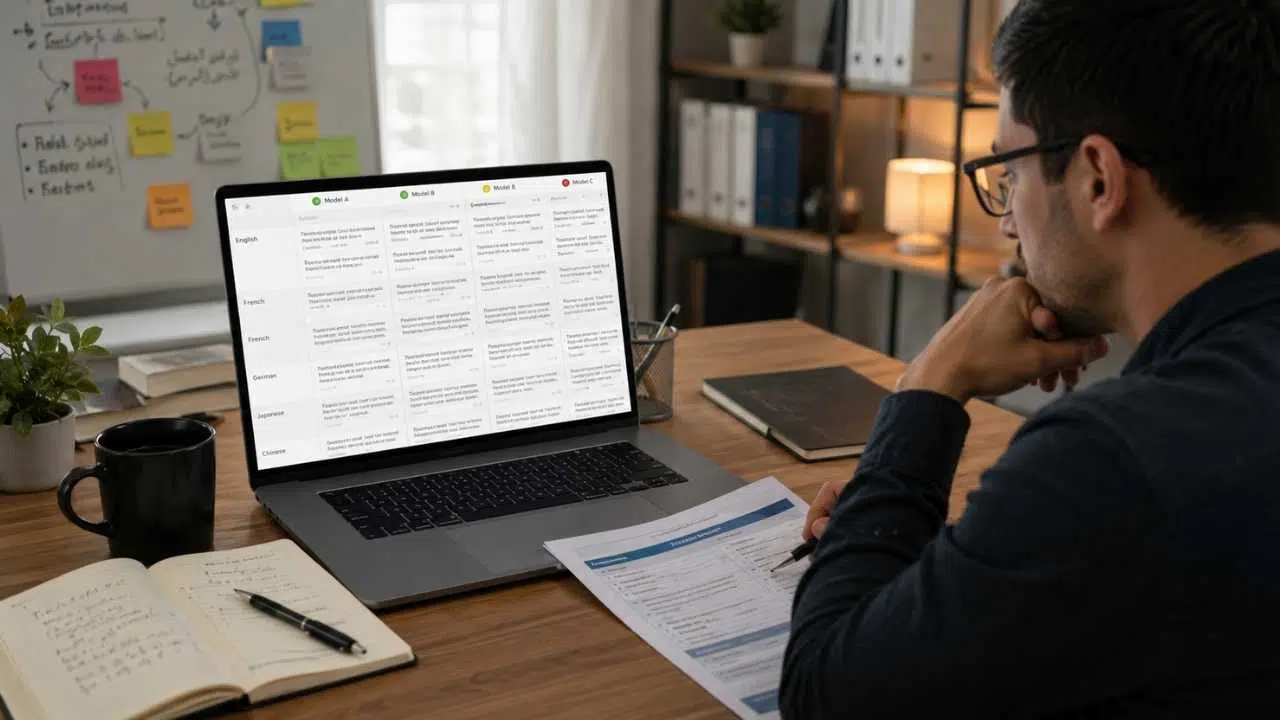
The process was manual and tedious. I would paste the same paragraph into Google Translate, DeepL, ChatGPT, Gemini, and three others, then line up the outputs side by side in a spreadsheet and read for differences. If most of them produced roughly the same sentence, I felt more confident. If they diverged meaningfully, I knew I had a problem that required a closer look.
What surprised me was how often they diverged, and how invisibly. As Editorialge covered in its recent comparison of leading AI translation engines, no single model leads across all language pairs. The engine that performs best on English to French does not necessarily lead on English to Japanese or English to German. The same inconsistency I was observing at sentence level maps directly onto that broader structural problem.
What 7 Models Actually Disagreed On
Over about three months, I ran a mix of business documents through this multi-model comparison process: proposals, contract summaries, a product FAQ, and several email threads with international partners.
The disagreements fell into a few repeating categories.
Formality register. German business writing has a strict formal register. Two of the seven models I tested consistently produced output that read correctly but felt casual in a way a German business contact would notice. The other five landed closer to the appropriate tone. But without comparing them, I would not have known which category my default model fell into.
Numerical and conditional constructions. This is where the risk concentrates. Sentences like “prices are subject to change after 30 days” or “a 10% fee applies unless otherwise agreed” translate differently depending on whether the model interprets the clause as a firm rule or a contingency. In three of seven tests, at least one model produced a reading that changed the implied obligation.
Industry vocabulary. For a product spec sheet that included technical measurements, two models invented plausible-sounding terminology that did not correspond to the industry-standard term. The phrasing was fluent. It was also wrong.
The 2026 AI translation landscape, as covered in Editorialge’s analysis of the Google Translate Gemma versus ChatGPT Translate comparison, frames the competition as a clash of philosophies rather than a straightforward quality race. What neither philosophy addresses is the structural gap: a model that excels at “contextual refinement” can still hallucinate on a specific clause type, and a model that leads in privacy-first architecture can still miss an industry term. Single-engine users inherit whichever failure mode their chosen model carries.
The Pattern Underneath Every Divergence
Once I had three months of comparison data, the pattern was hard to ignore. The models were not unreliable in random ways. Each had a specific category of content where it consistently underperformed, while performing well everywhere else. The problem was that I had no way of knowing, in advance, which category any given document would expose.
This matches what the research says. According to industry data synthesized from the Intento State of Translation Automation 2025 and WMT24 General Findings, leading large language models produce incorrect or fabricated output between 10 and 18 percent of the time on translation tasks. That figure does not mean every sentence is wrong. It means errors cluster in the parts of the document that carry the most weight, precisely because those parts involve complex syntax, domain-specific terminology, or culturally specific conventions that individual models handle inconsistently.
According to Forrester Research’s 2025 findings, knowledge workers spend an average of 4.3 hours per week verifying AI outputs. My spreadsheet approach was a homemade version of that verification burden. It worked, but it was not scalable. Every document I needed translated was adding an hour of manual comparison time.
What Changed When I Stopped Picking Manually
The logical conclusion of my spreadsheet process was to automate it. If the right answer is the output that most models agree on, I needed something that ran all the comparisons and surfaced the consensus, rather than requiring me to do it by hand.
MachineTranslation.com runs the same source text through 22 AI models simultaneously, including Google Translate, DeepL, ChatGPT, Gemini, Claude, and others, and delivers the translation that the majority agree on. The mechanism is called SMART. It does not pick a winner based on a benchmark score. It selects the rendering that achieves the highest convergence across 22 independent outputs, then surfaces the alternatives so users can see what the dissenting models produced.
The practical effect in my workflow was a reduction in the manual comparison step. Rather than opening seven tabs and reading for differences, I received a single output with the underlying model agreement visible. The first time I ran a complex contract summary through it, the conditional clause that had caused my near-miss produced a clear consensus result. Twelve of the 22 models agreed on the same rendering. Two produced the ambiguous variant I had seen before. I could see the divergence, understand it, and act on it rather than miss it entirely.
According to a 2026 enterprise survey by Crowdin, 95 percent of enterprise teams now prioritize platforms with multi-provider orchestration over single-model tools, with quality assurance and governance cited as the leading factors. The small and mid-market adoption curve is following the same logic, just arriving a little later.
Human Verification as the Final Layer
For the documents where accuracy carries contractual or reputational weight, AI consensus is a strong start. It is not the end point.
MachineTranslation.com includes a Human Verification option within the same platform. After the SMART consensus output is produced, a professional human reviewer validates and certifies the translation before it leaves the workflow. For proposals going to regulated markets, contracts with penalty clauses, or technical specifications where terminology precision matters, that combination covers the gap that even a well-performing consensus system leaves open.
The point is not to distrust AI translation. The technology has improved substantially, and for most business communication it is genuinely reliable. The point is that the content categories where it still fails tend to be the same categories where a mistake carries the largest consequence. Having a human verification step available in the same platform, rather than in a separate workflow, is what makes it practical rather than theoretical.
What I Would Tell Anyone Sending Work Across Languages
The lesson I took from three months of spreadsheet comparisons is not that AI translation is broken. It is that trusting any single model without knowing its failure modes is the actual risk.
For routine communication, most AI translation engines are good enough. For a proposal, a contract, a product claim that will be read in a market you do not natively understand, the question worth asking is not “which model is best” but “what happens when this model gets it wrong and I cannot tell.” As noted in Editorialge’s coverage of AI tools transforming business productivity, the difference between tools that save you time and tools that quietly cost you credibility often comes down to what the tool does with uncertainty, not how fast it operates.
Multi-model comparison is the practical answer to that question. Whether you build the comparison process yourself, as I did before finding a platform that automated it, or use a system that runs it by default, the underlying principle is the same: the translation that 22 models agree on carries a structurally different level of confidence than the one that any single model produced on its own. For anyone operating across languages professionally, the English to German translation workflow is one of the clearest demonstrations of why that gap matters.
That distinction cost me nothing to learn the first time. Barely.