
Google called it the helpful content update, and that name did a lot of work. It sounded clean. Friendly, even. Who could argue against helpful content? Publishers were told to write for people, avoid empty SEO pages, show expertise, and stop manufacturing content only to attract search traffic. On paper, that sounded reasonable. As an editor, I have no problem with that principle. Most of the web did need a cleanup.
But the more I watched the aftermath, the harder it became to believe that “helpfulness” was the whole story.
The update was never only about helping users find better answers. It was also about control. Control over which sites deserved visibility. Control over how much traffic independent publishers could realistically expect. Control over what Google’s systems considered trustworthy, authoritative, and safe enough to rank.
That does not mean every site that lost traffic was innocent. Plenty of bad content deserved to disappear. Scaled junk, lazy affiliate pages, rewritten product descriptions, expired domain tricks, and parasite SEO pages polluted search for years.
But the problem is that Google’s cleanup did not only hit the garbage.
It also exposed a brutal truth: in modern search, being genuinely helpful is not always enough.
The Name Made The Update Sound Simpler Than It Was
The phrase “helpful content” created the impression that Google was making a simple quality judgment. Helpful pages up. Unhelpful pages down.
That is not how it felt in practice.
Google’s own public guidance talked about people-first content, original information, satisfying user experience, and avoiding content created mainly for search engines. Those are good standards. A serious publisher should care about all of them.
The difficulty is that these standards are not as objective as they sound.
What counts as helpful? Who decides whether a page feels satisfying? How does an automated system separate a thin affiliate page from a genuinely useful independent review written by a small specialist site? How does it judge experience when the signals around brand, user behavior, backlinks, authority, and popularity already favor larger domains?
That is where the neat public language starts to crack.
A page can be clear, accurate, tested, and useful, yet still lose to a larger site with stronger brand signals, better domain trust, or more historical search demand. A small publisher can spend days creating a better answer, only to watch a broader media brand outrank it with a safer-looking, less useful page.
This is the part that makes editors suspicious.
Not full tin-foil-hat suspicious. Just suspicious enough.
What The Helpful Content Update Actually Rewarded
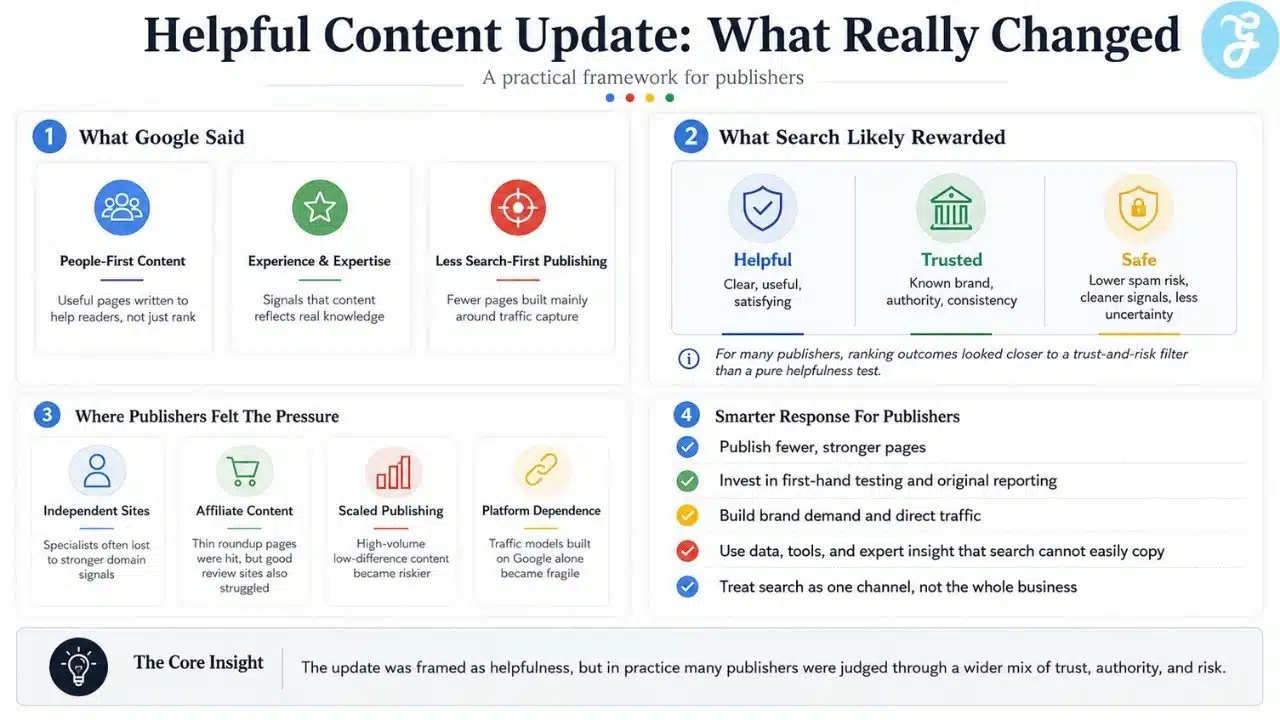
The helpful content update was presented as a push toward better content. In reality, it often behaved like a broader quality and trust reset.
That distinction matters.
A pure helpfulness system would reward pages that solve the reader’s problem better than competing pages. A broader trust reset also looks at whether the source itself seems safe, known, authoritative, consistent, and unlikely to create risk for Google’s results.
That is understandable from Google’s side. Search at global scale is messy. They have to fight spam, AI junk, affiliate manipulation, fake expertise, reputation abuse, and entire networks built to game rankings.
But from the publisher side, the result can feel deeply unfair.
A small site may have real expertise and better content, but not enough brand gravity. A niche publisher may know the product category better than a general media company, but lack the broader authority signals. A specialist writer may have tested the product properly, while a large site may win because its domain looks safer to the algorithm.
This is where “helpful” becomes a polite word for something more complicated.
The system is not only asking, “Does this page help the reader?”
It is also asking, “Do we trust this source enough to send traffic there?”
Those are not the same question.
Small Publishers Learned The Hardest Lesson
The harshest impact has been felt by small and independent publishers.
Some of them absolutely deserved to lose traffic. Let’s not pretend every indie site is noble. The internet has plenty of small spam too.
But many independent publishers were doing the kind of work Google claimed to want: original reviews, hands-on testing, niche expertise, specific recommendations, and content written by people who actually understood the subject.
HouseFresh became one of the clearest public examples. The site built detailed air purifier reviews and reported a major collapse in Google referrals after algorithm changes. The painful part was not just the traffic loss. It was the feeling that specialist work had been pushed below larger publishers with stronger brand recognition.
That pattern is what worries me.
If the search system keeps rewarding big-brand safety over smaller-site usefulness, the open web becomes less diverse. Readers get fewer specialist voices. Publishers learn that deep expertise is not always enough. The incentive shifts from “build the best answer” to “build the safest-looking authority machine.”
That is not helpfulness.
That is risk management.
The Spam Problem Was Real, But The Cleanup Was Messy
To be fair, Google had a real problem to solve.
Search results were full of pages made for algorithms, not readers. Scaled content abuse became easier with AI tools. Affiliate pages were often thin, repetitive, and written to capture commissions rather than guide buyers. Expired domains were repurposed to manipulate trust. Parasite SEO let weak commercial content ride on the authority of stronger domains.
Some of this was shameless.
When high-authority sites publish unrelated coupon pages, outsourced product reviews, or third-party content designed mainly to exploit ranking power, Google has every reason to step in. The site reputation abuse crackdown was necessary. It was overdue.
The issue is not that Google fought spam.
The issue is that its public language made the process sound cleaner than it was.
The web did not experience one neat correction where bad actors disappeared and good publishers rose. It experienced volatility, confusion, collateral damage, uneven recoveries, and a growing sense that the rules were becoming harder to read.
That is dangerous for publishers because editorial investment requires confidence. If a team spends money on reporting, testing, expert review, and editing, it needs some belief that quality can still earn visibility.
When that belief breaks, budgets change.
AI Made The Timing Even More Uncomfortable
The helpful content conversation became even stranger once AI content entered the room.
At first, the message around “people-first” content sounded like a warning against machine-made filler. Then the industry shifted. Google’s guidance became less about whether a human or machine produced the content and more about whether the content was useful and reliable.
That is not unreasonable. A human can produce garbage. AI can help produce a useful draft when guided by an expert editor. The source alone does not determine quality.
But the timing still feels uncomfortable.
Publishers were being told to avoid scaled, search-first content while Google itself was moving toward more AI-shaped answers inside search. Content creators were warned not to flood the web with low-value automation, while search engines became more aggressive about summarizing, extracting, and reformatting information directly inside the results page.
That is the quiet contradiction.
Publishers are told to be more helpful, more original, and more trustworthy. Then, when they succeed, their work may become raw material for search features that reduce the need to click.
This is not a conspiracy theory. It is a business model conflict.
Brand Authority Became The Invisible Gatekeeper
One of the biggest lessons from the helpful content era is that quality alone does not travel very far without trust signals.
That sounds obvious until it hits your analytics.
A small site can publish a better article, but if it lacks brand demand, strong backlinks, topical history, author recognition, user engagement signals, and enough perceived authority, it may still struggle. A larger site can publish an average article and benefit from the trust already attached to the domain.
This is why many publishers felt gaslit.
They were told to improve content. So they improved it. They added expert review, better author pages, clearer sourcing, cleaner formatting, better page experience, and more original analysis.
Then rankings still fell.
At some point, the conversation stops being about whether the content is helpful and starts being about whether Google’s systems can confidently recognize helpfulness on smaller sites. Those are different problems.
And when recognition depends heavily on authority signals, smaller publishers are not competing on quality alone. They are competing against history.
That is a much harder game.
The Affiliate Web Got What It Deserved, But Not Only What It Deserved
Affiliate content is a perfect example of the messy reality.
For years, too many affiliate pages were built like commission traps. “Best” lists with no testing. Product roundups written by people who never touched the product. Review pages assembled from Amazon descriptions. Fake expertise wrapped in SEO formatting.
Those pages deserved to lose.
But affiliate content is not automatically bad. A properly tested review can be more useful than a generic news article. A niche publisher may know a product category far better than a mainstream magazine that entered the space only because affiliate revenue looked attractive.
The helpful content era should have separated fake affiliate content from useful affiliate content.
Sometimes it did.
Sometimes it looked like brand authority swallowed nuance.
That is the frustrating part. Google’s systems may be trying to clean up abuse, but the blunt-force effect can punish entire categories of content because the category itself became associated with manipulation.
Good publishers then spend their time proving they are not spam instead of building better work.
What Publishers Should Actually Learn From This
The wrong lesson is “SEO is dead.”
SEO is not dead. Lazy dependence on Google is what is dying.
The right lesson is that publishers need to build content and distribution systems that do not collapse every time Google changes how it defines quality.
That means being more selective about what gets published. If a page only exists because a keyword tool says the volume is decent, it probably does not deserve editorial resources anymore. If a topic can be answered by ten nearly identical websites, it is not a strong business asset.
Publishers should focus on work that is harder to replace:
- Original reporting
- First-hand product testing
- Proprietary data
- Expert interviews
- Strong opinion backed by evidence
- Tools, calculators, templates, and interactive resources
- Community-driven insight
- Deep niche expertise that cannot be faked quickly
The distribution side matters just as much. Newsletter lists, direct traffic, branded search, community channels, YouTube, podcasts, and referral partnerships are no longer “nice extras.” They are survival infrastructure.
Google can still send traffic. Publishers should still optimize for search.
But they should stop building businesses that depend on Google being fair, predictable, or emotionally invested in their survival.
Google is not your editor.
Google is not your partner.
Google is a platform with its own incentives.
The Real Helpfulness Test Starts After The Click
The real test of helpfulness is not whether an algorithm rewards a page. It is whether a reader would miss that page if it disappeared.
That is a harder standard, and frankly, a better one.
Would anyone search for your brand directly? Would anyone bookmark your article? Would anyone forward it to a colleague? Would another writer cite it because it added something original? Would a reader trust your recommendation because they believe you actually did the work?
If the answer is no, the content is weak no matter how well it ranks.
If the answer is yes, the content has value even if Google temporarily fails to understand it.
That is where publishers need to rebuild confidence. Not in chasing every ranking signal, but in producing work that creates real reader attachment.
The uncomfortable truth is that the helpful content update was never only about helpfulness. It was about Google tightening control over the quality, trust, and commercial risk of its results.
Some of that was necessary. Some of it was overdue. Some of it also hurt the exact publishers the open web needs more of.
So the practical move is not to wait for Google to become more generous. It is to become less dependent.
Build content people recognize. Build formats search cannot fully absorb. Build trust that lives outside the results page. Build a direct audience that does not need an algorithmic permission slip to find you.
That is the only version of helpfulness publishers can still control.