I’ve watched it happen over and over on the screen. Hours, sometimes even days, spent researching, writing, and editing detailed articles are suddenly rendered almost invisible. Google’s AI Overviews slice right through our hard work, providing users with instant answers directly on the search page. The result is simple: readers get exactly what they need without ever clicking through to our sites. This immediate drop in traffic and engagement is more than just frustrating; it undervalues the massive effort required to produce quality content.
Even highly structured, deeply researched content is not immune. Users glance at the AI-generated summary and move on. Your work is effectively reduced to a footnote while the AI takes the spotlight, serving as a loud warning that publishers must take seriously.
Traffic Loss Is Real and Measurable
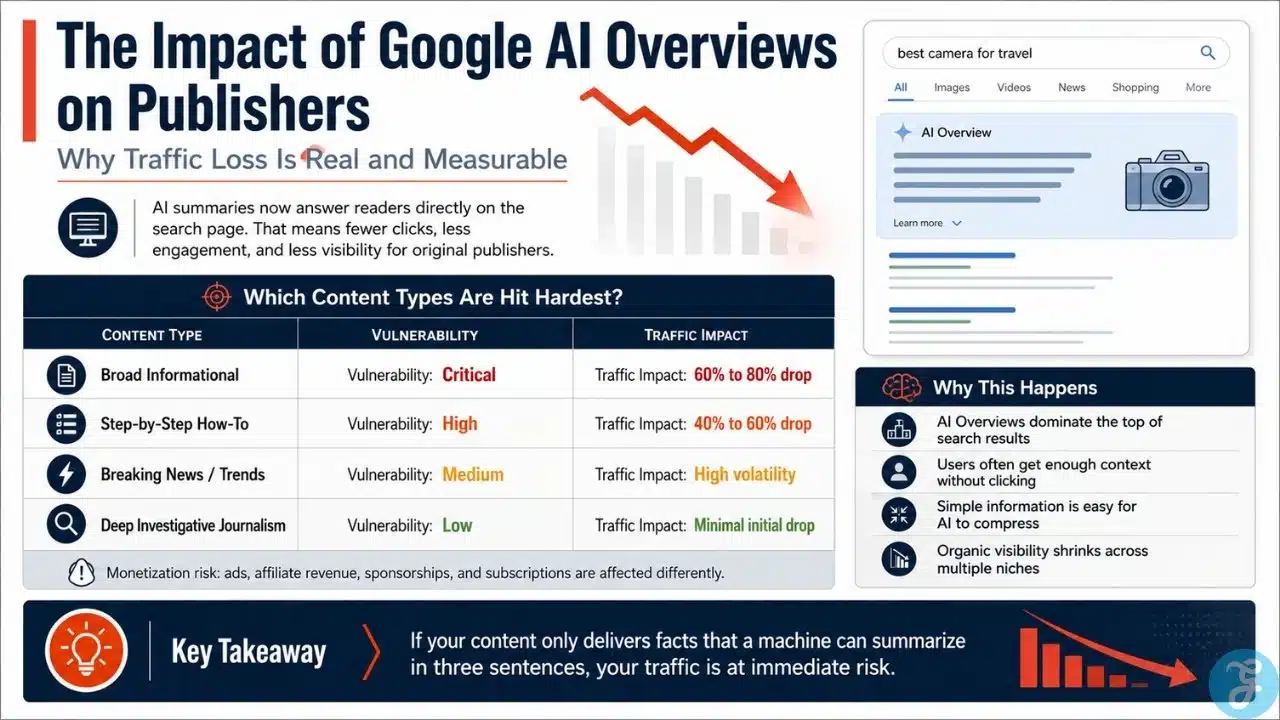
The shift is obvious across multiple niches. Because AI summaries dominate the absolute top of search results, readers rarely bother to scroll past them. Clicks and pageviews are cratering because different content styles are being systematically intercepted. To understand the scale of this disruption, we have to look at how specific categories of information are being cannibalized by the search interface.
The real-world Impact of Google AI Overviews is not uniform across the web. Certain formats are facing near-total erasure of their organic search visibility, while others retain a slight buffer due to the complexity of user intent.
| Content Category | AI Vulnerability Level | Primary Monetization Risk | Expected Traffic Impact |
| Broad Informational | Critical | Programmatic Display Ad Revenue | 60% to 80% decline in programmatic impressions |
| Step-by-Step How-To | High | Affiliate and Video Pre-roll | 40% to 60% drop in lifestyle and tech niches |
| Breaking News / Trends | Medium | Sponsorships and Direct Ads | High volatility based on algorithmic refresh speed |
| Deep Investigative Journalism | Low | Premium Subscriptions | Minimal initial drop, but relies on brand searches |
Casual readers tracking news and current events rarely click the full article once a summary provides the basic context. Similarly, step-by-step how-to guides are answered so quickly by the snippet that comprehensive tutorials lose their traffic entirely. Even long-form analysis and opinion pieces suffer; while AI cannot capture true nuance, users frequently decide they have gleaned enough from a paragraph to skip the deep dive. General informational topics are the most vulnerable of all because the algorithm condenses multiple web sources into a single, clean block. The ultimate takeaway is that if your content only offers data that a machine can summarize in three sentences, your traffic is at immediate risk.
Why Publishers Must Adapt
Ignoring this shift is a losing strategy. The broader Impact of Google AI Overviews is actively rewriting reader expectations alongside traditional traffic patterns. People expect answers instantly now, and their willingness to explore multiple independent websites is shrinking by the day. Publishers who refuse to change their playbook risk losing not just their daily clicks, but their long-term authority and relevance.
We are moving away from an era where search engines act as traffic aggregators. Instead, they are transforming into answer engines that treat the open web as a free training database.
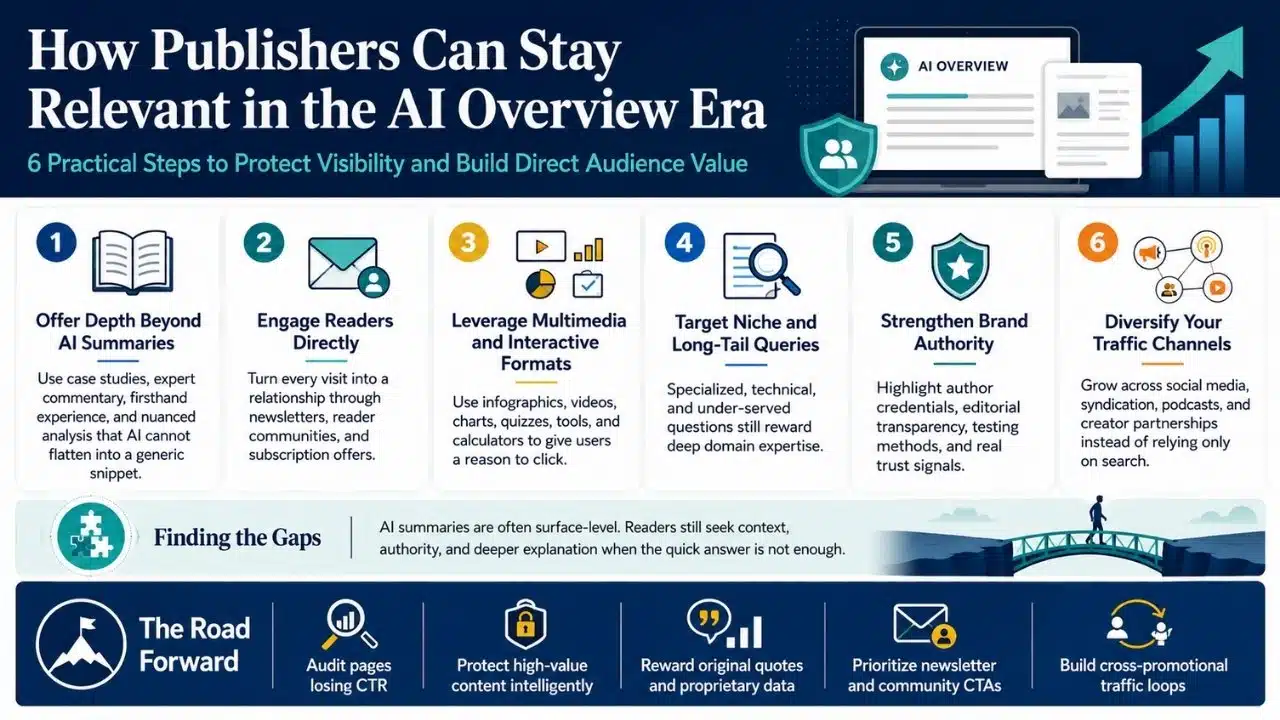
6 Practical Steps to Stay Relevant
1. Offer Depth Beyond AI Summaries
AI excels at surface-level answers, which means depth is your primary defense line. Publishers must provide the kind of insights that cannot be condensed into a generic snippet. This means centering your articles around highly detailed case studies, unique expert commentary, and nuanced, contextual analysis. AI Overviews simply cannot replicate firsthand human expertise or complex, multi-layered reasoning.
2. Engage Readers Directly
Relying solely on search traffic is incredibly risky right now. Building a direct, unmediated connection with your audience creates a necessary safety net to offset the negative Impact of Google AI Overviews.
To break away from over-reliance on external platforms, a sustainable media business must treat every organic visit as a single, high-stakes opportunity to capture a permanent relationship.
Launching newsletters that deliver exclusive insights, fostering active communities where readers interact with your team, and offering subscription models that provide value far beyond standard search queries will drastically reduce your dependence on Google visibility.
3. Leverage Multimedia and Interactive Formats
Because AI summaries are primarily text-based, you can capture attention by building assets machines cannot easily replicate. Integrating clean infographics, interactive charts, and video demonstrations gives users a visual reason to click. Tools, calculators, or quizzes that require active user input also drive sustained engagement that a flat text block cannot satisfy.
4. Target Niche and Long-Tail Queries
AI summaries prioritize broad, high-volume subjects, leaving a gap for specialized content. Focusing heavily on hyper-specific queries that require deep domain expertise ensures you remain relevant. Answering the highly technical, underrepresented questions in your niche guarantees that your core audience will still depend directly on your specific insights.
5. Strengthen Brand Authority
Faced with a wall of text, readers are still far more likely to click through if they recognize a trusted name. You can buffer your site against AI disruptions by clearly highlighting author credentials, maintaining strict editorial transparency, and emphasizing your specific testing methodologies. Building real credibility makes your site a destination rather than an accidental click.
6. Diversify Your Traffic Channels
Relying entirely on a single search engine is increasingly precarious. Smart publishers are actively diversifying by cultivating audiences on social media platforms, utilizing syndication networks, and expanding into podcasts. Spreading your reach across multiple distinct channels dramatically reduces your vulnerability to sudden algorithmic shifts.
Finding Gaps in the Summaries
While this trend poses a massive challenge, it does expose a few critical gaps. Because AI summaries often provide only surface-level data, they frequently act as an accidental primer. A reader might see the quick snippet, realize they need actual context, and then actively look for an authoritative source to go deeper. Designing content with this specific journey in mind allows you to catch those high-value readers who want more than a superficial answer.
Long-Term Implications
This is fundamentally more than a traffic problem; it is an ecosystem crisis. If readers rely solely on automated summaries, fewer original human voices will gain the visibility needed to survive, causing the diversity and richness of the web to diminish. Publishers must double down on original investigative reporting and deep insights while shifting their internal metrics away from raw clicks toward reader retention and returning visitors.
The Road Forward
The disruptive impact of Google AI Overviews is real, and it is growing. Surviving this shift requires a decisive, proactive response across every level of your content strategy.
-
Audit your existing index to isolate exactly which high-volume informational URLs are experiencing the steepest drops in click-through rates.
-
Deploy immediate script blocks on low-value data scrapers while carefully managing your permissions for major search crawlers.
-
Pivot your internal writing KPIs away from generic search volume metrics and toward exclusive quotes, proprietary data generation, and firsthand experiments.
-
Re-engineer your user experience so that a newsletter signup or a community invite is the primary call to action on every single landing page.
-
Establish collaborative content partnerships with niche-adjacent creators to build internal cross-promotional traffic loops that operate independently of major search networks.
Discovery patterns are changing permanently. Publishers who truly understand their audience, provide irreplaceable human value, and act strategically are the ones who will survive and thrive despite the disruption.