


A child can use a tablet every day and still have a healthy relationship with technology. Another child can use a screen for a much shorter time and still struggle with mood, sleep, attention, or stopping when asked. That is why parents need better signals than minutes alone.
The real question is not only, “How much screen time is too much?” A better question is, “What does screen use do to the child’s daily life?” Healthy tech use kids develop over time usually shows up in ordinary behavior: they can stop without a major battle, sleep well, still enjoy offline play, talk about what they learned, respect family rules, and use technology for a purpose instead of needing it for every quiet moment.
This article looks at the practical signs of healthy tech use in kids. It also explains warning signs parents should notice early, how to build better kids tech habits, and how to support tech wellness children can carry into school, friendships, and later independence.
Technology is not going away. The goal is not to make children afraid of screens. The goal is to help them use screens without letting screens run the day.
What Healthy Tech Use in Kids Really Means
Healthy tech use in kids means technology fits into a child’s life without crowding out sleep, schoolwork, movement, family connection, offline play, creativity, and emotional balance. It is not a perfect routine.
No family gets this right every day. Some days include extra screen time because of school assignments, travel, illness, online classes, or family logistics. Other days may be mostly offline. A healthy pattern is judged over time, not by one messy afternoon.
Healthy tech use usually has three parts:
| Area | What It Means |
| Purpose | The screen has a clear role, such as learning, creating, communicating, or relaxing within limits |
| Balance | Screen use does not replace sleep, play, schoolwork, family time, or physical activity |
| Self-regulation | The child can follow rules, transition away, and recover without repeated meltdowns |
This is why healthy screen behavior is broader than screen-time limits.
A child watching one short science video and then building a model offline is using technology differently from a child scrolling videos for an hour and becoming angry when the device is removed. Both involve screens. Only one supports a healthier learning life.
Why Parents Should Watch Patterns, Not Just Minutes
Screen-time numbers can help, especially for younger children. But numbers do not tell the whole story.
Thirty minutes of a high-quality reading app with parent support is different from thirty minutes of overstimulating video clips before bed. A teen using a laptop to finish a school project is different from a teen scrolling social media until midnight. A child using a drawing app to create something is different from a child tapping through endless reward loops.
Parents should look at the pattern around screen use. Important questions include:
- Does the child sleep well?
- Can the child stop when the session ends?
- Does the child still enjoy offline activities?
- Is schoolwork getting done?
- Does the child become calm, curious, or agitated after screen use?
- Are screens used in shared spaces or secretly?
- Does technology support learning or mostly fill boredom?
- Does the child understand basic safety and privacy rules?
This pattern-based view is more useful than counting every minute with guilt.
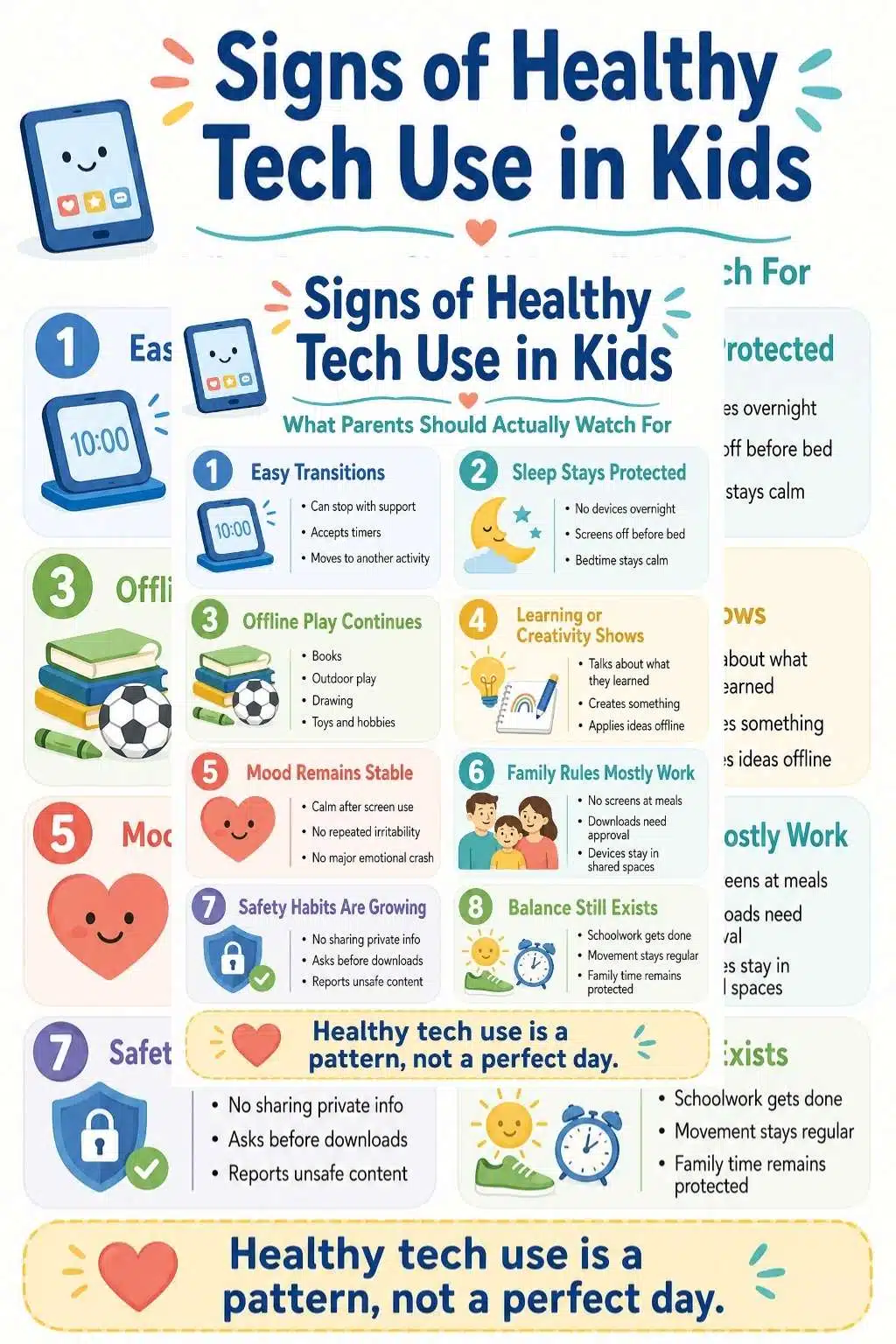
12 Signs of Healthy Tech Use in Kids
Healthy tech use in kids is less about perfection and more about whether the child’s life still feels broad, active, connected, and age-appropriate. Below are some of the signs of healthy tech use in kids.
1. The Child Can Stop Without a Major Battle
One of the strongest signs of healthy tech use is the ability to stop. That does not mean a child always smiles and happily hands over the tablet. Most children will sometimes ask for more time. That is normal. The concern begins when every ending becomes a major conflict.
Healthy signs include:
- The child accepts a timer or warning
- The child can finish a level or activity and stop
- The child may complain briefly but recovers
- The device does not control the whole mood of the room
- The child can move into another activity with support
This kind of transition shows growing self-regulation. For younger children, parents may need to help more. A five-minute warning, visual timer, natural stopping point, or clear next activity can make a big difference.
For older children, healthy transitions should become more independent. They may still need boundaries, but they should gradually understand that stopping is part of the routine.
If stopping always turns into screaming, bargaining, hiding devices, or emotional collapse, the app, game, platform, or timing may need adjustment.
Sometimes the problem is not the child’s character. It is the design of the platform. Autoplay, streaks, rewards, notifications, and endless feeds are built to make stopping harder.
2. Sleep Stays Protected
Sleep is one of the clearest health signals. A child with healthy tech habits does not let screens regularly push bedtime later, interrupt sleep, or become part of late-night secret use.
Good signs include:
- Devices stay out of bedrooms overnight
- Screens stop well before sleep
- The child can follow bedtime routines without constant device negotiation
- The child wakes reasonably rested
- Nighttime checking, gaming, or scrolling is not part of the routine
Poor sleep can affect mood, learning, memory, behavior, and attention. That means bedtime screen habits matter even when the screen content seems educational.
A child may say they are watching a learning video, practicing a language, or reading on a tablet. But if the device keeps the brain alert close to bedtime or leads to one more video, one more message, or one more game, the routine needs better boundaries.
A simple family rule often works well: Screens charge outside the bedroom. This does not solve every issue, but it removes one major source of temptation.
3. Offline Play Still Happens Naturally
Healthy screen behavior leaves room for offline life. Children still need drawing, building, outdoor play, sports, pretend play, reading, music, chores, puzzles, family conversation, boredom, and hands-on exploration. Screens should not become the only enjoyable activity.
Healthy signs include:
- The child still plays with toys, books, art materials, or sports equipment
- Outdoor play or movement remains part of the week
- The child can handle some boredom without immediately asking for a device
- Screen-free family time does not feel impossible
- Offline hobbies continue
This matters because offline play builds skills that screens cannot fully replace.
A game can show a child how to build a house. Blocks let the child feel balance, weight, failure, adjustment, and patience. A drawing app can be creative. Paper and pencils still build hand control, planning, and slower thinking. A science video can explain plants. Planting a seed teaches waiting.
Healthy tech use does not compete with offline learning. It supports it.
4. The Child Talks About What They Learned or Created
A strong sign of healthy tech use is transfer. The child not only consumes content. They can explain, repeat, use, build, draw, discuss, or apply something from the screen experience.
Good signs include:
- “I learned how volcanoes work.”
- “I practiced multiplication.”
- “I made a drawing.”
- “I built a game level.”
- “I found out why leaves change color.”
- “I learned a new word.”
- “I want to try this experiment.”
This does not mean every screen session needs to be educational. Children also relax and play. But when the screen is presented as learning, there should be some sign that learning happened.
If the child only talks about coins, skins, rewards, rankings, streaks, or unlocking characters, the platform may be training engagement more than understanding.
Parents can ask simple follow-up questions:
- What did the app ask you to do?
- What was hard?
- What did you learn?
- Can you show me without the screen?
- What should we try offline now?
These questions turn passive use into conversation.
5. Schoolwork and Responsibilities Are Not Being Avoided
Healthy tech use does not constantly push responsibilities aside. Children may use devices for homework, research, school portals, reading apps, or educational tools. That is normal. But entertainment screens, games, videos, and chats should not repeatedly delay homework, chores, meals, hygiene, or family responsibilities.
Healthy signs include:
- Homework gets done before entertainment screens
- The child can separate school screen use from leisure screen use
- Chores and routines do not require constant device negotiation
- The child does not rush responsibilities carelessly to return to screens
- Devices are not used as an excuse to avoid difficult work
A useful family rule is simple:
First responsibilities, then recreational screens.
For some children, this must be very clear. “Learning app time” should not become a loophole for endless device use. If a child says they need the tablet for school, parents should know which task, which app, and how long it should take.
Healthy tech wellness for children is not about removing fun. It is about keeping technology from becoming the escape route from every hard thing.
6. Mood After Screen Use Is Mostly Stable
Parents should watch the child after the device turns off. The after-screen mood often says more than the screen-time number.
Healthy signs include:
- The child returns to normal mood fairly quickly
- Screen use does not regularly lead to irritability
- The child does not seem overstimulated every time
- There is no repeated sadness, anxiety, or anger after specific platforms
- The child can shift to dinner, homework, play, or bedtime without emotional chaos
Some screen activities are more intense than others. Fast videos, competitive games, social comparison, multiplayer pressure, and endless feeds may affect mood differently from a calm drawing app or a short learning video.
Parents should notice which tools create problems. A child may handle a math app well but struggle after short-form videos. A teen may handle gaming with friends well but feel worse after social media scrolling. Another child may become anxious with timed learning apps.
The screen category matters less than the child’s response.
7. The Child Uses Technology Creatively, Not Only Passively
Healthy tech use often includes creation. That might mean writing, drawing, coding, recording music, editing a video, building a slideshow, making a digital story, practicing photography, designing a simple game, or researching a personal interest.
Passive screen use is not always bad. Watching a documentary or listening to an audiobook can be valuable. But if nearly all screen time is passive consumption, the routine may need more variety.
Healthy creative tech use includes:
- Making something
- Solving problems
- Practicing a skill
- Asking questions
- Researching safely
- Sharing a project with family
- Using digital tools to support offline interests
A child who uses a tablet to design a comic and then draws one on paper is building a learning loop. A child who watches endless videos about drawing but never draws may be stuck in consumption.
Healthy kids’ tech habits should leave the child feeling capable, not just entertained.
8. The Child Follows Family Tech Rules Most of the Time
A child with healthy tech habits does not need perfect obedience. Children test limits. That is part of growing up. But most of the time, they should understand the rules and follow them with reasonable support.
Family tech rules may include:
- No devices at meals
- No screens before bed
- Devices charge outside bedrooms
- Parent approval before downloading apps
- No purchases without permission
- Schoolwork first
- No chatting with strangers
- Screens only in shared spaces for younger children
- Limited entertainment screen time on school nights
Healthy signs include:
- The child knows the rules
- The child understands why the rules exist
- The child follows the rules most days
- Rule-breaking is occasional, not constant
- Parents do not need to restart the same battle every day
If rules are ignored constantly, the problem may be unclear expectations, inconsistent enforcement, unsuitable apps, peer pressure, or too much private device access.
Rules work better when they are simple, visible, and explained. “Because I said so” may stop a child once. A clear reason builds judgment.
9. The Child Understands Basic Privacy and Safety
Healthy tech use includes safety awareness. Children do not need adult-level knowledge of data privacy, but they should gradually learn basic rules.
Depending on age, healthy signs include:
- They do not share full name, address, school, or location publicly
- They know not to send photos without permission
- They ask before downloading apps
- They understand that strangers online are still strangers
- They tell a trusted adult when something feels wrong
- They know passwords are private
- They do not click every pop-up or ad
- They understand that not everything online is true
For teens, this should expand into stronger digital judgment:
- Recognizing scams
- Managing privacy settings
- Understanding social comparison
- Avoiding harmful groups or content
- Checking sources
- Knowing school rules around AI tools
- Understanding digital footprints
Privacy and safety are part of tech wellness that children need in 2026. A child who uses screens calmly but shares personal information freely still needs guidance.
10. Screens Do Not Replace Family Connection
Healthy tech use should not erase family connection.
There can be shared screen moments: watching a movie together, playing a family game, video calling relatives, or exploring a learning topic. The issue is when devices repeatedly replace conversation, meals, play, and attention.
Healthy signs include:
- Meals are mostly device-free
- The child can talk without needing a screen nearby
- Parents and children sometimes co-use media
- Family routines still include conversation
- Devices do not interrupt every shared moment
- Children still come to adults with questions, stories, or problems
Parents also need to model this. Children notice when adults check phones during conversations, scroll through meals, or sleep beside devices. A family cannot build healthy screen behavior only through rules for children. The adults’ habits shape the culture too.
This does not require perfect parenting. It requires visible boundaries.
11. The Child Can Handle Boredom Sometimes
Boredom is not a failure. It is often the space where imagination starts.
A child with healthy tech use does not need a screen for every waiting room, car ride, quiet afternoon, restaurant meal, or small gap in the day. Screens can be helpful sometimes, especially during travel or difficult family moments, but constant automatic use can weaken boredom tolerance.
Healthy signs include:
- The child can wait briefly without a device
- They can find something to do offline
- They can daydream, draw, read, talk, or observe
- They do not panic at every screen-free moment
- They understand that boredom is temporary
Parents can support this by keeping offline options available:
- Small books
- Drawing pads
- Travel games
- Puzzle cards
- Fidget toys
- Conversation games
- Music
- Simple notebooks
A child who can be bored sometimes is not deprived. They are practicing self-direction.
12. Physical Activity Still Has Space
Screens are usually sedentary. That is one reason balance matters. Healthy tech use means movement still fits into the day.
Good signs include:
- Outdoor play happens regularly
- Sports, dance, walking, biking, or active games remain part of the routine
- The child takes breaks during longer screen sessions
- Screens do not replace all after-school movement
- The child’s body is not always folded around a device
Movement supports mood, sleep, focus, coordination, and overall health. Screen use becomes more concerning when it quietly replaces physical activity week after week.
A simple rule can help:
After a long screen session, the next activity should involve movement. That could be outdoor play, stretching, walking, chores, dancing, sports, or even helping set the table. The goal is to remind the body that learning and living do not happen only through a screen.

Healthy Tech Use by Age Group
Healthy tech use looks different as children grow. A preschooler and a teenager should not have the same rules, expectations, or independence.
| Age Group | Healthy Tech Use Looks Like |
| Under 5 | Short, high-quality, shared use with adult involvement |
| 6-8 | Guided learning apps, clear time limits, easy transitions, and offline follow-up |
| 9-12 | More project use, research support, privacy lessons, and screen-free sleep routines |
| 13+ | Greater independence with accountability, digital literacy, social media guidance, and sleep protection |
The goal is gradual responsibility. Young children need more structure. Older children need more coaching. Teens need privacy and trust, but not unlimited access without guidance.
Healthy independence is earned through behavior.
Healthy Screen Behavior vs Warning Signs
Parents can use this comparison to judge the pattern more clearly.
| Healthy Screen Behavior | Warning Sign |
| Child can stop with support | Every ending becomes a major conflict |
| Sleep stays stable | Screens push bedtime later |
| Offline play continues | Offline hobbies disappear |
| Child talks about learning | Child only talks about rewards or levels |
| Family rules mostly work | Rules are ignored or hidden use increases |
| Mood is stable after use | Child becomes irritable, anxious, or withdrawn |
| Screens support schoolwork | Screens delay or replace schoolwork |
| Child uses tech creatively | Child mostly consumes endless feeds |
| Devices stay out of bedrooms | Secret late-night use appears |
| Child asks for help with unsafe content | Child hides online experiences |
One warning sign does not always mean a serious problem. A pattern of warning signs means the family routine needs attention.
How Parents Can Encourage Healthier Kids Tech Habits
Healthy tech use is easier when the family system supports it. Parents can start with small, repeatable changes.
Create Screen-Free Times and Places
Meals, bedtime, bedrooms, homework blocks, and family conversations are good starting points. The rule should protect something valuable, not simply punish screens.
Turn Off Autoplay and Notifications
Autoplay and notifications make stopping harder. Turning them off gives children a better chance to control their attention.
For younger children, shared spaces make supervision easier and reduce secretive use.
Pair Screen Learning With Offline Follow-Up
A science video can lead to a drawing. A math app can lead to a card game. A story app can lead to reading a physical book.
Review Apps Regularly
If an app causes conflict, pushes purchases, disrupts sleep, or teaches little, remove it.
Talk About the Why
Children are more likely to cooperate when rules make sense. Explain that the goal is sleep, learning, safety, creativity, and family connection.
Model Better Habits
Parents do not need to be perfect. But visible boundaries matter. Put the phone away during meals. Avoid checking messages during every conversation. Charge devices outside the bedroom when possible. Children learn from what adults repeat.
Frequently Asked Questions About Healthy Tech Use Kids
1. What Are Signs of Healthy Tech Use in Kids?
Signs of healthy tech use in kids include stable sleep, easy transitions away from screens, continued offline play, good mood after use, completed schoolwork, safe online behavior, and the ability to talk about what they learned or created.
2. What Are Good Kids Tech Habits?
Good kids tech habits include using screens for a clear purpose, following family rules, keeping devices out of bedrooms at night, balancing screens with offline play, asking before downloads or purchases, and taking breaks during longer sessions.
3. What Is Healthy Screen Behavior?
Healthy screen behavior means screen use does not regularly disrupt sleep, learning, mood, physical activity, family time, or offline interests. It also means the child can stop with reasonable support.
4. How Can Parents Support Tech Wellness Children Need?
Parents can support tech wellness children need by setting screen-free zones, choosing high-quality content, modeling healthy habits, turning off autoplay, reviewing apps, protecting sleep, and talking openly about online safety.
5. Is Educational Screen Time Always Healthy?
No. Educational screen time can still be too long, too passive, too distracting, or too hard to stop. The quality of the tool, the child’s behavior after use, and the balance with offline learning all matter.
6. When Should Parents Worry About Screen Use?
Parents should pay attention when regular screen use causes sleep problems, mood changes, secrecy, school avoidance, loss of offline interests, constant conflict, or unsafe online behavior.
Healthy Tech Use Is a Pattern, Not a Perfect Day
No family gets technology right every day. There will be long car rides, sick days, school projects, rainy weekends, tired parents, and moments when a screen helps everyone get through the afternoon. That does not mean a child has unhealthy tech habits. The real issue is the pattern.
Healthy tech use kids can sustain leaves room for sleep, movement, books, play, schoolwork, creativity, privacy, safety, and family connection. Screens have a place, but they do not own every quiet moment. Devices support learning, but they do not replace effort. Apps can entertain, but they do not become the only source of fun.
Parents do not need to fear every screen. They need to watch the child. A healthy routine is visible in ordinary life: bedtime is calm, meals have conversation, homework gets done, offline play still happens, the child can stop without a daily war, and technology feels like one part of childhood instead of the center of it.
That is the goal. Not perfect limits. Better balance, better habits, and a child who can grow up using technology without being used by it.






















