

Every single day on the calendar carries the weight of centuries. Some dates are remembered for a single, earth-shaking revolution; others quietly collect disparate moments of triumph, tragedy, discovery, and artistic birth. August 18 is one of those rare days that balances colossal civil rights victories, enigmatic historical departures, astronomical breakthroughs, and pivotal geopolitical turns across every continent.
From the quiet coastal towns of Bengal rectifying the frantic borders of the 1947 Partition to the American halls of power ratifying women’s suffrage, and from the fateful disappearance of one of India’s most fiery freedom fighters to the cosmic discovery of helium in the skies above Guntur, August 18 has left an indelible mark on human civilization.
Here is an exhaustive, journalistically curated dive into the global history, cultural milestones, famous births, and monumental departures of August 18.
August 18 at a Glance
| Category | Key Highlights on August 18 |
| Major Bangalee Milestone | Bharat Bhukti Dibas (India Inclusion Day) in 1947; reported demise of Netaji Subhas Chandra Bose (1945). |
| Global Civil Rights | The 19th Amendment is ratified in the United States (1920), securing women the constitutional right to vote. |
| Scientific Discovery | French astronomer Pierre Janssen discovers Helium during a total solar eclipse in Guntur, India (1868). |
| Military & Warfare | “The Hardest Day” air battle during the Battle of Britain (1940); Battle of Long Tan in the Vietnam War (1966). |
| Major Births | Virginia Dare (1587), Emperor Franz Joseph I (1830), Gulzar (1934), Robert Redford (1936), Selim Al Deen (1949). |
| Major Deaths | Genghis Khan (1227), Honoré de Balzac (1850), B.F. Skinner (1990), Kim Dae-jung (2009), Kofi Annan (2018). |
| Global Observances | Vietnam Veterans’ Day (Australia), Constitution Day (Indonesia), National Science Day (Thailand). |
The Bangalee Sphere: Bangladesh & India
The history of Bengal and the broader Indian subcontinent on August 18 is marked by dramatic border realignments, literary triumphs, and unresolved historical mysteries.
Historical Turning Points
Bharat Bhukti Dibas (India Inclusion Day) – 1947
When the British partitioned India on August 15, 1947, the hurried drawing of the Radcliffe Line produced profound administrative confusion. Due to initial mapping errors and map rumors, several Hindu-majority districts in West Bengal—namely Nadia, Malda, and Murshidabad—were temporarily designated as parts of East Pakistan.
For nearly three days, the green flag of Pakistan was hoisted in places like Krishnanagar, Ranaghat, and Malda town, causing widespread panic and local unrest. Following frantic appeals from local leaders and an immediate review of the border commission’s final award, the Radcliffe modification was officially announced on the night of August 17. On the morning of August 18, 1947, the Pakistani flag was brought down and the Indian Tricolor was hoisted across these border districts. To this day, community organizations throughout Nadia and Malda celebrate August 18 as Bharat Bhukti Dibas (India Inclusion Day).
The Enduring Enigma of Netaji Subhas Chandra Bose – 1945
According to official Japanese government announcements and multiple subsequent inquiries, August 18, 1945, marks the day Indian revolutionary leader Netaji Subhas Chandra Bose suffered third-degree burns after his overloaded Mitsubishi Ki-21 bomber crashed shortly after takeoff from Matsuyama Airfield in Taihoku (now Taipei, Taiwan). Netaji reportedly succumbed to his injuries in a nearby Japanese military hospital later that night.
However, the circumstances surrounding his departure remain one of the most contested historical mysteries in modern South Asia. While the official stance of the Japanese and Indian governments (supported by the Shah Nawaz Committee and the Khosla Commission) affirms his death in Taipei, alternative theories—investigated extensively by the Mukherjee Commission in 2005—suggest that Netaji orchestrated an escape to the Soviet Union to continue his anti-imperialist campaign. Regardless of the competing theories, August 18 remains a day of deep solemnity and reflection for millions across the Bangalee sphere.
Prominent Births in the Region
Selim Al Deen (1949–2008):
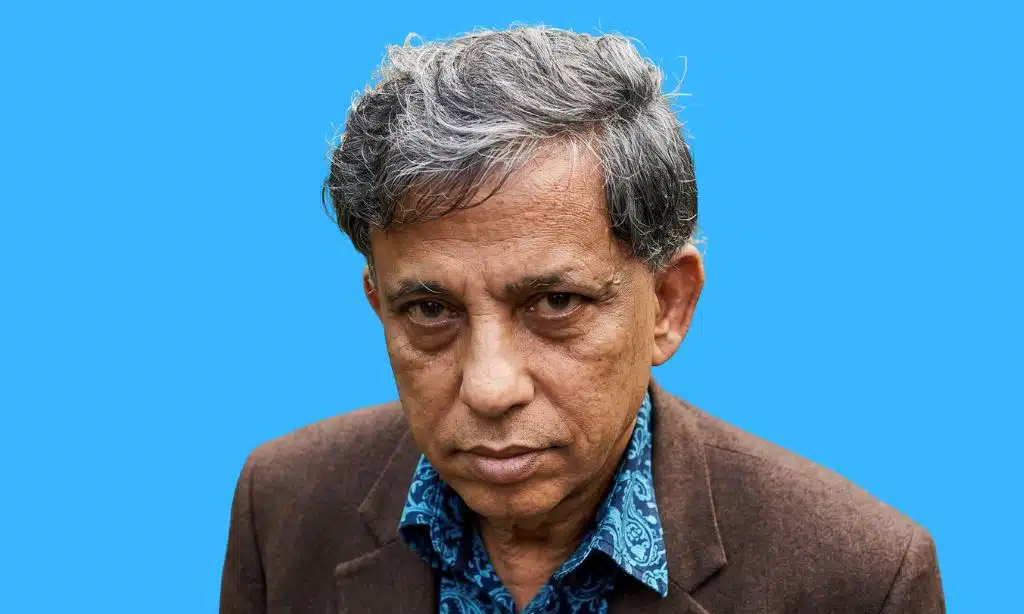
Born in the village of Senurkhil in Feni, Bangladesh, Selim Al Deen is profoundly revered as the “Natyacharya,” or the great master of drama. He boldly broke away from traditional, Euro-centric theatrical conventions to pioneer a uniquely modern, homegrown style deeply rooted in Bengali oral narratives, rural folklore, and ethnic myths. After studying Bengali Literature at Dhaka University, he channeled his passion into academia, co-founding the Drama and Dramatics Department at Jahangirnagar University, where he also earned his PhD exploring medieval Bengali theater. A true visionary of the stage, he was a driving force behind the renowned ‘Dhaka Theatre’ and introduced the groundbreaking ‘Dwaitadwaitabadi’ (dualistic and non-dualistic) theory of art.
Beyond his iconic plays like Kittonkhola, Chaka, and Hargoj, he gifted the literary world with timeless masterpieces such as Keramat Mangal, Hat Hadai, Joiboti Kanyar Mon, Bonpangshul, and Nimojjon. In recognition of his monumental contributions to the arts, he was honored with the Bangla Academy Literary Award in 1984 and the Ekushey Padak—Bangladesh’s second-highest civilian award—in 2007.
Gulzar (Sampooran Singh Kalra) (Born 1934):
Born in Dina, Jhelum District (now in Pakistan) before moving to India post-Partition, Gulzar grew into one of the most sublime poets, lyricists, screenwriters, and directors in cinema history. Winner of an Academy Award, a Grammy, multiple National Film Awards, and the Dadasaheb Phalke Award, his evocative poetry redefined modern Urdu and Hindi expression.
Vijaya Lakshmi Pandit (1900–1990):
Born into the illustrious Nehru family in Allahabad, Pandit was a fierce freedom fighter who endured multiple British imprisonments. In 1953, she shattered diplomatic barriers by becoming the first female President of the United Nations General Assembly, setting an early precedent for South Asian women in international statecraft.
Peshwa Baji Rao I (1700–1740):
Born on August 18, 1700, the celebrated general and Peshwa of the Maratha Empire is credited with expanding Maratha supremacy across Central and Northern India through revolutionary cavalry warfare and rapid operational maneuvering.
Notable Subcontinental Deaths
-
Shawkat Ali (1918–1975): Passing away on August 18, 1975, Shawkat Ali was a pioneering politician, an early organizer of the Awami Muslim League, and an indispensable leader of the historic 1952 Bengali Language Movement (Rashtrabhasha Sangram Parishad).
Global History
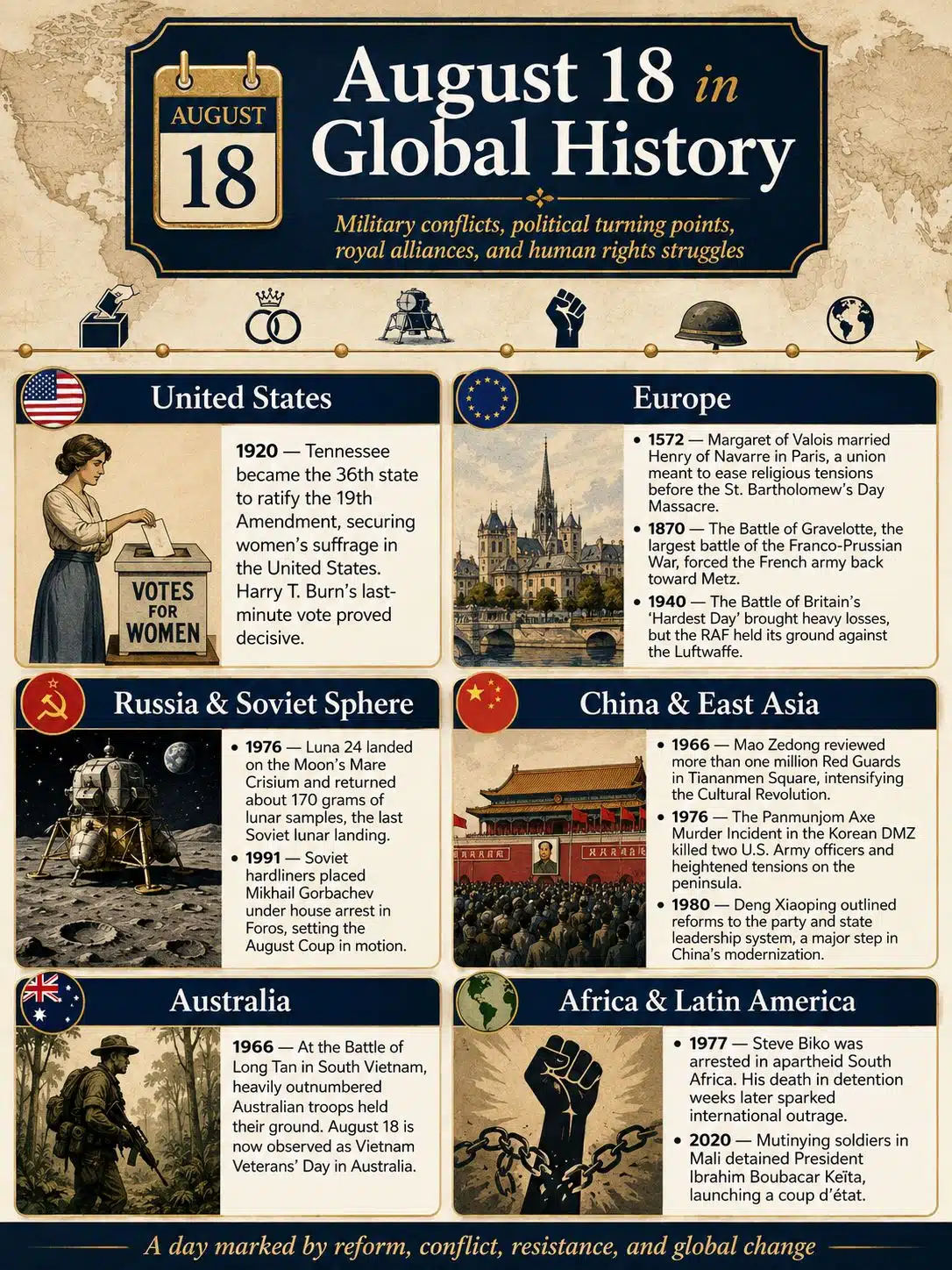
August 18 features a rich chronicle of military conflicts, royal marriages, constitutional shifts, and human rights struggles across the globe.
United States: The Triumph of the 19th Amendment
On August 18, 1920, the landscape of American democracy changed forever. Tennessee became the 36th state to ratify the 19th Amendment to the U.S. Constitution, thereby securing the requisite three-fourths state majority to grant women the legal right to vote.
The vote hung on a knife-edge in the Tennessee state legislature. A 24-year-old representative named Harry T. Burn had originally planned to vote with the “anti-suffrage” camp, sporting a red rose on his lapel. However, Burn carried a handwritten letter in his pocket from his mother, Febb Ensminger Burn, which read: “Hurrah, and vote for suffrage! Don’t keep them in doubt… Be a good boy and help Mrs. Catt put the ‘rat’ in ratification.” Burn switched his vote to “Aye,” instantly breaking a 48–48 tie and enfranchising approximately 27 million American women.
United Kingdom & Europe
-
The “Hardest Day” in the Battle of Britain (1940): During the zenith of World War II, the German Luftwaffe launched a massive, concentrated air offensive targeting British airfields and radar stations. Known to history as “The Hardest Day,” this engagement resulted in the highest number of combined aircraft losses of any single day in the air campaign. Despite heavy casualties on both sides, the Royal Air Force (RAF) successfully defended its sector stations, delivering a fatal strategic blow to Operation Sea Lion—Adolf Hitler’s proposed amphibious invasion of Britain.
-
The Royal Marriage that Preceded a Massacre (1572): In Paris, the Huguenot (Protestant) King Henry III of Navarre married the Catholic princess Margaret of Valois. The union was publicly framed as an olive branch to reconcile France’s warring religious factions. Instead, the gathering of thousands of prominent Protestant nobles in Catholic-dominated Paris created the powder keg that exploded six days later in the horrific St. Bartholomew’s Day Massacre.
-
Battle of Gravelotte (1870): The largest battle of the Franco-Prussian War occurred on August 18. Prussian forces under General Helmuth von Moltke secured a pyrrhic but decisive victory over French forces under Marshal François Achille Bazaine, forcing the French army into the fortress of Metz and paving the way for the unification of the German Empire.
Russia & The Soviet Sphere
-
Luna 24 Touches Down on the Moon (1976): In the twilight chapter of the Cold War Space Race, the Soviet robotic probe Luna 24 landed in the Mare Crisium basin of the Moon. The lander successfully drilled into the lunar regolith, extracted 170.6 grams of core samples, and returned them safely to Earth. This mission served as the final lunar landing conducted by the Soviet Union.
-
The Seeds of the 1991 Soviet Coup: On the evening of August 18, 1991, hardline members of the Soviet government, KGB, and military (the “State Committee on the State of Emergency”) arrived at Soviet President Mikhail Gorbachev’s presidential dacha in Foros, Crimea. They placed him under house arrest, demanding his resignation and initiating the abortive August Coup that accelerated the formal dissolution of the USSR just four months later.
China & East Asia
-
Deng Xiaoping’s Modernization Doctrine (1980): Deng Xiaoping delivered a watershed speech to an enlarged meeting of the CCP Political Bureau titled “On the Reform of the Party and State Leadership System.” This address systematically diagnosed the dangers of over-concentrated power, bureaucratic inertia, and patriarchal governance, laying down the ideological and administrative architecture that propelled China’s modern economic rise.
-
Mao Zedong Greets the Red Guards (1966): In Tiananmen Square, Mao Zedong donned a military uniform to review over one million radicalized youth, officially sanctioning the Red Guard movement and unleashing the most turbulent phase of the Cultural Revolution.
-
The Panmunjom Axe Murder Incident (1976): In the Korean Demilitarized Zone (DMZ), two U.S. Army officers were killed by North Korean soldiers during a dispute over pruning a poplar tree that obstructed UN observation lines. The incident brought the Korean Peninsula to the brink of open war before both sides de-escalated.
Australia & Canada
-
Battle of Long Tan (1966, Australia): In a rubber plantation near Long Tan in South Vietnam, D Company of the 6th Battalion, Royal Australian Regiment (108 men), found themselves surrounded by an estimated 1,500 to 2,500 Viet Cong and North Vietnamese troops. Supported by intensive artillery fire from the nearby Nui Dat base, the Australian forces held their ground against overwhelming odds. Today, August 18 is commemorated across Australia as Long Tan Day and Vietnam Veterans’ Day.
-
Canadian Labor & Political Milestones: August 18 has seen key jurisdictional and treaty adjustments across Canada, particularly relating to early trade unions and indigenous land consultations in Ontario and Quebec during the 19th and early 20th centuries.
Rest of World: Africa & Latin America
-
Arrest of Steve Biko (1977, South Africa): Bantu Stephen Biko, the leader of the Black Consciousness Movement in apartheid South Africa, was stopped and arrested at a police roadblock near Grahamstown. He was transferred to Port Elizabeth security police headquarters, where he was subjected to brutal torture. His subsequent death in detention on September 12 ignited global outrage and intensified international sanctions against the apartheid regime.
-
2020 Malian Coup d’État: Mutinying soldiers within the Malian Armed Forces seized control of the military base in Kati, entered the capital city of Bamako, and detained President Ibrahim Boubacar Keïta and Prime Minister Boubou Cissé, forcing their resignations and establishing a transitional military council.
Science, Astronomy & Literature: The Discovery of Helium
August 18 holds a singular place in the annals of astrophysics and chemical history.
The Helium Breakthrough of 1868
On August 18, 1868, French astronomer Pierre Janssen was stationed in Guntur, Madras Presidency (modern-day Andhra Pradesh, India), to observe a total solar eclipse. Utilizing a newly devised spectroscope, Janssen analyzed the solar prominences exposed by the moon’s shadow.
He detected a brilliant yellow emission line with a wavelength of 587.49 nanometers. While initially assumed to be sodium, subsequent analysis by English astronomer Norman Lockyer proved that this line belonged to an entirely new element unknown to terrestrial chemistry. Lockyer named the element Helium (after Helios, the Greek god of the Sun). Helium became the very first chemical element discovered in the cosmos before being physically identified on Earth (which occurred in 1895).
Literary Milestones: The American Debut of Lolita (1958)
On August 18, 1958, G.P. Putnam’s Sons published the first American edition of Vladimir Nabokov’s controversial masterpiece, Lolita. Previously printed in Paris by the avant-garde Olympia Press and banned across multiple countries, the novel became an overnight literary sensation in the United States, selling out its initial run in days and igniting historic debates on artistic liberty, obscenity laws, and literary aesthetics.
Notable Birthdays on August 18
August 18 has produced an eclectic roster of monarchs, explorers, screen icons, scientists, and visionaries.
-
Virginia Dare (Born August 18, 1587): Born on Roanoke Island (modern-day North Carolina), Dare was the first child born to English parents in the Americas. Her grandfather, Governor John White, returned to England for supplies shortly after her birth. When he finally returned in 1590, the entire settlement had vanished, leaving behind only the cryptic carving “CROATOAN” and cementing Dare’s name as an enduring piece of early American lore.
-
Meriwether Lewis (1774–1809): Selected by President Thomas Jefferson to co-lead the Corps of Discovery alongside William Clark, Lewis mapped the uncharted lands of the Louisiana Purchase, traversed the Continental Divide, and reached the Pacific Ocean, laying the geographic foundation of North American expansion.
-
Emperor Franz Joseph I of Austria (1830–1916): Reigning for 68 years, Franz Joseph presided over the transformation of the Austrian Empire into the Dual Monarchy of Austria-Hungary. His ultimatum to Serbia following the assassination of his nephew, Archduke Franz Ferdinand, in 1914 set into motion the catastrophe of World War I.
-
Robert Redford (Born August 18, 1936): An iconic figure of American cinema (Butch Cassidy and the Sundance Kid, All the President’s Men), Redford won an Academy Award for directing Ordinary People. Beyond his screen presence, Redford founded the Sundance Institute and Film Festival, transforming independent cinema across the globe.
-
Just Fontaine (1933–2023): The French prolific striker holds one of the most unbreakable records in sports history: scoring 13 goals in a single FIFA World Cup tournament (Sweden, 1958).
Notable Deaths on August 18
From empire builders whose conquests redrew world maps to international statesmen who championed global peace, August 18 marks the departure of several giants of history.
-
Genghis Khan (c. 1162 – August 18, 1227): Founder and Great Khan of the Mongol Empire, Genghis Khan united nomadic tribes to establish the largest contiguous land empire in human history. His military campaigns reshaped Eurasian demographics, trade routes (the Silk Road), and governance. His final resting place remains one of the world’s most closely guarded archaeological secrets, as his escort allegedly executed anyone who witnessed his funeral procession.
-
Honoré de Balzac (1799 – August 18, 1850): A titan of French 19th-century literature and a founding master of European realism. His monumental multi-volume magnum opus, La Comédie humaine (The Human Comedy), offered an unsparing, panorama of post-Napoleonic French society.
-
B.F. Skinner (1904 – August 18, 1990): One of the most cited psychologists of the 20th century. Skinner developed the philosophy of Radical Behaviorism, invented the operant conditioning chamber (the “Skinner Box”), and pioneered research into schedules of reinforcement, fundamentally altering educational models and cognitive behavioral therapies.
-
Kim Dae-jung (1924 – August 18, 2009): The 15th President of South Korea and 2000 Nobel Peace Prize laureate. Known as the “Nelson Mandela of Asia,” Kim survived assassination attempts, death sentences, and exile under military dictatorships before winning the presidency and pioneering the landmark “Sunshine Policy” of reconciliation with North Korea.
-
Kofi Annan (1938 – August 18, 2018): Hailing from Ghana, Annan served as the 7th Secretary-General of the United Nations (1997–2006). Awarded the Nobel Peace Prize in 2001 alongside the UN, Annan revitalized UN operations, launched the Global Compact, led the response to the HIV/AIDS epidemic, and established the Millennium Development Goals.
International Observances & Cultural Days
Beyond political milestones, August 18 is observed across various cultures and nations through both solemn remembrance and celebratory holidays:
-
Long Tan Day / Vietnam Veterans’ Day (Australia): Officially commemorated on August 18, this national day honors the sacrifice of all Australian personnel who served in the Vietnam War, marking the anniversary of the 1966 Battle of Long Tan.
-
Constitution Day (Indonesia): Celebrated one day after Indonesian Proclamation Day (Independence Day), August 18 honors the formal ratification of the 1945 Constitution of Indonesia (Undang-Undang Dasar 1945) by the Preparatory Committee for Indonesian Independence.
-
National Science Day (Thailand): This day commemorates King Mongkut (Rama IV), the “Father of Thai Science,” who calculated and witnessed the total solar eclipse of August 18, 1868, at Waghor village in Prachuap Khiri Khan province.
-
Bad Poetry Day: A widely enjoyed lighthearted cultural observance encouraging writers to pen intentionally terrible verses for humorous relief.
Fascinating “Did You Know?” Trivia
1. The Red Rose vs. The Yellow Rose
During the heated suffrage battles in Tennessee in August 1920, supporters of women’s voting rights wore yellow roses, while anti-suffragists wore red roses. Observers could tally the expected vote by counting the boutonnieres in the room. When Representative Harry Burn entered wearing a red rose but voted “Aye” after reading his mother’s letter, observers were so stunned that a chaotic shouting match broke out in the chamber, forcing Burn to escape through an attic window to avoid angry anti-suffrage lobbyists.
2. An Element Found 93 Million Miles Away Before Earth
When Pierre Janssen detected the spectral signature of Helium during the August 18, 1868 eclipse in Guntur, India, the scientific establishment initially ridiculed the idea that an element could exist on the Sun that had never been discovered in Earth’s crust. It took 27 years before Scottish chemist William Ramsay finally isolated helium on Earth in 1895 while treating the uranium-bearing mineral cleveite.
3. The 1999 “Grand Cross” Doomsday Panic
On August 18, 1999, astrologers and tabloid doomsday theorists warned that a rare planetary alignment forming a “Grand Cross” in the sky—accompanied by a solar eclipse days earlier—would trigger catastrophic tectonic shifts, nuclear meltdowns, and the end of modern civilization. The day passed without a single major global anomaly, becoming another classic entry in the catalog of failed apocalyptic forecasts.
Final Thoughts
Examining a single date across human history offers a profound perspective on how connected our global journey truly is. On August 18, we witness the spectrum of human endeavor: the courage of women demanding an equal voice at the ballot box, the intellectual curiosity that allowed astronomers in colonial India to discover the building blocks of the universe, the complex and unresolved sacrifices of national liberation movements, and the timeless contributions of poets, artists, and peacebuilders.
Whether it is the local celebration of Bharat Bhukti Dibas in the border towns of West Bengal, the solemn legacy of the Battle of Long Tan in Canberra, or the enduring diplomacy of Kofi Annan, August 18 reminds us that history is not merely a collection of past years—it is the living, breathing foundation upon which our contemporary world is constructed.





















