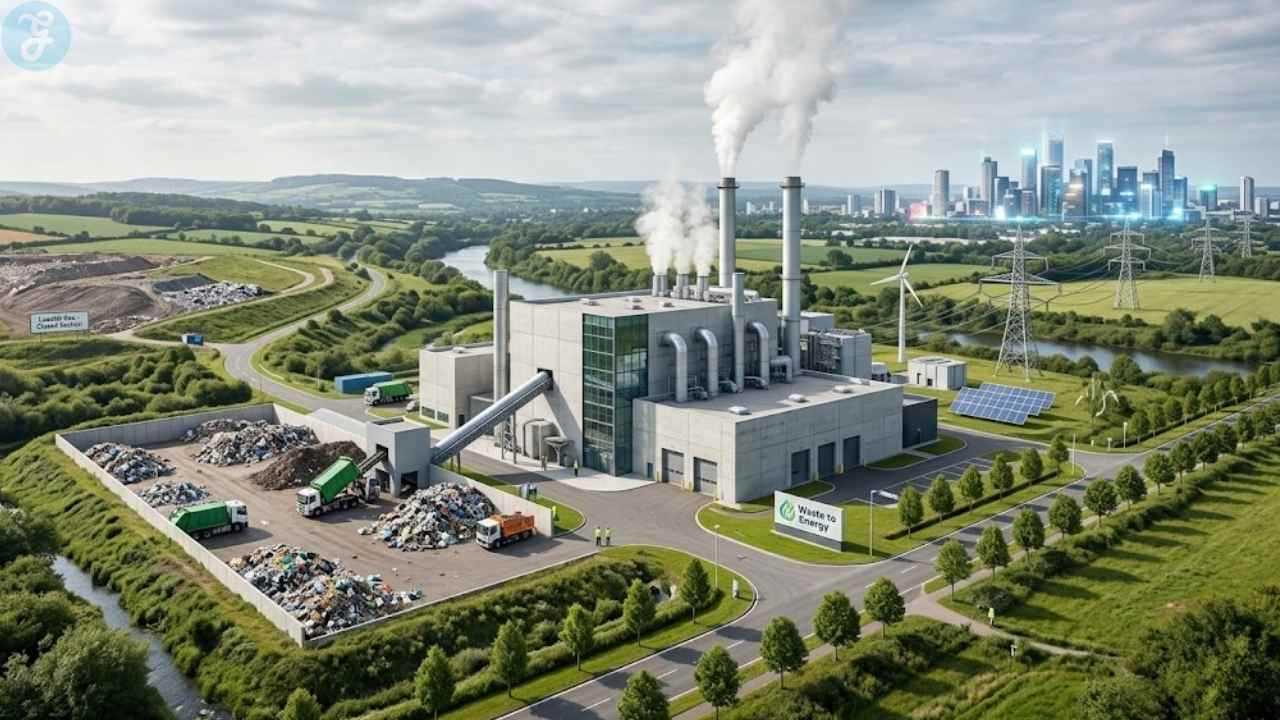
Communities constantly pay to bury mounting trash piles, only to pay again for costly electricity. Waste-to-Energy Technology offers a practical solution to this double expense by transforming municipal solid waste into usable power, heat, or biogas, easing local landfill pressure.
In the United States, modern facilities utilize advanced methods like incineration, anaerobic digestion, gasification, and pyrolysis to recover valuable resources from everyday refuse. While the environmental benefits of diverting millions of tons of trash are clear, implementing these complex systems requires careful analysis of high upfront capital costs, strict emission controls, and actual energy yields.
Understanding the specific operational numbers and immediate structural tradeoffs is absolutely essential for evaluating long-term performance. By examining how these distinct processes operate on a commercial scale, local governments and corporate businesses can make highly informed decisions about whether adopting these localized power solutions makes financial and environmental sense for their unique community needs.
What Is Waste-to-Energy (WTE) Technology?
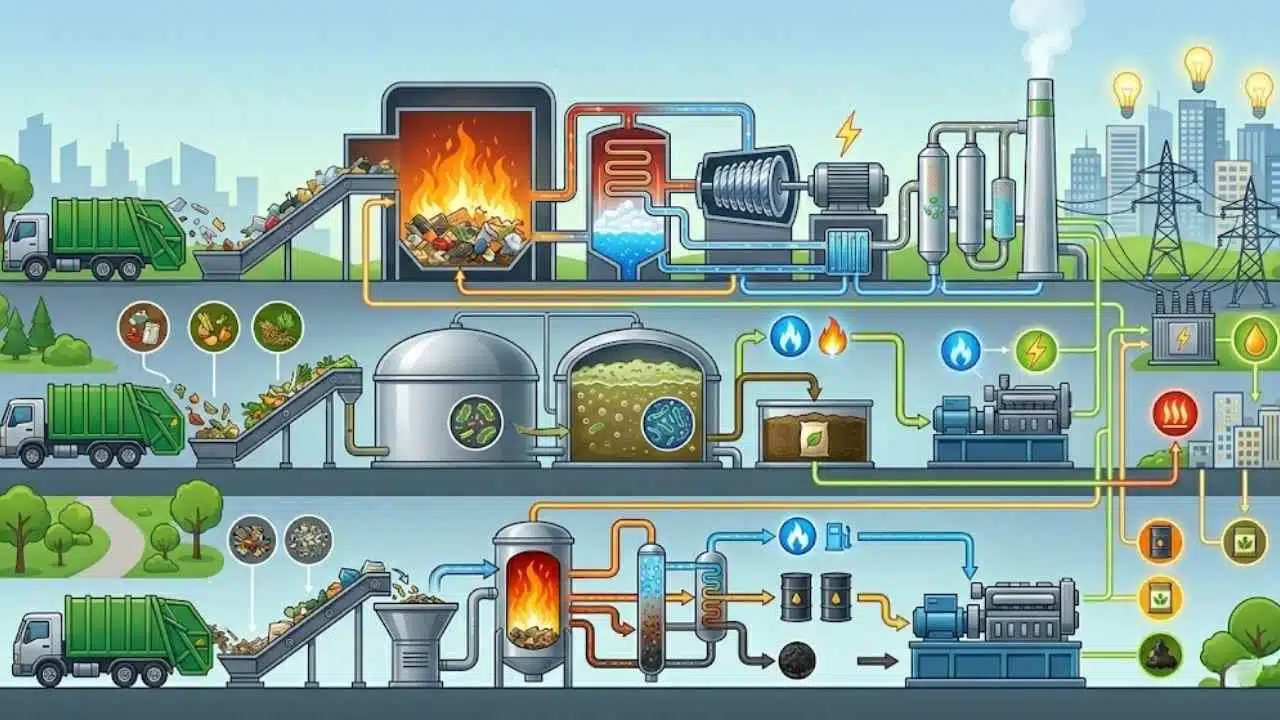
Waste becomes power when heat makes steam, steam turns a turbine, and captured gas fuels an engine.
Waste-to-energy is a branch of waste management that turns non-recyclable waste materials into usable heat, electricity, or fuel. The United States Environmental Protection Agency places energy recovery below source reduction and recycling, but above disposal, which is a helpful way to frame it: WTE works best after you remove what can still be reused or recycled.
In the U.S., the EPA currently lists 75 facilities that recover energy from the combustion of municipal solid waste. A typical plant produces about 550 kilowatt-hours of electricity per ton of waste, so cities are not just reducing trash volume, they are also creating a steady stream of energy recovery.
- Incineration: Burns mixed municipal solid waste (MSW) to make steam for electricity generation.
- Anaerobic digestion: Uses microbes to break down food waste, wastewater solids, and other organics into biogas.
- Gasification and pyrolysis: Heat sorted waste with little or no oxygen to make syngas, oils, char, or other fuel products.
The basic idea is simple. Instead of sending every leftover ton of trash to landfills, communities can recover energy and materials from the part of the stream that still has value.
The Two Problems Waste-to-Energy Technology Addresses
Waste-to-energy gets attention because it tackles two expensive headaches at once. It reduces the amount of trash that needs landfill space, and it turns part of that same waste stream into useful power.
Overflow of Municipal Landfills
As of the latest EPA methane inventory, landfills are the third-largest source of methane emissions in the United States. EPA estimates U.S. landfills released 119.8 million metric tons of carbon dioxide equivalent of methane in 2022, which represented 17.1% of total human-caused methane emissions.
That is why landfill diversion matters so much. The U.S. Energy Information Administration says waste-to-energy plants can shrink 2,000 pounds of garbage to about 300 to 600 pounds of ash and reduce waste volume by about 87%.
A large Florida example makes that concrete. Palm Beach County’s Renewable Energy Facility 2 processes 3,000 tons of post-recycled municipal solid waste a day, cuts waste volume by more than 90%, and was designed to extend the life of the local landfill to 2053.
Demand for Sustainable Energy Sources
Waste also helps with the energy side of the equation. EIA has reported that U.S. waste-to-energy plants generated about 14,000 gigawatt-hours of electricity a year over the last decade, which is small on a national scale but valuable as steady baseload power.
Local facilities show how that looks in practice. Pinellas County burns an average of 2,700 tons of trash a day and produces up to 75 megawatts of electricity, while Hennepin County’s HERC processes about 365,000 tons of waste a year and sends steam to heat Target Field and downtown Minneapolis.
One feedstock, two outcomes: less pressure on landfills and more dependable local energy production.
Key Benefits of Waste-to-Energy Technology
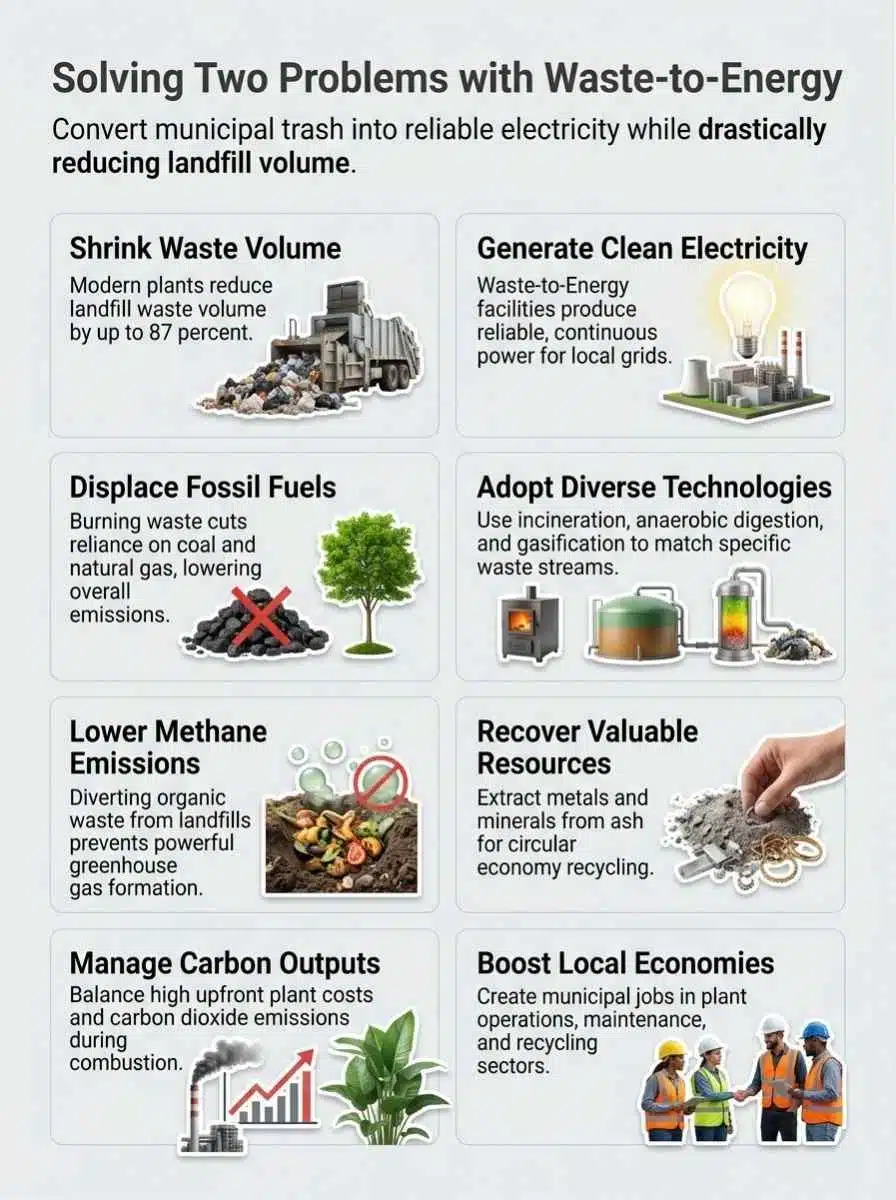
The strongest case for waste-to-energy is practical, not theoretical. It helps cities buy time on landfill capacity, recover metals and energy, and reduce some dependence on fossil fuels in the part of the waste stream that cannot be recycled cleanly.
Volume Reduction and Landfill Diversion
Volume reduction is the fastest benefit to see. When trash is combusted or the organic fraction is diverted into anaerobic digestion, far less material ends up sitting in a landfill for decades.
That can also improve resource recovery. Pinellas County reports recovering about 60 million pounds of metal from combustion residue each year, which shows why metal capture should be built into plant design from the start.
Less trash to bury, more material recovered, and more breathing room before the next landfill expansion fight.
Renewable Energy Generation
The energy side varies by technology. Combustion plants make steam for turbines, anaerobic digestion makes biogas for engines or boilers, and combined heat and power systems squeeze more useful output from the same ton of waste.
| U.S. example | What it handles | Energy output | Why it matters |
|---|---|---|---|
| Palm Beach REF 2 | 3,000 tons of post-recycled MSW per day | Enough electricity for about 40,000 homes | Shows how a large county can pair landfill diversion with local power sales |
| Pinellas County WTE | About 2,700 tons per day | Up to 75 MW and about 440,000 MWh a year | Generates revenue while still recovering large volumes of metal |
| Hennepin County HERC | About 365,000 tons per year | Electricity plus district steam heat | Good example of energy production that supports both the grid and nearby buildings |
Fossil Fuel Displacement
Waste-to-energy does not erase carbon dioxide emissions, but it can displace some fossil fuels and avoid methane from buried waste. Hennepin County says one ton of trash processed at HERC creates enough electricity to run a house for 21 days, while that same ton buried in a landfill would create enough electricity for about 3 days through landfill gas.
That gap matters if your community wants dependable local renewable energy and stronger grid resilience. It is one reason many planners see WTE as a complement to recycling and composting, not a substitute for them.
Common Waste-to-Energy Technologies
These technologies all sit under the waste-to-energy umbrella, but they are not interchangeable. The right fit depends on what is in the waste stream, how much sorting is possible, and whether the goal is electricity, heat, biogas, or higher-value fuels.
| Technology | Best feedstock | U.S. commercial maturity | Main watch-out |
|---|---|---|---|
| Incineration | Mixed non-recyclable MSW | Mature, with 75 combustion facilities listed by EPA | High capital cost and ash handling |
| Anaerobic digestion | Food waste, wastewater solids, manure, fats, oils, and grease | Widely used, with more than 1,200 U.S. water resource recovery facilities operating digesters | Needs clean organic feedstock and gas cleanup |
| Gasification and pyrolysis | Sorted, more consistent feedstock | Far less commercial for mixed MSW in the U.S. | More preprocessing and tighter feedstock control |
Incineration
Incineration is still the main waste-to-energy route for municipal solid waste in the United States. Mass-burn plants can accept mixed trash, use the heat to make steam, and send that steam through turbines for electricity generation.
Modern air controls are what separate current facilities from the dirty incinerator image many people still have in mind. The EPA notes that baghouse systems can remove more than 99% of particulate matter, and plants such as Lee County’s facility also rely on scrubbers and activated carbon injection to control mercury and acid gases.
Anaerobic Digestion
Anaerobic digestion works best when the feedstock is mostly organic, think food scraps, wastewater solids, fats, oils, and grease. Microbes break that material down without oxygen and produce biogas, which can then be used for heat, electricity, combined heat and power, or upgraded fuel.
This route has more U.S. scale than many readers expect. EPA says more than 1,200 water resource recovery facilities have anaerobic digesters, and its 2023 survey work identified 310 U.S. facilities processing food waste, though EPA also says that count is still likely low.
Gasification and Pyrolysis
Gasification and pyrolysis sound similar, but the operating logic is different. Gasification uses limited oxygen or steam to make syngas, while pyrolysis heats material without oxygen to make oils, char, and off-gases.
NREL’s 2023 comparison is a useful reality check for decision-makers. Combustion is the mature commercial option for mixed municipal solid waste, while gasification and pyrolysis still have far fewer U.S. commercial projects and usually need more sorting, drying, or sizing before they run well.
Environmental Impact of Waste-to-Energy
The environmental story is mixed, which is exactly why this topic needs a balanced look. Waste-to-energy can reduce landfill methane and improve resource recovery, but incineration still creates carbon dioxide and every system has to manage emissions and residues carefully.
Reduction of Greenhouse Gas Emissions
The climate case is strongest when waste-to-energy keeps organics from decomposing in landfills and when the recovered power offsets fossil fuel generation. That is especially true in dense areas where hauling trash longer distances would add more truck traffic and more emissions.
The limit is just as important to understand. Combustion still creates carbon dioxide, especially from plastics, so the cleaner path is to remove reusable and recyclable materials first, send suitable organics to anaerobic digestion where possible, and burn only the leftover non-recyclable fraction with strict controls.
Good policy starts with reduction and recycling first, then uses energy recovery for what is left.
Resource Recovery and Circular Economy Support
Waste-to-energy supports a circular economy best when it is paired with front-end sorting and back-end recovery. Metals removed before or after combustion stay in productive use, and digestate from anaerobic digestion can return nutrients to beneficial uses when it meets the right standards.
Real facilities show that resource recovery is more than a talking point. Pinellas County reports recovering about 60 million pounds of metal a year, and HERC recovers more than 11,000 tons of scrap metal annually.
- Before processing: Pull out batteries, hazardous waste, and clean recyclables.
- During processing: Capture energy through steam systems, engines, or combined heat and power.
- After processing: Recover metals and manage ash or digestate under the right rules.
Challenges and Considerations
Waste-to-energy is useful, but it is not simple. The biggest issues are carbon dioxide emissions, upfront cost, ash handling, public trust, and the risk of building a system that competes with recycling instead of supporting it.
CO2 Emissions from Incineration
This is the core criticism of incineration. Burning municipal solid waste releases carbon dioxide, and the plastic share of the stream makes part of that carbon closer to fossil carbon than renewable biomass.
Project economics are a second hurdle. The EPA says a new waste-to-energy plant typically needs at least $100 million to build, and larger facilities can cost two to three times that before you add long-term operating costs, emissions systems, and residue management.
Ash handling stays on the budget line for the life of the facility. EPA says combustion residue usually equals 15% to 25% of the processed waste by weight, with fly ash making up about 10% to 20% of the total ash, so disposal and testing plans need to be settled early.
Risks of Reducing Recycling Efforts
A plant that needs feedstock can create the wrong incentive if a city treats it as the centerpiece of solid waste management. EPA is clear that burning for energy recovery is not the same thing as recycling or waste minimization.
That is why the smartest projects protect recycling first. Paper, cardboard, metals, and source-separated organics usually create more value when they are recycled, composted, or digested than when they are burned in a mass-burn system.
- Ask about the waste hierarchy: Does the plan keep reduction, reuse, and recycling ahead of combustion?
- Ask about feedstock control: Will hazardous items and valuable recyclables be removed before processing?
- Ask about residues: Where will bottom ash and fly ash go, and how will they be tested?
- Ask about community impacts: What are the traffic, odor, noise, and air-monitoring plans?
Those questions may sound basic, but they often decide whether a project earns public trust or loses it.
Advancements in Waste-to-Energy Technology
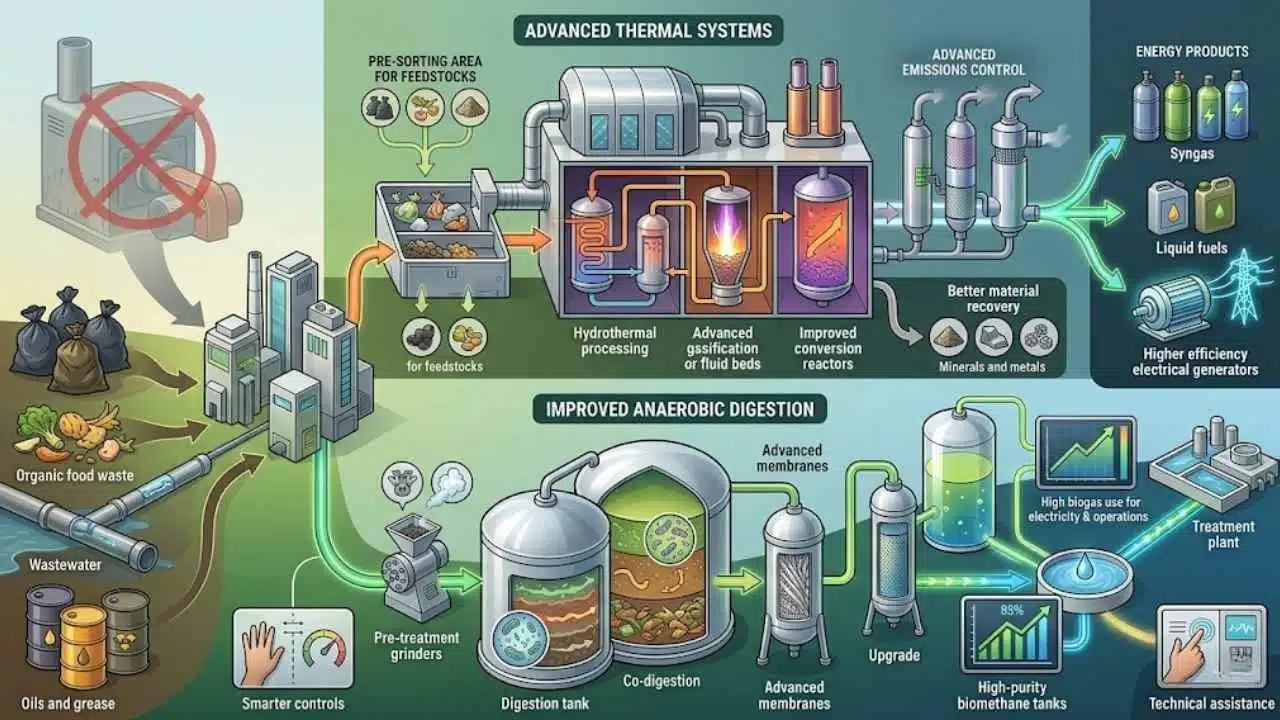
The next wave of waste-to-energy is less about putting a giant burner in every county and more about getting smarter with hard-to-handle waste streams. That means better gas cleanup, better controls, better material recovery, and better ways to handle wet organic waste.
Advanced Thermal Systems
The Department of Energy now treats waste as a broader energy resource, not just household trash. DOE says the U.S. has about 77 million dry tons of wet waste potential each year, enough to generate roughly 1.079 quadrillion Btu of energy, which is why research continues on hydrothermal processing, advanced gasification, and improved thermal conversion.
For communities, the practical takeaway is straightforward. Advanced thermal systems may offer better performance on certain sorted streams, but they still demand consistent feedstock and disciplined operations, which is why combustion remains the more bankable option for mixed MSW today.
Improved Efficiency in Anaerobic Digestion
Anaerobic digestion is advancing in quieter but important ways. Better pretreatment, co-digestion, membrane systems, and biogas upgrading help facilities pull more usable energy from food waste, wastewater solids, fats, oils, and grease.
EPA points out that more than half of U.S. water resource recovery facilities with digesters already use their biogas as an energy resource, and about one third of those facilities generate electricity for operations on-site. That makes anaerobic digestion one of the most practical near-term upgrades for places with a heavy organic waste stream.
There is also real help available. In the latest DOE update, the 2026 Waste to Energy and Materials Technical Assistance Program is offering no-cost support to state, local, and Tribal governments, with applications open through May 31, 2026.
Final Thoughts
If you strip away the jargon, waste-to-energy (WTE) solves two problems at once: it reduces the amount of municipal solid waste headed to landfills, and it turns part of that same stream into useful energy.
Used well, it is a tool, not a shortcut.
The best projects keep recycling and composting first, then use incineration, anaerobic digestion, or other energy recovery methods for what remains. If your community is weighing landfill pressure, greenhouse gas emissions, and rising power needs, waste-to-energy deserves a serious look with real numbers, clear safeguards, and a long-term plan for resource recovery.
FAQs
1. What is generative AI for marketing?
Generative AI for marketing is AI that makes marketing materials and ai generated content. It uses large language models to create content and help teams with marketing generative ai tools.
2. How can businesses use generative AI?
Businesses use generative ai to do keyword research, predict consumer behavior, analyze customer data, and automate content creation. It can handle customer inquiries, run marketing automation, and personalize customer interactions.
3. Can generative AI help with market research and SEO?
Yes. It can help market research by using up to date information and help businesses identify SEO friendly keywords. It can also create other marketing materials and analyze data for trends.
4. Can generative AI make images or videos?
Yes. Software developers can use generative ai to make highly realistic images and product demo videos. It can also create text and ai generated content to create content beyond plain words.
5. Do I need human oversight when implementing generative AI?
Yes. Implementing generative ai needs human oversight, because generative ai promises speed but can make mistakes. Humans check quality, fit for the intended audience, and how the tools analyze data.