Building a cybersecurity career without a degree requires replacing traditional academic credentials with tangible proof of your technical capabilities. While degree programs exist, top security hiring managers prioritize practical skills, foundational networking knowledge, hands-on lab experience, and industry-recognized certifications like CompTIA Security+ or BTL1.
Transitioning into the field—whether starting from an IT helpdesk, systems administration, or a self-taught background—depends on demonstrating competence in threat analysis, systems architecture, and security protocols. By systematically acquiring core IT fundamentals, completing practical labs (such as TryHackMe or home lab setups), and building a public portfolio of write-ups, you can bypass the traditional four-year degree requirement and land an entry-level security role.
A Cybersecurity Career Without a Degree Still Needs a Target Role
Cybersecurity covers far more than ethical hacking. NIST’s NICE Framework organizes the field around work roles, knowledge, tasks, and skills. The European Cybersecurity Skills Framework similarly defines 12 professional role profiles rather than presenting security as a single occupation.
For a beginner, that means choosing a direction before choosing a certificate.
Reasonable early targets include:
- security operations and monitoring;
- identity and access management;
- vulnerability management;
- governance, risk, and compliance;
- IT support with security responsibilities;
- junior infrastructure or cloud security;
- incident handling and defensive analysis.
Penetration testing gets much more attention online than its usefulness as a first job would suggest. Good penetration testers need networking, Linux and Windows knowledge, web fundamentals, troubleshooting ability, and a clear understanding of normal system behavior.
Someone starting from scratch may find a defensive operations or IT role a more realistic first step. Canada’s Cyber Security Skills Framework, for example, describes cyber security operations analyst as a common entry-level SOC role. Even that profile lists previous IT-environment experience and a college diploma among typical requirements. “Entry-level” often means junior within security, not necessarily suitable for someone who has never worked with production technology.
1. Learn IT Before Trying to Specialize in Security
Security is much easier once ordinary computing stops feeling mysterious.
Start with networking. You should be able to explain, at a basic level:
- IP addresses and subnets;
- TCP and UDP;
- common ports;
- DNS and DHCP;
- routing and NAT;
- HTTP and HTTPS;
- VPNs;
- firewall behavior.
Then learn how Windows and Linux handle users, permissions, processes, services, files, network connections, and logs. Identity deserves attention early. Know the difference between authentication and authorization. Understand multi-factor authentication, privileges, roles, service accounts, and least privilege.
Basic scripting also pays off quickly. Python, PowerShell, or Bash is enough to start. You do not need to become a developer. A small script that extracts failed logins from a log file or checks a list of IP addresses is already useful evidence that you can apply technical knowledge instead of simply memorizing terminology.
2. Use Hands-On Labs Before Spending Heavily on a Home Lab
A rack of networking equipment is not an entry requirement. Browser-based training can take a beginner surprisingly far before there is any reason to build a dedicated home environment.
TryHackMe’s Cyber Security 101 path currently covers areas including networking, Windows, Linux, Active Directory, command-line work, security operations, digital forensics, incident response, and introductory offensive security.
PortSwigger’s Web Security Academy is more specialized. It is free and provides interactive labs covering web vulnerabilities such as SQL injection, cross-site scripting, access control problems, authentication weaknesses, SSRF, and API testing. It is particularly useful if application security or penetration testing is the eventual goal.
Hack The Box Academy offers Skill Paths and Job Role Paths and becomes more useful once basic networking and command-line work no longer require constant guidance.
Do not judge progress by the number of completed rooms.
After a lab, be able to explain:
- What happened?
- What evidence showed it?
- Which tool or command helped?
- Why did the technique work?
- How could it be detected or mitigated?
That explanation is what turns lab practice into interview material. Keep offensive testing inside intentionally vulnerable labs, systems you own, or environments where you have explicit authorization.
3. Choose One Entry Certification With a Clear Purpose
Certifications can help compensate for a missing degree because employers recognize them. They can also become an expensive form of course collecting. For most beginners, one sensible certification plus practical evidence is a better starting point than several introductory credentials.
ISC2 Certified in Cybersecurity
ISC2’s Certified in Cybersecurity, or CC, is explicitly entry-level and has no work-experience requirement. Its exam covers security principles, incident-response and continuity concepts, access control, network security, and security operations.
As of August 2026, the standard CC exam costs US$199 in the Americas and several other regions, with separate pricing for EMEA and the UK. CC holders also pay a US$50 annual maintenance fee.
Current candidates should know about two changes. ISC2 stopped accepting new participants into its One Million Certified in Cybersecurity program on May 20, 2026. Existing eligible participants with valid codes can still have different arrangements, but a new learner should not assume the exam is free.
ISC2 is also changing the CC exam outline on September 1, 2026. Anyone testing around that date should use study material matching the correct exam version.
Cisco CCST Cybersecurity
Cisco’s CCST Cybersecurity is another foundational option. The current 100-160 exam covers security principles, network and endpoint security, vulnerability assessment, risk management, and incident handling.
Cisco currently lists it at US$125 with a 50-minute exam and positions it as a first step toward CyberOps Associate. It is a sensible choice for someone already leaning toward networking or security operations.
CompTIA Security+
Security+ remains a widely available vendor-neutral certification, with SY0-701 still offered in 2026. Its popularity alone is not a reason to buy the exam.
Search current junior vacancies where you intend to work. If Security+ repeatedly appears in roles you could realistically apply for, that gives the certification a clear purpose. If those employers care more about Microsoft 365, Azure, Linux, networking, SIEM knowledge, or prior IT support, adjust the roadmap instead.
Microsoft SC-900
Microsoft’s Security, Compliance, and Identity Fundamentals certification is beginner-level and covers core security and identity concepts alongside Microsoft Entra, security products, and compliance services.
Microsoft also expects some familiarity with Azure and Microsoft 365. That makes SC-900 more relevant to Microsoft-heavy environments than to someone looking for one broad, vendor-neutral security credential.
4. Build a Portfolio That Shows Investigation, Not Completion Badges
A useful cybersecurity portfolio does not need ten elaborate projects. It needs a few pieces that show how you think.
Possible examples include:
- a simulated phishing investigation;
- Windows event-log analysis;
- a write-up from an authorized vulnerability lab;
- a network diagram with segmentation decisions explained;
- a Python, PowerShell, or Bash log-processing script;
- a DNS or HTTP traffic investigation;
- a hardening exercise on your own lab machine.
A screenshot saying “completed” is weak evidence.
A short report explaining the evidence, investigation, conclusion, and remediation gives an interviewer something real to discuss. GitHub is useful for scripts and Markdown notes, but it is not mandatory. A small personal site or several well-organized PDF case studies can do the same job.
Do not publish copied lab answers, credentials, proprietary information, client material, or findings from systems you were not authorized to test.
5. Treat IT Support as a Bridge, Not a Detour
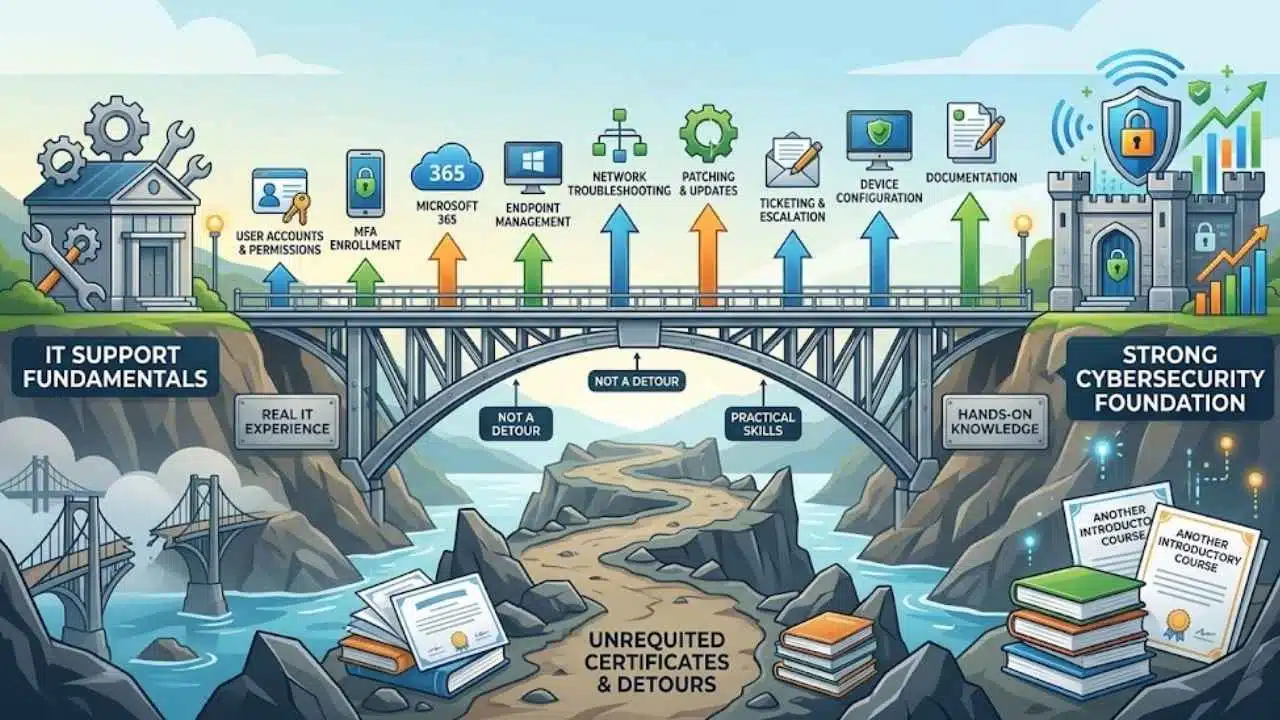
If security applications keep failing, another cybersecurity certificate may not be what your resume needs. It may need real IT experience.
Support roles can expose you to user accounts, permissions, MFA, Microsoft 365, endpoint management, network problems, patching, ticketing, device configuration, documentation, and escalation procedures.
U.S. labor guidance notes that some computer-support positions can be entered without a college degree and that candidates may qualify with a high school diploma plus relevant IT certifications. Requirements vary, especially for more technical roles.
The important part is the work itself. A help-desk position that handles phishing tickets, account provisioning, access problems, MFA enrollment, endpoint alerts, and patching can build a stronger security foundation than another six months of introductory courses. For complete beginners, this route is often underrated.
6. Write the Resume Around Evidence
Beginner cybersecurity resumes frequently devote too much space to training and too little to what the candidate actually did.
Instead of:
Completed Windows security laboratory.
A truthful project description might say:
Reviewed Windows authentication events in a controlled lab, identified repeated failed logins, documented the investigation, and proposed account-security measures. Only claim what you performed.
Projects should communicate the environment, tools, problem, evidence, and result without turning each entry into a paragraph. Career switchers should also resist deleting everything from their previous profession. Auditing, documentation, compliance, customer communication, escalation, analytical writing, and process control can all transfer into security work when described accurately.
7. Apply by Responsibilities, Not Just Cybersecurity Titles
Security job titles are inconsistent. NIST’s NICE Framework addresses this by describing cybersecurity work through tasks, knowledge, and skills rather than relying only on job names. Use the same approach during a search.
Look beyond “cybersecurity analyst” to roles such as:
- SOC analyst;
- security operations analyst;
- junior security analyst;
- IAM analyst;
- access management analyst;
- vulnerability analyst;
- security administrator;
- information security analyst;
- GRC analyst;
- IT support with security responsibilities.
Then read the actual duties. A degree marked “preferred” is not the same as a hard requirement. Government, licensing, immigration-dependent, regulated, or highly specialized positions may have requirements that cannot simply be worked around. Otherwise, if the responsibilities are a credible match, applying can still be worthwhile.
Non-degree applicants should expect some automated screening and employers to remain less flexible. That is a genuine disadvantage. Referrals, apprenticeships, internal transfers, professional groups, security communities, and demonstrable projects can help because they give employers evidence beyond a degree checkbox.
8. Prepare for Interviews by Explaining Systems
Memorized definitions tend to fall apart after the first follow-up question.
Practise explaining ordinary technical behavior instead:
- What happens after someone types a URL into a browser?
- What does DNS do?
- How do authentication and authorization differ?
- What can MFA reduce, and what risks remain?
- What would you examine after a suspicious login?
- Why might a workstation contact an unfamiliar IP?
- What does least privilege look like inside a company?
- How would you document and escalate an incident you could not resolve?
Do not claim experience with a SIEM, EDR platform, scanner, or cloud service you have never used. For an entry-level candidate, a clear explanation of how they would investigate an unfamiliar problem is often more credible than a resume packed with product names.
A Practical 12-Week Starting Path
Twelve weeks is enough to create structure. It is not a promise of employment.
- Weeks 1–4: Work on networking, Windows and Linux, identity, command-line skills, and basic scripting.
- Weeks 5–8: Choose a broad direction such as SOC work, IAM, GRC, cloud, or offensive security. Start relevant labs and turn several exercises into written investigations.
- Weeks 9–12: Complete one stronger portfolio project, prepare for one certification if target jobs justify it, rebuild the resume around evidence, and begin applying.
Someone already working in IT may move through the fundamentals quickly. A complete beginner may need several more months. There is little value in finishing the roadmap quickly if you cannot explain the material afterward.
Final Thoughts
Building a cybersecurity career without a degree is realistic, but skipping university makes proof of competence more important, not less. Start with ordinary IT before specializing. Pick a target role. Practise in authorized environments. Earn one certification when it solves a recognizable hiring problem. Build a small portfolio that demonstrates investigation and reasoning. If direct security jobs remain out of reach, consider IT support, networking, identity, systems, or cloud work before buying another beginner course.
The strongest non-degree candidate is rarely the person with the longest certification list. It is the person who can look at an unfamiliar technical problem, gather useful evidence, explain what is happening, and show what they would do next..