
The global fight for capital has never been more intense or strategically complex. As corporate founders and institutional investors evaluate where to park their money or launch their initial public offerings, comparing the London Stock Exchange vs US Markets has become the defining financial dilemma of 2026. For decades, these transatlantic financial hubs operated in relative parity, but the explosive rise of artificial intelligence and a shift in regulatory philosophies have dramatically widened the gap. Today, the conversation is no longer just about geography; it is a fundamental debate regarding how different economies value growth, tolerate risk, and reward innovation.
Understanding the stark realities separating these markets is essential for anyone looking to navigate the future of global equities without falling victim to outdated financial assumptions. To properly evaluate these massive financial ecosystems, we established a strict framework to separate historical nostalgia from current economic reality.
How We Selected Our 6 Key Facts on Global Markets
Relying on outdated metrics can lead to disastrous investment or listing decisions, which is why we filtered our data through the lens of recent economic shifts. We focused exclusively on systemic, verifiable trends that dictate how capital actually moves today.
-
Analysis of the sweeping UK Listing Rules (UKLR) overhauled in 2024 and their tangible 2026 outcomes.
-
Direct comparisons of market capitalization and daily trading volumes between the LSE, NYSE, and Nasdaq.
-
Review of sector-specific valuation gaps based on recent Equity Capital Markets (ECM) data.
-
Measurable trends in dividend yields versus share buyback cultures.
Understanding the metrics behind our analysis clarifies exactly who will find this breakdown most actionable.
Target Demography
This financial breakdown is strictly tailored for institutional investors, corporate founders planning an IPO, and financial analysts trying to understand transatlantic capital flows.
With the analytical baseline established, let us dive into the core realities separating these major financial hubs.
6 Eye-Opening Facts About the London Stock Exchange vs US Markets
The differences between these exchanges extend far beyond time zones, influencing everything from corporate governance to basic survival. Here is a detailed breakdown of the fundamental facts reshaping global finance.
The most undeniable difference begins with sheer scale and the availability of capital.
1. The Massive Liquidity and Capital Gulf
The financial firepower available in New York heavily outweighs that of London. The combined market capitalization of the NYSE and Nasdaq exceeds $60 trillion, driven by a deep pool of institutional and retail investors willing to deploy capital aggressively. In contrast, the London Stock Exchange sits closer to $6 trillion, meaning companies listed in the US often experience significantly higher daily trading volumes and better overall liquidity, allowing large investors to enter and exit positions without drastically impacting the share price.
Best for:
-
Megacap corporations and founders requiring massive injections of immediate capital to fund aggressive global expansion.
Why We Chose It:
-
It is the primary reason highly successful European companies frequently migrate across the Atlantic.
-
Liquidity directly impacts a stock’s volatility and its attractiveness to massive pension funds.
Things to consider:
-
High liquidity in the US also attracts aggressive algorithmic trading and short-sellers, which can drastically increase short-term stock volatility.
The type of companies dominating these exchanges provides another stark contrast.
2. Sector Composition: Tech Dominance vs. The Old Guard
The US markets, particularly the Nasdaq, have become the undisputed global home for technology, biotechnology, and AI hyperscalers. The sheer concentration of tech giants means that innovation-driven companies naturally flock to the US to be benchmarked against their peers. Conversely, the LSE remains heavily weighted toward traditional “old economy” sectors, including energy, mining, banking, and consumer goods, making it a reliable but decidedly less flashy index.
Best for:
-
Tech startups looking for high growth multipliers, or traditional industrials seeking a stable peer group.
Why We Chose It:
-
It explains why the major US indices frequently outperform the UK during massive tech-driven bull markets.
-
It highlights the distinct cultural identity of each respective stock exchange.
Things to consider:
-
The heavy tech concentration in the US means index funds are highly vulnerable to localized bursts in the technology sector.
This difference in sector composition directly fuels the most debated topic in transatlantic finance.
3. The Persistent “London Discount”
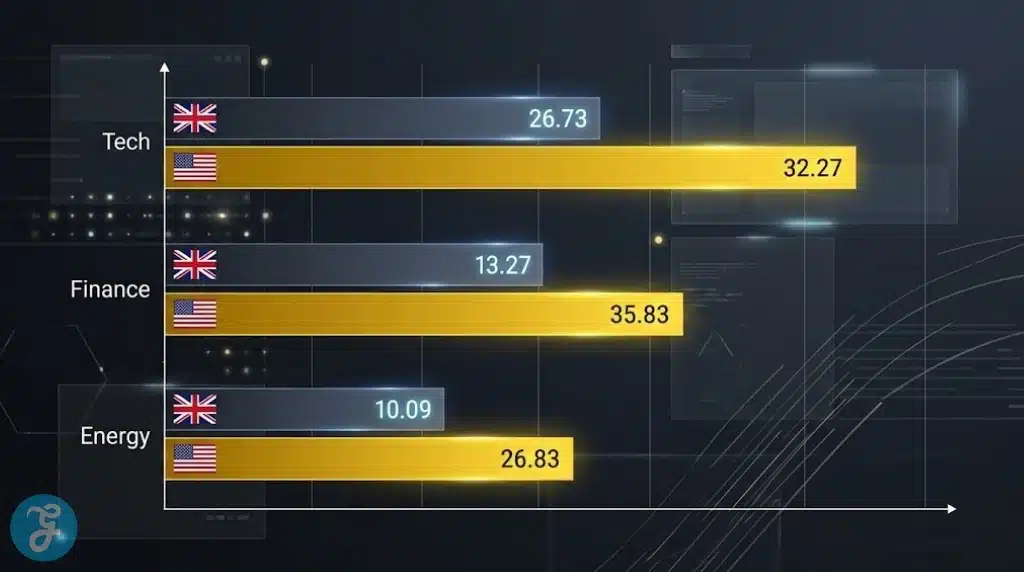
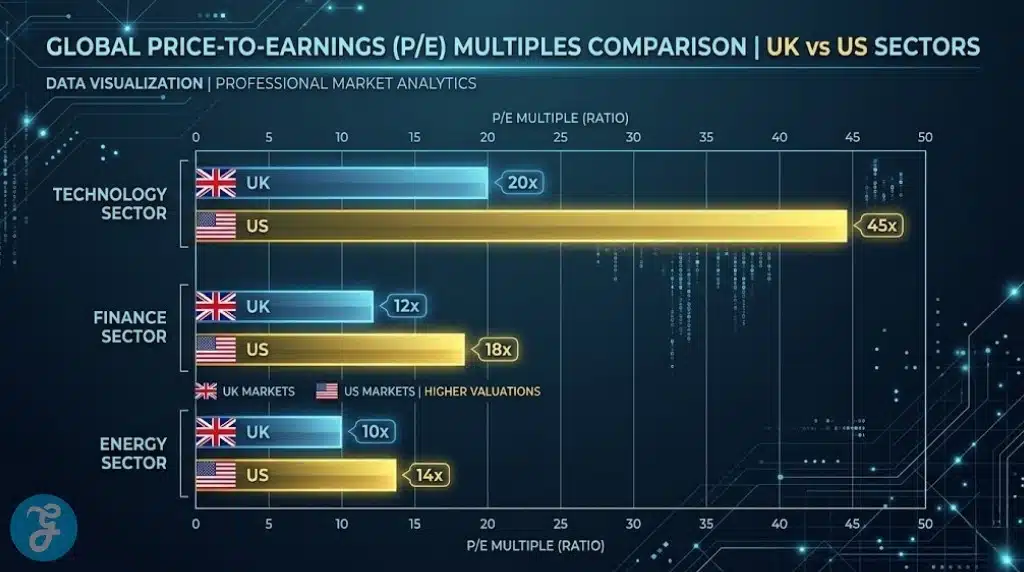
British executives have spent years fighting the reality that companies listed in London generally trade at lower Price-to-Earnings (P/E) multiples than structurally identical companies listed in the US. While part of this “London Discount” is attributed to the LSE having fewer high-growth tech firms, even traditional companies often find their valuations depressed in the UK compared to their American counterparts. US investors simply show a higher willingness to pay a premium for future growth potential rather than demanding immediate, steady profits.
Best for:
-
Value investors actively hunting for fundamentally sound, underpriced companies that the broader market has ignored.
Why We Chose It:
-
It is the single biggest frustration for UK-based CEOs and the leading cause of transatlantic delistings.
-
It perfectly illustrates the differing risk appetites of American versus European fund managers.
Things to consider:
-
Acquiring heavily discounted UK companies makes them prime targets for aggressive private equity buyouts.
To combat this capital flight, the UK had to radically alter its own rulebook.
4. The Aggressive UK Listing Rule Overhauls
In a desperate bid to remain competitive with the US, the Financial Conduct Authority (FCA) implemented a sweeping overhaul of the UK Listing Rules (UKLR) recently. These reforms effectively scrapped the traditional “premium” and “standard” listing segments in favor of a single, simplified category. More importantly, it allowed founders to utilize dual-class share structures more freely and removed the requirement for mandatory shareholder votes on significant acquisitions, directly mimicking the founder-friendly environment of New York.
Best for:
-
Visionary founders who want to retain absolute voting control of their company even after taking it public.
Why We Chose It:
-
It represents the most significant modernization of London’s financial regulations in decades.
-
It shows a definitive shift away from strict European compliance toward aggressive American-style corporate flexibility.
Things to consider:
-
Removing shareholder voting requirements on major deals significantly reduces the power of institutional investors to block risky corporate behavior.
Beyond capital growth, how these exchanges handle corporate profits differs wildly.
The LSE is historically renowned for its robust dividend culture, attracting investors who rely on a steady stream of passive income. UK companies face immense cultural pressure to return cash to shareholders via quarterly or annual dividends. In stark contrast, US markets heavily favor share buybacks—a tax-efficient method of returning value that artificially boosts a company’s stock price by reducing the number of outstanding shares, prioritizing capital appreciation over direct cash payouts.
Best for:
-
Income-focused portfolios and retirees seeking stable, predictable cash flow without having to sell their underlying assets.
Why We Chose It:
-
It defines the fundamental difference in how total shareholder return is calculated across the two regions.
-
It heavily influences how corporate boards allocate their excess cash reserves.
Things to consider:
-
High dividend obligations can starve a UK company of the vital research and development capital needed to compete globally.
Finally, the geographical makeup of the companies themselves tells a distinct story.
6. Domestic Focus vs. International Revenue Exposure
While the US stock market is perceived as the center of global finance, its major indices are heavily reliant on the strength of the domestic American consumer. Conversely, the top companies listed on the London Stock Exchange generate over 70% of their revenues from entirely outside the UK. This makes the LSE an incredibly unique proxy for global economic health, rather than just a reflection of the British domestic economy.
Best for:
-
Investors seeking broad, multinational exposure without having to navigate multiple foreign exchanges directly.
Why We Chose It:
-
It dispels the myth that investing in the London Stock Exchange is simply a bet on the British pound or local economy.
-
It highlights a built-in hedge against localized domestic recessions.
Things to consider:
-
Because UK-listed companies earn heavily in US dollars and Euros, their stock prices are highly sensitive to foreign exchange rate fluctuations.
To fully grasp how these distinct financial ecosystems stack up against one another, we must look at the raw data.
An Overview Of London Stock Exchange vs US Markets Strategies
The following matrix compares the core functionalities and strategic advantages of listing or investing in these regions.
Overview Comparison Table
| Feature | London Stock Exchange (LSE) | US Markets (NYSE/Nasdaq) |
| Primary Appeal | Value investing, high dividends | Hyper-growth, tech dominance |
| Market Capitalization | Approx. $6 Trillion | Over $60 Trillion |
| Regulatory Burden | Easing (Post-UKLR reforms) | High (Sarbanes-Oxley), but flexible |
| Sector Heavyweights | Financials, Energy, Mining | Technology, AI, Biotechnology |
| Valuation Multiples | Historically lower (Discounted) | Premium multipliers |
Reviewing this table naturally leads to specific recommendations based on differing financial goals.
Our Top 3 Picks and Why?
Choosing where to deploy capital depends entirely on the specific strategic outcome you require.
-
Nasdaq for Tech Dominance: It remains the undisputed champion for AI and software, offering multipliers that simply do not exist in Europe.
-
LSE for Dividend Income: For stable, long-term cash flow, the traditional heavyweights of London are unmatched in their dividend reliability.
-
NYSE for Maximum Liquidity: If you are managing billions and require seamless entry and exit points, the sheer volume of the NYSE is mandatory.
Translating these macro-level differences into a personal or corporate strategy requires a clear decision-making process.
How to Choose the Right Exchange by Yourself?
Whether you are a retail investor picking ETFs or a CEO prepping an IPO, you must align your strategy with the exchange’s inherent DNA.
We have structured a framework to help you navigate this massive financial decision.
The Selection Framework:
-
Evaluate your growth timeline: If you need immediate profitability, London is safer. If you are burning cash for future dominance, go to the US.
-
Assess your sector alignment: Putting a high-growth AI startup on the LSE risks it being misunderstood, just as a slow-growth utility might be ignored on the Nasdaq.
-
Determine control requirements: Decide if you are willing to surrender voting rights to institutional investors or if you demand dual-class share structures to maintain absolute authority.
Before finalizing your investment or listing strategy, run through this final verification process.
The Final Checklist
Ensure you have accounted for these critical factors before committing your capital.
-
Have you accounted for the hidden costs of cross-border tax implications and foreign exchange fees?
-
Does your target sector historically trade at a premium or a discount on your chosen exchange?
-
Are you prepared for the intense quarterly earnings pressure associated with US markets?
-
If listing, have you factored in the massive legal and compliance costs of the US Sarbanes-Oxley Act?
-
Does your investment timeline align with the dividend or share buyback culture of the respective market?
Looking beyond the immediate tactical decisions, we must confront the broader realities of global finance.
The Uncomfortable Reality of Global Financial Dominance
When critically analyzing the London Stock Exchange vs US Markets, one must confront a deeply uncomfortable truth regarding the future of European equities. The gravitational pull of American capital has become a black hole, effortlessly stripping the UK and broader Europe of its most promising, high-growth enterprises. Despite London’s aggressive regulatory overhauls aimed at creating a more founder-friendly environment, you cannot simply legislate liquidity into existence. A profound cultural divide exists; American investors are fundamentally willing to underwrite massive, speculative risk in pursuit of monumental innovation, while European markets remain culturally anchored in wealth preservation, stringent compliance, and immediate profitability.
This creates a terrifying feedback loop: as more tech giants list in the US, the center of gravity permanently shifts, leaving London at risk of becoming a glorious, heavily-regulated retirement fund of banks and oil conglomerates.
Ultimately, the survival of the London Stock Exchange doesn’t hinge on mimicking New York’s rules, but on whether it can successfully pioneer a new, distinct identity for sustainable, global capital that isn’t solely obsessed with the next quarter’s tech bubble. Navigating the complexities of transatlantic capital often brings up common queries from analysts and investors alike.
Frequently Asked Questions (FAQs) About London Stock Exchange vs US Markets
Addressing these common concerns helps demystify the logistics of international finance.
Why do UK companies dual-list in the US?
Companies dual-list via American Depositary Receipts (ADRs) to tap into the massive liquidity of US investors without having to completely abandon their domestic market and face local political backlash.
Are the listing fees higher in the US or the UK?
Generally, the US markets have significantly higher initial listing fees and ongoing compliance costs, largely due to the stringent reporting requirements of the SEC and the Sarbanes-Oxley Act.
Yes, most modern online brokerages allow retail investors to purchase international shares, though buying foreign stocks often incurs additional foreign exchange conversion fees and specific withholding taxes on dividends.
It is a system where a company issues two classes of shares, typically giving founders “super-voting” rights. This allows them to maintain majority control of the company’s decisions even if they own a minority of the actual equity.
Will the London Discount ever close?
It is unlikely to close completely without a massive cultural shift in European risk appetite. As long as US investors are willing to pay higher multiples for future growth, the valuation gap will persistently remain.