Running a small business means every dollar matters, and choosing the right marketing channel can be challenging. Many businesses invest in email campaigns or social media platforms like Facebook and Instagram without seeing clear returns, leading to wasted time and budget.
Think of it like selecting ingredients for a recipe—using the wrong mix can leave results underwhelming.
When comparing Email Marketing vs Social Media ROI, the difference is significant. Email marketing delivers an average return of $36 for every $1 spent, far outperforming social media, where ROI is often harder to measure accurately. This is why brands like Airbnb rely on platforms such as Mailchimp and Klaviyo to drive higher conversions and revenue.
Email Marketing vs Social Media ROI with clear insights into costs, conversions, and audience targeting. It also highlights practical strategies to improve performance and shows how combining both channels can boost customer retention and lead generation.
Maximize marketing ROI with smarter channel choices.
Email Marketing vs Social Media: An Overview
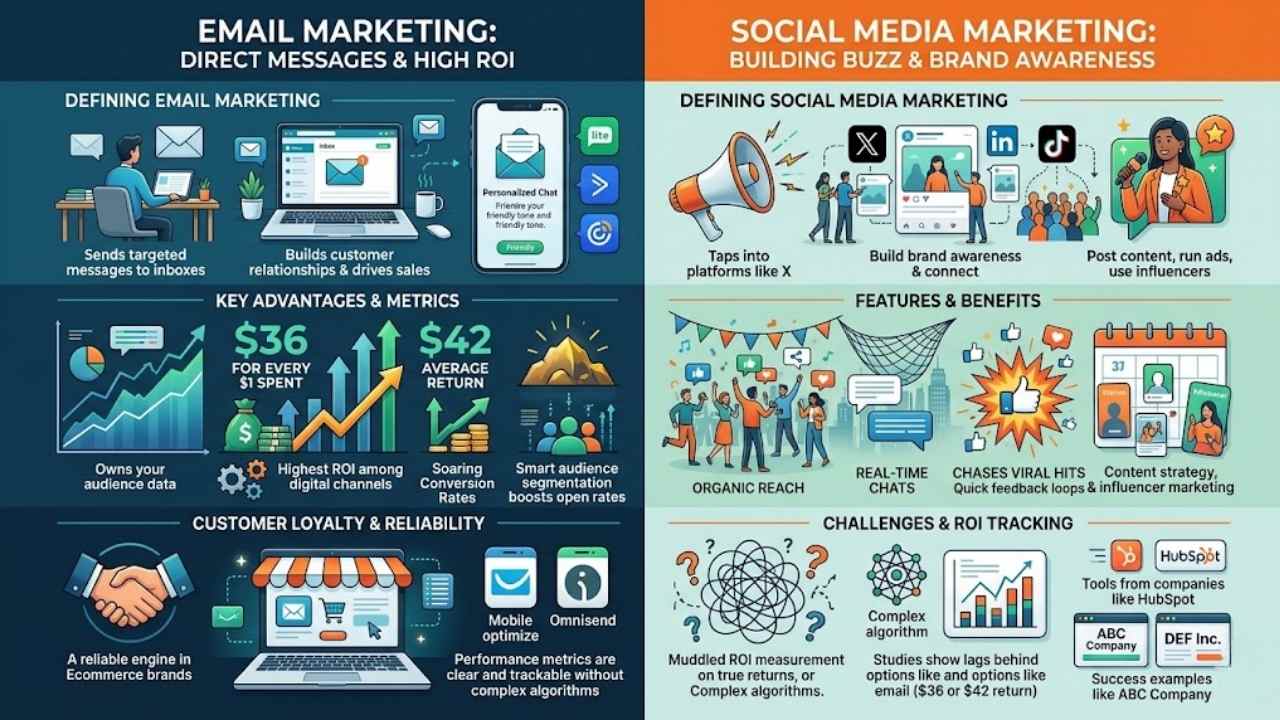
Ever wondered how email stacks up against posts on LinkedIn or TikTok for your business? Imagine, email marketing sends direct messages to folks’ inboxes using tools like MailerLite, while social media marketing builds buzz through shares and likes on platforms like X.
Defining Email Marketing
Email marketing sends targeted messages to people through their inboxes. Businesses use it to build customer relationships and drive sales. Tools like MailerLite, ActiveCampaign, and Constant Contact make this easy.
You own your audience data, which boosts personalization and automation. Imagine crafting emails that feel like a chat with a friend, leading to strong engagement rates. Email automation handles the heavy lifting, sending personalized messages at the right time.
This direct communication stands out in digital marketing. It beats social media with clear ROI tracking. Email generates $36 for every $1 spent, a big win for your budget. Studies show an average return of $42 per dollar on email.
Conversion rates soar higher than on platforms like LinkedIn or TikTok. Businesses focus on sales love this edge.
Email marketing consistently delivers the highest return on investment among all digital marketing channels available to businesses.
Your inbox as a gold mine for brand awareness. Open rates climb with smart audience segmentation. Ecommerce brands thrive here, outpacing social media’s viral potential. Growth marketing pros swear by tools like GetResponse and Omnisend for mobile optimization.
They track performance metrics without the hassle of complex social algorithms. Email drives $36 back per dollar, while social media muddles ROI measurement. It tops charts with superior conversion rates.
Your marketing strategy gains from this power. Think of it as a reliable engine for customer loyalty.
Defining Social Media Marketing
Social media marketing taps into platforms like X (Twitter) to build brand awareness and connect with people. You post content, run ads, and team up with influencers to spread the word.
This approach boosts organic reach, sparks real-time chats, and chases viral hits that draw crowds fast. Tossing a message into a bustling party; some folks notice, others join in, but tracking every reaction gets tricky.
Businesses chase marketing goals here, yet complex ROI tracking often muddles the picture on true returns.
Social media for its wide net and quick feedback loops. You craft content strategies that mix posts, stories, and influencer marketing to engage audiences. Tools from companies like HubSpot help manage it all, while spots like ABC Company and DEF Inc.
showcase success stories. Still, measuring return on investment stays tough compared to clearer channels, with studies showing social media lags behind options that yield $36 or even $42 per dollar spent.
ROI Comparison: Email Marketing vs Social Media
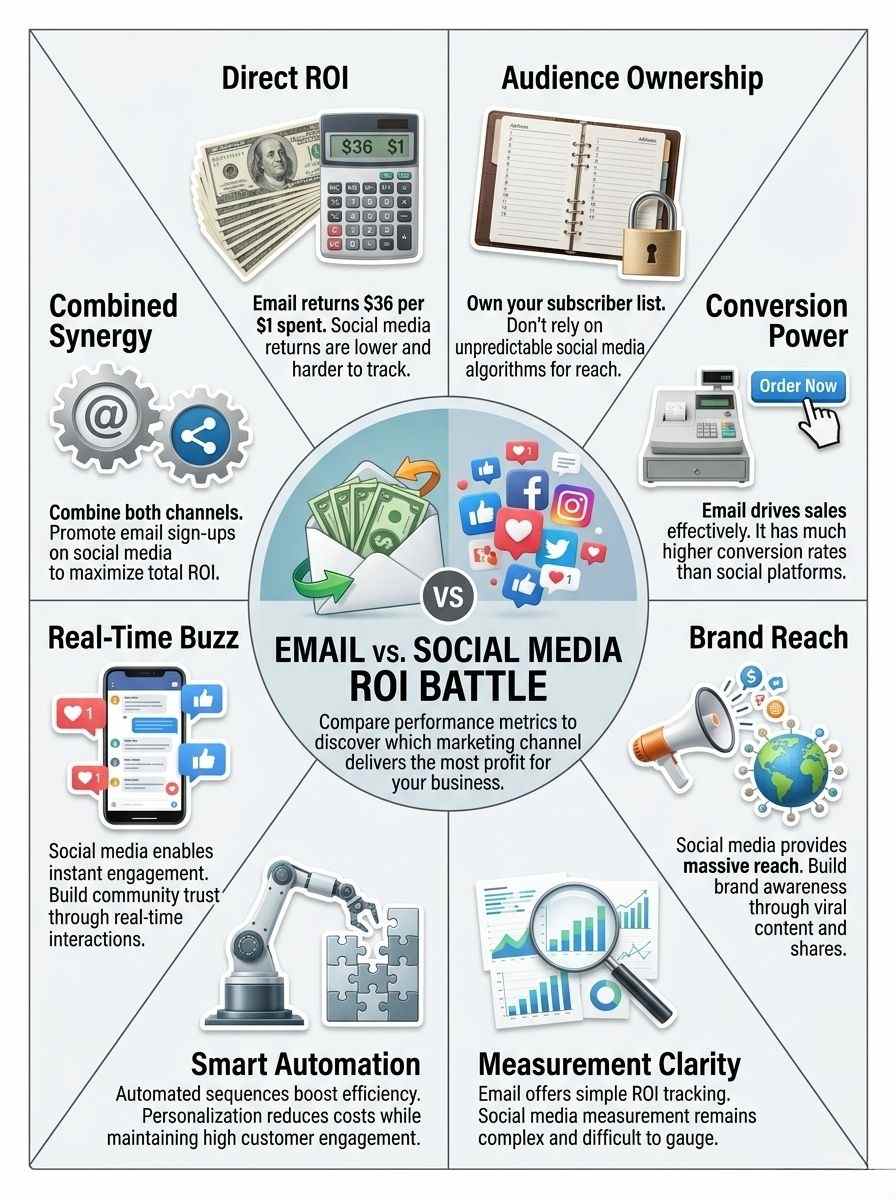
Ever wondered why email marketing often trumps social media in pure profit punch, like a heavyweight champ landing knockout blows? Check out the numbers, where tools like Brevo show email’s click-through rates soaring higher than Instagram’s viral posts, sparking real sales that make your budget smile.
Direct ROI Data: Email vs Social Media
Let’s check out the straight facts on ROI, where email marketing often leaves social media in the dust.
| Metric | Email Marketing | Social Media Marketing |
|---|---|---|
| Average Return per Dollar Spent | Email marketing generates $36 return for every $1 spent; studies show businesses can expect an average return of $42 for every dollar spent. | Social media has complex ROI tracking that makes measurement more difficult; its average return consistently falls below email marketing investments. |
| Total ROI Ranking | Email marketing delivers a significantly higher ROI than social media across all digital channels; it consistently delivers the highest return on investment among all digital marketing channels available to businesses. | Social media marketing trails behind email in ROI, with more challenges in tracking effectiveness. |
| Conversion Rates | Email marketing typically has a much higher conversion rate, making it the better option for businesses focused on sales; it drives sales more effectively. | Social media marketing shows lower conversion rates compared to email. |
| Key Benefits for ROI | Email marketing is known for having a high return on investment; it provides clearer measurement of return on investment and campaign effectiveness; it’s the better option for businesses that want to maximize their return on investment and improve conversion rates. | Social media has complex ROI tracking mechanisms, which complicate clear measurement. |
Cost Analysis and Budget Impact
Email marketing saves you money in the long run, folks, while social media can eat up your budget without clear returns.
| Aspect | Email Marketing | Social Media Marketing |
|---|---|---|
| Return per Dollar Spent | You get $36 back for every $1 you invest, studies show. Businesses expect an average return of $42 for every dollar on email. This beats all other channels. | Tracking ROI gets complex, which makes measurement tough. Returns often fall short of email’s high benchmarks. |
| Cost Efficiency | Email delivers the highest ROI among digital options. It drives sales better with clear metrics. You own your audience data, cutting long-term costs. | Budgets stretch thin due to tricky tracking. Reach is wide, but conversion rates lag, hiking total expenses. |
| Budget Impact | Spend less to gain more with personalization. Conversion rates soar, maximizing your ROI. Email stands out as the top choice for sales-focused firms. | Engagement shines, but vague ROI clouds budget planning. Viral content helps, yet it demands constant spending without guaranteed payoffs. |
| Measurement Clarity | You track effectiveness easily, boosting campaign tweaks. This clarity aids smart budgeting. | Complex mechanisms obscure true returns. You struggle to gauge impact, risking budget waste. |
Sales and Conversion Rate Comparison
Let’s look at how email marketing stacks up against social media in sales and conversion rates, using hard numbers to show the differences.
| Aspect | Email Marketing | Social Media Marketing |
|---|---|---|
| Conversion Rates | This channel boasts much higher conversion rates. Businesses see it drive sales more effectively. Focus on sales? You get the better option here. | Conversion rates run lower. Tracking ROI gets complex, which muddles measurement of campaign effectiveness. |
| Sales Return | Studies show businesses expect an average return of $42 for every dollar spent. It generates $36 return for every $1 invested, topping all digital channels. | Returns lag behind, with complex ROI tracking making measurement tough. Investments yield less clear results. |
| Total Impact | It delivers the highest return on investment among digital marketing channels. You maximize ROI and boost conversion rates with this choice. | ROI measurement stays tricky. Average returns fall short compared to other channels. |
Key Advantages of Email Marketing
Email marketing delivers strong returns, often outpacing social media with solid conversion rates that boost your bottom line. Imagine, you control your subscriber list through platforms like Beehiiv, adding personal touches and auto-sends that feel like a chat with an old friend, keeping folks coming back for more.
Higher ROI and Conversion Rates
Businesses love a good bang for their buck, and email marketing delivers just that. It generates $36 in return for every $1 you spend, outshining social media by a mile. Studies show an average return of $42 per dollar on email campaigns, making it the top choice for return on investment (ROI).
You get higher conversion rates too, driving sales more effectively than posts on platforms like Facebook or Instagram. Tools like EmailOctopus and Beehiiv help you track this ROI with ease, turning your content strategy into a money-making machine.
Business marketing strategies as a race, folks, email pulls ahead with clear wins in ROI and conversions. It beats social media hands down, offering $36 back per buck while social’s complex tracking leaves you guessing.
Focus on sales? Email’s your ally, with ROI (return on investment) that consistently tops the charts across digital channels. Grab kits from Flodesk or thm2g to boost personalization, and watch those conversion rates soar without the hassle of viral guesswork.
Personalization and Automation Benefits
Email marketing lets you tailor messages to each reader, like fitting a glove to a hand. You send offers that match what folks bought before, boosting their interest right away. Automation handles the heavy lifting; set it up once, and emails go out on their own, saving you time and hassle.
This setup drives sales more effectively than social media, with studies showing $42 back for every dollar spent. Your inbox working like a smart assistant, knowing just what to say and when.
Readers feel seen and valued, leading to higher conversion rates that beat social media hands down. Tools like segmentation sort your list into groups, making each campaign hit the mark.
Personal touches turn casual browsers into loyal buyers, fast.
Automation in email marketing streamlines your efforts, firing off welcome notes or cart reminders without a hitch. You own the audience data, unlike social media where algorithms call the shots.
This control gives clearer ROI tracking, with $36 returned per dollar invested. Picture a well-oiled machine churning out results while you sip coffee. Personalization amps up engagement, as customized subject lines grab attention like a neon sign.
Readers stick around longer, clicking through at rates social media can only dream of. Software such as drip campaigns nurtures leads over time, building trust step by step. All this adds up to smarter marketing that maximizes your budget and sparks real growth.
Ownership of Audience and Data
You build your own email list, so you control who sees your messages. Social media platforms own their audiences, which means algorithms can limit your reach anytime. Think of it like owning a cozy house versus renting an apartment, you decide the rules in your space.
Businesses love this setup because it leads to steady results. Email marketing generates $36 return for every $1 spent, far outpacing social media’s tricky metrics. You keep all the data too, from open rates to clicks, giving you clear insights.
No one yanks away your contacts overnight.
This control boosts your edge in sales. Imagine sending personalized offers directly, no middleman involved. Studies show businesses expect an average return of $42 for every dollar on email marketing.
Social media tracking gets messy, but email gives you straightforward numbers. You nurture leads without platform whims. Higher conversion rates follow, making email the smarter pick for growth.
Own your audience, and watch your ROI soar.
Key Advantages of Social Media Marketing
Your brand lighting up like a fireworks show on platforms such as Instagram and TikTok, where massive audiences spot you fast, chat with you right away, and share your posts like wildfire, boosting visibility in ways email just can’t match—curious for the full scoop? Stick around!
Greater Reach and Brand Awareness
Social media platforms, like Facebook and Instagram, let you connect with millions of users in seconds. You build brand awareness fast, as posts spread like wildfire through shares and likes.
Your message reaching folks across the globe, without knocking on doors. Businesses love this, because it sparks conversations and draws in new eyes. Email marketing delivers $36 for every $1 spent, but social media shines here with its massive audience potential.
You engage people right away, turning strangers into fans.
Think about viral content; one clever video on TikTok can explode overnight. This boosts your visibility in ways email can’t match. Sure, social media has complex ROI tracking that makes measurement tough, while email provides clearer results.
Yet, you gain real-time feedback from comments and interactions. Brands use this to refine their approach, creating buzz that sticks. Your audience grows organically, fostering loyalty through fun, shared experiences.
Real-Time Engagement with Audiences
Chatting with friends at a lively party, that’s social media for you. Platforms like Facebook and Instagram let brands jump into conversations right away. Customers ask questions, you answer fast.
This builds trust, like a quick high-five. Sure, email marketing pulls in $36 for every buck spent, but social media shines here with instant back-and-forth. Think of it as a live game, not a delayed replay.
Brands share updates, fans respond in seconds. Tools such as Twitter polls spark fun debates. Engagement feels alive, drawing people in.
Humor me, imagine your brand as a stand-up comedian getting laughs on the spot. Social media offers that stage. Users comment, share stories, create buzz. Contrast this with email’s clear ROI tracking, social’s setup can feel tricky to measure.
Yet, the real-time vibe boosts loyalty. Post a question on LinkedIn, watch replies roll in. It’s like tossing a ball, folks catch and throw back. This direct link turns followers into fans.
Viral Potential of Content
Social media shines when your content catches fire and spreads fast. Users share posts, videos, or memes across platforms like Facebook or Instagram, boosting visibility overnight.
Envision a clever ad that friends tag each other in, it explodes with likes and retweets. This viral magic builds buzz, drawing crowds without extra ad dollars. Email marketing generates $36 return for every $1 spent, yet social media’s reach feels like a wildfire you can’t control.
Businesses chase this thrill, hoping one hit post turns followers into fans.
Tracking goes tricky on social media, with complex metrics hiding true gains. Email marketing delivers clearer views, like $42 back per dollar in some studies. Still, that viral spark on social channels creates instant hype, pulling in audiences who might never see your emails.
Think of a brand’s challenge video taking off, it sparks talks and shares everywhere. Social media lags in direct sales, but its spread potential feels like striking gold in a crowded room.
Email tops with higher conversion rates, making it the sales champ in general.
How to Improve ROI on Both Channels
Want to pump up your returns from email blasts and Facebook posts? Try split testing your subject lines and ad images, then track clicks with tools like Mailchimp and Hootsuite to see what drives real sales.
Email Marketing Optimization Tips
Email marketing packs a punch with returns like $36 or even $42 for every dollar you spend, outshining social media in conversion rates and sales drive. You can amp up those wins by tweaking your approach, making it a top pick for businesses hungry for clear, measurable results over the tricky tracking in social channels.
- Segment your lists to hit the right folks, like sorting friends into groups for a party invite so everyone feels special; this personalization boosts engagement, and studies show it leads to higher ROI, with email delivering $36 back per buck while social media lags in direct sales impact.
- Test subject lines with A/B splits, you know, like trying two jokes to see which gets the laugh; businesses report this ramps up open rates, driving that superior $42 average return that email holds over social media’s complex metrics.
- Automate your sequences for timely follow-ups, think of it as a helpful robot buddy sending birthday cards on autopilot; this cuts costs and lifts conversion rates, proving email’s edge as the better option for sales-focused outfits compared to social platforms.
- Clean your subscriber list regularly, pruning dead branches from a tree to keep it healthy; folks see this slashes bounce rates, enhancing that high ROI where email generates far more than social media’s viral but less trackable gains.
- Craft mobile-friendly designs, since most opens happen on phones, like packing a picnic that’s easy to eat on the go; data highlights this improves click-throughs, underlining email’s $36-per-dollar punch that surpasses social media in clear effectiveness measures.
- Track metrics with tools like Google Analytics, pairing it with email platforms for sharp insights; this reveals email’s consistent outperformance, with higher returns and easier ROI tracking than the murky waters of social media campaigns.
- Offer value in every send, such as tips or deals that feel like a warm chat over coffee; readers love this, and it fuels email’s reputation for driving sales more effectively, boasting conversion rates that make it the champ over social media.
- Time your emails based on audience habits, say, like knowing when your pal checks their phone for news; optimizing this way maximizes opens, aligning with facts that email’s $42 return per dollar invested trumps social media’s broader but less precise reach.
Social Media ROI Growth Strategies
Social media marketing offers broad reach, but its ROI often lags behind email’s impressive returns. You can boost your social media ROI with smart strategies, even as facts show email generates $36 or even $42 for every $1 spent, far surpassing social platforms.
- Focus on precise targeting to cut through the noise on social media. Platforms like Facebook and Instagram let you zero in on specific audiences with ads. This approach boosts engagement, and it helps overcome the complex ROI tracking that makes social measurement tougher than email’s clear metrics. Aim for demographics that match your brand, then watch conversions rise as you refine based on data. Studies highlight how email’s higher conversion rates, often driving more sales, push you to mimic that precision on social for better results.
- Create content that sparks real-time interactions to build loyalty. Post polls, stories, or live videos on Twitter or TikTok to engage users instantly. Such tactics tap into social’s viral potential, but email marketing consistently outperforms with its $36 return per dollar versus social’s trickier tracking. Encourage comments and shares to amplify your message, turning followers into advocates who boost your brand without heavy spending.
- Analyze performance metrics regularly to spot what’s working. Use tools like Google Analytics or platform insights to track clicks, shares, and sales from social campaigns. Facts show social media’s ROI measurement is more difficult than email’s straightforward approach, which delivers superior investment returns across channels. Review data weekly, adjust underperforming posts, and focus on high-engagement content to steadily improve your outcomes.
- Invest in paid promotions wisely to expand your audience. Run targeted ads on LinkedIn or YouTube with budgets that start small and scale up based on results. While email boasts the highest ROI among digital channels at $42 per dollar, social’s greater reach can complement it if you monitor costs closely. Set clear goals for each campaign, like lead generation, and compare returns to avoid overspending on platforms with complex tracking.
- Collaborate with influencers to leverage their followings for authentic endorsements. Partner with niche creators on platforms such as Pinterest or Snapchat to reach new eyes. This strategy enhances brand awareness, though email’s personalization drives more effective sales with its high conversion rates over social. Choose influencers whose values align with yours, track engagement from their posts, and calculate ROI by measuring traffic and conversions they generate.
- Optimize posting times and frequency for maximum visibility. Schedule content during peak hours using tools like Hootsuite or Buffer to hit when your audience is active. Social media shines in real-time engagement, but email’s ownership of audience data gives it an edge in ROI, often $36 per $1 spent. Test different schedules, analyze response rates, and adjust to keep your content fresh and your followers hooked.
- Integrate user-generated content to foster community and trust. Encourage fans to share their experiences with your brand on Instagram or Facebook. This builds viral momentum, contrasting with email’s superior ROI and clearer measurement of campaign effectiveness. Highlight top submissions in your feeds, which can lower costs while increasing authenticity and driving indirect sales.
- Track and refine calls-to-action in every post to guide users toward purchases. Use strong, clear CTAs like “Shop Now” or “Learn More” on social channels. While social marketing has complex ROI mechanisms, email provides the better option for maximizing returns and improving conversions. Experiment with CTA placements, monitor click-through rates, and tweak based on what converts best to lift your social performance.
Combining Email Marketing and Social Media for Better ROI
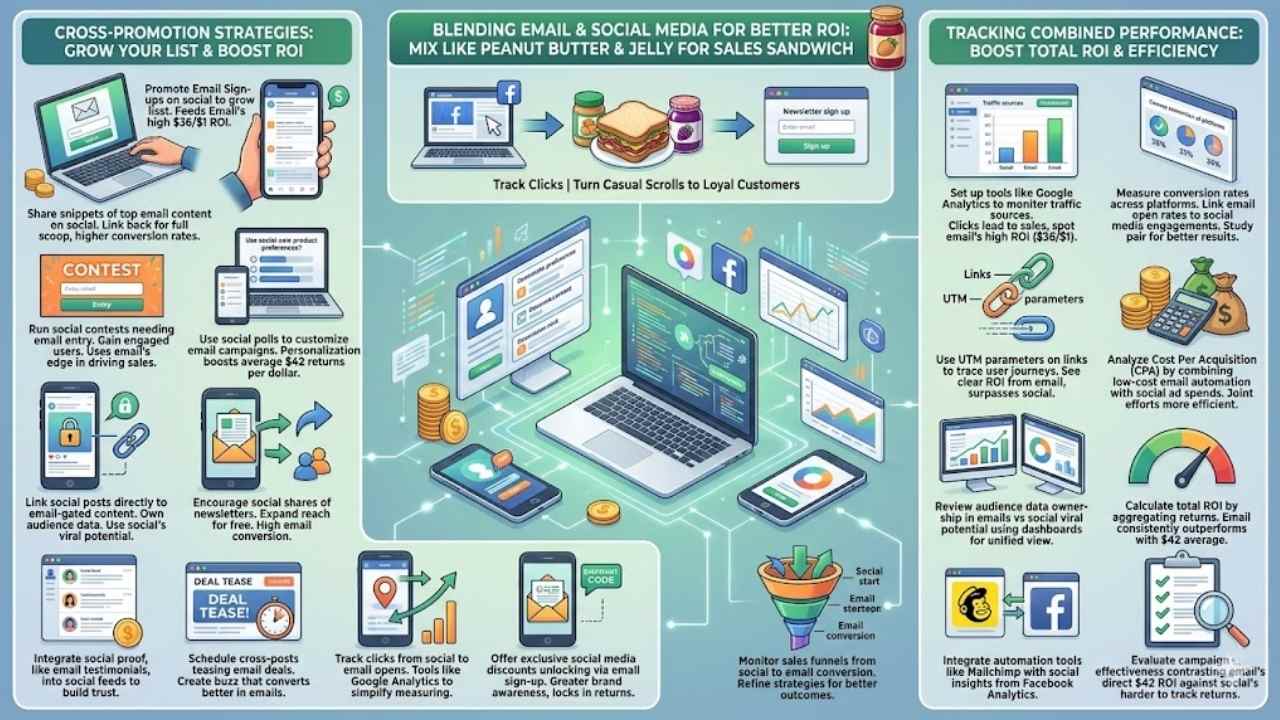
Blending your email blasts with Instagram posts, like mixing peanut butter and jelly for a killer sandwich that boosts sales. You can track clicks from Facebook ads straight to your newsletter sign-ups, turning casual scrolls into loyal customers who keep coming back for more.
Strategies for Cross-Promotion
You can boost your ROI by blending email marketing with social media. This mix taps into email’s high returns, like $36 or $42 per dollar spent, while using social media’s reach to drive more sales.
- Promote your email sign-ups on social media platforms to grow your list fast, and watch how this feeds into email’s superior ROI of $36 for every $1 invested, way ahead of social media’s trickier tracking.
- Share snippets of your top email content on social channels, sparking interest that leads followers back to your inbox for the full scoop, where conversion rates soar higher than on social media alone.
- Run contests on social media that require email entry, pulling in engaged users who then experience email marketing’s edge in driving sales more effectively, with returns that consistently beat social media investments.
- Use social media polls to gather preferences, then customize email campaigns around them for personalization that boosts those impressive $42 average returns per dollar, making your complete strategy a winner.
- Link social posts directly to email-gated content, owning your audience data through emails while leveraging social’s viral potential, and enjoy how this combo clarifies ROI measurement over social media’s complex tracking.
- Encourage social shares of your email newsletters, expanding reach without extra cost, and capitalize on email’s higher conversion rates that make it the go-to for businesses aiming to maximize returns and improve sales.
- Integrate social proof like user testimonials from emails into your social feeds, building trust that funnels traffic to email lists known for generating $36 back per buck, far surpassing social media’s averages.
- Schedule cross-posts where social teases upcoming email deals, creating buzz that converts better in emails, the channel with the highest ROI across all digital options for smart businesses.
- Track clicks from social to email opens using tools like Google Analytics, seeing directly how this synergy amplifies email’s $42 return advantage and simplifies measuring effectiveness compared to social media’s hurdles.
- Offer exclusive social media discounts that unlock via email sign-up, merging the strengths for greater brand awareness on social while locking in email’s proven high returns and direct sales power.
Tracking Combined Performance Metrics
Tracking combined performance metrics helps you see the full picture of your marketing efforts. It blends data from email and social media to boost your total ROI.
- Set up tools like Google Analytics to monitor traffic sources from both channels, and watch how email clicks lead to social shares that drive sales; studies show email marketing generates $36 return for every $1 spent, so track these flows to spot where that high ROI shines through in combined campaigns.
- Measure conversion rates across platforms by linking email open rates to social media engagements, revealing how email’s higher rates, often $42 per dollar spent, pair with social’s reach for better results in general.
- Use UTM parameters on links in emails and social posts to trace user journeys, helping you see the clear ROI from email, which surpasses social media’s returns, and adjust tactics based on real data.
- Analyze cost per acquisition by combining email’s low-cost automation with social’s ad spends, noting email’s $36 per $1 edge that makes joint efforts more efficient for businesses aiming to maximize investments.
- Track engagement metrics like click-through rates from emails that feed into social interactions, since email delivers the highest ROI among digital channels, and this combo can enhance sales more effectively than social alone.
- Review audience data ownership in emails versus social’s viral potential, using dashboards to compare how email’s personalization boosts conversions, typically much higher than social, for a unified view of performance.
- Calculate total ROI by aggregating returns, where email consistently outperforms with averages like $42 per dollar, while social’s complex tracking gets clearer when merged with email’s straightforward metrics.
- Monitor sales funnels that start on social and end with email conversions, emphasizing email as the superior option for ROI and conversions, to refine strategies that improve outcomes across both.
- Integrate automation tools like Mailchimp with social insights from Facebook Analytics, showing how email’s high return, $36 for every $1, combines with social’s real-time engagement for measurable growth.
- Evaluate campaign effectiveness by contrasting email’s direct $42 ROI against social’s harder-to-track returns, using combined reports to guide businesses to email-focused tactics that drive sales better.
Final Thoughts
We’ve compared email marketing’s stellar ROI, like earning $42 for every buck spent, against social media’s broader reach but trickier tracking. These tips make boosting returns simple, think of them as your easy roadmap to smarter spending and higher sales.
So, which channel will you amp up first in your next campaign? Mastering both can skyrocket your business growth, turning small efforts into big wins. For more insights, grab our free guide on tools like Mailchimp or Hootsuite to get started today.
Frequently Asked Questions (FAQs) About Email Marketing vs. Social Media ROI
ROI stands for return on investment, and it shows how much bang you get for your buck in marketing efforts. Think of it like planting seeds; email often yields a bigger harvest than social media posts that might just blow away in the wind.
Yes, studies show email marketing boasts an average ROI of $42 for every dollar spent, way higher than social media’s $2.80. It’s like email is the reliable old truck that gets you there, while social media is the flashy sports car that guzzles gas without much mileage.
3. Why might my business see better ROI from email over platforms like Facebook or Instagram?
Email lets you target folks who already signed up, building loyalty like a cozy chat over coffee. Social media, on the other hand, fights algorithms and fleeting attention spans. Plus, with email, you own the list, not some tech giant calling the shots.
Track metrics like open rates and clicks for email, then tweak for better results; for social media, focus on engaging content that sparks shares. Remember, blending them is key, like mixing peanut butter and jelly for the ultimate sandwich.