Navigating the fragmented social media landscape in 2026 requires more than a basic search for follower counts; it demands a data-driven approach to finding voices that actually convert. The best influencer marketing platforms to find creators have evolved into sophisticated AI engines capable of “vibe-checking” content for brand safety, verifying audience authenticity, and predicting campaign ROI with startling accuracy. As the “nano-influencer” trend dominates the market, the ability to find and manage thousands of smaller relationships at scale has become the new competitive edge.
The 2026 marketing era is defined by “Deep Attribution.” Brands are no longer satisfied with likes and comments; they want to see exactly how a creator’s post influences the multi-touch customer journey. The best influencer marketing platforms to find creators 2026 mentioned in this guide are selected for their massive databases, their high-tech fraud detection systems, and their seamless integration with e-commerce stacks. Moving into 2026, these tools are the bridge between shouting into the void and building a loyal, creator-led community.
Selection Criteria For Our Top Rankings
We evaluated over forty platforms to identify the most effective solutions for brand-creator partnerships. Our team focused on tools that offer “Predictive Performance” and robust relationship management features. The following table illustrates the weighting system we used to determine the top contenders for 2026.
| Criterion | Weighting |
| Discovery Depth (Search & Filters) | 35% |
| AI Audience Auditing (Fraud Detection) | 25% |
| CRM & Relationship Management | 20% |
| E-commerce & ROI Tracking | 20% |
Analyzing The 12 Best Influencer Marketing Platforms to Find Creators 2026
The following selections represent the pinnacle of influencer discovery and management technology currently available. Each platform has been chosen for its unique ability to solve the primary challenge of modern marketing: finding authentic people who resonate with specific target demographics. These tools provide the digital foundation you need for a high-growth 2026.
1. Grin
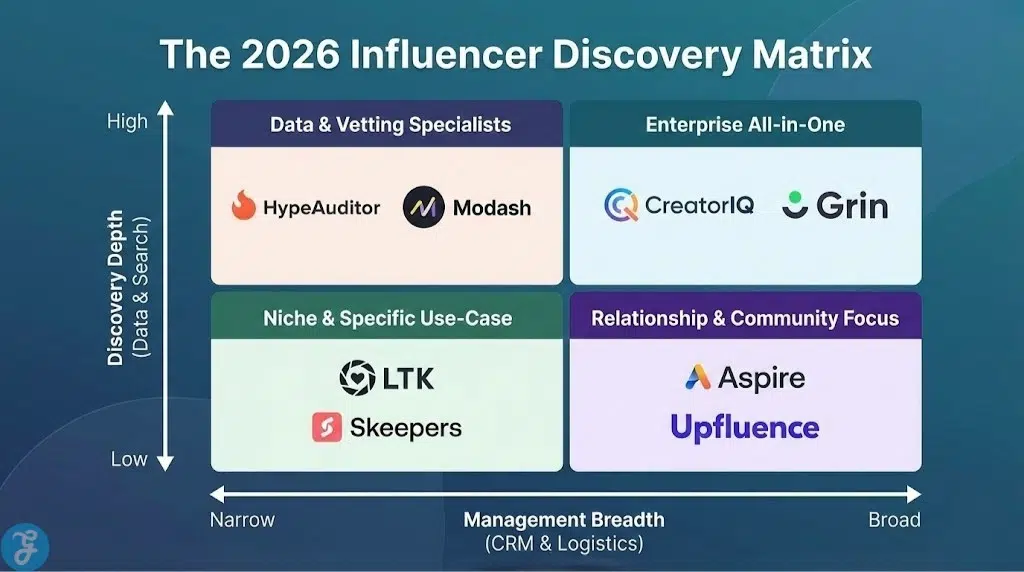
Grin is the definitive leader for 2026 for any brand running on Shopify or Magento. It is a “creator management platform” rather than a traditional marketplace. In 2026, its “Auto-Vetting” AI scans every creator who tags your brand, instantly analyzing their audience for bot activity and brand alignment. It reveal the intent behind “seamless” by integrating discovery directly into your e-commerce shipping and payment flows.
Special Features:
-
Direct Shopify integration for automated product seeding and fulfillment
-
“Likability” scores that predict how well a creator’s audience will react to ads
-
Automated affiliate link generation and payment processing
Things To Consider:
-
Primarily built for e-commerce; less effective for B2B or “service” brands
-
Higher price point that targets established brands rather than startups
Best For: DTC brands looking for an all-in-one relationship and shipping tool
2. CreatorIQ
CreatorIQ is the 2026 powerhouse for global enterprises that need deep, verifiable data. It is the platform used by companies like Google and Disney because of its “Creator Integrity” suite. In 2026, it features “Cross-Platform Attribution” that can track a user’s journey from a TikTok video to a web purchase across devices. It provides a professional “data-first” experience for those who need to justify every dollar of their budget.
Special Features:
-
Advanced “Audience Overlap” tools to see how many followers creators share
-
Custom “white-label” portals for creators to join your brand community
-
Real-time campaign performance dashboards with deep-funnel analytics
Things To Consider:
-
Extremely complex interface that requires a dedicated team member to manage
-
One of the most expensive platforms on the market
Best For: Large enterprises and agencies managing massive creator budgets
3. Modash
Modash is the 2026 champion for “Volume Discovery.” It features a database of over 250 million creators, the largest in the industry. It doesn’t require creators to “sign up” to be found; it indexes every account on Instagram, TikTok, and YouTube. It reveal the intent behind “scale” by allowing you to find thousands of nano-influencers in specific cities or niches in seconds.
Special Features:
-
“No-opt-in” database—find any creator on the planet with over 1k followers
-
Ultra-fast filtering for niche interests, locations, and audience demographics
-
Integrated “Ad Permission” tools to easily get usage rights for creator content
Things To Consider:
-
Lacks the deep CRM and shipping features found in Grin or Aspire
-
Pricing is based on the number of searches and exports per month
Best For: Brands running high-volume, “always-on” nano-influencer campaigns
4. Aspire (formerly AspireIQ)
Aspire is the go-to for “Relationship-First” marketing in 2026. It focuses on turning influencers into long-term brand ambassadors. In 2026, its “Creator Marketplace” has been upgraded with AI that suggests creators who are already fans of your competitors. It simplifies the bridge between a “one-off post” and a permanent brand advocate by providing a highly social and collaborative workspace.
Special Features:
-
A vibrant marketplace where creators can apply directly to your active briefs
-
Automated “influencer whitelisting” for running ads through creator accounts
-
Excellent workflow automation for managing content approvals and contracts
Things To Consider:
-
The marketplace can lead to many “low-quality” applications if briefs aren’t specific
-
Relationship tools are more robust than its raw discovery data
Best For: Community-focused brands looking for long-term ambassadors
5. Impact.com
Impact.com has successfully merged “Affiliate Marketing” and “Influencer Marketing” into one unified platform for 2026. Through its Creator suite, you can manage both your high-end celebrity talent and your thousands of micro-affiliates in one dashboard. It reveal the intent behind “performance” by paying creators based on actual sales rather than just flat fees. It provides the financial foundation for a performance-driven campaign.
Special Features:
-
Unified dashboard for both influencers and traditional affiliate partners
-
Highly flexible contract engine that supports “hybrid” (fee + commission) pay
-
Robust protection against affiliate fraud and bot-driven sales
Things To Consider:
-
The interface is “business-heavy” and lacks the aesthetic flair of Grin or Aspire
-
Can be difficult to navigate for those who aren’t familiar with affiliate marketing
Best For: Brands that want to pay influencers based on actual performance and sales
6. Upfluence
Upfluence is unique in 2026 for its “Customer-to-Creator” tool. It scans your own customer database to find people with high social media followings who have already purchased from you. In 2026, this is considered the “Golden Ticket” of discovery, as an influencer who already loves your product is 5x more likely to convert. It simplifies the bridge between your CRM and your marketing team.
Special Features:
-
Chrome extension that allows you to analyze any profile while browsing social media
-
Native integrations with Gmail and Outlook to manage outreach from your inbox
-
Direct “PayPal” integration for fast, one-click creator payments
Things To Consider:
-
The database is smaller than Modash or HypeAuditor
-
Pricing can be opaque and often requires a long-term contract
Best For: Brands wanting to turn their existing customers into their biggest influencers
7. HypeAuditor
HypeAuditor is the “Truth Engine” of 2026. It specializes in fraud detection, using over 35 metrics to determine if a creator’s followers and engagement are real. In 2026, it features “AI Content Sentiment Analysis,” which tells you exactly how an audience feels about a creator (e.g., are the comments positive or just emoji spam?). It provides a professional “vetting” experience to ensure your brand safety.
Special Features:
-
The industry’s most respected “Audience Quality Score” (AQS)
-
Competitor analysis tools to see which influencers other brands are using
-
Detailed “Engagement Authenticity” charts that visualize follower growth spikes
Things To Consider:
-
Primarily a data tool; outreach and management features are less developed
-
Some features require purchasing “credits,” which can add up quickly
Best For: Brands terrified of “fake followers” and wanting the most accurate data
8. LTK (LikeToKnow.it)
LTK remains the powerhouse for “Fashion, Beauty, and Home” in 2026. It is a closed ecosystem where high-performing creators sell products directly through the LTK app. In 2026, its “LTK Connect” platform allows brands of all sizes to access their curated list of 200,000+ vetted creators. It reveal the intent behind “shopping” by placing your brand in front of users who are specifically looking to buy.
Special Features:
-
Access to a highly “curated” group of professional creators with high conversion rates
-
Direct “Shop the Look” integration that is a staple for the fashion industry
-
15 years of historical sales data to help predict campaign success
Things To Consider:
-
Very focused on specific niches (Fashion/Beauty); less useful for Tech or B2B
-
“Closed” ecosystem means you can’t find creators outside the LTK network
Best For: Fashion and lifestyle brands seeking direct retail conversion
9. Klear by Meltwater
Klear is the “Ease-of-Use” champion for 2026. It provides a very visual and intuitive discovery process, using a “Klear Score” to rank influencers in thousands of niche categories. In 2026, its “Social Listening” integration (via Meltwater) allows you to find creators who are already talking about your industry’s trending topics. It provides a great user experience for marketing teams that need to move fast.
Special Features:
-
Exceptional “Niche Search” that finds creators in highly specific sub-cultures
-
Automated campaign reports that look professional and are ready for board meetings
-
Integrated legal and contract management tools
Things To Consider:
-
Higher price point since it is often bundled with the Meltwater PR suite
-
The search database isn’t as updated as Modash’s real-time index
Best For: Mid-to-large PR and marketing teams that need “speed-to-discovery”
10. Tagger by Sprout Social
Tagger has become a 2026 powerhouse following its integration into the Sprout Social ecosystem. It is the best tool for “Social Commerce” strategy, allowing you to see which specific posts are driving the most conversation. In 2026, its “Signals” feature alerts you when a creator’s engagement is trending upward before they become “too expensive.” It bridges the gap between social management and influencer discovery.
Special Features:
-
Deep integration with Sprout Social for unified social media management
-
“Tagger Signals” AI for spotting trending creators and viral topics early
-
Global search capabilities across 10+ social platforms
Things To Consider:
-
Requires a Sprout Social subscription for the best experience
-
Interface can be data-heavy and requires a bit of training
Best For: Teams that want their influencer discovery and social management in one place
11. Influencity
Influencity is the 2026 choice for “Modular Pricing.” It allows you to build your own plan based exactly on the features you need (e.g., just discovery, or just management). In 2026, its “Audience Overlap” tool is considered one of the most accurate in the industry, helping you avoid “redundancy” when hiring multiple creators. It simplify the bridge between “budget constraints” and “enterprise power.”
Special Features:
-
Fully customizable pricing model—only pay for what you actually use
-
Excellent “Lookalike” feature to find creators similar to your best performers
-
Real-time audience auditing for every social platform
Things To Consider:
-
The “à la carte” pricing can become expensive if you need many features
-
Lacks a direct e-commerce “shipping” integration like Grin
Best For: Growing brands and agencies that need a flexible, scalable tool
12. Skeepers
Skeepers is the 2026 leader for “User-Generated Content” (UGC) at scale. It focuses on getting real people to create reviews and videos rather than just high-profile celebrities. In 2026, its “UGC Licensing” tool makes it easy to take creator videos and turn them into paid social ads with one click. It reveal the intent behind “authenticity” by focusing on content quality over raw follower counts.
Special Features:
-
Dedicated to finding creators who specialize in high-quality UGC and reviews
-
Automated “Rights Management” for repurposing content in your own ads
-
Strong focus on the European market as well as North America
Things To Consider:
-
Not the best tool for finding “Top-Tier” celebrity influencers
-
Focused more on content creation than “influencer” distribution
Best For: Brands that need a constant stream of high-quality UGC for their ads
2026 Influencer Marketing Overview
The market has shifted toward “Full-Funnel Creator Management” where discovery is just the first step. Most leading platforms now feature “AI-Persona Matching” which suggests creators based on the aesthetic and tonal similarity to your existing brand assets. This comparison highlights the primary strengths of the three industry leaders in the 2026 landscape.
| Platform Name | Primary Advantage | Best For |
| Grin | E-commerce Direct Integration | Shopify & DTC Brands |
| CreatorIQ | Enterprise-Grade Data | Global Luxury & Tech Brands |
| Modash | Massive Nano-Creator Database | High-Volume Recruitment |
How To Choose The Right Influencer Platform
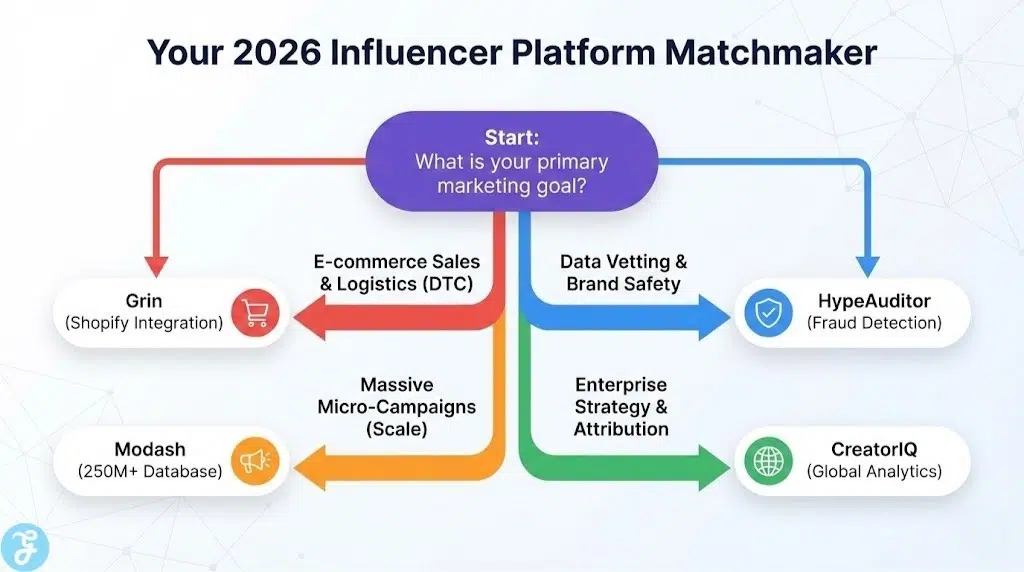
Choosing a platform depends on your “Brand Goal”—do you want raw “Sales Attribution” or broad “Awareness”? You should audit your existing e-commerce stack; if you use Shopify, Grin is almost mandatory, whereas if you are a PR firm, HypeAuditor or Klear may be more useful. This comparison matrix helps you align your 2026 marketing goals with the most appropriate creator hardware.
| Marketing Goal | Recommended Platform | Primary Benefit |
| DTC Sales & Product Seeding | Grin | Direct Shopify & Logistics Sync |
| Vetting & Fraud Detection | HypeAuditor | Most Accurate Audience Data |
| Massive Micro-Campaigns | Modash | 250M+ Creator Database |
| Enterprise Brand Strategy | CreatorIQ | Global Scale & Deep Attribution |
Final Thoughts On Creator Discovery
Winning the battle for attention in 2026 means moving from “buying ads” to “building relationships.” The best influencer marketing platforms to find creators 2026 mentioned here provide more than just a list of names; they provide the intelligence needed to find true brand partners. By selecting a tool that matches your specific business model—whether it is a performance-driven affiliate system or a community-focused ambassador program—you ensure that your 2026 marketing spend is an investment in human connection rather than just another digital expense.