

Have you ever stepped on the scale at your doctor’s office, seen a number pop up, and heard the doctor mention your BMI? You probably nodded as you understood. Deep down, you might be wondering what this number actually means for your health. Does it tell the whole story? Should you stress about it?
Here is a secret that might surprise you. Doctors have used Body Mass Index for almost 200 years, yet many health experts today question whether it works well. Understanding BMI matters because this simple metric shapes how doctors talk to you about your weight and wellness.
I am going to walk you through exactly what BMI is, where it falls short, and what other tools offer a clearer picture of your actual health. We will look at whether you can carry extra weight and still be perfectly healthy.
Grab a cup of coffee, and let’s go through it together. I will show you everything you need to know about Understanding BMI: Is It Still A Useful Health Metric?
Understanding BMI: Is It Still A Useful Health Metric?
Body Mass Index, or BMI, acts as a simple screening tool that doctors use to spot potential weight-related health problems. Your doctor calculates this number using your height and weight, and then uses it to sort you into different health categories.
Definition of BMI
BMI measures your weight in relation to your height. Doctors and health professionals use this metric to screen for weight risks in large populations.
The calculation is straightforward, making it accessible for quick health assessments in the US. Did you know a mathematician named Adolphe Quetelet developed this tool back in the 1830s? He created it to study population averages, not to measure individual health.
Your BMI gives a number that falls into specific weight categories. These categories help identify potential health concerns quickly.
Calculating your BMI involves a simple math formula. You take your weight in pounds, divide it by your height in inches squared, and multiply by 703.
This screening tool is standard in doctors’ offices worldwide. Health metrics like BMI offer a starting point for conversations about weight management and metabolic health.
Doctors appreciate its simplicity, yet many health professionals recognize its limitations when used alone. Your personal assessment requires looking at the full picture of your wellness, not just one number on a chart.
As health assessment experts frequently note, BMI is a useful starting point, but it tells only part of your health story.
How BMI is calculated
Now that you know what BMI is, we can talk about how doctors actually calculate it. The math behind this health metric uses two simple measurements you probably already know.
Instead of doing the math yourself, many people use the free CDC BMI Calculator app on their phones for instant results. If you want to understand the manual process, here is how it works:
- Gather your weight in pounds and your height in inches to start the calculation process.
- Multiply your weight in pounds by 703, which is a conversion factor for American measurement units.
- Multiply your height in inches by itself to square your height.
- Divide the result from step two by the result from step three to get your final Body Mass Index score.
- Ask your doctor to explain your personal number, since scores between 18.5 and 24.9 represent the normal weight range for most adults.
What Is a Healthy BMI?
Doctors use BMI ranges to sort people into different weight categories. These categories help identify potential health risks.
Your personal number matters most when your doctor looks at it alongside your complete health profile. It should never be treated as just a single number floating in space.
BMI categories for adults
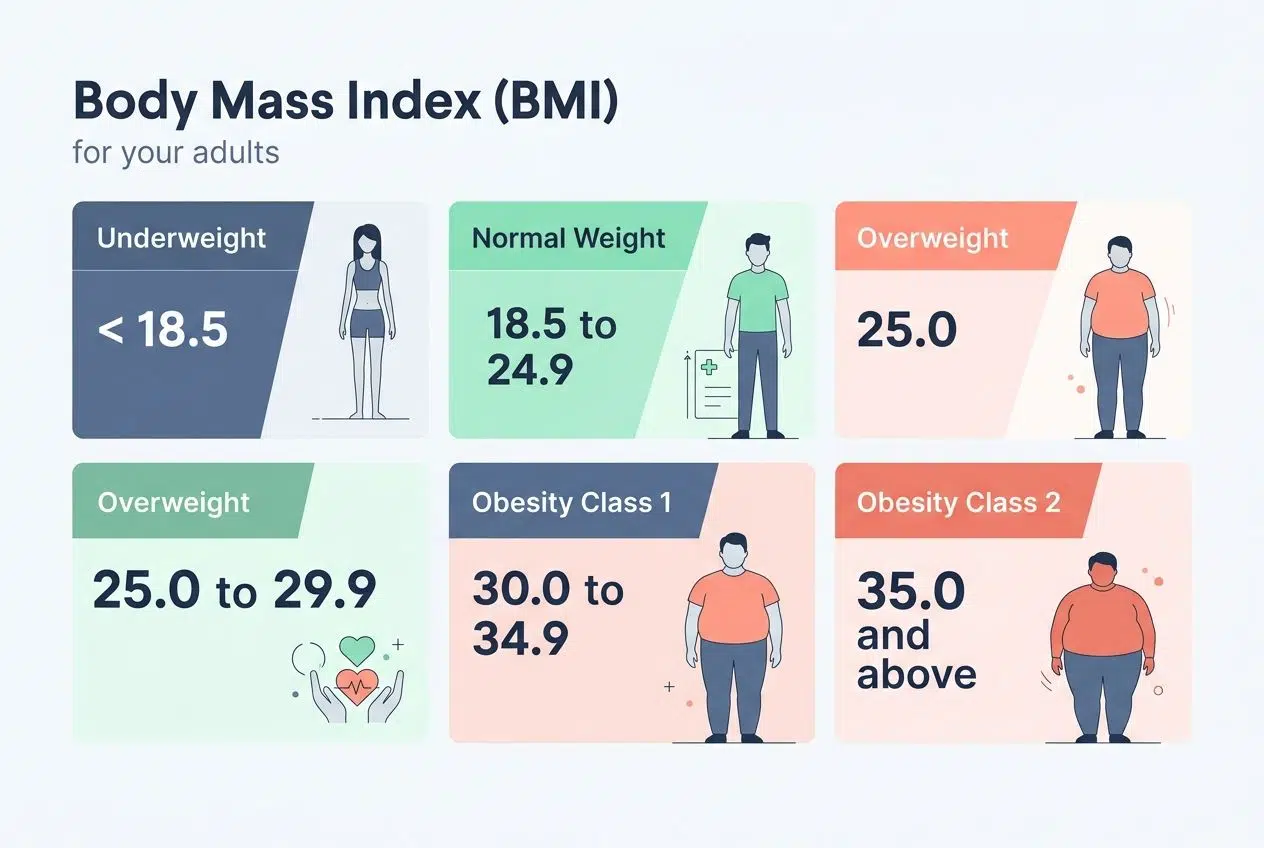
Adults fall into five distinct categories that help healthcare providers screen for weight-related health risks. Each category carries different implications for your wellness and disease prevention strategies.
| BMI Range | Category | What It Means |
|---|---|---|
| Below 18.5 | Underweight | Your weight falls below the typical range for your height. Talk to your doctor about whether you need nutritional adjustments or health screening. |
| 18.5 to 24.9 | Normal Weight | You are in the sweet spot where weight-related health risks tend to be lower. This range is considered ideal for most adults. |
| 25.0 to 29.9 | Overweight | Your weight exceeds the normal range for your height. Increased health risks may emerge, though individual factors matter greatly. |
| 30.0 to 34.9 | Obesity Class 1 | Health risks climb at this level. Conditions like heart disease and type 2 diabetes become more common. |
| 35.0 and above | Obesity Class 2 | Serious health complications pose significant concerns here. Medical intervention and lifestyle changes deserve priority attention. |
Your BMI category offers a starting point for conversations with healthcare professionals. It does not tell the complete story, but it signals where you stand in relation to population averages.
For context, data from the Centers for Disease Control and Prevention shows the average American adult has a BMI of about 28.5. That means the average person actually falls into the overweight category.
These ranges apply to most adults between the ages of 20 and 65. Muscle mass, bone density, and body composition all influence what your health status actually looks like.
Someone with significant muscle might land in the overweight category and still enjoy excellent cardiovascular fitness. This reality makes BMI just one piece of a much larger puzzle.
BMI ranges for children and teens
Kids and teenagers need different categories than adults because their bodies change so rapidly during growth years. Their BMI is compared to growth charts based on age and sex.
| BMI Category | Percentile Range | What It Means |
|---|---|---|
| Underweight | Less than 5th percentile | Your child weighs less than most kids their age and sex |
| Healthy Weight | 5th percentile to less than 85th percentile | Your child falls within the normal weight range for their age and sex |
| Overweight | 85th percentile to less than 95th percentile | Your child weighs more than most peers but hasn’t reached the obese category yet |
| Obese | 95th percentile or greater | Your child’s weight puts them at higher risk for weight-related health problems |
Percentiles tell you how your child stacks up against other kids in their age group. Think of it like standing in line, where the 50th percentile means your child is right in the middle.
The CDC created these growth charts to give doctors a fair way to screen young people. In late 2022, the CDC even expanded these charts to help doctors better track severe obesity up to a BMI of 60.
Healthcare providers plot your child’s measurements on these special charts during check-ups. Growing bodies pack on muscle, bone, and fat at different rates.
One simple number simply cannot capture the full picture. Your pediatrician can explain exactly where your child falls and what it means for their health.
Uses of BMI as a Health Metric
Doctors use BMI to spot people at risk for weight-related problems like heart disease and diabetes. Researchers also rely on it to study health patterns across large groups of people.
Doctors use BMI as a front-line screening tool to spot people at risk for weight-related health problems. High scores are often linked to serious conditions like heart disease, type 2 diabetes, and certain cancers.
The US Preventive Services Task Force actually recommends that clinicians screen all adults for obesity using this exact metric. Major insurance companies, like Blue Cross Blue Shield, rely on this screening to identify populations needing support.
This metric helps healthcare providers start conversations about lifestyle changes early. BMI screening works incredibly fast and costs almost nothing, making it practical for clinics everywhere.
Schools measure student body mass to flag children who might benefit from extra exercise and dietary support. The process gives healthcare systems a quick way to assess risk factors, though individual results always need deeper evaluation.
Population health studies
Researchers use BMI data to track health patterns across large groups of people. These population studies help scientists spot trends in weight categories across different regions and ages.
Public health officials collect information to understand which communities face higher health risks. For example, the CDC runs the Behavioral Risk Factor Surveillance System, which contacts over 400,000 Americans yearly to track several key metrics:
- Regional obesity rates across all 50 states.
- Changes in metabolic health trends over time.
- Which specific age groups struggle most with weight management?
- Where new community nutrition programs are needed most.
This information guides doctors and public health leaders. They use it to create new strategies to improve wellness across the country.
Limitations of BMI
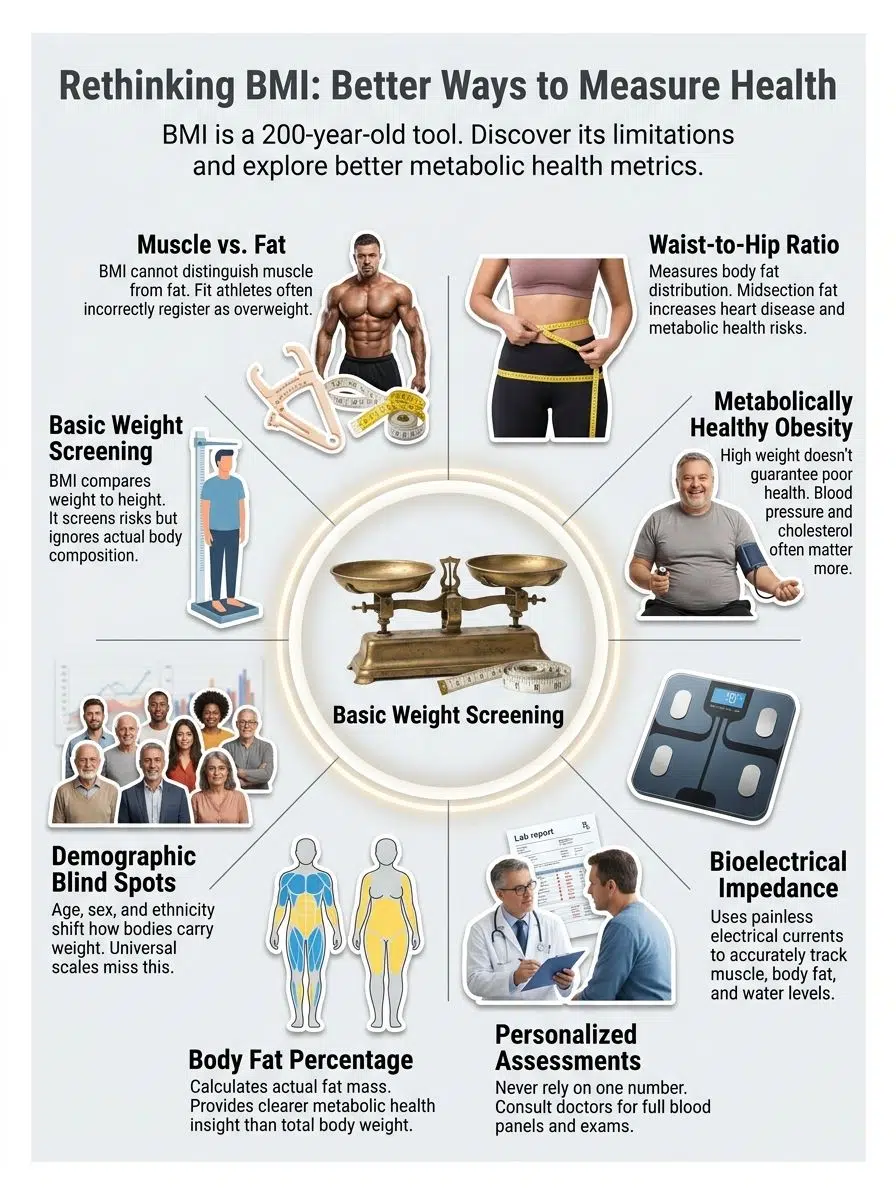
BMI misses the bigger picture because it cannot tell the difference between muscle and fat. Your weight tells only part of your health story, so doctors need better tools to get the full picture.
In June 2023, the American Medical Association officially adopted a new policy recognizing the significant limitations of BMI. They noted its historical shortcomings and recommended that doctors use it only in combination with other measurements.
Inability to distinguish between muscle and fat
Muscle weighs more than fat, and this creates a major problem for body composition assessment. A person who lifts weights regularly might have a high BMI, yet carry very little body fat. The health metrics system fails to tell the difference between these two types of tissue.

Think about a typical NFL running back. Many of these professional athletes stand 6 feet tall and weigh 225 pounds, giving them a BMI of over 30, which the standard chart labels as obese.
The screening tool misses what really counts, which is where your weight comes from and how it affects your body. Body fat percentage tells a much clearer story than weight categories alone.
Two people with identical numbers can have completely different body compositions. One individual might store fat around their organs, which carries serious health risks.
Another person might carry extra weight as muscle tissue, which actually protects against disease. Healthcare professionals recognize that body composition analysis provides superior insight into metabolic health.
Variations due to age, sex, and ethnicity
Your age, sex, and ethnicity all shape how your body works. These factors matter immensely when doctors look at your physical measurements, because a rigid approach misses key details.
Several biological factors skew standard BMI results:
- Age differences: A 65-year-old processes weight differently than a 25-year-old, and natural muscle loss masks true health risks.
- Biological sex: Men tend to carry more muscle naturally, while women experience significant metabolic shifts after menopause.
- Ethnic background: Different populations face unique health risks at the exact same BMI level.
For example, research from the Asian American Diabetes Initiative shows that Asian Americans face increased metabolic risks at lower weights. They recommend treating a BMI of 23 as the cutoff for the overweight category in Asian populations, rather than the standard 25.
This variation means your health assessment must go beyond a generic number. Your doctor must look at your personal health risks and family history to give you real guidance.
When BMI is not a reliable indicator
BMI falls short in many real-world situations, especially for athletes and muscular individuals. Because muscle tissue weighs more than fat, the scale becomes a blunt instrument for health assessment.
Older adults face different challenges with these standard charts. Many seniors develop sarcopenia, a condition involving natural muscle loss over time.
This condition can mask dangerous weight gain, leaving a senior with a “normal” BMI but dangerous levels of internal fat. Pregnant women, people with certain medical conditions, and those taking specific medications also experience readings that do not reflect their true health status.
Research consistently shows that different populations carry weight differently, yet standard categories treat everyone the exact same way. Clinical evaluation and personalized health metrics matter far more than a single number on a chart.
Alternative Tools to Measure Health
Doctors and researchers use other methods that provide a clearer picture of your actual health. These tools measure what your body is really made of, rather than just your total weight.
Waist-to-hip ratio
Your waist-to-hip ratio measures fat distribution around your body, telling a totally different story than standard weight charts. You calculate this by dividing your waist measurement by your hip measurement.
This metric matters because it reveals exactly where your body stores fat. People who carry extra weight around their midsection face higher risks for heart disease and metabolic problems.
The World Health Organization provides specific target ranges for this metric:
- Men: Aim for a ratio below 0.90.
- Women: Target a ratio below 0.85.
Many fitness enthusiasts on forums like r/Fitness note that consistency is key when tracking this at home. A common insider tip is to measure your waist directly across your belly button every single time, ideally using a tension-controlled tool like a MyoTape for total accuracy.
Your BMI might say you are fine, yet your waist-to-hip ratio could signal real health concerns. Your healthcare provider can help you interpret your results in context with your other health metrics.
Body fat percentage
Body fat percentage measures the actual amount of fat in your body compared to your total weight. This assessment cuts right through the muscle-versus-fat problem. A person who lifts weights regularly might weigh more than someone who is sedentary, yet carry far less body fat. This percentage tells the real story about your metabolic health.
Doctors and fitness experts measure body fat using several distinct methods:
- Skinfold Calipers: A quick manual pinch test used frequently by personal trainers.
- The Bod Pod: A specialized machine that uses air displacement to measure body composition.
- DEXA Scans: The gold standard in sports medicine. In the US, a DEXA scan usually costs between $75 and $150, providing a complete map of bone density and fat distribution.
Health professionals often prefer these methods because they actively separate muscle from fat. For most adults, a healthy body fat range sits between 10 to 20 percent for men and 18 to 25 percent for women, though these numbers naturally shift with age.
Bioelectrical impedance analysis
Bioelectrical impedance analysis, or BIA, sends a tiny, painless electrical current through your body to measure composition. The method tracks how fast the current travels, since muscle conducts electricity much better than fat does.
You can find BIA technology in many popular smart scales for your home, like the Withings Body+ or the Garmin Index S2. These tools help you track your precise body fat percentage, lean muscle mass, and water content right from your bathroom.
If you use a smart scale at home, here is a crucial tip: hydration drastically changes the reading. For accurate results, you must measure yourself first thing in the morning under the exact same hydration conditions every single day.
Drinking a large glass of water or taking the test after a sweaty workout will completely skew your BIA numbers. This technology gives you a clearer picture than standard charts because it actively separates muscle from fat.
The test takes just seconds and requires no invasive procedures. Your healthcare professional can use these results to create a personalized plan that fits your specific needs.
Can You Be Overweight and Still Be Healthy?
You can absolutely carry extra weight and still maintain excellent health. Your weight category tells only part of your story, and many people with higher numbers on the scale have strong fitness levels.
Doctors call this phenomenon “metabolically healthy obesity.” According to recent medical research, nearly 30% of people classified as obese actually fall into this healthy category.
To be considered metabolically healthy, doctors look for several positive indicators:
- Healthy blood pressure levels without medication.
- Normal cholesterol and triglyceride readings.
- Stable blood sugar and excellent insulin sensitivity.
- A strong capacity for cardiovascular exercise.
This reality completely challenges the idea that weight alone determines wellness. Your body composition matters far more than your scale reading.
A screening tool serves as a starting point for conversations, but it should never stand alone as a final verdict. Your nutritional habits, daily movement, and sleep quality shape your wellness far more than a simple calculation.
When to Consult a Healthcare Professional
Your doctor can put your measurements into real context by looking at your whole health picture. A healthcare professional helps you figure out what your weight actually means for your body.

Understanding your BMI in context
BMI scores tell only part of the story about your health. Doctors look at your complete medical background, not just a single number floating on a page. Your age, sex, ethnicity, and muscle mass all shape what a healthy weight looks like for you. This is why health professionals pair standard charts with advanced internal screening tools.
Doctors rely on specific medical tests to evaluate your internal health:
- Fasting Lipid Panel: Checks your cholesterol and triglyceride levels.
- Hemoglobin A1C: Measures your long-term average blood sugar levels.
- Blood Pressure Monitoring: Evaluates your daily cardiovascular stress.
These internal factors reveal your metabolic health far better than external measurements alone. Context transforms how doctors interpret your obesity risk and wellness.
Genetics, lifestyle, stress levels, and medical history all play massive roles in how your body functions. The main goal is understanding what your specific body needs to thrive.
Personalized health assessments
Your basic measurements tell one part of the story, but your doctor needs the full picture to give you real, actionable advice. A personalized health assessment goes much deeper than standard metrics.
Your healthcare professional looks at your body composition, metabolic health, and genetic risk factors all together. They ask deep questions about your daily habits, your stress levels, and your favorite ways to exercise.
If you need specialized guidance, your primary doctor might refer you to a Registered Dietitian for custom nutritional planning. They might also suggest seeing an endocrinologist to rule out any underlying hormonal imbalances.
Your doctor creates a weight management plan that actually fits your life, rather than handing you a generic template. This comprehensive approach gives you real answers about your health status and outlines the steps that actually matter for you.
Wrapping Up
Body Mass Index serves as a helpful starting point for conversations, but it should never stand alone as your complete picture. Doctors and nutritionists know this truth well. They combine it with body fat percentage, waist-to-hip measurements, and bioelectrical impedance analysis to get the real story. A single number simply cannot capture your full health status.
Your metabolic wellness and fitness level matter far more than what any scale tells you. You should talk to your healthcare professional about what health metrics make sense for your specific situation.
Obesity risk factors vary wildly from person to person, making strict guidelines completely outdated. Your nutrition habits, physical activity, sleep quality, and stress levels shape your actual health outcomes.
Consider scheduling a clinical evaluation with your doctor to discuss your weight, body composition, and personal risk factors. They can help you answer the main question behind Understanding BMI: Is It Still A Useful Health Metric? Together, you can build a personalized plan that focuses on your long-term life quality.
Frequently Asked Questions (FAQs) on Understanding BMI
1. What is BMI, and how do you figure it out?
BMI stands for Body Mass Index, and you calculate it by dividing your weight in pounds by your height in inches squared, then multiplying by 703. The result places you into categories: underweight (under 18.5), normal weight (18.5 to 24.9), overweight (25 to 29.9), or obese (30 and above).
2. Is BMI still a good health metric today?
BMI gives a quick snapshot of body size, and the CDC still uses it as a standard screening tool when combined with other health measurements like waist circumference and blood pressure.
3. Why do some folks say BMI isn’t fair or accurate?
BMI can misclassify people with high muscle mass, like athletes or bodybuilders, as overweight when they’re actually fit and healthy. On the flip side, someone with low muscle mass might fall into the normal range even if they carry excess belly fat, which poses real health risks.
4. Should I worry if my BMI says I’m not in the “normal” range?
Don’t panic! Your doctor will look at several factors beyond this one number, including your waist circumference, blood pressure, and cholesterol levels. Think of BMI as just one piece of your health puzzle, not the whole picture.