


Do you want to start your own consulting business, but worry that you lack experience? You might think that landing consulting jobs requires years of working at big firms like McKinsey, BCG, or Bain. Many people feel stuck right there. They assume they need a fancy degree to charge real money for their advice. The truth is, this exact fear stops most people from even trying. Breaking into freelance consulting with no experience is entirely possible today. Many successful consultants came from totally different backgrounds and used their transferable skills, like problem-solving and leadership, to build a thriving career.
They learned to show their value through real results, not just fancy titles on a resume. This guide shows you exactly how to build your freelance consulting business from scratch.
You will learn how to find your niche, set your rates at $50 per hour or higher, and land your first clients through networking and job boards like Upwork. You will discover how to use your existing skills and build a strong personal brand on LinkedIn.
By the end, you will have a clear roadmap to start earning as a freelance consultant in 2026. Grab a cup of coffee, and let’s go through it together.
I will show you everything you need to know.
What is Freelance Consulting?
Freelance consulting means you offer expert advice to businesses without working as a full-time employee for just one company. You work on your own terms, pick your clients, and solve specific problems using your unique skills.
Recent 2026 data from Upwork shows that the US freelance workforce has grown to over 73 million people. While the average US freelancer earns around $48 per hour, specialised business consultants easily hit the $75 to $100 mark.
Key Differences Between Freelance Consulting and General Freelancing
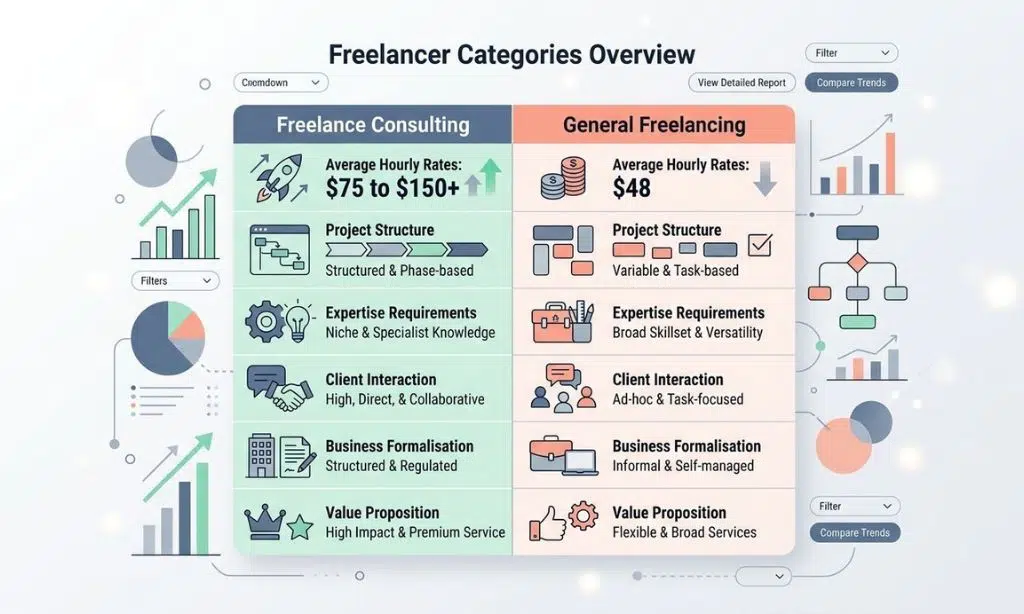
Understanding these key differences shapes your path to hitting that $75 per hour target in 2026.
| Aspect | Freelance Consulting | General Freelancing |
|---|---|---|
| Project Structure | Project-based work with measurable deliverables and clear business outcomes. | Ongoing or task-based engagements without specific quantifiable results required. |
| Expertise Requirements | You must present yourself as an expert. Perfect skill matches are required for each project. | Broader flexibility allows you to take varied roles without expert-level positioning. |
| Average Hourly Rates | Commands higher rates; independent management consultants in the US earn $75 to $150+ per hour in 2026. | Typically lower hourly rates compared to consulting professionals (US average is $48). |
| Client Interaction | Requires direct client engagement with C-suite executives and delivery of quantifiable business impact. | May involve less intense client relationships and communication demands. |
| Business Formalisation | Requires registering an LLC, obtaining an Employer Identification Number (EIN) from the IRS, and setting up a corporate bank account. | Steps are less formalised; fewer legal business structures are strictly necessary for basic tasks. |
| Value Proposition | Must build a clear value proposition and proof of concept to win contracts. | A simple portfolio or work samples suffice without extensive proof of expertise. |
Consulting demands you prove your expertise through measurable results. You show clients exactly how your work impacts their business bottom line. General freelancers often complete tasks without tracking the wider business outcomes.
Setting up your consulting business requires formal steps in the US. You obtain an EIN from the tax authority and often form an LLC to protect your personal assets. Your business structure signals professionalism to potential clients.
Common Industries for Freelance Consultants
Freelance consultants work across many different sectors. Each industry offers unique opportunities for you to earn premium rates.
- Technology consulting: In 2026, AI implementation is the hottest niche. US companies pay top dollar for experts who can integrate tools like Zapier or custom Large Language Models into their daily workflows.
- Management consulting: You guide clients through major changes and solve complex business problems. Boutique consulting firms and freelancers capture massive market share here by offering highly specialised expertise.
- Operations consulting: You improve how businesses run their daily activities. Companies undergoing digital transformation desperately need operations consultants to streamline their supply chain management.
- Marketing consulting: You guide businesses in reaching customers. You develop campaigns and analyse consumer behaviour to help brands compete in crowded digital markets.
Step-by-Step Guide to Starting Freelance Consulting
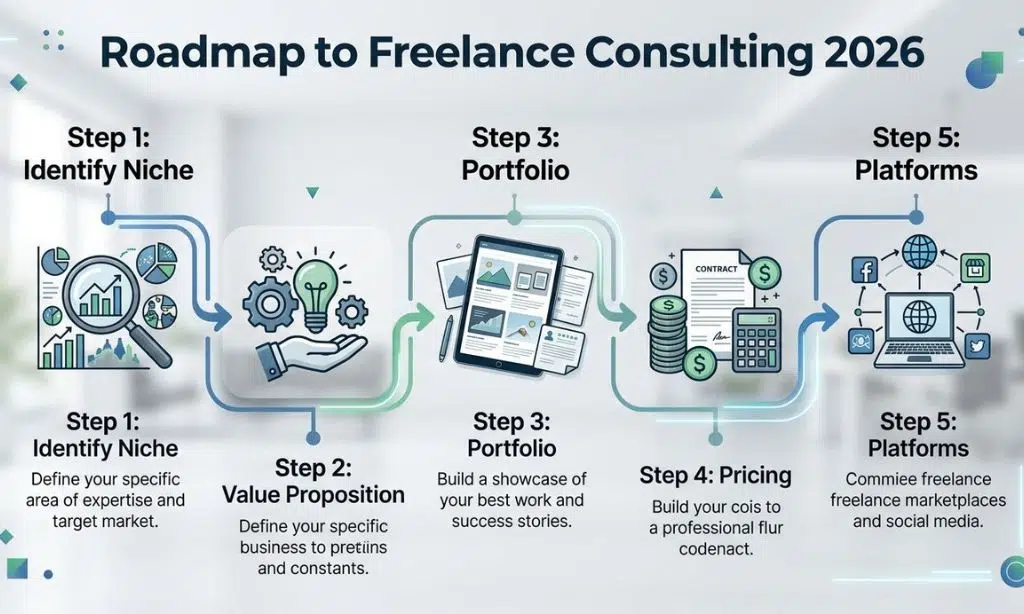
Starting a freelance consulting business requires you to follow a clear roadmap that moves you from a simple idea to profitable action. You will work through five key phases that build your expertise and establish your credibility.
Step 1: Identify your Niche and Expertise
You must focus on your specific skills and the problems you solve best when picking your consulting niche. Think about your past roles, projects, and the challenges you tackled successfully.
Your niche sits at the intersection of what you do well and what US clients will actually pay for. Jobbers.io market data for 2026 shows that AI engineering, cybersecurity, and digital marketing strategy have the highest demand and lowest supply.
If you have a tech background, do not just call yourself an IT consultant. Position yourself as a specialist in Zero-Trust Network Implementation or Workflow Automation Architecture.
Test your commitment before you leap fully into independent consulting. Try a small side project on platforms like Catalant or TalMix to see if you actually enjoy this type of work.
Step 2: Build a Clear Value Proposition
Your value proposition tells clients exactly what you offer and why they should hire you over someone else. Start by identifying the specific pain points your ideal clients face.
Your proposition must address real problems and offer actionable recommendations that clients can implement right away. Focus on your transferable skills like problem-solving, clear communication, and strategic thinking.
“In a world of automated outreach, US clients are looking for proof of human work. Your value proposition must clearly link your technical literacy to their specific business context.”
Write articles on LinkedIn sharing your insights about industry trends. Engage with your professional network by commenting thoughtfully on posts.
A strong proposition answers this question: “What quantifiable impact do I create for my clients?” An education consultant might say they help schools improve student retention rates by 15% through curriculum redesign.
Step 3: Create a Portfolio or Proof of Concept
Build a portfolio that shows real results from projects you have completed. If you lack paid experience, start with unpaid or side projects to build your case studies.
Frame these early projects as learning opportunities. Include case studies that show exactly how you solved problems for small businesses or startups.
- Use dedicated platforms: Build your visual portfolio on a platform like Fueler.io or Notion, which allows you to cleanly present “Proof of Work” alongside your resume.
- Quantify everything: Use numbers like “Reduced operational costs by 10% in six months” or “Increased sales by 15% in three months.”
- Add social proof: Include testimonials and reviews from early clients or projects to boost your credibility immediately.
Develop a proof of concept by delivering results for real clients, even if you charge less than your target rate initially. Collect feedback from each project and use it to refine your approach.
Step 4: Set Competitive Pricing and Goals
Pricing your consulting services requires an honest assessment of your expertise, market demand, and the value you deliver to clients. A common mistake is forgetting to account for non-billable hours.
According to 2026 industry benchmarks, most independent consultants can only bill for 50% to 60% of their working hours. The rest of your time goes to administrative tasks, marketing, and sales calls.
If you aim to earn $75 per hour, you must factor in this non-billable time, plus your self-employment taxes and software expenses. You might actually need to charge $120 per billable hour to hit your true take-home target.
Set clear, measurable goals for revenue, client acquisition, and the specific project types you want to pursue. Track your results carefully and measure the impact you create for each client so you can confidently justify your rates.
Step 5: Leverage Online Platforms and Networks
Online platforms and networks open doors to clients you cannot reach alone. Strategic use of these tools builds your consulting reputation and fills your pipeline with high-quality work.
- Join UpWork and use the “US Only” filter to access immediate client opportunities from domestic companies willing to pay premium rates.
- Apply to enterprise-focused platforms like Catalant or Braintrust once you establish your track record; these networks connect you directly with Fortune 500 executives.
- Build your consulting network through LinkedIn by sharing relevant content, engaging with posts, and connecting with industry leaders in your niche.
- Conduct informational interviews with current professionals in your target field to learn how others broke into consulting.
- Use alumni outreach to find mentors and referral sources; contact your school’s career services to identify alumni working in consulting.
How to Land Your First Clients
Your first clients usually come from places you already know. Job boards, freelance platforms, and your personal network all work exceptionally well.
Finding Clients Through Job Boards and Freelance Platforms
Job boards and freelance platforms offer you direct access to clients who need consulting help right now. These spaces connect you with people actively searching for experts.
- Start with established platforms such as Catalant, TalMix, and Upwork, which list consulting projects regularly.
- Complete a small project on these platforms before fully transitioning to full-time consulting.
- Set up a professional website to showcase your expertise, since some platforms require proof of prior freelance work before accepting you.
- Polish your CV and craft customised cover letters for each job board submission.
- Explore specialised staffing agencies, which provide other routes to finding contract consulting work.
Networking and Referrals
Your network becomes your most valuable asset when landing your first clients. Start by building connections on LinkedIn and reaching out to alumni from your university.
Attend industry events, webinars, and conferences to meet consultants and recruiters face to face. Personalised outreach works so much better than generic, automated messages.
“Send individual messages to your strongest connections, explaining clearly what you offer and asking for introductions. This simple step often yields a much higher conversion rate than cold emailing strangers.”
Informational interviews with people in your field give you insider knowledge and often lead to referral opportunities. Successful professionals like Jen Dyck-Sprout built their practices through proactive networking and genuine relationship building.
Crafting a winning pitch
Your pitch must show what makes you different from the dozens of other applicants. Highlight transferable skills like leadership, problem-solving, and analytical thinking that directly match the job description.
Tailor each pitch to the specific consulting role by aligning your past experiences with their immediate needs. Keep your pitch to one single page, focused, and completely concise.
Start your cover letter by addressing the exact pain point they mentioned in their job listing. Explain your motivation for joining consulting and how it fits with what you have accomplished before.
A strong pitch answers one critical question: why should this client hire you instead of someone else? Structure your message around solving their specific problem, not just listing your software skills.
Strategies to Prove Your Value
Your clients need concrete proof that you deliver real results. You gather strong feedback from satisfied customers and build immense trust through these genuine success stories.
Delivering measurable results
Clients hire consultants to solve real problems and see real changes in their bank accounts or operations. You must show exactly what you achieved for each client.
Track numbers like cost cuts, revenue gains, or hours saved. Use visual tools like Tableau or Microsoft Power BI to gather data and build interactive dashboards that prove your impact.
- Use tracking software: If you work in project management or operations, use tools like Jira to map story points directly to business value.
- Frame your results: Use proven frameworks such as SWOT analysis or Porter’s Five Forces to make your recommendations stronger.
- Document everything: Save these wins in a spreadsheet. A 5% improvement in workflow speed counts, and you will need these stats for your future pitches.
Collecting Testimonials and Reviews
Ask your clients for feedback right after you finish a project. Specific testimonials work best, so request details about the measurable outcomes and your professional conduct.
“To build serious B2B credibility in the US market, claim your profile on review platforms like Clutch.co or G2. Having verified, third-party reviews carries far more weight with enterprise clients than quotes on your own website.”
Reviews from small firms or startups prove your value to new prospects. Solicit reviews after each engagement to build a steady stream of undeniable social proof.
Building Long-term Client Relationships
Your clients will stay with you if you keep them informed and involved throughout your projects. Share updates regularly, even when things move slowly on their end.
To automate this process, use client reporting tools like DashThis or AgencyAnalytics. These platforms allow you to send branded, automated monthly reports showing your ongoing ROI.
- Deliver on your promises: Show up when you say you will, meet all your deadlines, and solve problems before they become massive issues.
- Listen closely: Understand their real challenges, not just what they say they want during the initial kickoff call.
- Propose follow-on work: Strengthen your relationships by offering to tackle additional challenges your clients face after the initial project ends.
Scaling Your Freelance Consulting Business
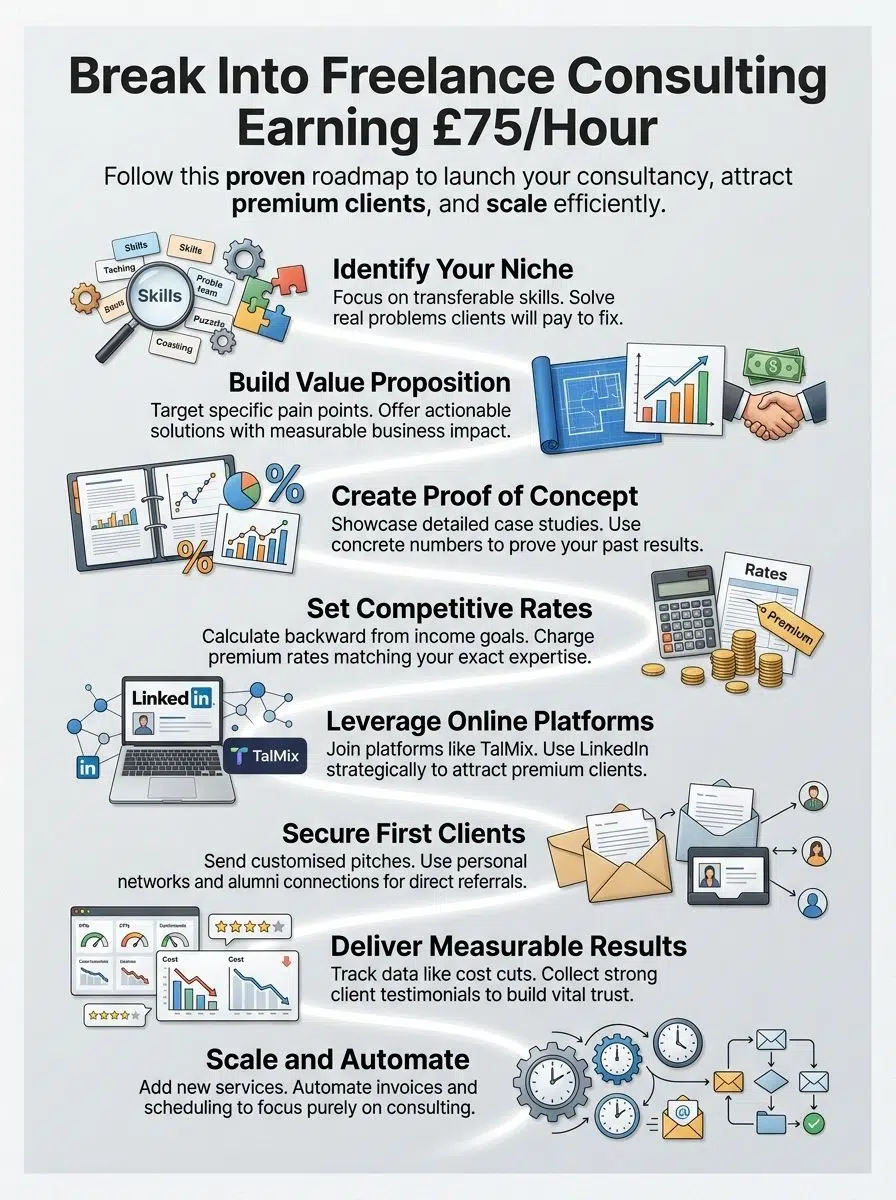
You will grow your consulting firm by building your reputation, offering fresh services, and using software tools to work smarter.
Establishing Yourself as an Authority in Your Niche
Establish your authority by publishing content on platforms like Medium, Quora, and LinkedIn. These sites give you the perfect space to share your knowledge with thousands of daily readers.
“Do not just post generic advice. Publish deep-dive case studies on a platform like Substack to show your exact methodology and build a dedicated subscriber list of potential clients.”
Join respected organisations like the Institute of Management Consultants (IMC) to access excellent learning resources and meet other professionals. Attend industry events where you can raise your profile among peers.
Build your credibility through a professional website and a highly active online presence. Maintain consistent communication with your network by sharing valuable insights regularly.
Expanding Your Service Offerings
You can dramatically grow your consulting income by adding new services to what you already offer. Clients truly value consultants who solve multiple problems at once.
- Offer fractional services: A massive trend in 2026 is the rise of the “Fractional Executive” (like a Fractional CMO or COO). This allows you to embed yourself in a company for a few days a week at a high retainer.
- Strategy consulting: This pairs perfectly with your existing expertise to create a complete, high-ticket package.
- Pursue certifications: Get relevant certifications like PMP or AWS to show clients you have formal training to handle highly complex projects.
- Partner up: Collaborate with other freelancers so you can offer bundled services and serve much larger enterprise clients together.
Automating Key Processes for Growth
Automating your business processes saves you incredible amounts of time and money as you grow your freelance consulting firm. Set up automated invoicing to ensure timely cash flow without the manual data entry.
Tools like QuickBooks streamline your financial management and tax prep. For managing your actual client pipeline, you need a dedicated CRM software.
- Use HubSpot CRM: This is excellent for scalable inbound marketing if you generate leads through newsletters or white papers.
- Try BigTime: This platform is purpose-built for professional services firms, smoothly linking your time tracking directly to your billing.
- Automate scheduling: Use calendar tools to reduce the annoying administrative burden of booking meetings across different US time zones.
Final Words
You have learned exactly how to identify your niche, build a strong value proposition, and create proof of your skills.
These practical steps make entering freelance consulting simple and highly achievable, even if you are starting with zero formal experience in the field.
Your first clients will arrive through targeted job boards, proactive networking, and pitches that show real, quantifiable value.
Take action on platforms like Upwork, Catalant, and TalMix right away. Delivering measurable results and collecting verified testimonials transforms you into an absolute authority in your space.
This proven approach lets you confidently charge $50 to $75 per hour by 2026.
You can scale your business by automating your sales processes, expanding into fractional service offerings, and building long-term relationships that bring consistent repeat work.
Start today by choosing your consulting niche and setting up your formal business structure with an LLC and an EIN.
Reach out to your first potential clients this week, because your freelance consulting career is ready to begin.
Frequently Asked Questions (FAQs)
1. How can I start freelance consulting with no experience in 2026?
Start by identifying your strongest skills, even if they come from school or hobbies, then create a free profile on Upwork or Fiverr to showcase what you can offer. Offer to solve small problems for friends or local groups first so you can gather real examples and testimonials. This hands-on approach helps you build confidence and proof of your abilities quickly.
2. What steps should I follow to earn £60 an hour as a new consultant?
Pick one focused area where you can offer clear advice, such as social media strategy or basic business planning, then set transparent pricing that reflects the specific value you deliver. Use LinkedIn to connect with potential clients and always ask satisfied customers for short reviews, as 92% of people read online reviews before hiring a service provider according to a 2023 BrightLocal study.
3. Do I need special qualifications to become a freelance adviser?
No formal degree is required, but completing a short course on platforms like Coursera or LinkedIn Learning in areas like communication or project management will boost your credibility fast. Learning the basics of contracts and client care will help you stand out from day one.
4. How do I find my first paying client without any past jobs in consulting?
Tell everyone in your network about your new services and join local Facebook Groups or online business communities where people often post requests for help. Respond politely, show exactly how you can solve their problem, and you’ll often land your first client within a few weeks.






















